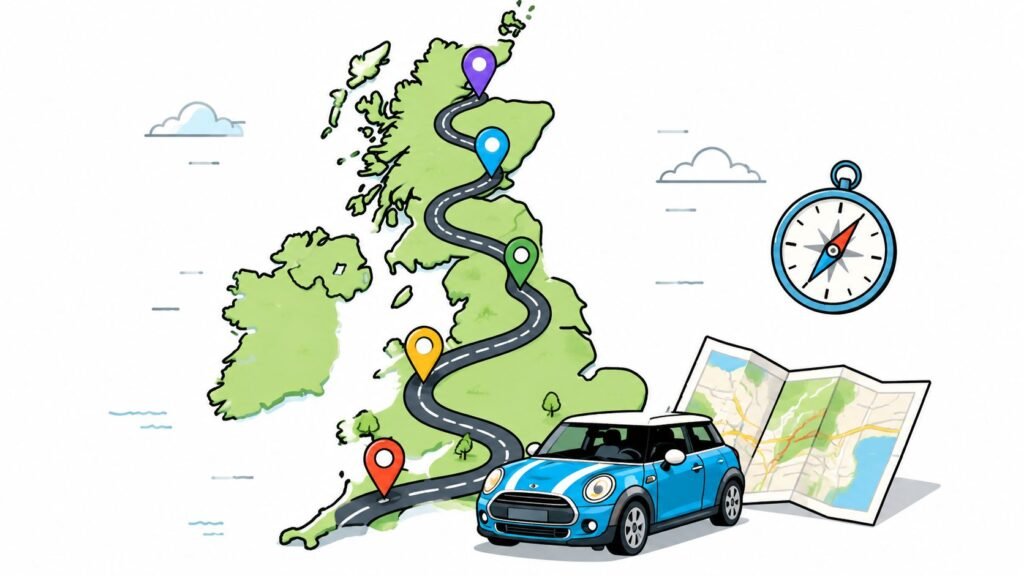
You've opened a map, dropped pins across London, Bath, York, Edinburgh, the Highlands, Wales and Ireland, and somehow built a holiday that requires a new hotel almost every night. It looks exciting on screen. On the road, it usually means long transfers, rushed visits, tired passengers and constant repacking.
A good UK road trip planner doesn't begin with a list of attractions. It begins with limits. Choose one region, protect your driving time, build around two or three overnight bases, and use live traffic information before every major departure. Great Britain's roads carried 343.2 billion vehicle miles in the 12 months ending March 2026, according to the Department for Transport road traffic statistics. That scale matters, because popular corridors can turn a short-looking route into an exhausting day.
Why Most UK Road Trip Plans Fall Apart Before the Engine Starts
The classic mistake is a fourteen-day, four-country itinerary with forty stops. Every pin looks achievable when the route is viewed as a coloured line on a map. The itinerary collapses by the third day because the map measures distance, while the driver experiences junctions, villages, weather, parking searches and slow traffic.
The first failure is the daily leg. Any transfer that regularly runs beyond four hours consumes the day, especially when you're unfamiliar with left-side driving. The second is the single-night stop. Arrive late, unload, find dinner, charge devices, repack and leave again. Repeat that pattern and the holiday becomes a packing marathon rather than a road trip.
Motorways create a different kind of fatigue. They can be efficient, but long stretches of unfamiliar driving demand concentration, and they rarely deliver the scenery people imagined when booking a self-drive holiday. The hidden cost is also considerable in practical terms. A reroute between distant regions can force you to sacrifice a museum visit, a coastal walk, a reserved meal or a full morning at your next base.

Treat the map as a driving surface
UK distances look modest because the country is compact. The roads often aren't fast. Single-lane A-roads, village traffic, roundabouts, steep gradients, roadworks and rain all reduce the pace shown by a simple route calculation. A scenic B-road can be the highlight of a day, but it can also turn a supposedly easy transfer into a slow, tiring drive.
Start with one country or one coherent region per trip. England can support a history-led route through a compact area, Scotland needs more patience because its terrain and roads stretch out, Wales rewards a concentrated base, and Ireland requires separate planning for ferries and currency.
The slow-traffic morning rule: If a rural route includes narrow lanes, livestock, weather exposure or single-track sections, schedule it after breakfast and protect the afternoon. Don't place a critical attraction at the end of a route you know may run slowly.
Use two or three overnight bases. Stay several nights at each, drive loops from the base, and move only when the next cluster of experiences justifies the packing. That simple structure gives you room for a wet-weather swap, a rest morning and an unplanned village or viewpoint without wrecking the entire itinerary.
Choosing the Right Region and Duration for Your Trip
Region selection is a constraint problem, not a popularity contest. Start with three inputs: how many days you have, what you want to see, and how much driving you'll accept each day. If you love museums, historic houses and cathedral cities, choose a denser English region. If scenery and walking matter more, accept slower roads and fewer stops in Scotland or Wales.
England offers the greatest concentration of cultural sights, but that density comes with traffic and parking pressure. A week or more works well when you anchor the route around one area, such as the Cotswolds or Yorkshire, instead of attempting to connect every famous city. History-led travellers can build days around Oxford, Bath, York, stately homes and abbeys. Nature-led travellers should select fewer attractions and leave time for footpaths, moorland and country lanes.
Scotland rewards a longer, slower approach. Inverness and Fort William make useful hubs, but weather and single-track roads limit what you can sensibly combine. A seven-to-ten-day route can include Edinburgh plus a Highland base, provided you don't treat every glen, loch and island as a quick detour. Skye, the Cairngorms and the west coast each deserve breathing space.
Wales is compact, hilly and strongly nature-first. Four days can work for a long weekend if you base yourself in or near Snowdonia and avoid excessive cross-country transfers. Add time when walking, coastal scenery and weather flexibility matter more than collecting towns.
Ireland is a separate logistical exercise. Combining Northern Ireland and the Republic means planning for ferries, different currencies and border-crossing logistics. Eight to ten days gives Galway and Killarney room to function as proper bases, while Dublin's car-unfriendly centre is better avoided with a direct route around the city.
| Region | Minimum Days | Daily Drive Ceiling | Best For | Key Constraint |
|---|---|---|---|---|
| England | 7 | 3 hours | History, culture, museums and cities | Traffic and parking |
| Scotland | 7 | 3 hours | Highlands, islands and dramatic landscapes | Weather and single-track roads |
| Wales | 4 | 2 hours | Walking, mountains and coast | Hilly roads and slow local routes |
| Ireland | 8 | 3 hours | Atlantic scenery, culture and regional touring | Ferries, currencies and border logistics |
Choose the region that matches your tolerance, not your ambition. A shorter route enjoyed fully beats a bigger route experienced through a windscreen.
Mapping Routes, Daily Legs, and Pacing with Confidence
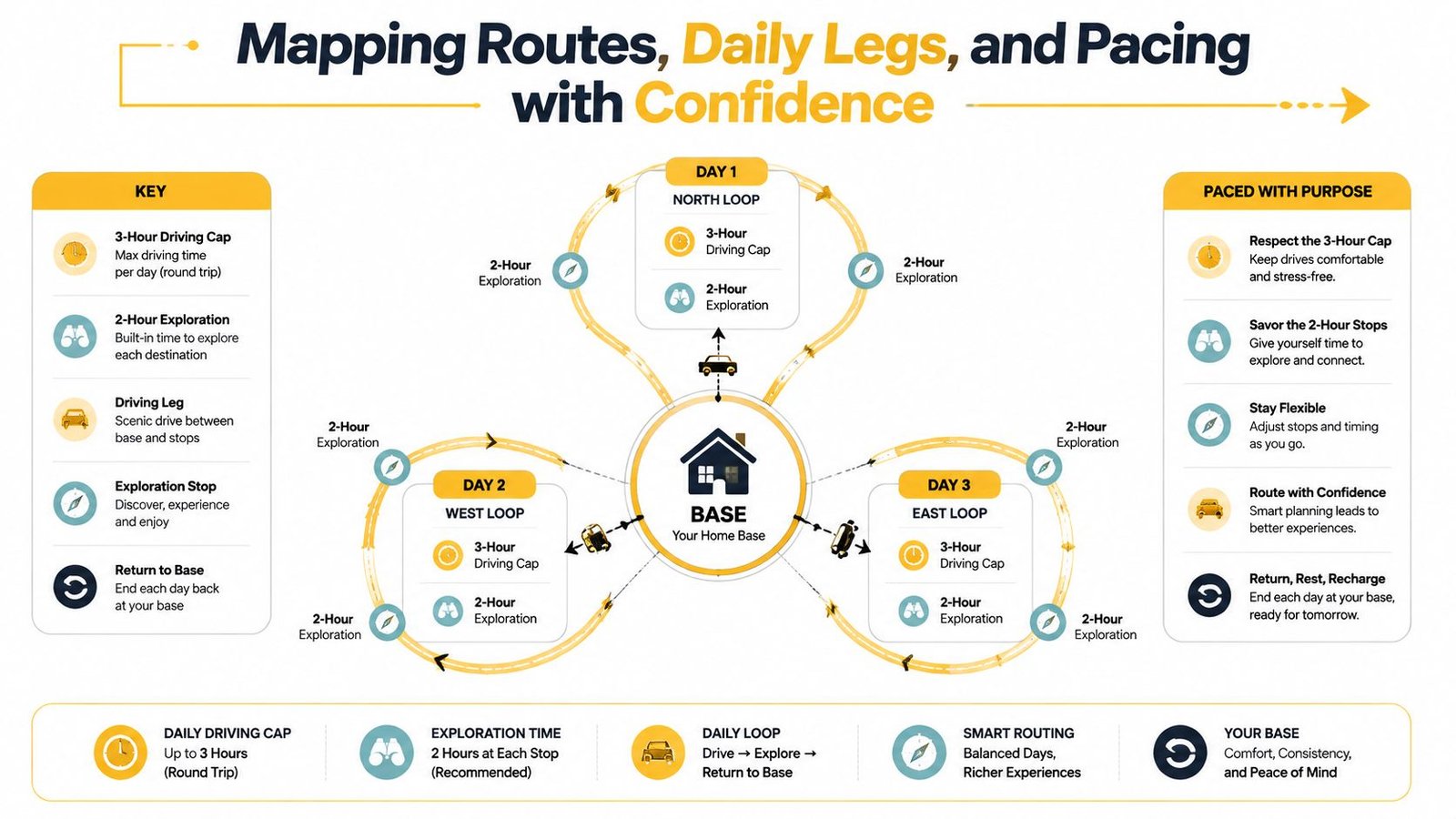
Build each day from the overnight base outward. Mark the base, identify one main experience, add one secondary stop nearby, then draw the return route. This produces a loop rather than a chain of unrelated pins, and it keeps luggage in the room while you explore.
Use the three-hour rule for transfers between bases. For daily exploration, cap each outward or return leg at roughly two hours. The purpose isn't mathematical precision. It's a guardrail against turning a sightseeing day into a sequence of navigation decisions.
Read the road category before choosing the view
Motorways are efficient for transfers but can be monotonous. A-roads vary considerably, with some offering fast regional connections and others narrowing through villages or hilly terrain. B-roads may deliver the scenery you came for, but their bends, passing places and slower traffic can make a short distance consume much of a morning.
Regional concentration makes this approach practical. In 2025, the South East recorded 54.5 billion vehicle miles, equal to 16% of all traffic in Great Britain, as shown in the DfT regional road data. The same open data covers every junction-to-junction link on motorways and A-roads, plus some minor roads, which supports route-level planning rather than relying only on a static map.
Before departure, check the relevant regional service. GOV.UK directs travellers to National Highways traffic information for England and separate live traffic services for Scotland and Wales. For a practical cross-border workflow, check Traffic Scotland, AA Roadwatch, Transport NI, and the applicable National Highways or former Highways England feed. Verify incidents first, roadworks second, then repeat the check on the travel day.
Depart before 8 a.m. or after 10 a.m. when a route touches commuter motorways. On rural roads, mid-morning is often the better choice because visibility has improved and the earliest agricultural movements may have eased. Don't assume an early start is always best if fog or heavy rain affects exposed routes.
Watch this route-planning overview before you finalise the loops:
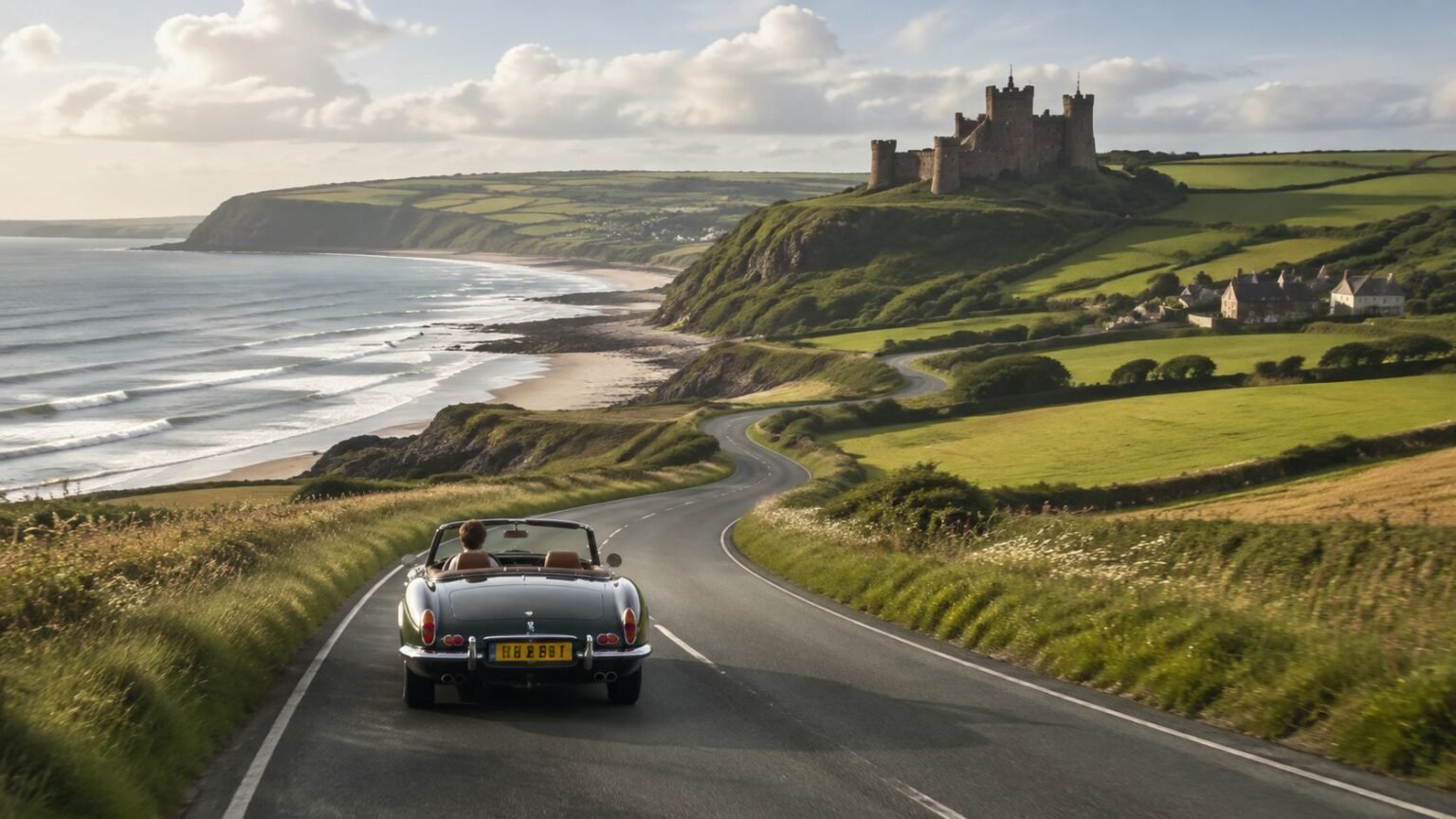
For coastal route inspiration, keep the Penzance to Land's End coastal road visual beside your map, then check the actual road conditions before committing to the drive. The winning pattern is simple: unpack at the base, drive loops, and move accommodation only twice or three times during a regional itinerary.
Booking Transport, Accommodation, and the London Arrival
Booking order affects the route more than most travellers expect. Secure the rental car first when travelling during busy summer periods or planning Highland weekends, particularly if you're collecting outside Edinburgh or Inverness. Vehicle choice matters too. Automatic cars and larger vehicles can disappear before the scenic route has even been decided.
A London arrival needs a separate decision. Heathrow and Gatwick pickups place you into busy road networks immediately, and central London adds congestion, restricted zones and difficult parking. The cleaner option is to arrive in London without a car, travel by rail to Edinburgh or Manchester, then collect the vehicle where the driving holiday begins.
If London driving is unavoidable, plan the timing carefully. The Congestion Charge applies to the central zone, broadly bounded by the Inner Ring Road, from 7:00 to 18:00 Monday to Friday and from 12:00 to 18:00 on Saturdays, Sundays and bank holidays, according to Transport for London's Congestion Charge guidance. Enter before 07:00 or after 19:00, confirm the current payment process online, and park outside the zone whenever possible.
Reserve the structure, not every minute
Choose two or three base hotels or self-catering cottages per region. Book the first and last nights firmly, then keep middle nights flexible where possible so bad weather can push a coastal day inland without forcing a full cancellation chain. Layer reservations with free cancellation until 48 hours before arrival when the property permits it.
Travelling with a dog changes the search considerably. Use a focused resource for top places to stay with pets, then confirm the property's own pet rules, parking, nearby walking access and cleaning charges before paying.
Check the rental agreement for Dartford Crossing, the M6 Toll and Tyne Tunnel fees. Don't assume the rental company handles every charge automatically, and don't leave toll administration until the vehicle return. Keep booking confirmations, insurance details and pickup instructions offline as well as in your email.
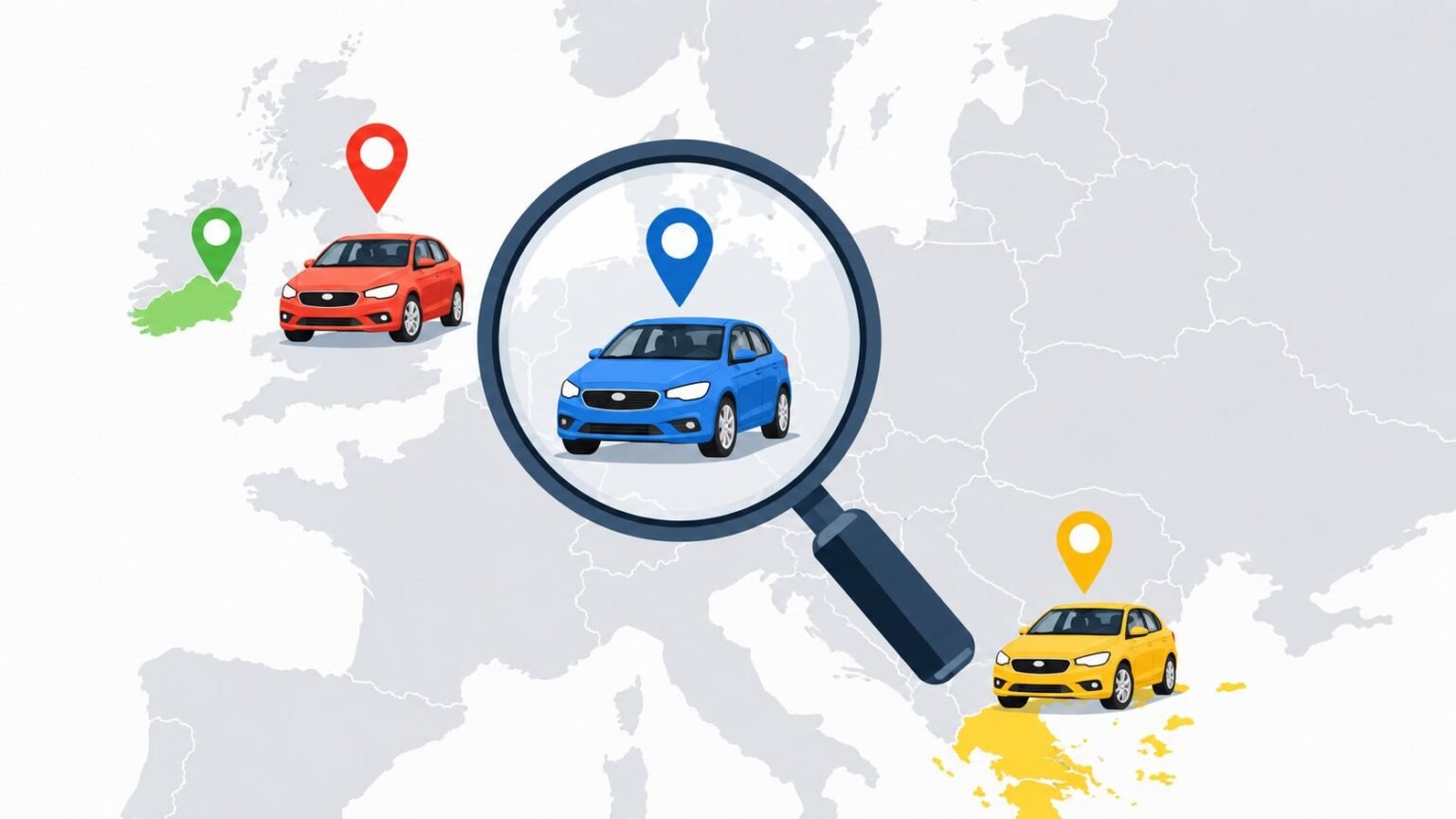
A useful visual reference for comparing vehicle options is this European car rental comparison image. Choose the smallest vehicle that fits your passengers and luggage comfortably. Narrow lanes reward compact dimensions, while excessive luggage makes every overnight change slower.
Driving Rules, Rural Safety, and On-Road Logistics
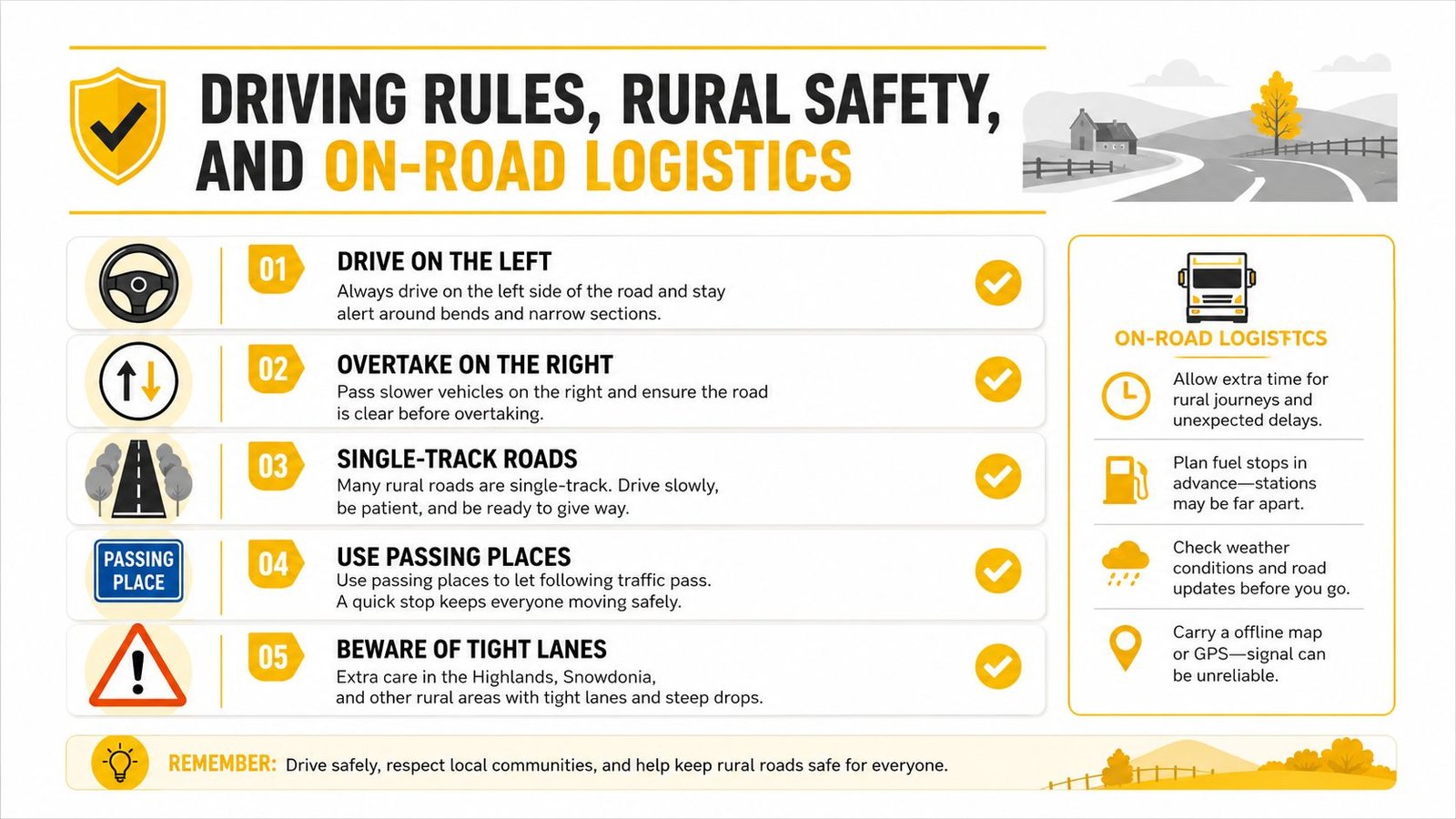
Foreign drivers usually struggle less with the headline rule, drive on the left, than with the small decisions that follow it. Keep left unless overtaking, overtake on the right, and approach roundabouts by reading the lane markings rather than copying the car ahead. Give yourself time to settle before attempting a long Highland or Welsh transfer.
The general limits are clear, but signs always control. In England, Scotland and Northern Ireland, the default built-up limit is 30 mph, while Wales generally uses 20 mph on roads with street lighting unless signs say otherwise. For cars, the general limit is 60 mph on single carriageways and 70 mph on dual carriageways and motorways, as set out in the GOV.UK speed-limit guidance.
Make narrow roads a planned experience
Single-track lanes with passing places are part of the Highlands, Snowdonia and rural Ireland. The passing place isn't a parking bay. Use it to let approaching traffic through, and never force another driver to reverse long distances because you stopped in the wrong position.
Rural roads also bring livestock, tractors, sudden fog and limited visibility around bends. Tourists who brake sharply for a viewpoint can create a hazard behind them, especially on popular Highland routes. Slow before blind bends, keep your eyes beyond the vehicle ahead, and leave enough space to stop without harsh braking.
Rural driving rule: If a route depends on single-track roads, shorten the sightseeing list before you shorten the safety margin.
The DfT road casualty data records 959 fatalities on rural roads in 2024, about 60% of all road deaths, despite rural roads carrying 45% of traffic. The same source states that rural roads are around six times more likely than motorways to produce a killed-or-seriously-injured outcome. Those figures justify a conservative route design. Reserve rural segments for daylight, reduce mileage, and use trunk or A-road corridors for longer transfers.
Carry a high-visibility vest and warning triangle if your rental company doesn't provide them. If your trip continues to France, check the equipment and documentation rules for that country, including any breathalyser requirements. For remote legs, fill the tank above half before leaving a larger town. Fuel availability becomes part of route design in the Highlands and western Ireland, so don't wait for the warning light.
Download offline mapping for mountain sections. Ordnance Survey mapping helps when the route leaves strong mobile coverage, and a physical road atlas remains a sensible backup if a phone overheats, loses signal or becomes inaccessible. Store the accommodation address and the fallback route offline before you leave the previous base.
Use one operational check each morning
The night before, make three decisions: which road you'll take, where you'll refuel, and what you'll do if weather or traffic blocks the main route. In the morning, check the weather, inspect live traffic, confirm opening times, and set the first stop in the navigation system before moving off.
GOV.UK separates live traffic guidance by jurisdiction, directing travellers towards National Highways for England and separate services for Scotland and Wales. That fragmentation means your planner should switch feeds when your route crosses a border. Use GOV.UK's traffic-information service as the starting point, then open the regional service relevant to the day's roads.
Motorway markings can help you judge distance when fatigue makes speed feel deceptive. The DfT's traffic-sign guidance says motorway chevrons are spaced 40 metres apart, and keeping two chevrons between your vehicle and the car ahead provides a safe following distance at 70 mph. Countdown markers at motorway exits show 100 yards per bar, which helps you prepare for a junction without a last-second lane change.
Let the budget set route density
Self-drive costs fall into four practical groups: rental car, fuel, accommodation, and food plus admissions. The planning mistake is to price the car and room, then add an unrealistic number of driving days and paid stops. A route with fewer bases can cost less in fuel and parking while giving you more time at the places you've paid to visit.
For working estimates, rental cars can sit around £35 to £90 daily, depending on season and transmission. Petrol can work out at roughly £0.18 to £0.22 per mile, while mid-range hotels may cost £80 to £140 nightly and self-catering cottages sleeping four may run £110 to £180 nightly. Food and admissions can sit around £40 to £70 per person daily. These figures are planning ranges, not guarantees, so check live prices before booking.
London, Edinburgh and the Scottish Highlands tend towards the upper end of those ranges. Wales, Northern England and rural Ireland can be less expensive, with planning guidance placing them 20% to 30% lower than those high-cost areas. Shoulder season, particularly April to May and September to early October, can reduce rental and lodging rates by 15% to 25% while traffic thins.
Keep a contingency line of 12% of total trip cost for weather reroutes, tunnel charges and city parking. The budget should decide whether you can afford a distant detour, not merely confirm a route you've already overfilled.
If you lock the keys inside the vehicle, stop improvising and contact roadside assistance first. Keep a practical car lockout guide available for general recovery guidance, but don't attempt a risky entry method on a rental vehicle.
Sample Itineraries Across England, Scotland, Wales, and Ireland
These routes are deliberately restrained. They use two or three bases, keep major transfers separate from ambitious sightseeing, and leave room to choose between history and scenery rather than pretending every traveller wants the same holiday.
| Itinerary | Duration | Bases | Total Mileage | Max Daily Drive | Best For |
|---|---|---|---|---|---|
| Cotswolds and Yorkshire | 7 nights | Cotswolds, York | Moderate | 3 hours | History and culture |
| Edinburgh and the Highlands | 6 nights | Edinburgh, Inverness | Moderate to long | 3 hours | Culture with Highland scenery |
| Snowdonia and North Wales | 5 nights | Snowdonia | Moderate | 2 hours | Nature and walking |
| Galway and Killarney | 6 nights | Galway, Killarney | Moderate | 3 hours | Coastal landscapes and regional touring |
England with two cultural bases
Stay three nights in the Cotswolds, then three nights in York. Use the first cluster for Bath, Stonehenge, Oxford and the villages, but don't force all four into one day. History and culture travellers should prioritise Oxford, Bath and a carefully timed Stonehenge visit, while nature-led travellers can replace one city with a longer Cotswold walk.
The transfer north is the day to protect. Route towards York with a sensible stop rather than adding another distant attraction. From York, make loops to the Moors, Whitby and Fountains Abbey. The Cotswolds' narrow lanes and Yorkshire's moorland roads can both slow the schedule, so leave the earliest arrival time flexible.
For a visual prompt when comparing coastal alternatives, use this UK coastal-drive image. It should inspire the route, not dictate the mileage.
Scotland with an urban start and Highland base
Stay two nights in Edinburgh and four nights in Inverness. Use the first transfer day to include Stirling if the timing works, then continue north. Culture-led travellers can prioritise Edinburgh, Stirling and Highland history. Nature-led travellers can use Inverness for Cairngorms loops or route west towards Fort William and Skye.
Single-track roads change the equation. A route that looks short may require passing-place stops, careful reversing and slower progress behind local traffic. Don't combine Skye with several major mainland attractions unless the weather forecast and road conditions give you a generous margin.
Travellers who want a polished multi-day format rather than independent routing can compare the structure with a luxury 10 day Europe tour, then retain the same principle here: fewer bases, longer stays and deliberate transfers.
Wales from one Snowdonia base
Stay five nights in Snowdonia. Use Caernarfon and Beddgelert for history and village atmosphere, then allocate separate days to Anglesey and the Lleyn Peninsula. Nature-led travellers should keep one full day open for a longer walk or weather delay. Culture-led travellers can combine the castle area with local towns and coastal scenery.
This is the route where one base pays off most clearly. Mountain roads, changing weather and walking conditions make a rigid sequence fragile. Return to the same accommodation each evening and let the forecast choose the next loop.
Ireland without a Dublin driving problem
Stay three nights in Galway and three nights in Killarney. Drive directly between the two regions rather than routing through Dublin's centre. Galway suits Atlantic scenery and cultural evenings, while Killarney provides a strong base for nature-led loops and western vistas.
History-led travellers can add heritage sites to each loop, but don't stack distant coastal viewpoints into the same day. Rural Ireland can use narrow roads and local traffic that make the sat-nav estimate optimistic. Treat the stated driving time as a minimum planning signal, not a promise.
Pre-Departure Checklist and Final Trip Confidence
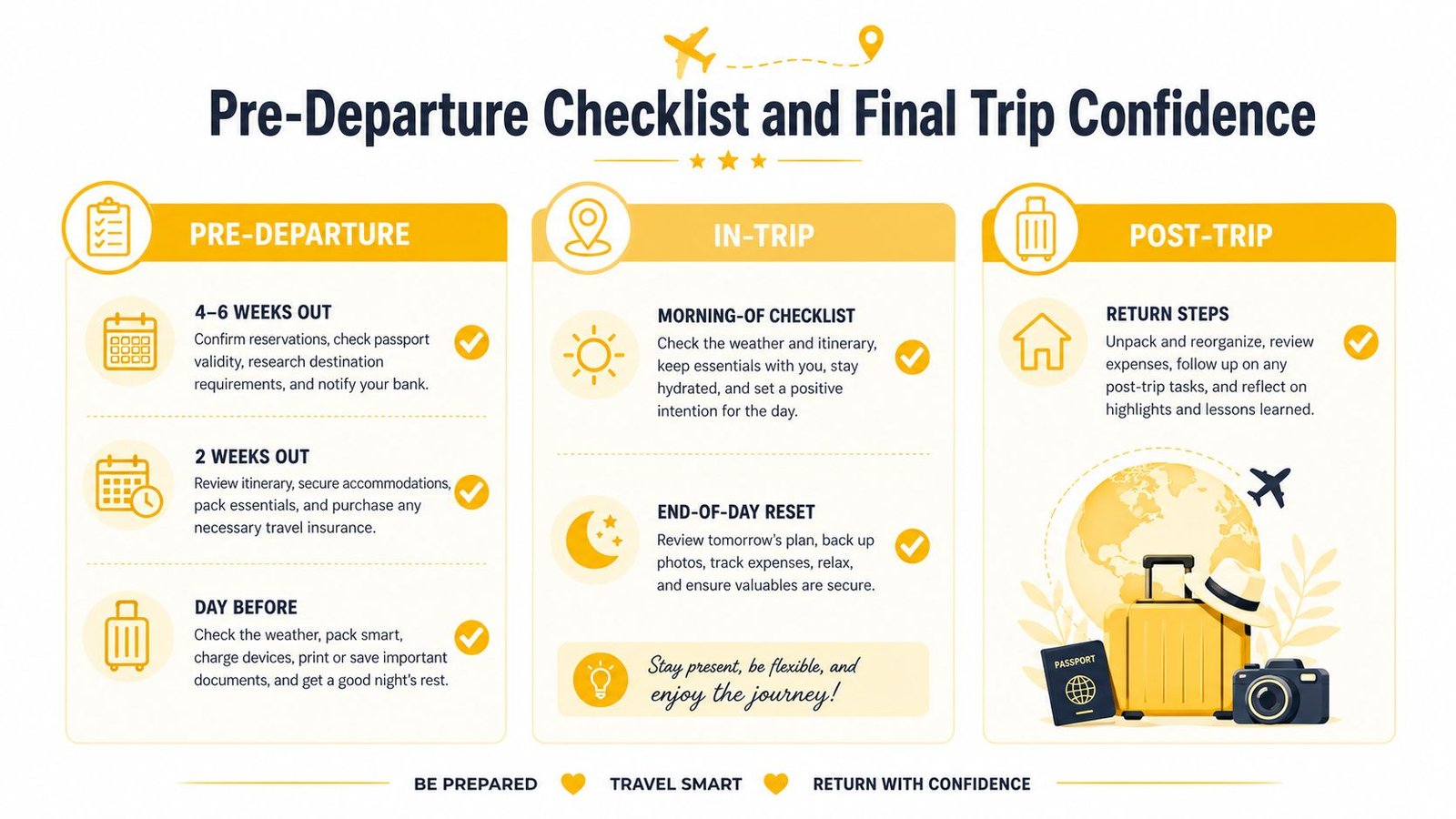
A reliable itinerary becomes simple when you divide the work into three checkpoints. Don't wait until the night before to discover that the licence, ferry, rental policy or London charge needs attention.
Before departure
Four to six weeks out
- Documents: Check passports, driving licences, insurance and any rental eligibility requirements.
- Route shape: Choose the region, bases and transfer days before selecting individual attractions.
- Transport: Book the rental car and any ferry crossings that control the route.
Two weeks out
- Licence access: Retrieve the DVLA licence code if the rental provider requires it.
- Accommodation: Confirm parking, pet rules, cancellation terms and late-arrival procedures.
- London planning: Confirm Congestion Charge and ULEZ requirements if the arrival involves central or inner London driving.
The day before
- Vehicle check: Photograph the rental car, confirm fuel policy and save the roadside assistance number.
- Navigation: Download offline maps, the next accommodation address and one fallback route.
- Supplies: Fill the tank above half for a remote leg, charge devices and pack water, layers and walking footwear.
During the trip
Run the same short check every morning. Look at weather and incidents, decide whether the planned road still makes sense, confirm fuel access, then leave with the fallback route available offline.
Reset the car. Remove rubbish, recharge phones, review the next base, and move anything needed for the morning into the passenger area. This small routine prevents rushed departures and forgotten equipment.
After the return
Inspect the vehicle with the rental representative, keep the final condition record, and resolve tolls or charges while the booking details are still accessible. Save the route that worked, note the roads that ran slowly, and record which stops deserved more time.
The best UK road trip planner is the one that leaves you with a route you'd happily drive again. Choose your region tonight, select the first base, and let the rest of the itinerary grow around a pace you can actually enjoy.
BTOURS offers curated self-drive itineraries across England, Scotland, Wales and Ireland, with regional routes, selected accommodation and flexible pacing built into the planning. Visit BTOURS to turn your preferred bases and travel style into a practical road trip plan.