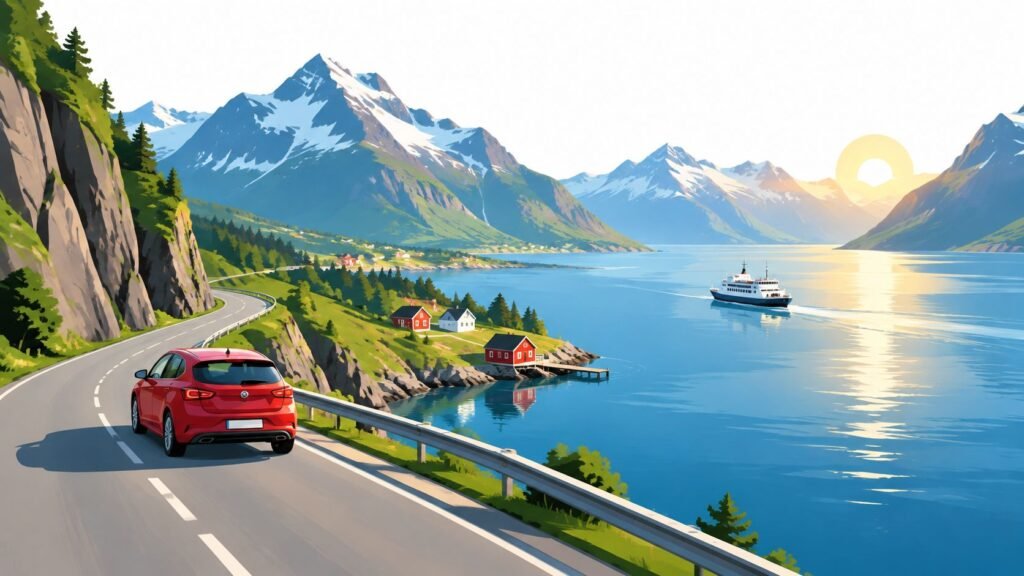
A Norway road trip is a flexible self-drive journey across 95,052 km of public roads, woven with ferries, tunnels and fjord crossings, and it rewards slow pacing over distance. For a UK traveller, the right plan usually means treating 200 to 300 km a day as a satisfying target, not a failure to cover ground.
You're probably looking at a map, tracing a line from Oslo to Bergen, then north towards Geiranger or Lofoten, and wondering why the journey time seems absurdly long. The answer is that Norway isn't a motorway holiday with scenery on the side. Its roads pass through mountains, under fjords, across bridges and onto ferries, while the route that looks short on a map can consume most of a day.
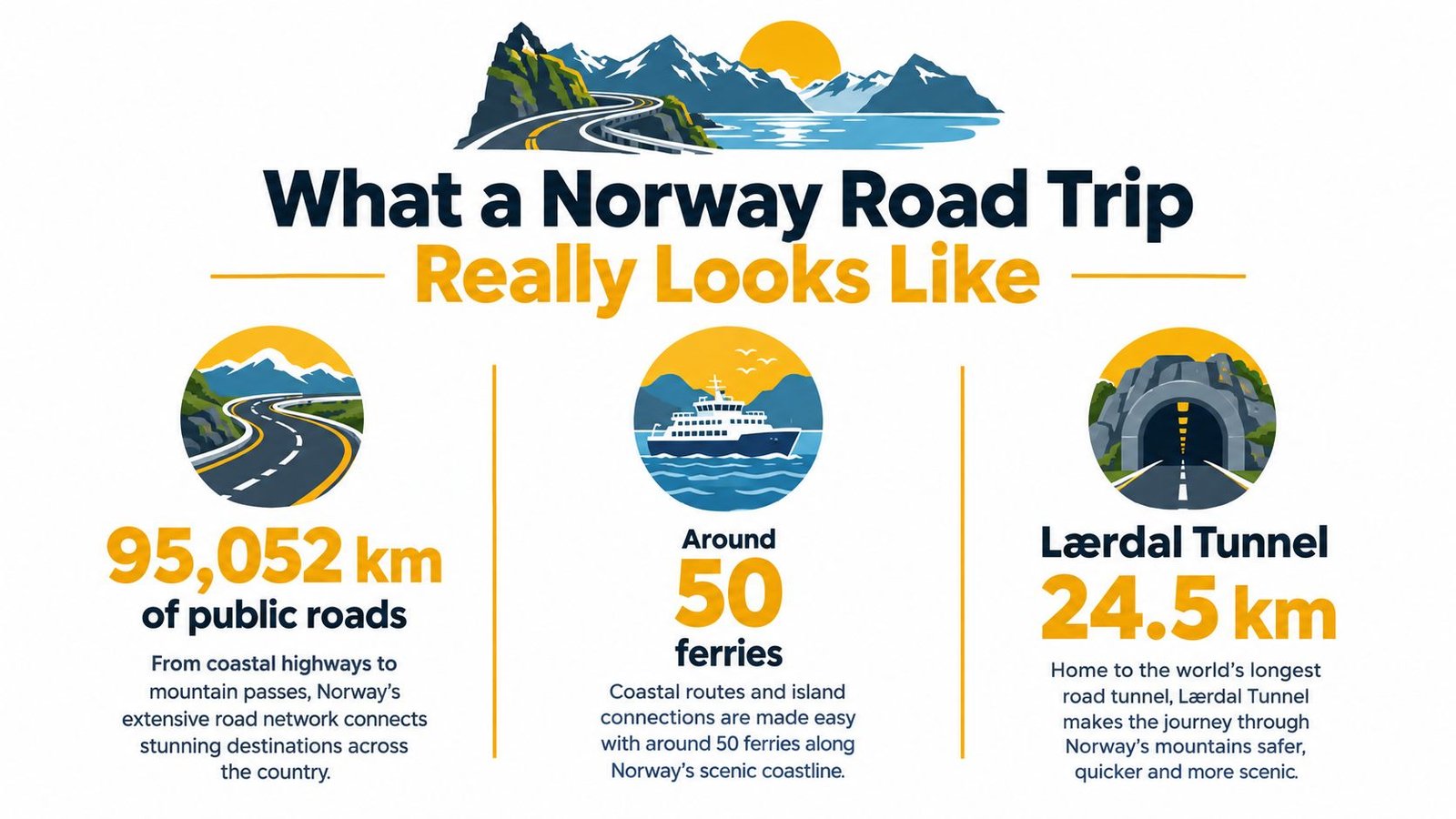
The government's National Transport Plan 2025–2036 records 10,565 km of national roads, 44,590 km of county roads and 39,897 km of municipal roads, alongside more than 1,260 road tunnels with a combined length of about 1,550 km. Those figures explain why your itinerary needs flexibility from the start.
What a Norway Road Trip Really Looks Like
A British couple landing in Oslo or Stavanger for a first self-drive holiday must settle four decisions before collecting the keys: what to drive, which region to choose, how many days to allow, and how much to reserve for ferries. Scenic pull-ins are only part of the calculation. At the hire desk, boot space, charging access, insurance excess and ferry arrangements can shape the route more than a landmark on the map.
Norway's road network feels large because journeys follow practical corridors through mountains, valleys and coastal settlements. The National Transport Plan identifies around 50 ferries on coastal routes, while the country's tunnels include the 24.5 km Lærdal Tunnel. A ferry crossing belongs in the driving plan, not in a separate sightseeing column. Your choice of vehicle and route should account for both.
The pace matters more than the mileage
Allow four to five hours of driving on a full day, then add ferry queues, food, photo stops and short walks. A route that looks reasonable in a UK planner can become exhausting on narrow roads behind slow traffic, in poor weather or where safe stopping places are limited. Keep the schedule loose enough to absorb a late crossing without turning the evening into a race.
Fill the tank before leaving a larger town, particularly on remote links between fjord villages or across a high plateau. Keep food and water in the car. Electric drivers should check charging locations before committing to a long section, rather than assuming every attractive overnight stop has a charger.
Practical rule: If your route requires driving from breakfast until dinner every day, it is a transfer schedule, not a scenic itinerary.
Choose fewer regions, stay in appealing small towns and leave time for a ferry crossing or valley that deserves more than a hurried photograph. This decorative Skye road-trip image reflects the same planning principle: the road should form part of the holiday, not merely connect the stops.
Norway's strategic road network is more limited than its headline total suggests. European Commission reporting places the TEN-T road network at 4,845 km, while its real-time travel-time system covered 462 km, or 9.5%, so plan around key corridors rather than expecting motorway-style journey times everywhere. The European Commission transport data records 4.5 million vehicle-hours spent in congestion on the reported state network in 2019. Delays still develop near cities, ferry approaches and popular attractions, even in a sparsely populated country.
Driving Rules and Speeds UK Travellers Must Know
A first drive from the ferry or airport can feel unfamiliar because Norway uses right-hand traffic. Junction priority may go to vehicles approaching from the right, and trams often have priority. UK-registered vehicles must display the letters “UK”, as explained in the RAC guide to driving in Norway.
Learn the speed envelope
Norwegian limits are lower than many UK drivers expect, and bends, tunnels and changing weather make the signed limit a ceiling rather than a target. The Norway driving speed guidance lists 50 km/h in built-up areas and 80 km/h outside built-up areas when no other sign applies. Main asphalted through-roads may be signed at 90 km/h, while 110 km/h applies only on the best-quality motorways.
| Road or situation | Rule or limit |
|---|---|
| Built-up area | 50 km/h unless signed otherwise |
| Standard rural road | 80 km/h unless signed otherwise |
| Main asphalted through-road | 90 km/h where signed |
| Motorway | Up to 110 km/h where signed |
| Junction priority | Vehicles from the right may have priority |
| Trams | Often have priority |
| Driving side | Right-hand traffic |
A full UK photocard driving licence is valid for tourists on short visits, and an International Driving Permit is not normally required. Keep your licence, rental agreement and insurance documents together so they are ready during a roadside check.
Equipment rules to follow without exception
Dipped headlights are required at all times. Tunnels are common, so adjust between dipped and main beam for visibility, road conditions and oncoming traffic. Seatbelts must be worn in every occupied seat. Store a reflective hi-vis vest inside the cabin, where you can reach it, rather than under luggage in the boot.
Norway's alcohol limit is particularly strict, with a legal blood alcohol limit of 0.02%. Make zero alcohol before driving your rule for the trip. Spot fines are possible, and serious offences can result in your licence being surrendered on the spot. An empty mountain road does not change those requirements.
Winter preparation must match the route and forecast. For roads covered in snow or ice, GOV.UK guidance for Norway states that winter tyres must have at least 3 mm tread. The same guidance specifies 5 mm and sufficient snow chains for truck drivers. Before leaving a hire-car depot, confirm the vehicle's tyre setup, especially if your route includes mountain roads or northern areas.
Choosing the Right Route for Your Trip
The best route depends less on the famous viewpoint you want to photograph and more on how you like to travel. Do you want scenery through the windscreen, or do you want to stop frequently for short walks, ferry rides and village cafés? That answer determines whether you should choose a compact fjord loop, a long coastal traverse or a northern island adventure.
| Route family | Typical days needed | Drive pace | Best for |
|---|---|---|---|
| Western fjords | 7 to 10 days | Short drives with ferries and rail | First-timers who want classic scenery |
| Atlantic coast | 10 to 14 days | Longer coastal days and ferry hops | Confident drivers who enjoy remote roads |
| Lofoten and the north | At least 10 to 14 days | Flexible, weather-dependent days | Travellers prioritising Arctic landscapes |
Western fjords for the first visit
The Bergen, Flåm, Gudvangen and Voss axis gives you the most concentrated introduction. It works well for a first Norway road trip because the driving days can stay short while ferries, fjord cruises and scenic rail journeys provide variety. Choose this route if you want to spend more time outside the car and don't mind paying for several transport layers.
The Norway in a Nutshell route is better treated as a framework than a rigid package. Base yourself around Flåm or Balestrand, then adapt each day to the forecast. A short walk beside a fjord will often give you a better memory than squeezing in another distant attraction.
Atlantic coast for drivers
The Atlantic Ocean Road, or Atlanterhavsveien, combines with the Kystriksveien coastal route between Trondheim and Bodø. The coastal journey covers around 650 km of islands, causeways and ferry hops, so it suits people who enjoy the mechanics of travel as much as the scenery. Allow 10 to 14 days, and accept that the weather can make the coast feel dramatic rather than polished.
This is not the route I'd choose for a nervous first-time driver. It's the route I'd choose after deciding that bridges, sea crossings and changing conditions are the point of the holiday. If you're comparing the planning rhythm with a closer British journey, this route from Blade Auto Keys offers useful context for how a road trip can be built around connected regions rather than a checklist of stops.
Lofoten and the north
Fly or take the ferry to Bodø, then build around Svolvær, Reine and Henningsvær. You can combine the islands with the E6 towards Tromsø, but don't attempt this as a rushed add-on to a southern fjord itinerary. Allow at least 10 to 14 days, and choose it if you can tolerate weather changes, slower progress and the possibility of altering plans.
My recommendation for most first-timers is the western fjords. Save Lofoten for a separate trip unless northern scenery is the reason you're going to Norway at all.
A Sample 10 to 14 Day Itinerary
A good first itinerary should feel spacious, not heroic. The route below begins in Oslo and moves west through Telemark and Hardangervidda, follows Hardangerfjord towards Bergen, then turns north through Sognefjord and the Geiranger and Trollstigen corridor.
The 10-day version keeps the fjord section tight and skips the Atlantic coast. The 14-day version adds breathing room and a two-night Lofoten extension by flying the rental car one-way from Bodø, if the rental company permits that arrangement.
| Day | 10-day route | 14-day route | Drive hours |
|---|---|---|---|
| 1 | Oslo to Telemark | Oslo to Telemark | 3 to 4 |
| 2 | Telemark to Hardangervidda | Telemark to Hardangervidda | 3 to 5 |
| 3 | Hardangervidda to Hardangerfjord | Hardangervidda to Hardangerfjord | 3 to 4 |
| 4 | Hardangerfjord to Flåm | Hardangerfjord to Flåm | 3 to 4 |
| 5 | Flåm and Nærøyfjord | Flåm and Nærøyfjord | 1 to 3 |
| 6 | Flåm to Bergen | Flåm to Bergen | 3 to 4 |
| 7 | Bergen to Sognefjord | Bergen to Sognefjord | 3 to 5 |
| 8 | Sognefjord to Geiranger | Sognefjord to Geiranger | 4 to 5 |
| 9 | Geiranger to Ålesund | Geiranger to Ålesund | 3 to 4 |
| 10 | Return or depart from Ålesund | Ålesund to Atlantic coast | 3 to 5 |
| 11 | Not included | Atlantic coast to Trondheim | 4 to 5 |
| 12 | Not included | Fly or transfer towards Bodø | Flexible |
| 13 | Not included | Bodø to Lofoten | 2 to 4 |
| 14 | Not included | Lofoten stay and departure | 1 to 3 |
Days 1 to 4 build the western approach
Leave Oslo for Telemark rather than driving straight towards the fjords. The change is gradual, and an overnight there breaks up the opening transfer. Continue across or around Hardangervidda according to road conditions, then settle near Hardangerfjord for a night that gives you time to walk beside the water.
Move towards Flåm on day four. Keep the drive under control, because travellers start adding every viewpoint they see on the map. Pick one headline stop, such as a waterfall, a plateau viewpoint or a short village walk, and leave the rest for another visit.
Days 5 to 10 follow the fjords north
Spend day five around Flåm and Gudvangen, using a fjord cruise or the railway instead of treating every experience as another car journey. Continue to Bergen, then head north towards the Sognefjord area. The Lavik to Oppedal ferry is a practical crossing to account for on relevant western routes, and it reinforces why arrival times shouldn't be planned to the minute.
From Sognefjord, move towards Geiranger. The Geiranger to Hellesylt Fjordcruise can replace a long road section and gives the terrain time to unfold without you concentrating on bends. Continue through the Trollstigen corridor if it is open and conditions are suitable, then use Ålesund or the Atlantic coast as your final southern base.
For the 10-day trip, stop there or depart from a practical airport. For the 14-day plan, build in the northern extension rather than squeezing Lofoten into a single overnight. This Harry Potter England and Scotland road-trip title card is a reminder that themed journeys work best when the route has a clear narrative. Here, the narrative is a move from inland plateau to fjord, coast and Arctic island.
Ferries Tolls and Choosing Petrol or Electric
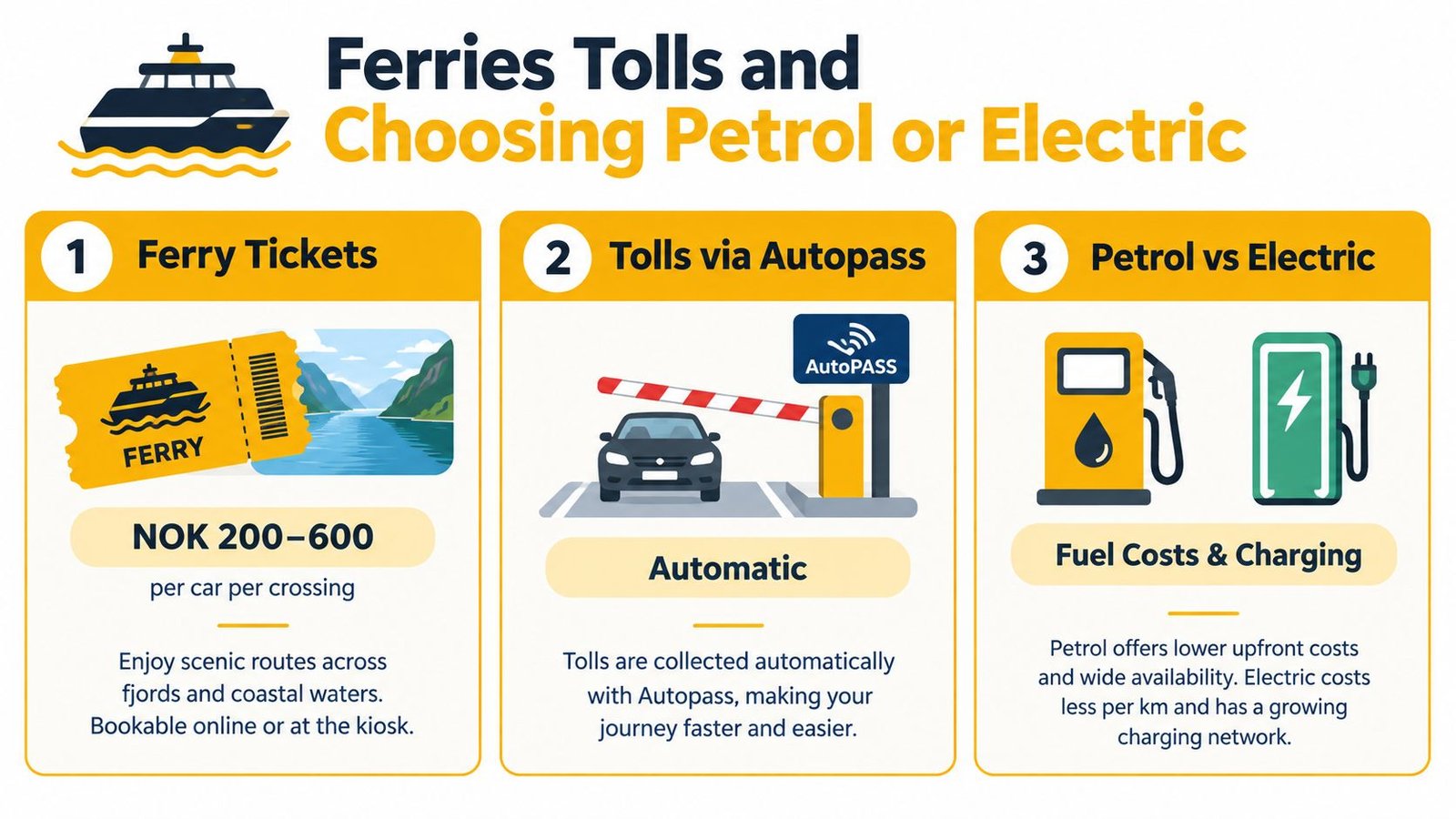
A UK self-drive trip to Norway has three running costs beyond the hire car: ferry crossings, automatic road tolls and fuel or charging. Set this budget before collection. A low rental rate can lose its appeal once you add a large engine, repeated ferry payments and tolls across a long route.
Norway's toll system is automatic. Every driver, regardless of nationality, pays Norwegian road tolls, and most toll stations require no stopping. Ferry crossings commonly use AutoPASS, the automated system used for road and ferry collection. Confirm with the hire company how the vehicle is registered and how charges will appear on your final invoice.
The three cost layers
Scenic ferry crossings often cost around NOK 200 to 600 per car per crossing, based on the route-planning assumptions for this trip. Some crossings accept online bookings, while others use a kiosk or automatic payment. Check each operator before departure, and leave time in the itinerary for queues, loading and weather-related delays.
Set aside a separate toll allowance. A southern loop lasting around two weeks can reach NOK 1,500 to 2,500 in tolls, depending on the route and vehicle. Ask the hire company whether it registers the number plate or provides an AutoPASS arrangement, then confirm any administration fees and the invoicing process.
Petrol is commonly budgeted at roughly NOK 22 to 26 per litre. On a 2,000 km loop, a petrol SUV can use around NOK 3,500 to 4,200 in fuel, while an EV may spend about NOK 700 to 1,000 on charging. Treat these as route-specific planning figures, not guaranteed pump or charger totals.
My petrol versus EV verdict
Norway has nearly 30,000 charging points and over 8,000 fast chargers. Visit Norway's electric-car guidance notes that EVs can receive lower tolls, discounted or free parking, and cheaper ferry tickets in many cases. A Tesla Model Y or Polestar 2 suits a planned southern route, especially when your accommodation offers overnight charging.
Check the exceptions before choosing an EV. An electric car over 2 tonnes may face a ferry surcharge of around NOK 100 to 300, depending on the crossing. Petrol remains the simpler option for spontaneous detours, remote mountain roads or accommodation without reliable charging.
The recommendation is straightforward. Choose electric for a mapped route with regular overnight bases and confirmed charging stops. Choose petrol when flexibility matters more than running cost.
Best Seasons and Where to Stay
Choose the season before fixing the route. On a Norway road trip, mountain passes, ferry timetables, daylight and road conditions can change the same itinerary completely.
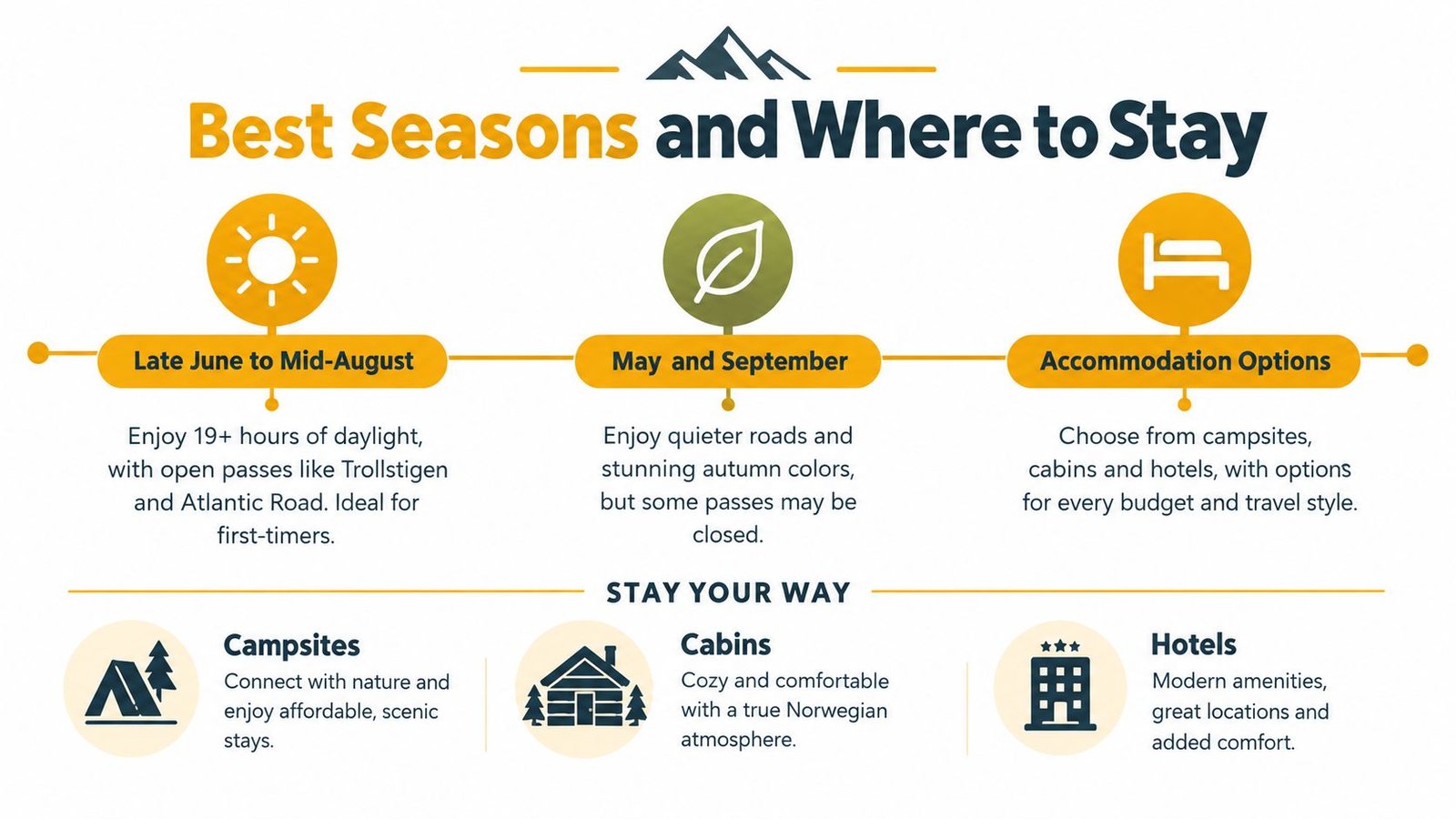
Late June to mid-August is the safest choice for first-timers who want long days and the best chance of open routes such as Trollstigen and the Atlantic Road. Daylight can exceed 19 hours during this summer period. Roads and activities are at their busiest, so reserve accommodation and popular excursions early.
Match the month to your confidence
May and September bring quieter roads and strong autumn colour. High passes can still close or become unsuitable, so choose these months only if you are ready to adjust the route. The reward is a calmer drive and easier availability.
November to March suits experienced winter drivers rather than a first self-drive trip. Snow-covered towns and the northern lights are compelling, but conditions demand winter or studded tyres when required, controlled speeds and confidence on ice. Winter tyres need a 3 mm minimum tread requirement when roads are covered in snow or ice.
Seasonal judgement: Summer gives you the widest road choice. Winter gives you a different country, not a cheaper version of the summer itinerary.
Choose accommodation for the route
Book accommodation around the route, not just the attraction list. Cabins and DNT hostels work well for travellers who want kitchens, practical locations and a lower-cost base. Mid-range rorbuer in Lofoten add character and a memorable waterside setting, while design-led hotels such as Juvet turn the overnight stay into part of the experience.
The accommodation planning ranges are NOK 500 to 900 for budget cabins and DNT hostels, NOK 1,400 to 2,200 for mid-range Lofoten rorbuer, and NOK 2,800 or more for character hotels such as Juvet. Treat these as planning bands, not fixed prices. Dates and availability can change the final cost.
July rooms can sell out six to nine months ahead, especially in Flåm, Geiranger and Lofoten. Reserve the nights that anchor your route first, then keep less popular stops flexible. For a visual example of this structured approach, see this Norway-style itinerary planning image, using a firm backbone with room for local discoveries.
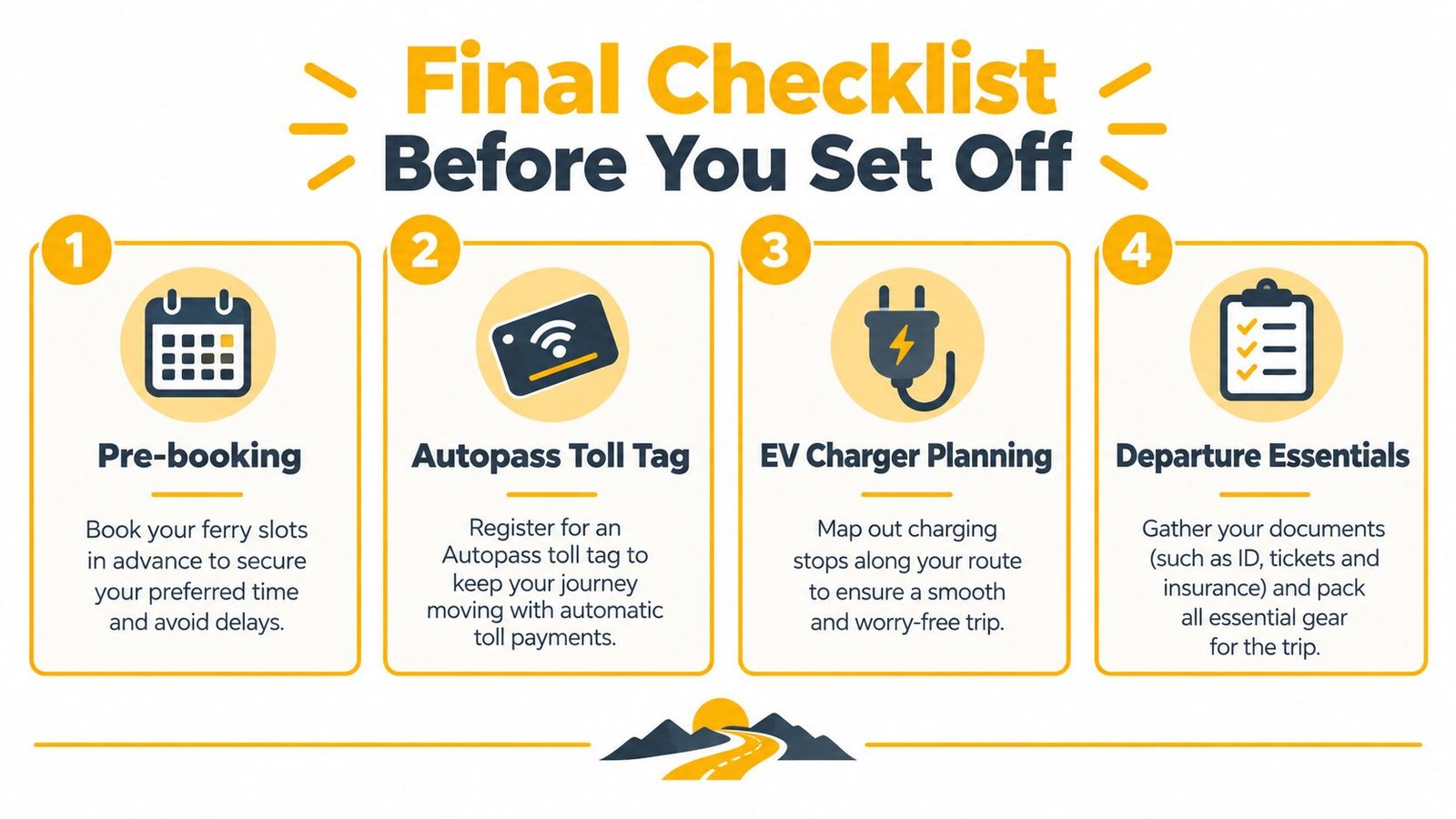
Final Checklist Before You Set Off
A Norway road trip can go wrong before you leave the rental desk. Check ferries, toll registration, charging access and road conditions while the route is still easy to change. That preparation matters more than squeezing another viewpoint into the itinerary.
Before booking
- Ferry slots: Mark crossings that accept reservations, then separate them from routes that run on a queue. Leave waiting time in the plan, especially when a missed sailing would disrupt an overnight booking.
- AutoPASS arrangements: Ask whether the hire car includes an AutoPASS tag or whether the rental company registers its number plate automatically. Confirm how toll charges will appear on your final rental invoice.
- EV charging: Place charging stops around overnight towns rather than relying on chargers beside attractions. Check that each accommodation accepts your connector and vehicle type.
- Popular nights: Reserve stays in Flåm, Geiranger and Lofoten early if you are travelling during the main summer window.
Before departure
Carry your full UK photocard licence, rental documents and insurance details. Ask the hire company how to adjust the headlamps, which tyres are fitted, how roadside assistance works and how tolls are billed. Travelling from November to April requires a direct check of the vehicle's winter readiness. Do not assume it suits every mountain road.
Keep a credit card with a PIN available for unattended fuel pumps, and place the hi-vis vest where the driver can reach it. Download offline maps before leaving the city. Coverage can become unreliable in remote valleys and along coastal stretches, so do not make your route dependent on a live signal.
On the road
Refuel or recharge before remote sections, even if the range display looks comfortable. Keep simple food and water in the car, and check ferry departures before committing to a late-day crossing. Build in spare time for weather, closures and the stop that unexpectedly takes an hour.
A compact charger prevents minor battery problems from becoming a nuisance when your phone handles navigation and photography. This guide to compact chargers for travel in 2026 can help you choose a lightweight backup for the car and accommodation.
Drop a stop when poor weather makes it unrewarding. Shorten the driving day when everyone is tired. Norway rewards attention, patience and flexibility, so leave room to continue through another tunnel when the fjord beyond it is worth the detour.
BTOURS creates curated self-drive journeys with flexible schedules, handpicked accommodation and practical support across the Nordics, including routes for travellers starting from the UK. Visit BTOURS to explore a Norway or Scandinavia itinerary with structure, while keeping the freedom to slow down.