You've opened the map, saved the viewpoints, and promised yourself you won't rush the Highlands. Then the route line appears: a vast loop beginning and ending at Inverness Castle, with single-track roads, remote coastlines, unpredictable weather and far more tempting stops than any sensible schedule can hold. The Scotland route NC500 rewards curiosity, but it punishes careless pacing.
The right approach isn't to collect every viewpoint. It's to build enough breathing room into the journey that you can stop for a beach, linger over lunch in a harbour village, or wait safely while traffic clears. A curated road trip, with sensible overnight bases and a plan for the less obvious logistics, will give you more Highland experience than a frantic campervan circuit.
Understanding the North Coast 500 Experience
Leave Inverness Castle expecting a simple scenic loop and the road will correct you quickly. A viewpoint may demand a slow approach, a narrow lane, a walk from limited parking and patience while local traffic passes. The reward comes from allowing time for those interruptions, not from forcing every attraction into one day.
Launched in 2015, the North Coast 500 became a 516-mile, or 805-kilometre, circular touring route around Scotland's northern Highlands. Some later descriptions give the route as 516 miles, or 830 kilometres, because measurements vary according to how the signed route is traced. The planning message remains the same: this is a substantial loop, not a compact scenic drive. The BBC's reporting on the route's early impact records a commissioned first-year study attributing 29,000 additional visitors and £9 million in extra spending to the route.

More than a road on a map
By 2017, visitor numbers in the participating areas had risen by an average of 26%, compared with 6% across the rest of the region, and route traffic had increased by 10%, according to the BBC report cited above. The NC500 therefore changed more than holiday itineraries. It redirected attention and spending towards Highland communities, while also placing greater pressure on roads, parking and local services.
A later evaluation recorded £13.46 million in additional sales, £22.89 million in Gross Value Added and around 179 full-time equivalent jobs supported in the north of Scotland. It also recorded room occupancy rising from 52% in 2014 to 78% in 2018. The published NC500 evaluation report shows the route's effect on accommodation, food, attractions and other local services.
That growth changes how you should travel. School traffic, deliveries, crofters, fishermen and emergency vehicles use these roads every day. A campervan schedule built around collecting viewpoints can create stress for you and delay people who live there. Choose fewer bases, allow unplanned stops and book the experiences that matter most. A curated trip usually delivers more than a rushed DIY circuit.
My rule: If the itinerary leaves no room for an unplanned stop, it's too ambitious.
Visitors arriving from London or another busy city should plan the transition carefully. The Highlands rewards attention, patience and local awareness rather than motorway-style efficiency. A visual guide to combining Great Britain rail and road travel suits travellers who want to reach the north efficiently, then explore the route without forcing every mile into one long driving day.
Strategic Itinerary Planning and Realistic Driving Times
The NC500's central planning constraint is its 516-mile loop. Route guidance from Make It Scotland places bare driving time at roughly 13 to 16 hours, while a practical itinerary usually takes five to seven days. That gap between driving time and holiday time is where many plans fail.
A navigation app might tell you that two places are close enough for a relaxed morning and an early lunch. It doesn't understand that a single-track section can require several pauses, that a scenic pull-in may be full, or that you'll want to leave the car to reach a beach, gorge, cave or lighthouse. It also won't account for weather forcing you to slow down or change a detour.
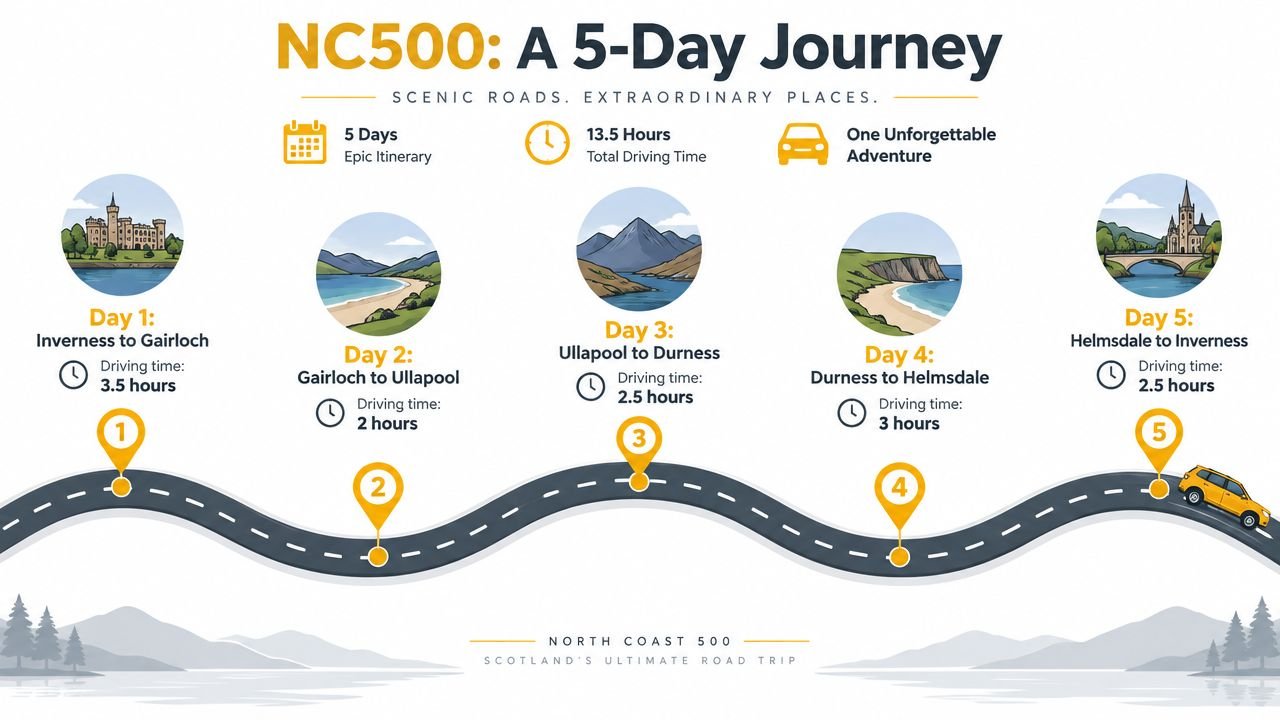
Build the journey in layers
Use three separate time allowances rather than one total driving estimate:
- Route time, the basic movement between overnight stops.
- Road friction, including passing places, livestock, congestion, weather and slower traffic.
- Experience time, covering walks, meals, viewpoints, historic sites and the stops you'll only discover once you're there.
The five-day structure shown in the infographic offers a workable framework, but don't treat its individual driving figures as a promise. The useful principle is the sequence of manageable bases: Inverness, Gairloch, Ullapool, Durness, Helmsdale and back to Inverness. A seven-day version gives you more freedom to split demanding legs, add a rest afternoon or stay longer in the areas that suit you.
A three-day loop is possible in the narrow sense that a capable driver can cover the distance. It's a poor choice for anyone who wants to walk, eat locally, photograph the surroundings or respond to weather. You'll spend too much of the holiday watching the road through the windscreen.
Don't assume a campervan is essential
The NC500 is often presented as a campervan adventure, but that format can create its own pressure. A larger vehicle needs more care on narrow roads, popular parking areas fill quickly, and overnight decisions become stressful when you're tired and the next legal stopping place isn't obvious.
A lower-stress alternative combines rail travel to Inverness, a smaller hire car for selected legs, short transfers and carefully chosen overnight stays. You can also design a partial NC500 experience rather than insisting on the full circle. That approach works particularly well for couples and international visitors who want the without turning every evening into a search for parking.
Use a coastal route planning reference from BTOURS as inspiration for the wider principle: a road trip should connect places meaningfully, not just maximise the number of miles completed.
Navigating the Six Distinct Highland Regions
The NC500 is easier to understand when you stop treating it as one continuous stretch. The route commonly takes in six Highland areas, Easter Ross, Caithness, Sutherland, Assynt, Wester Ross and Inverness as the return point, each with a different rhythm and visual identity. Macdonald Hotels' overview of the NC500 regions provides a useful geographic framework, but the best itinerary gives each area enough time to feel distinct.
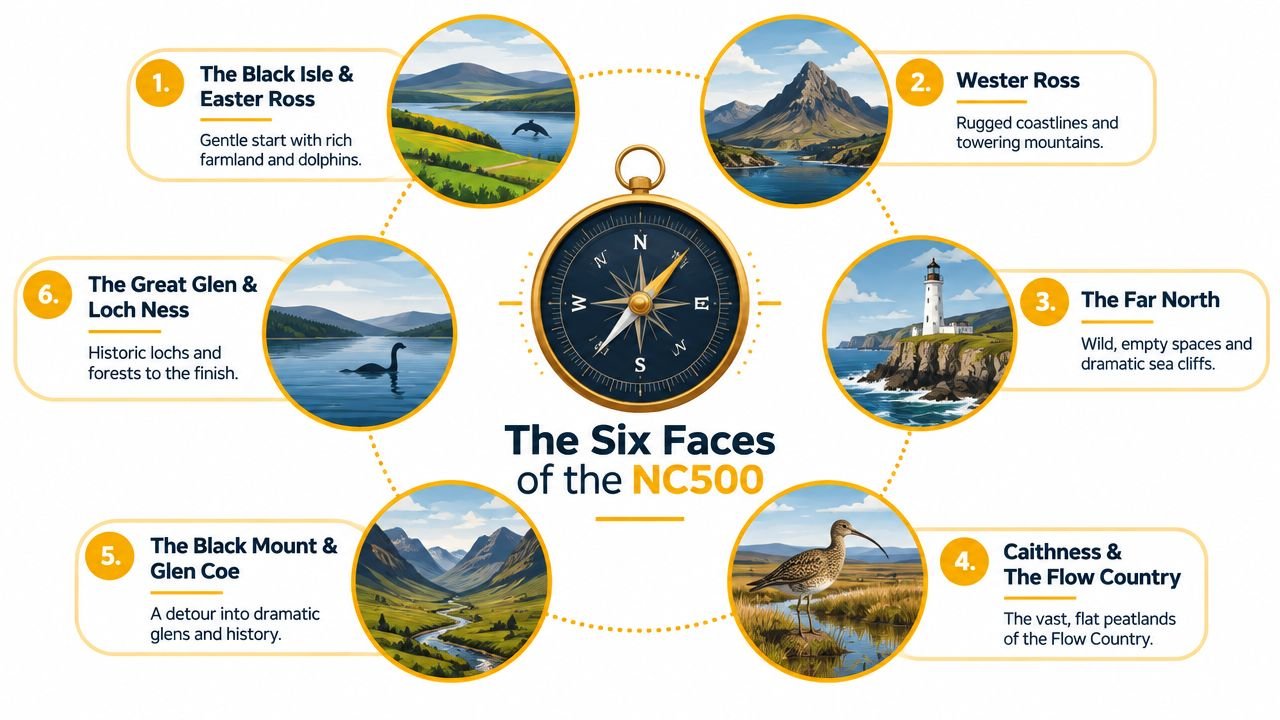
Easter Ross gives you a gentle beginning
From Inverness, Easter Ross offers a softer introduction than the exposed west and north coasts. The Black Isle and surrounding farmland create a calmer opening, with rolling ground, small settlements and opportunities for wildlife watching around the firths. Don't sprint through this section just because the roads feel easier. It's a good place to settle into left-side driving, learn how your vehicle behaves and make your first deliberate stop.
The contrast becomes more pronounced as you approach the northern coastline. Caithness brings open horizons, sea cliffs, wind-shaped headlands and historic sites that feel separate from the greener inland scenery. John O'Groats is the obvious marker, but it shouldn't be the only objective. Continue towards Dunnet Head and Duncansby Head if conditions allow, and leave time to walk rather than photographing the nearest signpost before moving on.
Sutherland and Assynt demand patience
Sutherland is where the route begins to feel remote. The spaces expand, the settlements become more scattered and the scenery asks you to slow down. Look for quiet coastal villages, beaches and headlands rather than assuming the famous stops are the whole story. Smoo Cave near Durness is a strong example of a place that rewards leaving the car, while the surrounding coast offers a sense of scale that no passing photograph can reproduce.
Assynt is the geological showstopper. Its mountains appear abruptly above lochs and moorland, creating the kind of scenery that makes a short road distance consume an entire afternoon. Kylesku Bridge deserves a proper viewpoint stop, and the roads towards Achmelvich, Stoer and the Old Man of Stoer are precisely the sort of detours that make a five-day schedule feel tight.
If you're interested in the practical side of the region, the Ullapool test centre information from Fast Track Driving Lessons offers useful local context about roads around Ullapool. It's especially relevant for drivers who want to understand why remote Highland routes require different preparation from familiar urban roads.
Wester Ross is where itineraries unravel
Wester Ross combines rugged coastline, mountain scenery and detours that look short on a map but unfold slowly in person. Gairloch, Loch Maree, Torridon and the roads around Shieldaig all deserve more than a passing glance. Applecross is a standout excursion, but approach its mountain road only when conditions, vehicle suitability and driving confidence make it sensible.
The best hidden stops often sit just beyond the headline route. A coastal village, a small café or a viewpoint above a loch can be more memorable than another crowded car park. Keep your schedule flexible enough to follow local recommendations, but verify opening times before relying on one restaurant or attraction.
Inverness completes the circle
The return through Easter Ross and Inverness gives the journey a useful decompression period. Dunrobin Castle and its gardens are a natural historical stop on the eastern side, while Inverness itself works well as more than a start line. Explore the city's riverfront, cathedral, market and castle area before flying or taking the train onwards.
For a broader visual reference on Scottish road-trip planning, this Scotland road-trip title card reinforces an important point: Scotland's strongest journeys come from combining scenery, history and local life rather than chasing a single scenic road.
Mastering Single-Track Roads and Driving Logistics
Highland driving changes the meaning of distance. A west-coast leg can cover relatively few miles yet take much longer than expected because vehicles slow for bends, livestock, pedestrians, weather and oncoming traffic. Official NC500 road-safety guidance stresses keeping left, choosing a speed that preserves your ability to make decisions and allowing time for road conditions and stops.
Single-track roads work when every driver cooperates. Passing places aren't optional decorations. They're part of the traffic system, and using them correctly prevents a small hesitation from becoming a queue.
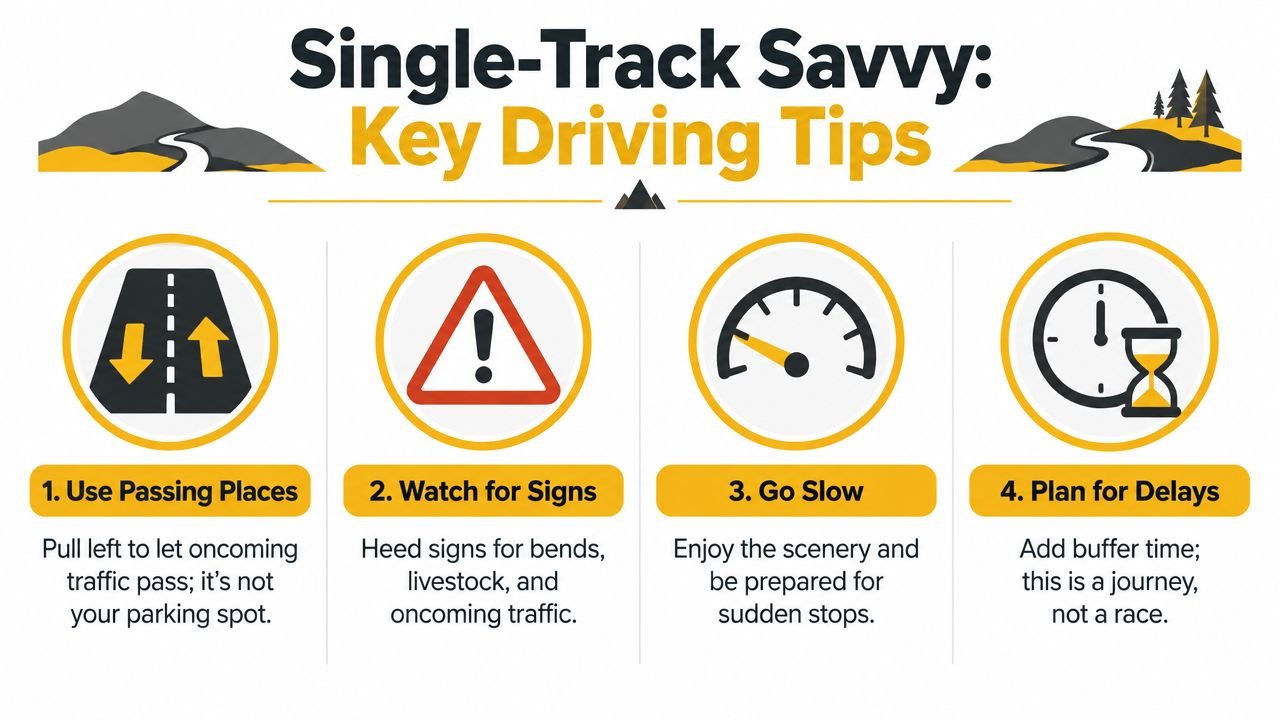
Learn the road language
- Use passing places: Pull into a passing place, or stop opposite one when appropriate, to let oncoming traffic pass. Never leave your vehicle there as a parking bay.
- Keep left: Oncoming traffic may appear suddenly around a bend, so hold your side and avoid cutting corners.
- Look well ahead: Read warning signs for sharp bends, livestock and changing road conditions before you commit to a manoeuvre.
- Leave a buffer: Add time for stop-start traffic and never build an attraction booking around the fastest possible journey.
A driver behind you may be local, working or responding to a timetable. If you're travelling slowly to take in the scenery, use a safe passing place and let them through. Don't stop in the carriageway for photographs. Find a proper pull-in, park considerately and make sure your doors won't open into traffic.
Practical rule: If you can't see enough road to make a calm decision, reduce speed before the bend, not during it.
Make safety part of the itinerary
The route's remoteness affects more than comfort. Emergency journeys can be long, and congestion around bottlenecks affects residents as well as visitors. The sensible response isn't anxiety. It's preparation, patience and a vehicle that's ready for the conditions.
Check the weather before leaving each base, keep fuel levels comfortable and avoid treating a short distance as permission to squeeze in another major detour. A road trip becomes enjoyable when the driver still has concentration left.
Handpicked Accommodation and Authentic Local Dining
A good NC500 overnight stop should solve more than sleep. It should reduce the next day's driving pressure, put you near a useful cluster of sights and give you a reason to look forward to arriving. Handpicked lodges, historic inns and small hotels often do that better than a last-minute campsite search after a long day on narrow roads.
The argument for characterful accommodation isn't luxury for its own sake. It's control. A confirmed room means you know where you're going, you can dry wet layers, charge devices, ask about local conditions and eat without moving the car again. That stability matters when the route has already demanded constant attention.
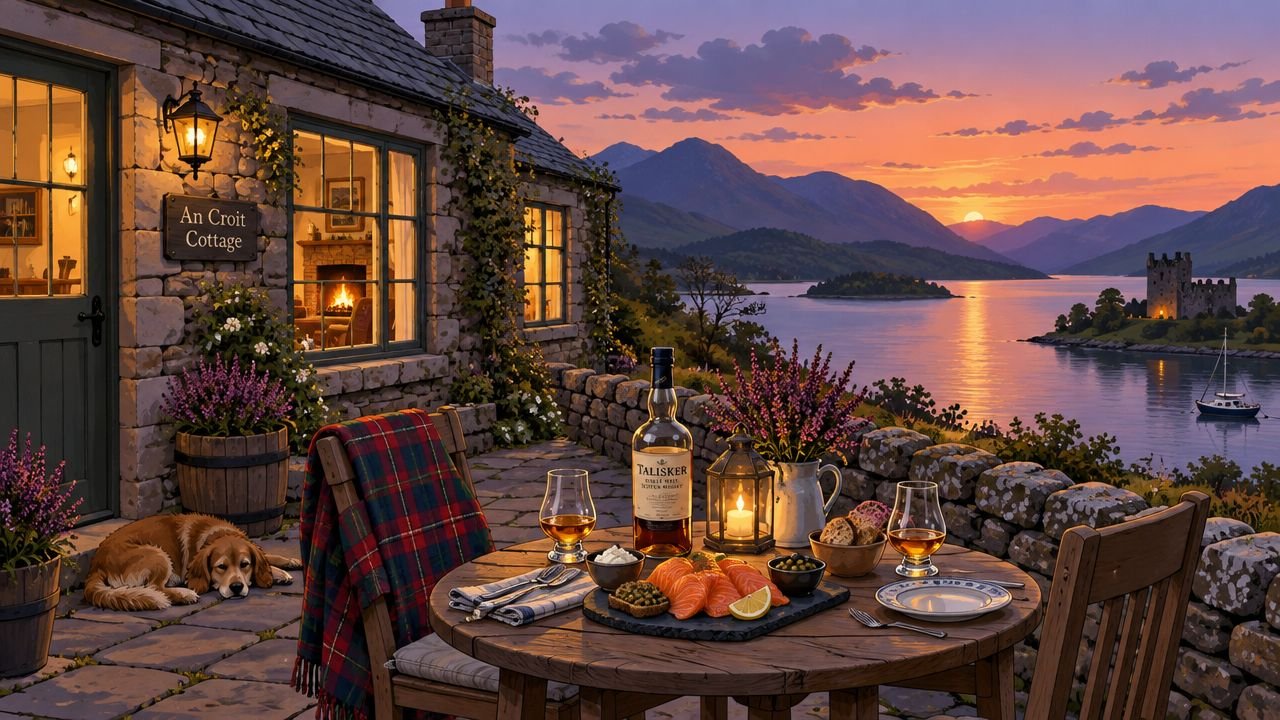
Choose bases, not just beds
A sensible accommodation plan might pair a comfortable Inverness start with coastal nights around Gairloch or Ullapool, a northern base near Durness or Thurso, and an eastern stop around Helmsdale or Golspie. The exact choice depends on your direction and interests, but the principle stays the same: avoid changing rooms to shave a small amount from the next day's drive.
Ask three questions before booking:
- Can I reach it comfortably before dark? Remote entrances and poor weather make late arrivals unpleasant.
- Does it support the day's activities? A base near a beach, trail or harbour gives you more options if conditions change.
- Can I eat nearby? In remote areas, a short walk to dinner is a major advantage.
Eat where the route feels local
The Highlands rewards travellers who plan meals as part of the experience. Look for seafood, local lamb, seasonal produce, traditional baking and cafés attached to village life rather than relying on petrol-station food for every meal. A long lunch in a coastal village can be more valuable than another rushed viewpoint.
Book ahead where possible, especially for small restaurants with limited seating. Ask hosts for current recommendations, because opening patterns can change and a place that looks perfect online may not serve food on the day you arrive.
Finish demanding drives with something restorative: a proper dinner, a dram by the fire where appropriate and an early night. That rhythm gives you the energy to walk the next morning instead of treating every attraction as a roadside photo opportunity.
Seasonal Considerations and Responsible Travel Practices
Summer is not automatically the best season for the NC500. Longer daylight can help, but popularity brings crowded viewpoints, busy roads, pressure on accommodation and greater strain on villages that were not designed for constant visitor traffic. A shoulder-season trip often feels more spacious and gives you a better chance of speaking with local hosts, eating without a frantic timetable and finding quiet stretches of coastline.
The economic case for visiting remains strong. Coverage of a later impact study reports that the route generated almost £100 million in economic benefit and supported around 1,335 to 1,355 jobs, as reported by STV's coverage of the NC500 impact. The same reporting also records widespread resident concerns about littering, dangerous driving and environmental strain. The route's success is therefore not a reason to ignore its pressures. It's a reason to travel with more care.
Make your visit lighter on the Highlands
- Travel outside the busiest periods: Choose spring or autumn if your priorities are calmer roads and a more connected local experience.
- Stay in established accommodation: Spend with local hotels, inns, cafés, shops and attractions rather than treating the region as a free overnight backdrop.
- Carry waste until you find a proper bin: Remote pull-ins cannot absorb careless littering, and overflowing bins damage the places people came to enjoy.
- Park legally and considerately: Never block passing places, gateways, access roads or viewpoints needed by other vehicles.
- Drive without ego: Speeding on a narrow road endangers residents, visitors and emergency services.
Overnight vehicle rules deserve particular attention. Some NC500-area car parks in Sutherland have carried a £10 nightly charge, a one-night limit and a 72-hour return ban, with enforcement penalties reaching £100, reduced to £50 if paid within 14 days, according to reported Highland Council parking rules. Check signs at the exact car park rather than relying on old forum advice.
The route has even appeared on Fodor's 2025 No List, a clear sign that overtourism now belongs in the planning conversation. You don't need to avoid the NC500. You need to avoid behaving as though the Highlands exists solely for your convenience.
Final Preparations and Essential Packing Checklist
The best NC500 trips feel spontaneous because the important details were handled before departure. Download offline maps for every region, save accommodation addresses and phone numbers, and keep a written route outline in case mobile coverage disappears. Your phone is useful, but it shouldn't be the only thing standing between you and the next overnight stop.
Start with the vehicle. Check tyres, lights, screen wash, oil, fuel range and breakdown cover before leaving Inverness. If you're hiring a car, inspect it carefully, understand the excess and confirm what to do if a warning light appears. Choose a vehicle you can place confidently on a narrow road, not the largest model available.
Pack for changing conditions
- Clothing layers: Bring a waterproof outer layer, warm mid-layer, comfortable walking trousers and spare socks. Highland weather can change quickly.
- Walking essentials: Pack sturdy footwear, a small daypack, water and a torch for short trails and darker approaches.
- Navigation backup: Save offline maps and accommodation details, then carry a paper route overview as a fallback.
- Vehicle supplies: Keep water, snacks, a phone power bank, a first-aid kit, a blanket and a high-visibility vest in the car.
- Camping equipment: If you're camping, use this expert camping gear checklist from LuminAID to audit shelter, lighting, cooking and emergency items before you leave.
Confirm the details people forget
Recheck every booking, including arrival windows, breakfast times, parking arrangements and cancellation terms. Confirm restaurant opening days before planning a remote dinner, and keep a backup option for food in the car. Download any attraction information you need while connected, especially if you're planning a detour to a cave, castle, lighthouse or walking route.
Leave someone at home with your broad itinerary and accommodation details. Tell them when you expect to check in, particularly if you're travelling beyond the main settlements. You don't need to turn the NC500 into an expedition, but remote travel deserves a more disciplined approach than an ordinary city break.
Finally, remove the pressure to complete every stop. Choose the scenery and experiences that matter most, then protect enough time to enjoy them. The strongest Scotland route NC500 itinerary is organised before departure and flexible once the road, weather and local advice offer something better.
BTOURS creates self-drive and multi-day itineraries across Scotland, combining scenic routes with handpicked accommodation, flexible pacing and practical planning support. Visit BTOURS to explore a lower-stress way to experience the NC500 and other carefully designed journeys across Britain.