The popular advice about Scotland in winter starts in the wrong place. Snowy mountains, woolly hats and dramatic photographs make good inspiration, but they don't tell you whether your hire car can reach the next hotel before dark, whether a single-track road will be passable, or whether a ferry will sail.
For a self-drive trip, winter disruption is usually a daylight, road and ferry problem before it becomes a snow problem. Scotland's weather changes sharply between exposed islands, maritime coasts, inland glens and high ground. Plan around those differences and winter becomes one of the country's most rewarding seasons. Ignore them and a beautiful itinerary can become an exhausting race against the light.
Why Winter in Scotland Is a Different Planning Problem
Snow is the least useful way to judge a Scottish winter route. The true test is whether the itinerary still works when daylight is short, roads are exposed and a ferry crossing fails. Around the winter solstice, the far north gets roughly an hour less usable daylight than the Central Belt. VisitScotland also reports that January to March and October to December generated £2.5 billion from around 7.6 million visits in 2023, as noted in Scotland's winter travel overview.
That visitor demand keeps many attractions and accommodation providers operating, but remote services still need checking before you commit. Winter is a proper travel season, not just a quiet version of summer.
Plan by disruption profile, then choose the month. A summer route can absorb a wrong turn, a long lunch or an unexpected viewpoint. A winter route cannot absorb all three when the sightseeing window closes early.
Use four planning layers:
- Daylight: set a realistic driving limit before dusk instead of copying a summer schedule.
- Regional exposure: separate sheltered cities and coasts from exposed islands, glens and high ground.
- Road type: treat motorways and main trunk roads differently from single-track roads, high routes and remote links.
- Ferry dependence: allow for a sailing to be cancelled without turning the rest of the holiday into a chain reaction.
The road itself often matters more than the weather forecast. A route can remain open yet become a poor choice after sunset when it narrows, climbs or depends on passing places. Frost, rain, wind and poor visibility can disrupt a day even when snow never settles.
The practical rule: put the most weather-sensitive leg at the centre of the decision, not at the end.
If ferries shape the trip, build flexibility around them. If you want scenery with more dependable access, choose cities, the east coast and lower-level routes. If snow is the priority, accept that mountain conditions will control the itinerary and keep the plan flexible. That trade-off is the foundation of a workable winter self-drive route.
Daylight and Temperature Across Scotland
The table below shows how usable daylight and typical temperatures vary by region around the solstice. Use it to set the shape of each driving day, not just to decide which coat to pack. Regional winter conditions are summarised in the Scotland winter climate and travel guide, but the practical differences come from latitude, exposure and elevation.
| Region | Dec daylight | Feb daylight | Typical day temperature | Winter risk notes |
|---|---|---|---|---|
| Edinburgh and the Central Belt | About 7 hours | Longer than December | Cool, often around low single figures | Frost, rain and darkness after a short sightseeing window |
| Inverness and inland Highlands | About 6.5 hours | Longer than December | Colder inland, with freezing conditions possible | Ice and snow become more likely away from the coast |
| West coast and islands | About 6 to 7 hours, depending on latitude | Longer than December | Maritime conditions, generally milder than upland areas | Wind, rain and ferry disruption |
| Northern Isles and far north | About 5.5 to 6 hours | Longer than December | Coastal cold, with colder exposed ground | Very short daylight, wind and exposed links |
| Cairngorms and higher ground | Varies by latitude | Longer than December | Frequently below coastal temperatures | Snow, ice, wind and rapid visibility changes |
The table is more useful than a national average. Edinburgh and the Central Belt can support a fuller sightseeing day, while the Northern Isles and far north require earlier starts and shorter driving ambitions. Higher ground can change the decision again, even when a nearby coastal town is wet rather than icy.
Use this rhythm in the darkest part of winter:
- Have breakfast after first light.
- Put the longest drive in the middle of the day.
- Schedule viewpoints and short walks before the afternoon fades.
- Reach your accommodation before dusk.
- Keep evening plans close to your base.
Set your day around usable light, not the time shown on the map. A scenic stop that looks close on paper can become an awkward return across exposed ground once visibility drops. Ferry-dependent areas also need a separate check, because a short daylight window and a disrupted sailing can remove the margin from an otherwise manageable day.
Scotland is cold enough to demand preparation, but conditions are not uniformly Arctic. Longer-term data puts Scotland's average winter temperature at 5.77°C, compared with a UK-wide winter average of 6.95°C, in the Met Office's snow and winter conditions guidance. That national comparison should not dictate your route. In Northern Scotland, typical mean daily minimum temperatures in January or February range from about 2°C on west-facing coasts and the Western and Northern Isles to below -1°C over higher ground, according to the Met Office regional climate profile for Northern Scotland.
The Royal Meteorological Society reports that daytime maximum temperatures over low ground in January and February average around 5°C to 7°C in Scotland. Mean annual temperatures at low altitude range from about 7°C in Shetland to 9°C on the Ayrshire and Dumfries and Galloway coasts, as outlined in its UK climate resource. Pack for cold, wet exposure, then choose each road day according to light, elevation and ferry reliability.
Best Self-Drive Routes and Destinations in Winter
The best winter route isn't automatically the most famous summer circuit. I rank routes by how easily they can absorb a late start, a weather diversion or a cancelled activity.
The A9 between Edinburgh and Inverness is my first choice for travellers who want a dependable mainland spine. It gives you access to Highland Perthshire, Pitlochry and the Cairngorms without making the entire trip dependent on a ferry or a remote single-track road. The scenery remains strong in poor weather, and towns along the route give you realistic options for fuel, food and an overnight stop.
The A96 between Aberdeen and Inverness also suits a lower-risk itinerary. It doesn't deliver the same concentrated drama as Glencoe or the high Cairngorms, but its lower-level character makes it useful when you want to preserve flexibility. Use it as a dependable east and north-east connection, then add shorter scenic excursions when the forecast supports them.
The A82 through Loch Lomond and Glencoe is more exposed in practical terms. It is magnificent, but weather can change quickly around the lochs and glens, and the road deserves a slower schedule than a map estimate suggests. I favour it when the journey itself is the main experience, not when you need to arrive at a fixed time.
The North Coast 500 can be attempted in winter, but it isn't a casual loop. Eastern coastal stretches, exposed routes and remote services need more attention than the headline name suggests. Break it into manageable legs and avoid treating the whole circuit as a checklist.
Skye and the Hebrides are for travellers who can flex. Skye has a road connection to the mainland, but weather can still affect exposed routes, accommodation access and activities. The Hebrides add ferry dependency, and winter timetables and storms can remove the sailing you planned around. Islands are superb when you can stay put for an extra night. They're poor choices for a tightly packed itinerary.
For a visual comparison of route character, use this illustrated Scottish road-trip route image alongside the map, but don't let a route line persuade you to overfill the day.
The Cairngorms deliver the strongest chance of a classic snow-country experience, especially on higher ground. That reward comes with the greatest need for weather awareness. Choose the east coast and lowlands for reliable scenery, Argyll for a softer coastal adventure, the Cairngorms for full winter drama and the islands only if your schedule can move with the ferries.
Driving Safely on Scottish Winter Roads
Scotland's winter road risk is built around the freeze-thaw cycle. An overnight frost can leave a main road apparently clear while shaded bends, bridges, forest sections and exposed ridges remain slippery. The safest part of the day is usually after the morning frost has eased and before temperatures fall again, but that window depends on the route and forecast.
Transport Scotland advises drivers to check route-specific weather and road conditions, with winter service operating from October to May and winter patrols active from 1 November to 31 March. Its guidance for driving in bad weather is the right starting point before any Highland departure.
Check the road in two passes
Check once the night before and again before leaving. Look at the Met Office warnings, Traffic Scotland updates and the relevant local authority information. For the A9, A82 and A87, check for closures, incidents, wind restrictions and delays. On a single-track road, look beyond the main carriageway. A blocked passing place or fallen branch can matter as much as a formal closure.
Keep your speed below what the surface allows, not what the posted limit permits. Increase following distance, brake early and avoid sudden steering, acceleration or braking on ice. If you meet another vehicle on a single-track road, use a passing place correctly and never stop in one unless the road situation makes it unavoidable.
Know when to turn around
If visibility deteriorates on an exposed summit such as the Lecht or Cairnwell, don't push on to protect an itinerary. Find a safe turnout, avoid stopping on a blind bend and turn back while you still have a clear route. Whiteout conditions remove depth perception and make roadside edges difficult to identify.
Keep a generous fuel margin because services are spread out, and download offline maps before entering areas with weak signal. Tell your accommodation when you're leaving and call if you're delayed. In poor visibility, use headlights as required by law and carry a torch, shovel and flask where you can reach them. Lendrum's Driving School winter readiness guidance is a useful refresher before departure.
Store this illustrated single-track road guide with your trip notes. The principle is straightforward: a cautious turnaround is a successful driving decision, not a failed day.
What to Pack and Prepare for a Winter Self-Drive
A winter self-drive kit should solve situations, not fill a suitcase. One traveller may spend the morning in a heated car, step out into rain at a loch and then climb into a cold viewpoint wind before lunch. Clothing that works only in one setting becomes a liability.
Wear a thermal base layer, a warm insulating middle layer and a waterproof outer shell. Choose a hat and gloves that let you handle the steering wheel, phone and gear selector. Waterproof footwear matters more than fashionable footwear once a path turns saturated. Keep the shell and gloves in the passenger area, not buried under luggage.
Your car needs attention before the first scenic stop. Check antifreeze, battery condition and fluid levels. Use winter screenwash rated to at least -20°C, fit properly rated tyres and understand the distinction between summer, all-season and winter tyres in the UK. Carry a blanket, torch, jump leads, shovel, grit or cat litter for traction, spare screenwash and a thermos in the boot.
Pack for the delay you hope won't happen. A flask, water, medication and food turn a frustrating hold-up into a manageable one.
Prepare the people and the paperwork
Check DVLA vehicle tax, insurance terms and breakdown cover before travelling. If you're bringing a car from outside the UK, verify that the policy covers winter driving in the countries you will enter and that breakdown assistance reaches the full geographic area of the itinerary. Download offline maps for remote Highland roads, where mobile signal can disappear without warning.
Families need more than miniature versions of adult equipment. Keep children warm during roadside stops, bring spare gloves and allow for slower loading and toilet breaks. Pets need a secure travel setup, water and a warm, dry place at the destination.
Camera equipment also needs a plan. Cold batteries drain quickly, while moving a camera from damp air into a heated room can create condensation. Use a protective bag during temperature changes and keep spare batteries inside a warm layer.
Before setting off, save your vehicle and fuel notes with this illustrated UK fuel compatibility reference. Preparation is less glamorous than a viewpoint, but it protects every viewpoint that follows.
Choosing the Right Month for Your Winter Trip
There isn't one best winter month. There is a best month for the experience you want.
November suits travellers who value quieter roads and value over deep winter atmosphere. Daylight is already limited, and remote businesses may operate shorter opening hours, so it works better for cities, east-coast routes and flexible coastal bases than for an ambitious island circuit.
December brings festive energy, Christmas markets and Hogmanay planning, but the short days impose a hard limit on sightseeing. Edinburgh and Glasgow make sense if you want evening atmosphere, restaurants and indoor attractions. A Highlands route can work, but keep the daily mileage modest and avoid building the holiday around one exposed crossing.
January is the quietest choice for travellers seeking stillness and mountain conditions. It also brings deeper cold and stronger snow prospects in the Cairngorms. Choose it for a base-based trip, winter sport or slow scenes, not for a rigid tour with consecutive remote check-ins.
February is my preferred compromise for many self-drivers. Daylight is improving, winter sports remain available at Glenshee, the Nevis Range and Cairngorm, and Burns Night adds seasonal character. Wildlife activity begins to feel more noticeable, while the country still has a distinctly winter mood.
Snow isn't guaranteed in any month at low level. VisitScotland says winter temperatures typically average about 2°C to 6°C, while low-level lying snow averages around three days per month across Scotland and city snow often melts within a day or two, as described in its Scotland travel FAQs. The practical question is whether your selected roads and ferries remain usable, not whether every field turns white.
Ferries need special treatment in every month. CalMac and NorthLink operate winter timetables with fewer sailing options, and storms can cause cancellations. Compare the actual timetable for your dates, avoid making an island arrival the same day as an important departure, and keep a buffer day where the crossing determines the whole route.
Choose November for value and quiet, December for festivities, January for solitude and snow sport, and February for improving light with a strong winter feel. Families should check school holidays and half-term periods before assuming that a quiet month will remain quiet or that accommodation will be easy to find.
Winter Accommodation and Seasonal Experiences
A winter-ready room is more than a picturesque stone exterior. Before booking, ask whether the heating is reliable, whether hot water is available throughout the day and whether the final approach road remains usable in ice or snow. A remote cottage can be wonderful when you arrive in daylight with supplies. It can be a poor choice if the last stretch is steep, ungritted and far from food.
Highland lodges with backup heating are sensible for a slow, scenery-led stay. Historic properties offer atmosphere, but check their heating and access roads carefully. B&Bs can be welcoming and practical, although you should confirm winter opening hours rather than relying on summer listings.
Match the base to the experience
Remote bothies and farm cottages work when you want privacy and can carry food, accept weather delays and enjoy the property itself. Inns with log fires suit a route with short drives and sociable evenings. Hotels with drying rooms are valuable after coastal walks, especially when the forecast gives you rain rather than snow.
Use fixed bases for coastal wildlife watching, dark-sky viewing in Galloway and the Cairngorms, whisky distillery tours and low-light photography. A fixed base lets you choose the best clear-weather window instead of moving every morning.
Before paying, ask four direct questions:
- Heating: Is it included, timed or metered?
- Access: What are the last-mile road conditions in frost or snow?
- Staffing: Is someone available on site throughout the stay?
- Flexibility: What happens if a storm closes the road or cancels the ferry?
Late check-in flexibility matters more in winter than a decorative feature. Ask whether the host can accept an arrival after the planned time, and keep the phone number available offline. Book the place that remains comfortable when the weather forces you to spend an afternoon indoors.
Putting Your Winter Scotland Trip Together
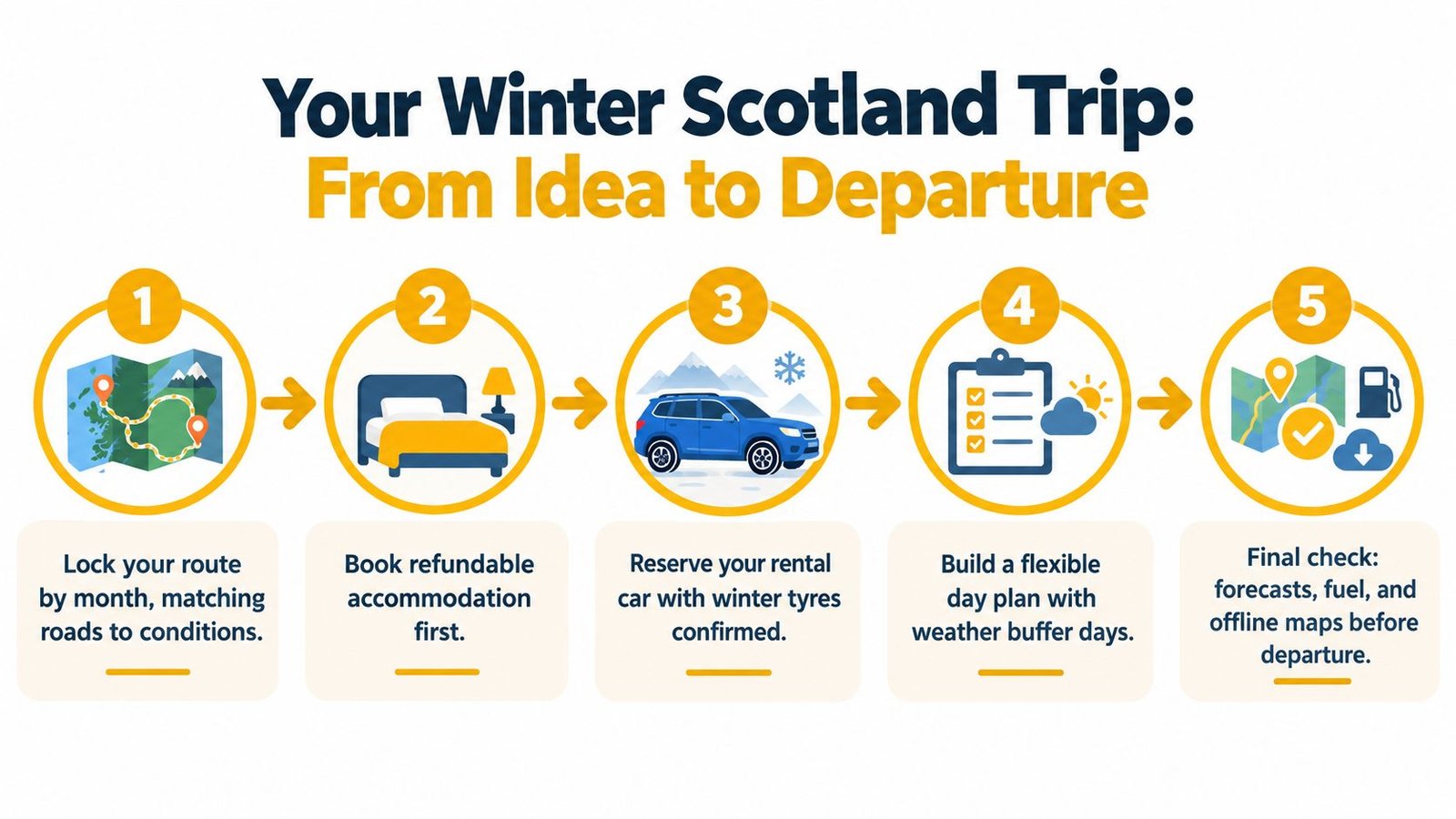
Build the trip in a fixed sequence. Start with the route, match it to the month, then protect the parts that weather can disrupt.
Five decisions before you pay
- Lock the route by month. Use the A9, A96, cities and lower-level routes for resilience. Choose Glencoe, the Cairngorms or remote islands only when their exposure suits your appetite for change.
- Book accommodation with room to move. Favour refundable rates where the route depends on a ferry, high pass or remote access road. Advance fares may suit a stable mainland itinerary, but they shouldn't dictate a risky schedule.
- Reserve ferry space early. Compare CalMac and NorthLink timetables, check the winter sailing pattern and avoid putting a critical onward connection immediately after an island arrival.
- Prepare the vehicle. Confirm tyre suitability, antifreeze, screenwash, battery condition, breakdown cover, fuel stops and offline mapping before collection or departure.
- Add experiences last. Choose distilleries, walks, viewpoints, wildlife trips and winter sport around the route's safe driving window, not the other way round.
Keep at least one adaptable day wherever a ferry or exposed road controls the itinerary. If a route closes, swap a mountain day for a city, distillery or coastal base rather than waiting beside an impassable road. If an island sailing fails, use the mainland as a substitute and move the crossing later, provided your accommodation terms allow it.
Your final review should happen close to departure, when the short-range forecast is useful. Check warnings, road conditions, ferry updates, fuel and accommodation messages before leaving, then check again in the morning. The best winter itineraries preserve options until the forecast becomes clear.
The trip hinges on one decision: match the route to the month. After that, commit to flexibility everywhere else. BTOURS offers curated self-drive itineraries through Scotland, including routes linking Glasgow, Glencoe, Fort William, Fort Augustus, Inverness, the Cairngorms, Pitlochry and Edinburgh, with winter departures available. Use BTOURS if you want a planned route with selected accommodation and support while keeping the freedom of travelling by car.