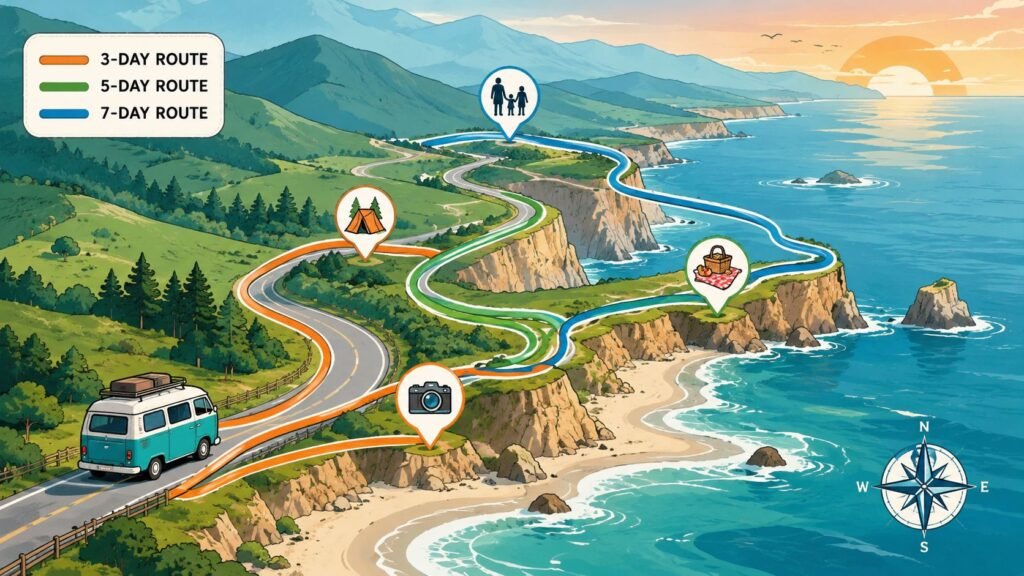
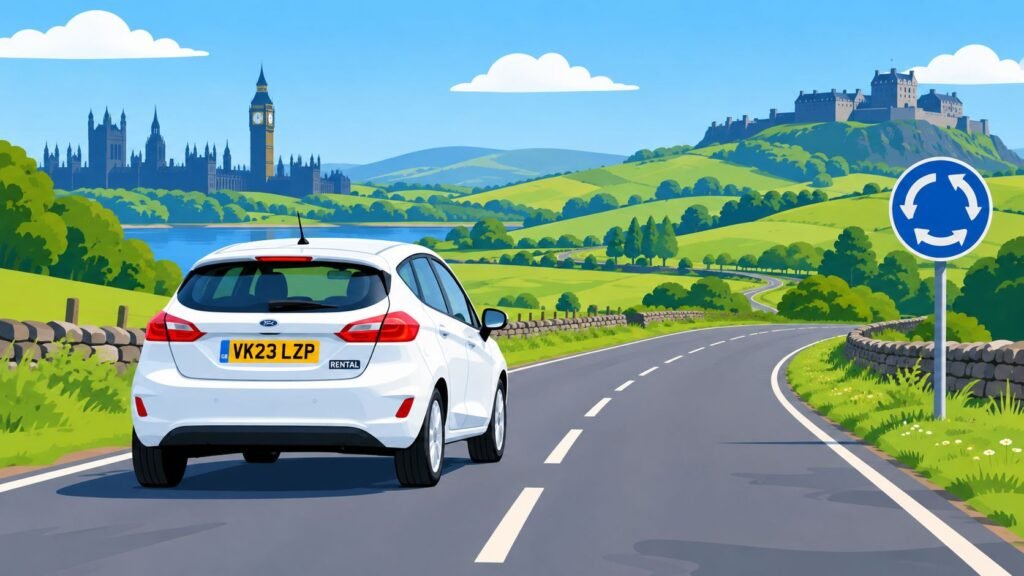
You've just landed at Heathrow, collected a rental car, and placed your luggage in the boot. The sat-nav says the countryside is only a short drive away, but the first roundabout arrives quickly, traffic is flowing on the opposite side of the road, and the road signs seem designed for people who already know the route. Your holiday is about to become either a brilliant, flexible adventure or an expensive lesson in rushed decisions.
Driving in the UK works exceptionally well when you use a car for the places that need one. It works poorly when you take a rental car into a congested city because it feels convenient. The right plan starts with your licence, vehicle, insurance and road confidence, then moves into the costs that many itineraries overlook, including congestion zones, parking, delays and unsuitable city driving. A scenic coastal loop or Highland route can reward every mile. A central London transfer often won't.
Planning Your First UK Self-Drive Adventure
The first decision is not which model of car to hire. It's whether each part of your itinerary benefits from having a car outside your accommodation. An international visitor arriving at Heathrow may want to drive straight towards the Cotswolds, but taking the Underground or a private transfer into central London first can be calmer and more economical. Collecting the car after the city portion removes urban navigation, parking searches and avoidable zone charges from the opening day.
A car becomes more valuable as you leave major rail corridors. It gives you access to village pubs, remote viewpoints, small harbours and countryside hotels that public transport doesn't always serve directly. It also lets you change plans when weather closes a viewpoint or a local festival makes one village unexpectedly busy. That freedom is the central appeal of a self-drive holiday, but it only pays off when the route has enough rural or regional travel to justify the vehicle.
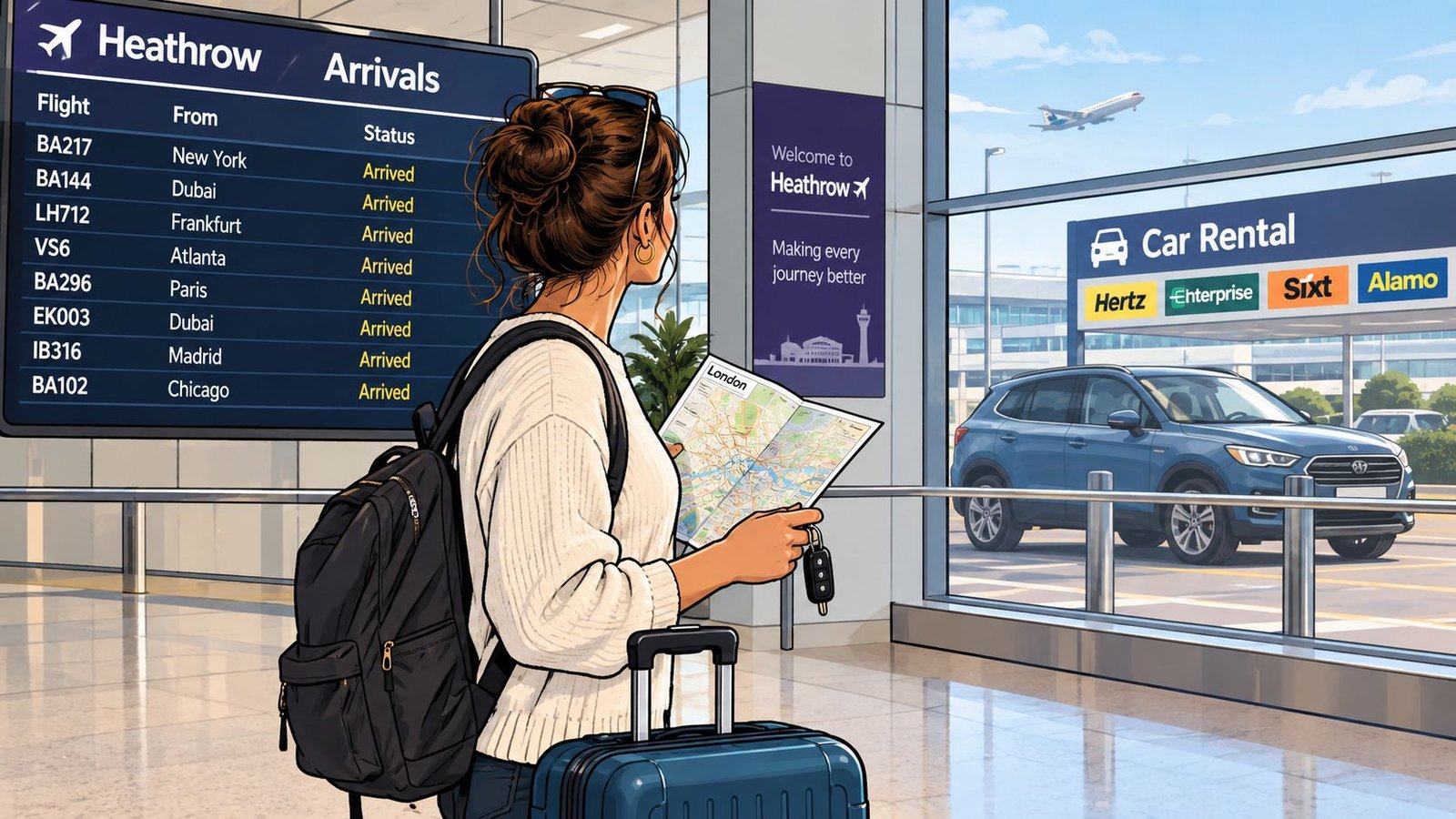
Before leaving the rental desk, answer four questions:
- Can you drive legally? Visitors with a full licence from a designated country can generally drive in Great Britain for up to 12 months from their last entry, under the legislation governing visitors' driving permits.
- Which side will you use? Traffic drives on the left, and the driver sits on the right in most UK rental cars.
- What will the route cost? London has a Congestion Charge, cities can operate clean-air zones, and parking can change the economics of a short urban stay.
- Does the car earn its place? A vehicle is useful for the Cotswolds, Lake District, Welsh mountains and Scottish Highlands. It's often a burden in central London, Edinburgh or other dense city centres.
Planner's rule: Start the car portion where the countryside starts, not automatically where the plane lands.
The same logic applies to Ireland. A coastal route such as the Ring of Kerry itinerary rewards flexible stops, while a city-centre stay may be easier before collecting the vehicle. Build the itinerary around experiences, not the assumption that every mile must be driven.
Licence Requirements and Car Rental Essentials
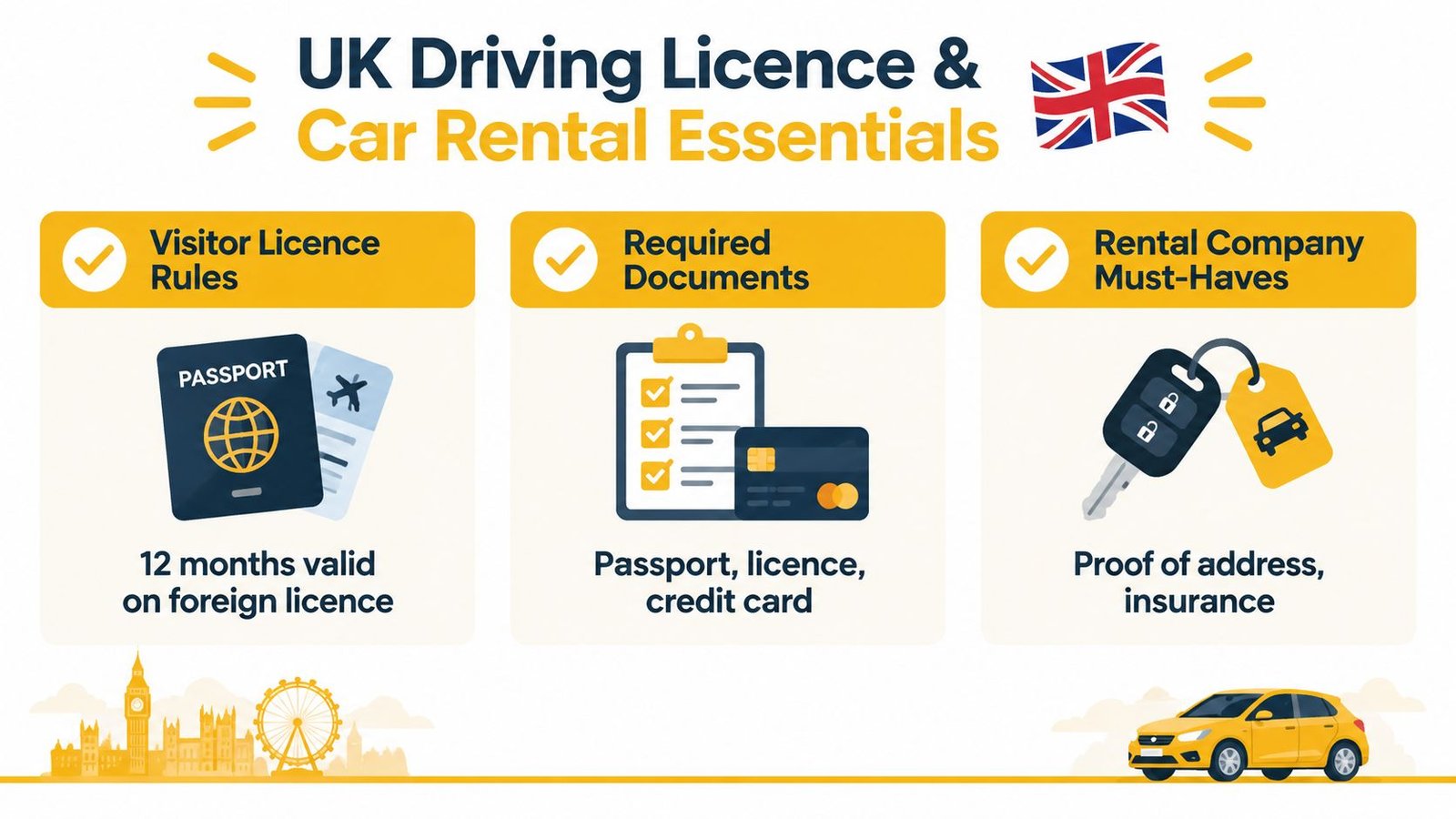
Sort the paperwork before you fly. A valid full driving licence is the foundation, and the 12-month visitor rule applies to eligible foreign licences from the visitor's last entry into the UK. If your licence isn't easily understood in English or isn't issued by a designated country, ask the issuing authority whether you need an International Driving Permit. Treat the permit as a supporting document, not a replacement for your original licence.
Rental companies commonly ask for your passport, driving licence and a payment card in the main driver's name. Some may request proof of address, additional identification or evidence of return travel, so check the exact terms of the branch where you'll collect the vehicle. Requirements can differ between countries, suppliers and vehicle categories.
Choose the car you can actually drive
Book an automatic if you're uncomfortable changing gear with your left hand or managing a clutch while adapting to left-side traffic. Manual cars are widely available, but a lower rental price isn't a saving if every roundabout becomes stressful. For rural touring, prioritise a compact vehicle. Narrow lanes, village car parks and older hotel entrances punish oversized cars.
At the counter, ask the agent to demonstrate:
- Fuel policy: Confirm whether the vehicle must return full, how the fuel gauge is recorded and which fuel type it uses.
- Excess and waivers: Find the excess amount, exclusions, tyre and glass cover, roadside assistance terms and any restrictions on ferries or cross-border travel.
- Additional drivers: Add every person who'll drive before departure. An unlisted driver can create serious insurance problems.
- Vehicle condition: Photograph every panel, wheel, windscreen and interior mark, then make sure the rental record includes existing damage.
For a second practical checklist, these car hire tips for business travellers are useful because business and leisure renters face many of the same documentation, deposit and vehicle-inspection issues.
Don't rush away from the depot. Adjust the mirrors, learn the lights and wipers, locate the reverse gear, set the sat-nav and practise moving off in a quiet area. Keep your licence, rental agreement, insurance details and emergency contact information accessible, rather than buried in a suitcase.
Mastering Left-Hand Driving and UK Road Rules
Left-hand driving becomes manageable when you create a repeatable routine. At every turn, remind yourself that the driver should finish on the left side of the road. At roundabouts, give way to traffic approaching from your right, follow the marked lane arrows and signal as you leave. Don't cut across lanes because the exit looks close. Stay in your lane unless signs or markings tell you to move.
On narrow country lanes, slow down before bends instead of braking sharply halfway through them. Use passing places, don't park in them, and expect tractors, cyclists, walkers and oncoming vehicles beyond blind corners. Hedge-lined lanes often feel wider than they are, so keep your nearside mirror away from walls and vegetation. If another driver stops to let you through, acknowledge them, but never squeeze into a gap that leaves no safe escape.
Know the limits that apply to your vehicle
The default limits for cars are 30 mph on roads with street lighting in England, Scotland and Northern Ireland, 20 mph in Wales, 60 mph on single carriageways, and 70 mph on dual carriageways and motorways, as set out in the UK Government speed-limit guidance. Signs can impose lower limits, and local restrictions always override the national default.
| Road type | Cars | Vans | Towing vehicles |
|---|---|---|---|
| Single carriageway | 60 mph | 50 mph | 50 mph |
| Dual carriageway | 70 mph | 60 mph | 60 mph |
| Motorway | 70 mph | 60 mph | 60 mph |
The vehicle distinction matters. Cars and motorcycles may use the higher single-carriageway limit, while vans and car-derived vans are limited to 50 mph, and towing vehicles have lower limits on single carriageways. Check the rental classification if you're hiring a larger van-based vehicle or towing equipment. A useful companion reference for key UK driving rules can help you review signs, markings and common legal mistakes before collection.
Treat stopping distances as a starting point
The Highway Code's braking-distance table uses dry-road assumptions. It isn't a safe margin for every real journey. Wet surfaces, worn tyres, heavy luggage, poor visibility, steep gradients and higher speeds all increase the distance needed to stop.
Maintain a larger gap than you think you need, lift off early before hazards and reduce speed before bends, junctions and queues. Rural A-roads and motorway approaches deserve particular care because a small delay in seeing a hazard or reacting to it can consume a surprising amount of road. Posted limits are permissions, not targets.
Drink-driving rules also differ within Great Britain. England, Wales and Northern Ireland use limits of 80 mg of alcohol per 100 ml of blood, 35 micrograms per 100 ml of breath, and 107 mg per 100 ml of urine, while Scotland uses 50 mg, 22 micrograms and 67 mg respectively, according to the official drink-drive limits. The practical recommendation is simple: don't drink at all if you're driving.
Understanding Congestion Charges and Hidden Driving Costs
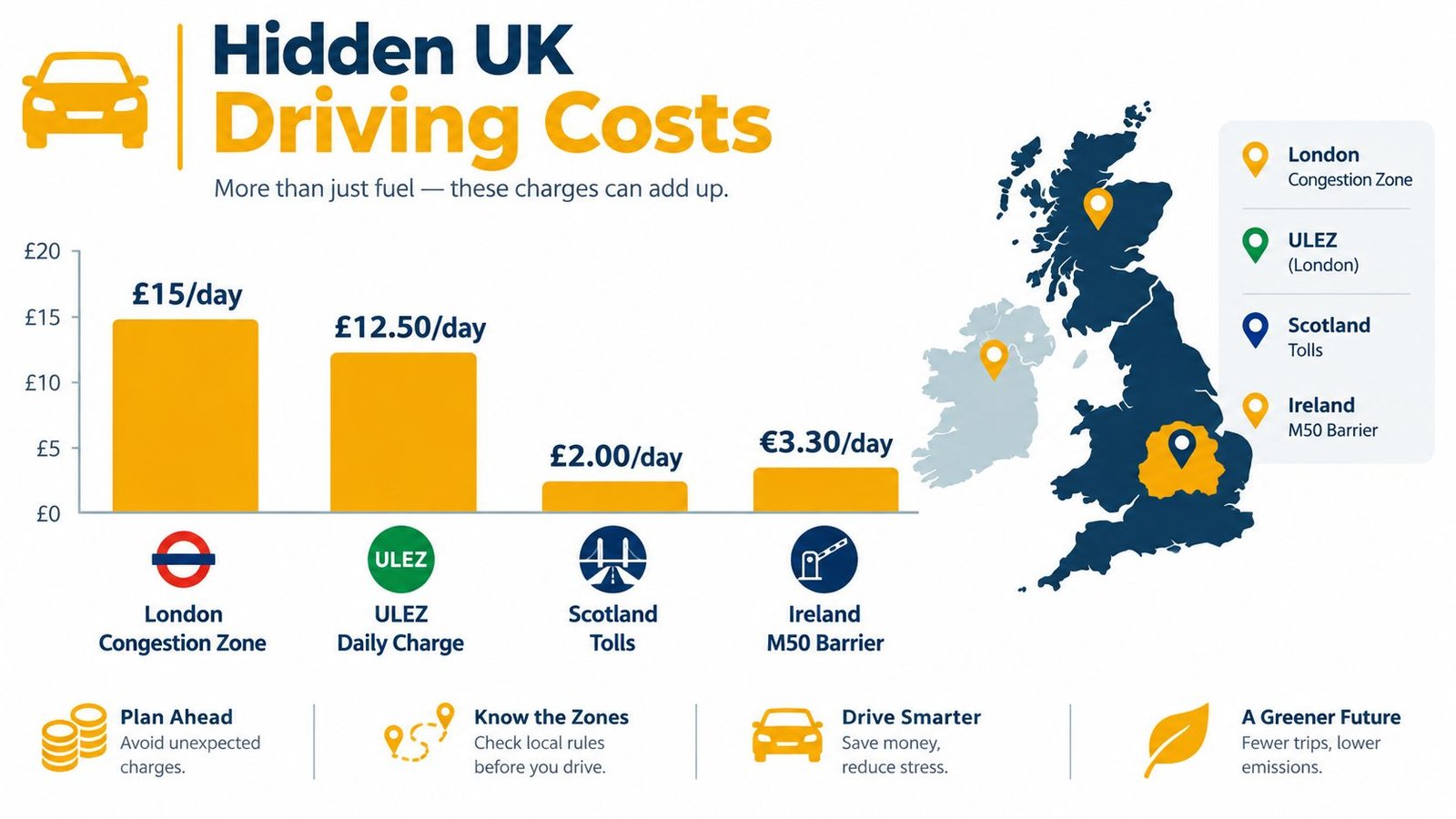
The rental rate is only the beginning of the driving budget. Fuel, parking, tolls, bridge crossings, insurance options and city charges can transform an apparently cheap car into the most expensive part of a short urban stay. Before confirming a route, price the car days separately from the city days.
London is the clearest example. The Transport for London Congestion Charge is £15 per day, rising to £17.50 when paid by midnight of the third day after travel. Residents and exemptions follow separate rules, and the old full electric-vehicle discount has ended. Some eligible electric vehicles may still receive a partial discount, so check the current TfL conditions rather than assuming an electric rental avoids every charge.
Build the route around the charge
If you're staying in central London, leave the car at the airport depot or an outer-area hotel and use public transport. Don't pay for a rental vehicle that sits outside your accommodation while you pay for fuel, parking and city access. If you must drive into the zone, confirm the vehicle's registration, understand the payment deadline and keep the confirmation.
London's Ultra Low Emission Zone has its own requirements and charge structure. Other cities, including Birmingham and Bristol, operate clean-air measures that may affect non-compliant vehicles. Check the official zone map for each destination, then ask the rental company whether its fleet is registered as compliant. Never assume that a hybrid or electric badge automatically removes every local charge.
Parking creates another hidden decision. A hotel with no private parking can make a rural village stop awkward, while a park-and-ride site may be the sensible choice for a cathedral city or major attraction. Tolls and bridge crossings should be checked route by route, particularly when a sat-nav offers a “faster” alternative that saves time but adds a charge.
Great Britain's motor traffic reached 342.6 billion vehicle miles, up 1.9% from the previous year and 1.2% above the pre-pandemic 2019 level, according to the Department for Transport road-traffic statistics. That recovery supports the popularity of touring, but it also means congestion and delay belong in your itinerary planning. Add time for busy local roads instead of treating the sat-nav's fastest estimate as a promise.
When to Drive and When to Take the Train
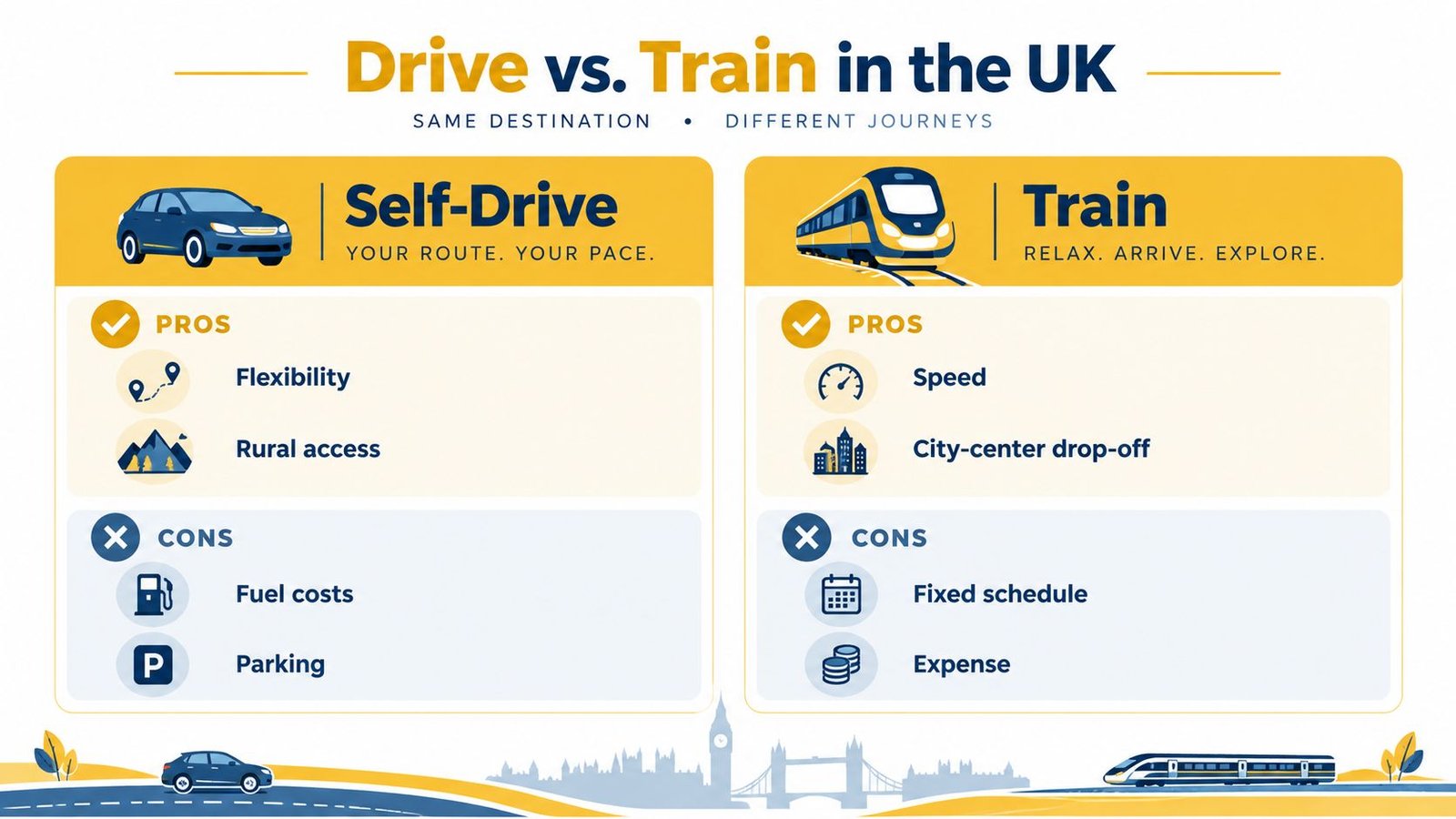
A hybrid itinerary usually beats a car-only itinerary. Drive where the scenery is the attraction and the stops are scattered. Take the train when you're moving between major cities, especially if the journey ends near the centre and parking would consume time and money.
London to Edinburgh is a strong example. Rail takes you between city centres while you read, work or watch the scenery. Driving gives you access to places between the two, but the value only appears if you've planned worthwhile stops such as historic towns, coastlines or countryside stays. A direct city transfer rarely needs a rental car.
Match transport to the landscape
The Cotswolds are excellent for self-drive touring because villages, gardens, viewpoints and country inns are spread across a broad area. Use one base and make loops rather than changing hotels every night. Avoid driving into the busiest village at peak visitor times, and walk the final part where parking is limited.
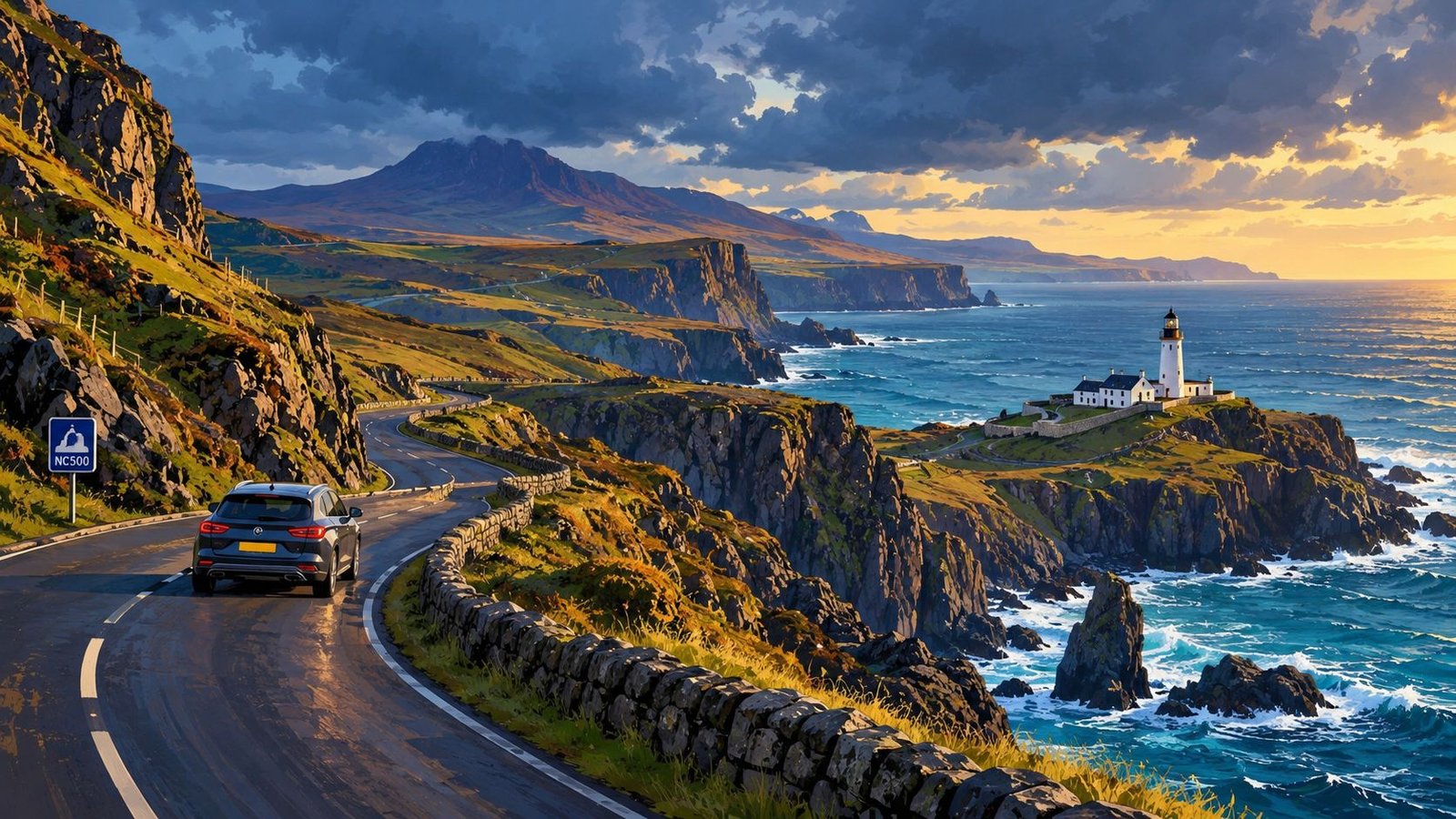
The North Coast 500 rewards a car, but it punishes rushed pacing. Narrow sections, passing places and seasonal traffic can turn a short-looking leg into a full day. Book accommodation in sequence, allow time for photo stops and don't treat the route as a race.
Coastal Wales sits between the two. A car opens access to beaches, castles, mountain roads and small communities, but rail or a guided transfer can work better for a point-to-point journey that includes Cardiff, Swansea or another major town. The same principle applies in Ireland. The Wild Atlantic Way is a driving experience, while Dublin exploration is usually easier without a rental car.
England's road network remains exposed to delay. Official travel-time measures for local A-roads show why distance alone isn't a reliable planning tool. A road trip can look compact on a map yet feel exhausting when queues, junctions and slower rural sections combine.
Choose the transport that protects the experience. A train is often the better sightseeing tool between cities. A car is the better key to remote landscapes.
For London, a city break followed by a rental pickup outside the centre is usually the cleanest arrangement. A visual reminder of the city portion can be found in this London travel image. Keep the urban days car-free, then start driving once flexibility begins to matter.
Curated Self-Drive Itineraries Across Britain and Ireland
The best routes have a clear rhythm. You drive a manageable stretch, stop somewhere that deserves time, eat locally, and sleep in a place that makes the next morning part of the journey. Trying to collect every landmark produces a motorway holiday with a scenic backdrop.
Scotland's northern loop
Give the North Coast 500 enough days to breathe. Base the route around Inverness, the east coast, the far north, the north-west and the western Highlands, then add detours for beaches, castles, sea lochs and small distilleries. The route's appeal lies in the transitions, not just in reaching a named viewpoint.
A North Coast 500 road-trip itinerary works best when accommodation is booked ahead and daily driving remains realistic. Fuel up before remote stretches, yield patiently on single-track roads and keep a flexible weather plan. A ruined castle, quiet beach or village café can be a better stop than a crowded “must-see” viewpoint.
The route's atmosphere comes from slow travel, changing light and the feeling that the road itself is part of the destination.
Britain and Ireland routes worth building around
- The Cotswolds: Use several nights around a central base, then explore Bibury, Broadway, Stow-on-the-Wold, gardens and less-visited lanes. Early starts help with narrow village roads.
- Lake District: Allow time for lakeside walks, historic houses and weather changes. Choose accommodation with parking and avoid packing too many valleys into one day.
- Snowdonia and North Wales: Combine mountain scenery with castles and coast. A flexible itinerary works better than trying to predict every summit condition.
- Yorkshire Dales: Build a loop through stone villages, market towns, abbeys and long valley roads. Leave room for walks because the best discoveries often begin after parking.
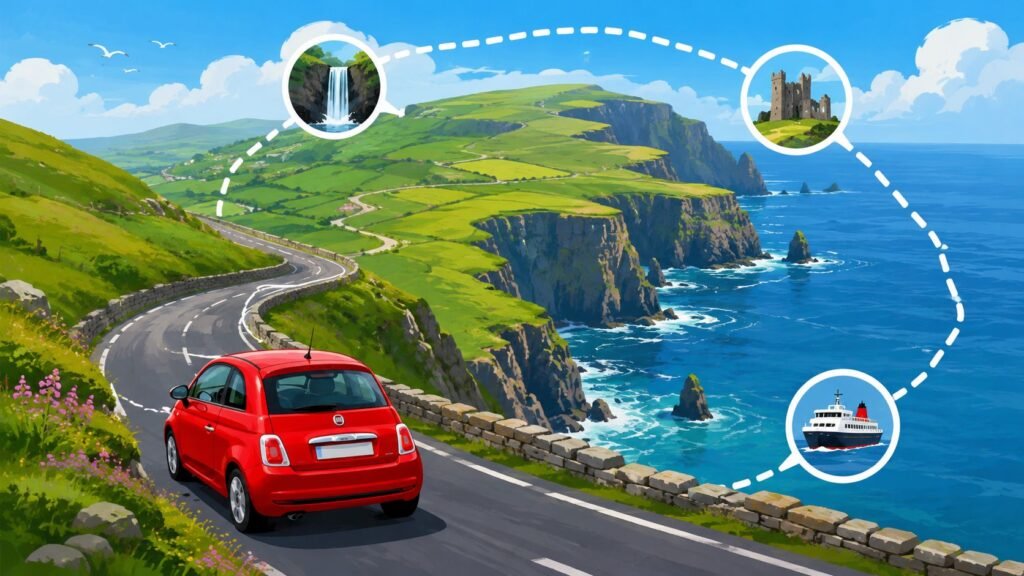
- Wild Atlantic Way: Give each coastal region its own character. Cliffs, beaches, islands and seafood towns deserve pauses, not just photographs through a windscreen.
BTOURS offers curated self-drive itineraries with vehicle-hire, accommodation and route-planning support across destinations including England, Scotland, Wales and Ireland. That approach suits travellers who want independent driving without organising every hotel, transfer and scenic detour themselves.
Final Tips for a Safe and Memorable Road Trip
Download offline maps before leaving the airport, save emergency details, and confirm exactly what your rental insurance covers. Spend the first few hours adapting to left-hand traffic, especially at roundabouts and on busy dual carriageways. Take proper breaks on long rural legs, keep the fuel tank topped up before remote stretches, and carry layers for rapidly changing British weather.
If you're visiting islands, reserve ferries early and check the rental company's rules for taking the vehicle across. In a breakdown or collision, move to safety, contact the rental provider and record the scene without admitting fault at the roadside. Families travelling with dogs should also prepare for long bends and winding roads, using practical motion sickness help for dogs before the journey begins.
The strongest plan is simple: use trains for dense city connections, transfers when they remove friction, and a car when the road leads to the experience you came to find.
BTOURS creates curated self-drive holidays, multi-day road trips and city breaks across England, Scotland, Wales and Ireland, combining route planning with selected accommodation and practical travel support. Visit BTOURS to find a journey that uses the car where it adds freedom, not where it adds unnecessary cost.