
For most independent travellers with limited time, a three-day Donegal road trip covering the southern coast, Glenveagh National Park and the Fanad peninsula give the best mix of cliffs, castles and coastal drives without feeling rushed. Travellers with more time should stretch it to five days and add Inishowen and Malin Head. Expect single-track roads and modest driving distances that still take longer than any map suggests.
Planning a Donegal coastal route: peninsulas, not one big loop
Donegal doesn’t work like a ring road. It’s a scatter of long, narrow peninsulas jutting into the Atlantic, which means most of your best driving days are out-and-back rather than a tidy circle. Try to treat it as one continuous loop and you’ll spend half your holiday backtracking on roads you’ve already seen, wondering why the satnav keeps recalculating.
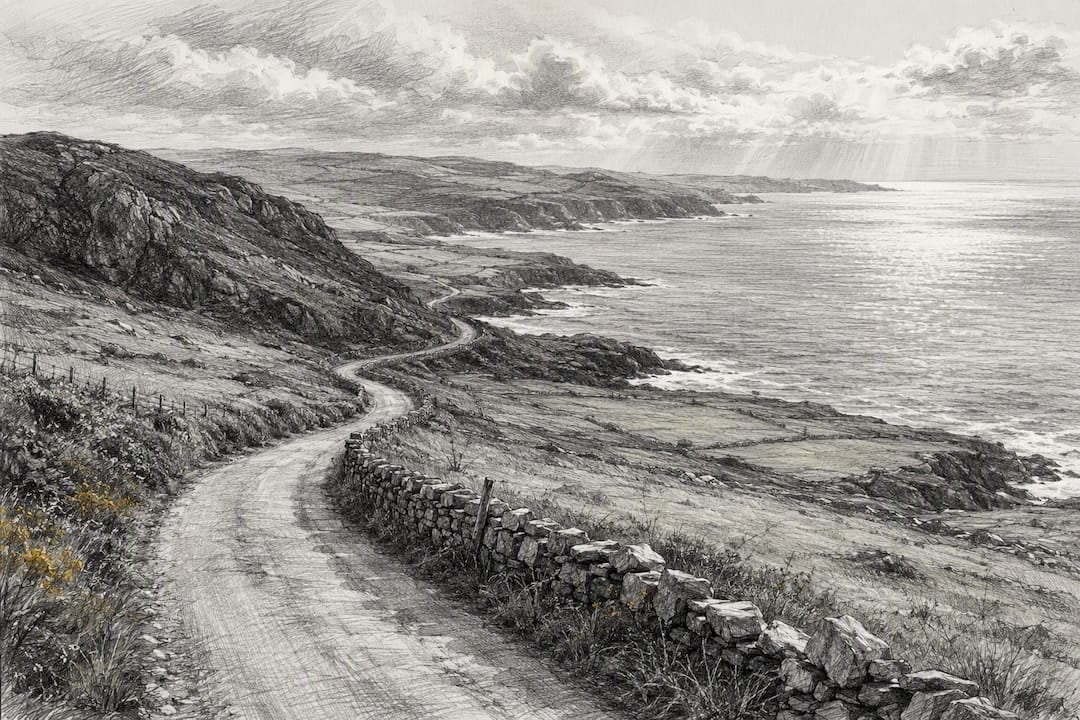
The county holds the longest stretch of the Wild Atlantic Way of any county on the route, and it’s also the least driven section of the whole thing. That’s good news if you want quiet roads and empty viewpoints, but it also means fewer overtaking opportunities and longer gaps between fuel stations than you’d get further south.
A route that Google Maps says takes 90 minutes will realistically take two hours once you factor in single-track sections, sheep, photo stops and the inevitable pause to let a tractor pass.
On base towns, you have two real choices:
- Single base, day trips out: Donegal Town or Letterkenny work well as central hubs, cutting down on packing and unpacking but adding driving time to reach the northern peninsulas.
- Moving accommodation: basing in Ardara or Glenties for the south, then Rathmullan or Buncrana for the north, cuts daily driving but means repacking each night.
For a three-day trip, a single base rarely works. For five days, splitting into two bases (south and north) tends to feel far more relaxed.
Compact Donegal itinerary: three days from Ardara to Inishowen
This is the itinerary to follow if you want the postcard version of County Donegal without burning every daylight hour behind the wheel. It hits the three names most people have actually heard of, Slieve League, Glenveagh and Fanad Lighthouse, plus a flexible third day depending on how much appetite you have left.
Pro Tip: Fill the tank whenever it drops below half, not when the light comes on. Rural filling stations in Donegal keep short hours, and some close entirely on Sundays.
Day 1: The southern cliffs. Start early from Ardara or Donegal Town and head for Slieve League. Park at the Bunglas viewing point (there’s a fee car park lower down and a free one further up if you don’t mind a longer walk) and allow at least 90 minutes for the short walk to the main viewpoint, longer if you fancy pushing on toward One Man’s Pass, which is exposed and not for anyone uneasy with heights or heavy wind. From there, drive to Malin Beg for its horseshoe beach and the old signal tower, then loop through Glencolmcille, worth an hour for the folk village, before tackling the Glengesh Pass on your way back. The pass is a serious hairpin climb with sheer drops and no barriers in places, so this is one to drive in daylight and good weather only. Budget the full day; this loop alone runs to 90 kilometres of slow, scenic driving.
Day 2: Glenveagh to Fanad. Morning at Glenveagh National Park, one of the attractions Discover Ireland flags as essential viewing in Donegal. Park at the visitor centre, take the shuttle bus (or the 3.5-kilometre walk) to Glenveagh Castle, and allow two to three hours if you want the castle tour and gardens rather than a quick look. Grab lunch in Church Hill or push on toward Milford. Afternoon is the Fanad peninsula: aim to reach Fanad Lighthouse in the late afternoon when the light softens the cliffs and the tour buses have mostly gone home. The lighthouse tour itself runs around 45 minutes and is worth booking ahead in July and August.
Day 3: Inishowen or a relaxed return. If you’re flying from Dublin or heading south again, a shortened loop around the lower Inishowen peninsula, taking in Grianán of Aileach for its Iron Age stone fort and panoramic views, gives you a taste of the peninsula without committing a full day. If you have the time, push further and treat Inishowen as its own half-day circuit before turning back toward Letterkenny for onward travel.
Parking across all three days is mostly free and informal, gravel laybys and small car parks rather than multi-storey structures, but spaces near Slieve League and Fanad Lighthouse fill by mid-morning in peak season. None of the walks described here need serious fitness, though Slieve League’s upper paths are uneven and not suitable for pushchairs or wheelchairs.
Extended Donegal itinerary: five relaxed days with time to linger
Stretch the same route to five days and the whole trip changes character. You stop treating each stop as a box to tick and start actually experiencing them, which is really the point of a self-drive holiday rather than a coach tour.
Day 1: Slieve League and Glencolmcille, unhurried. Same cliffs, same villages, but give yourself the full day. Walk further along the Pilgrim’s Path if conditions allow, spend a proper hour in Glencolmcille’s folk village rather than rushing through, and stay overnight in Ardara or Carrick rather than driving back.
Day 2: Glengesh Pass and a beach afternoon. Drive the pass in the morning light, then spend the afternoon at one of the quieter southern beaches, Maghera or Trá na Rossann, both good for a proper walk rather than a five-minute photo stop.
Day 3: Glenveagh, properly. This is where the extra time pays off. Book a longer guided walk if the visitor centre is running one, explore the castle gardens fully, and consider the Derrylahan Nature Trail for wildlife spotting; red deer are commonly seen at dawn and dusk. If the weather turns, the visitor centre exhibition and tearooms are a solid wet-weather fallback.
Day 4: Fanad and Rosguill loops. Drive the full Fanad peninsula loop rather than a there-and-back to the lighthouse, taking in Portsalon Beach and Ballymastocker Bay, regularly ranked among the country’s most attractive beaches. In the afternoon, cross to the Rosguill peninsula and drive the Atlantic Drive, a compact 15 kilometre loop that punches well above its length for coastal views.
Day 5: Inishowen and Malin Head. Give Inishowen the full day it deserves. Grianán of Aileach in the morning, then push north to Malin Head, Ireland’s most northerly point, for a windswept walk around Banba’s Crown. If time allows, the Inch Wildfowl Reserve near Burnfoot is worth a detour for birdwatchers, particularly in autumn and winter when whooper swans arrive from Iceland.
For anyone wanting a genuine rest day rather than a driving day, Rathmullan on the Fanad peninsula has a handful of small spa and wellness stays that make a sensible pause between days three and four, and it saves you re-driving the whole loop later.
Which scenic loops to prioritise: Inishowen 100, Fanad and Slieve League
Three named driving loops come up again and again in trip planning, and it’s worth knowing what each one actually delivers before you commit a day to it.
- The Inishowen 100: a signposted 100-mile circuit around the entire Inishowen peninsula, taking in Malin Head, Mamore Gap and Grianán of Aileach. Budget a full day if you want to stop properly; doing it in half a day means driving past most of what makes it worthwhile. Best light for photography at Malin Head is early morning or the last two hours before sunset.
- The Fanad peninsula loop: shorter and more manageable, roughly half a day including the lighthouse tour, though a full day lets you add Ballymastocker Bay and Portsalon without rushing. Fuel up in Milford before you start; there’s little on the peninsula itself.
- The Slieve League drive: technically just the approach road and the Bunglas car park, but treat it as a half-day minimum once you add the cliff walk and a stop in Glencolmcille. Parking fills quickly after 11am in July and August, so an early start pays off.
Folding these into either itinerary is straightforward: Slieve League anchors day one in both versions, Fanad sits naturally on day two or four, and Inishowen works best as either a short day three (compact plan) or a full day five (extended plan).
Driving in Donegal: passing places, weather and what to pack
Donegal’s back roads run to a different rulebook than anything you’ll find on a motorway, and it pays to know the etiquette before you’re stuck nose to nose with a delivery van on a blind bend.
On single-track roads, the driver nearest a passing place is expected to use it, whether that means pulling in or reversing back to reach one. Reversing to a passing place is completely routine here, not a failure of driving, so don’t hesitate to do it. If you’ve never driven on the left or you’re not confident with a manual gearbox, booking an automatic transmission is one of the better ways to reduce stress before you even leave the airport.
Before setting out each morning, check three sources:
- Donegal County Council’s alerts page, which posts road closures and resurfacing notices that can shut a planned route with little warning.
- Met Éireann and the RSA, who issue tiered weather warnings; the RSA has explicitly advised avoiding travel during red weather warnings and urges extra caution during orange and yellow alerts.
- AccuWeather’s driving-specific forecast, useful for spotting wind gust warnings that standard weather apps sometimes underplay.
Donegal’s coastal roads can shift from calm to genuinely hazardous within an hour when Atlantic wind fronts move through, particularly on exposed sections like Glengesh Pass and the Malin Head approach. Pack a basic car kit regardless of season: a torch, a warm layer, a phone charger that doesn’t rely on the car battery, and a printed map as backup, since mobile signal drops out completely in several of the more remote glens. In winter, add a scraper and screenwash rated for sub zero temperatures.
Local food and dining recommendations
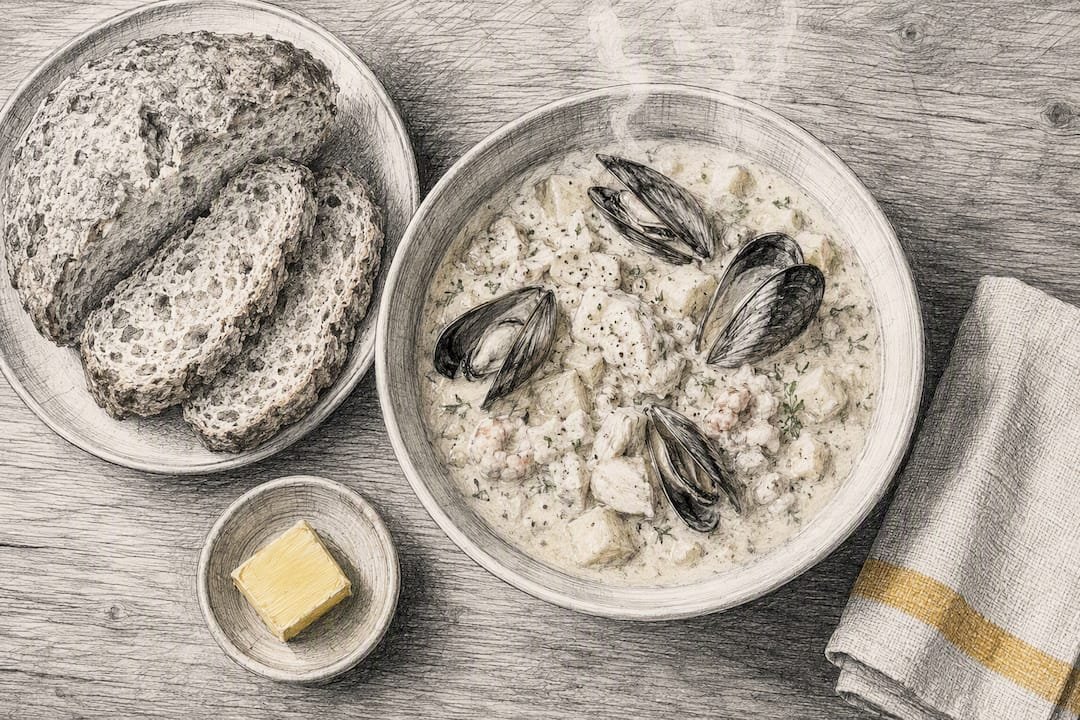
Donegal’s food scene rewards travellers who plan meals around the itinerary rather than hoping something turns up. Killybegs, Ireland’s largest fishing port, is the obvious stop for seafood; several harbourside spots serve the day’s catch with little fuss and no pretence. Ardara and Glenties both have solid pub kitchens doing seafood chowder and soda bread that make genuinely good lunch stops between Slieve League and Glenveagh.
Further north, Rathmullan and Milford have a handful of restaurants worth booking ahead in peak season, particularly if you’re staying overnight rather than passing through. Letterkenny, as the county’s largest town, has the widest spread of options if you want variety after several days of pub food.
Food tourism generally rewards the traveller who slows down enough to ask locals where they actually eat, rather than following the first sign for “traditional Irish fare.” That’s true well beyond Donegal; local cuisine plays a genuine role in how travellers experience a destination, and a five-day itinerary gives you far more room to seek out those recommendations than a rushed three-day dash.
If you’re self-catering for any nights, Donegal Town and Letterkenny both have supermarkets large enough to stock up before heading into more remote stretches, where shop options thin out considerably.
Safety tips for remote or rural driving in Donegal
The biggest risk on a Donegal road trip isn’t the cliffs, it’s fatigue and overconfidence on roads that look easy but aren’t. Several of the most scenic stretches, Glengesh Pass in particular, combine hairpin bends with sheer drops and no barriers, and they demand full attention even in good weather.
Keep the following in mind on any remote stretch:
- Never assume mobile signal; several glens and peninsula tips have none at all, so tell someone your rough route and expected arrival time.
- Slow down for livestock. Sheep wander onto unfenced roads regularly, especially in upland areas.
- Avoid driving cliff-edge roads like Slieve League’s approach or the Malin Head road after dark; there’s little to no lighting and verges can be soft.
- If a red weather warning is in force, change your plans rather than pushing through, in line with RSA guidance.
- Carry more fuel margin than you would at home. Rural stations can be scarce and closed on Sundays.
None of this should put you off. It simply means treating the driving itself as part of the holiday rather than something to get through as quickly as possible.
Suggested activities and experiences at each key stop
Each major stop rewards a different kind of attention. At Slieve League, the walk itself is the experience; go beyond the main viewpoint if you’re comfortable with exposed paths, since the views improve the further you go. At Glenveagh National Park, the castle tour is worthwhile, but the real draw for many visitors is the guided nature walks and the chance of spotting red deer at dawn or dusk.
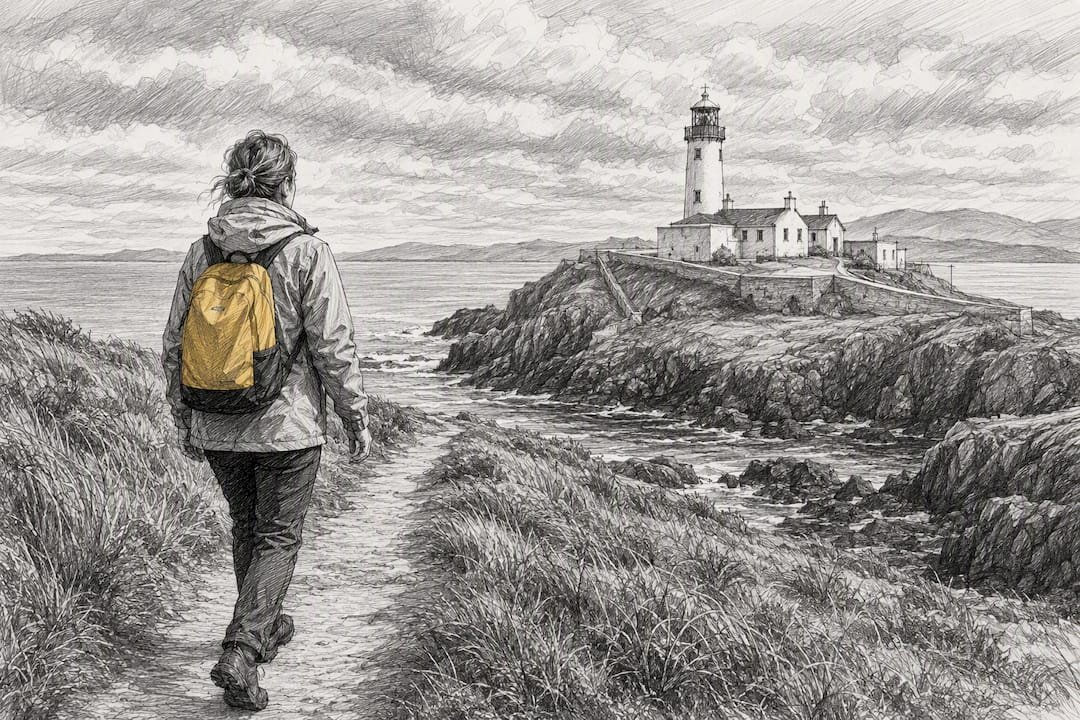
Fanad Lighthouse offers a genuine tour inside a working lighthouse, one of relatively few in Ireland open to visitors, and the surrounding coastline rewards a slow walk rather than a quick photo and drive-off. On the Inishowen peninsula, Malin Head’s appeal is partly the walk around Banba’s Crown and partly just standing at the edge of the country; bring a windproof jacket regardless of season. Grianán of Aileach takes only 20 to 30 minutes to explore fully but gives one of the best panoramic views in the county for very little effort.
For anyone travelling with an interest in wildlife, the Inch Wildfowl Reserve near Burnfoot deserves an hour, particularly outside summer when migratory birds arrive in numbers.
Transport options for those not driving
A self-drive car is genuinely the most practical way to see Donegal’s peninsulas, but it isn’t the only option if you’d rather not drive yourself. Local Link Donegal runs a rural bus network connecting the main towns, though services to remote spots like Fanad Lighthouse or Malin Head are limited and infrequent, making a full itinerary difficult without a car for at least part of the trip.
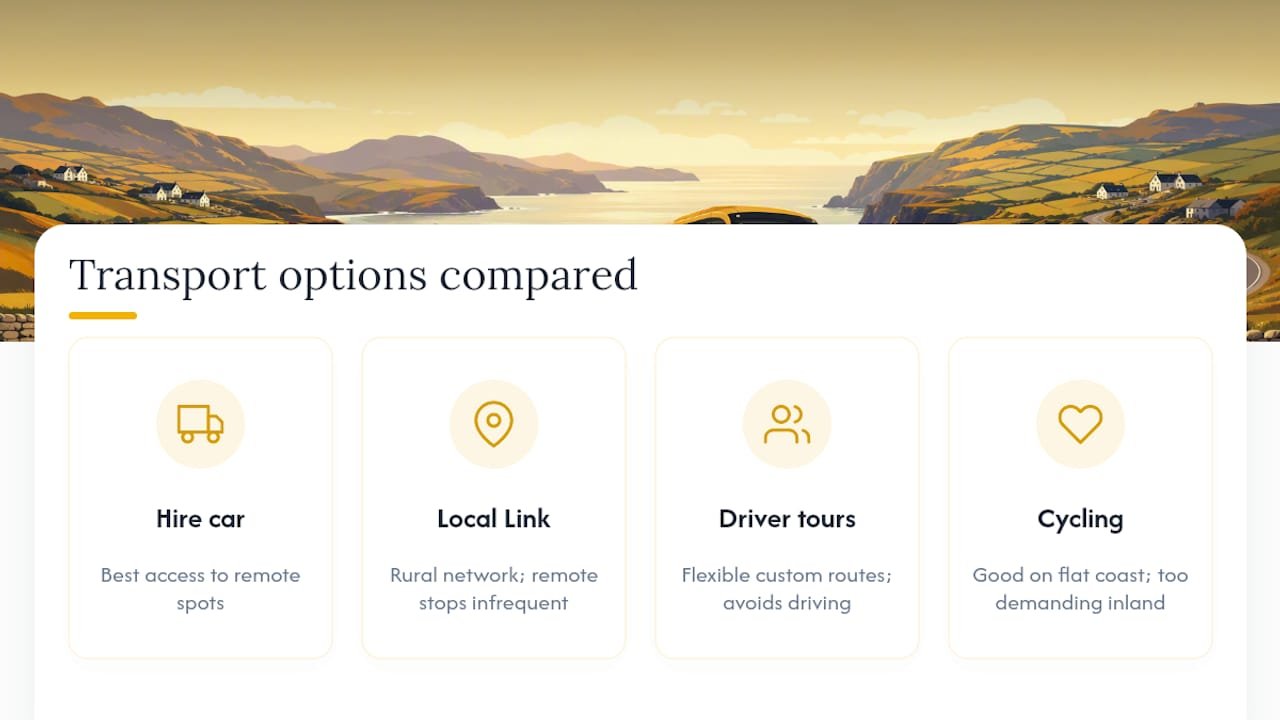
Private driver-guided tours exist for travellers who want the flexibility of a custom route without doing the driving themselves, and they’re worth considering if nobody in your group wants to tackle the single-track roads. Cycling is popular on some of the flatter coastal sections but demanding on the hillier interior routes, and isn’t realistic as a way to cover the full itinerary in three or five days.
For most independent travellers, the practical answer is a hire car paired with expert route planning, which is where a flexible self-drive itinerary with pre-arranged support removes the guesswork of figuring out bus timetables in a place where they barely exist.
Why the pace of your trip matters more than the route
Donegal doesn’t reward speed. The county’s character comes through in the pauses, the extra ten minutes at a viewpoint when the light shifts, the unplanned stop for a chat with a farmer moving sheep across the road, the second cup of tea because the rain hasn’t let up yet. Rush it and you’ll come home with a list of places you drove past. Slow it down and you’ll come home with a list of places you actually remember.
That said, a quicker route makes sense for travellers genuinely short on time, or those combining Donegal with a wider Irish trip and needing to keep moving. Three focused days still deliver the big three, Slieve League, Glenveagh and Fanad, without feeling like a checklist exercise, provided you resist the urge to add a fourth stop to an already full day.
If you’re unsure which pace suits your group, that’s exactly the kind of judgement call worth getting expert input on before you book flights and accommodation around a plan that might not fit how you actually like to travel.
— Theo
Let BTOURS build your Donegal self-drive itinerary
BTOURS is the option for travellers who want a Donegal road trip planned around how they actually want to travel, not a fixed coach schedule or a generic printout of driving directions.

A booked itinerary includes custom day-by-day pacing built around your interests, whether that’s leaning harder into Glenveagh’s nature trails or spending a full extra day around Slieve League, curated accommodation chosen for location rather than convenience, and on-trip support if plans need to change because of weather or a closed road. The company follows recognised standards for how self-drive adventure trips are planned and supported. Before booking anywhere, it’s worth reading through what to look for in a self-drive tour package so you know exactly what should be included. From there, the next step is simple: get in touch with BTOURS to start shaping a Donegal itinerary around your own pace, whether that’s three days or five.
Sources
Conditions on Donegal’s back roads change faster than most guidebooks can keep up with, so a few live sources are worth bookmarking before departure.
- Driving the Donegal Coast: Routes, Times, Warnings
- Places to visit in Donegal
- Alerts | Donegal
- Update – Road Safety Alert – Red weather warning issued for Donegal | RSA
FAQ
What is the most scenic part of Donegal?
The southern coast around Slieve League and Glencolmcille is widely considered the most dramatic stretch, with sea cliffs among the highest in Europe. The Fanad and Inishowen peninsulas run a close second, particularly around Fanad Lighthouse and Malin Head.
What is the best month to visit Donegal for a road trip?
Late May, June and September tend to offer the best balance of daylight, milder weather and fewer crowds than peak July and August. Winter driving is possible but demands far more caution given shorter daylight and a higher chance of severe weather warnings from the RSA.
What is the most beautiful drive in Ireland?
Donegal’s stretch of the Wild Atlantic Way is frequently named among Ireland’s most striking drives, partly because it’s the longest and least driven county section of the entire route. The Glengesh Pass and the Inishowen 100 are the two individual drives most commonly singled out.
What are some scenic driving routes in Donegal?
The three standout loops are the Slieve League approach road, the Fanad peninsula loop taking in the lighthouse and Ballymastocker Bay, and the signposted Inishowen 100 circuit around the northern peninsula. Each can be driven in half a day, though a full day lets you actually stop and explore rather than just pass through.
How many days do I need for a Donegal road trip?
Three days covers the essential highlights, Slieve League, Glenveagh and Fanad, at a comfortable pace without excessive daily driving. Five days allows time to add Inishowen and Malin Head, plus proper rest stops, and suits travellers who prefer slower, less packed days.