
You're at the booking crossroads. One option is to assemble flights, hotels, car hire and activities yourself, opening several tabs and hoping the timings work. The other is to speak to a travel professional who can turn those separate decisions into one organised holiday. Both routes can work, but they don't give you the same flexibility, responsibility or protection.
The useful question isn't tour operator vs travel agent. It's this: how complicated is your trip, how much control do you want, and who will carry the responsibility if a supplier fails? In the UK, that answer can affect whether the Package Travel and Linked Travel Arrangements Regulations 2018 apply, who is liable for the holiday's performance, and whether your booking has insolvency protection.
Two People, One Holiday
Two travellers can want the same destination and still need completely different booking models.
The first traveller books a flight, chooses a hotel, reserves a car and adds activities one by one. They control every detail, but they also have to coordinate every supplier. If the flight time changes, they must check whether the hotel, transfer and car booking still work.
The second traveller calls a high-street agency or specialist adviser. That person searches suppliers, recommends a suitable arrangement and completes the reservation. The adviser may be selling a package created by another business, or may be booking separate components on the traveller's behalf.
The plain-English difference
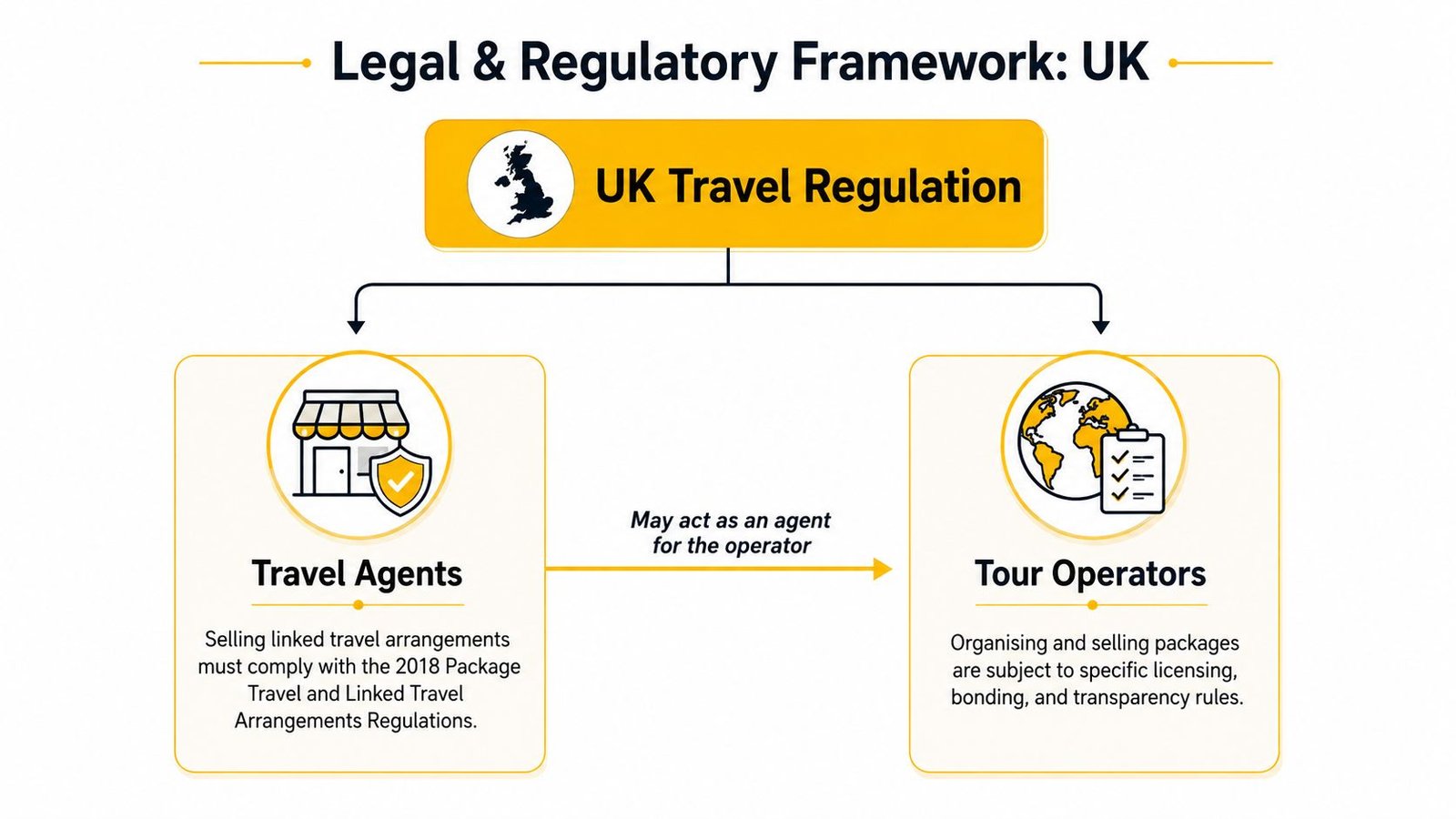
A tour operator creates the holiday. It combines travel services, such as transport, accommodation, car hire or excursions, and sells the resulting arrangement. The organiser controls how the itinerary is put together and generally holds the commercial relationships with the suppliers delivering its parts.
A travel agent is the intermediary. It sells or arranges another supplier's travel products rather than necessarily designing or operating the holiday itself. In the UK regulations, a retailer is a trader other than the organiser who sells or offers for sale packages combined by an organiser. Read the UK Package Travel Regulations guidance for the formal distinction.
That difference matters when the holiday changes. An agent may help you contact the airline, hotel or operator, but an organiser carries the legal responsibility for the performance of the travel services that make up its package. Government guidance also explains that organisers must provide insolvency security so travellers can obtain refunds and, where applicable, repatriation if the organiser fails financially. See the government framework for package-travel legislation.
Practical rule: Ask who organised the holiday, not merely which brand took your payment.
The choice also changes your control. An agent can search across multiple suppliers and build a custom combination. An operator can offer a more coherent itinerary because it has already selected the route, accommodation and inclusions.
For a simple booking, that distinction may barely affect your experience. For a self-drive journey crossing regions or countries, it can determine whether you spend your holiday travelling or troubleshooting. The right provider should match the complexity of your plans, your appetite for managing logistics and the level of confidence you want before departure.
Side-by-Side Comparison of Tour Operator and Travel Agent
The cleanest way to compare the two models is to follow the money, the contracts and the responsibility.
Tour Operator vs Travel Agent Key Differences
| Criteria | Tour Operator | Travel Agent |
|---|---|---|
| Services delivered | Combines services into a holiday, such as accommodation, transport, car hire and visitor experiences | Sells or arranges services supplied by other businesses |
| Who designs the itinerary | The operator creates the route, inclusions and schedule, either as a standard product or a tailored package | The agent recommends and assembles options from available suppliers |
| Level of control | Controls the structure of the package and coordinates its operating partners | Controls the advice and booking process, but usually not the underlying supplier inventory |
| Supplier contracts | Typically holds or manages the commercial arrangements with the suppliers delivering the package | Usually passes the customer into contracts with the relevant suppliers or organiser |
| Pricing and margin | Builds a package price and earns margin through the combined product | Usually receives commission from suppliers, or may charge a planning or service fee |
| Flexibility | Flexible within the operator's product design and supplier network | Strong for comparing separate components and creating a bespoke combination |
| Booking process | One package booking can simplify decisions and administration | One adviser can manage several reservations, but separate supplier terms may remain |
| After-sales support | The organiser is responsible for the package's performance under the applicable rules | The agent may assist with changes, while responsibility can remain with the suppliers or organiser |
| Financial protection | Depends on the package structure and whether flights are included, with insolvency-security duties for organisers | Depends on what the agent sells and whether it creates a package or linked travel arrangement |
| Best suited to | Guided tours, complex itineraries, multi-stop journeys and holidays where coordination matters | Flight-only bookings, hotel searches, simple breaks and trips needing broad supplier choice |
The operator model wins when coordination is more valuable than unlimited choice. A fixed route with selected accommodation, timed transport and included experiences can remove the risk of mismatched bookings. You're paying for the assembled result, not just for individual reservations.
The agent model wins when your needs don't fit a standard itinerary. An experienced adviser can compare different airlines, hotels, room types, cruise options or car suppliers and adjust the combination around your dates and budget. That works particularly well when you know what you want from each component and are comfortable checking the terms attached to each booking.
Commission doesn't automatically make an agent more expensive, and a package price doesn't automatically make an operator poor value. The meaningful comparison is the total arrangement, including time spent researching, the cost of correcting a failed connection and the support available when plans change.
Legal and Regulatory Differences in the UK
UK law draws the important line between a standalone booking, a linked travel arrangement and a package.
A package generally exists when at least two types of travel service are combined for the same trip. Those services can include transport, accommodation, vehicle hire or another significant visitor service. The trip must last at least 24 hours or include overnight accommodation for the stated package-travel threshold to apply. The Package Travel and Linked Travel Arrangements Regulations guidance sets out the framework.
A linked travel arrangement is different. Separate contracts may be made with separate traders, but the bookings are connected at the point of sale. The relationship still brings regulatory duties, so an agent shouldn't assume that separate payment screens automatically remove package-travel obligations.
What protection means in practice
The organiser has the central responsibility for the package's performance. If a contracted hotel, transfer provider or activity fails to deliver, the organiser isn't another booking website. It has duties connected with the services included in the package.
For flight-inclusive sales, the Civil Aviation Authority explains when ATOL protection is required. ATOL can support refunds, continuation of the holiday or repatriation if the relevant protected business ceases trading. It applies to flight-inclusive packages and certain flight-only arrangements that aren't exempt.
A package organiser must also arrange sufficient insolvency security. That protection is separate from the question of service quality. ABTA's role is industry representation and consumer support, while any dispute process depends on the business's membership and the terms available for that complaint. Don't assume every agent offers identical protection because the booking was made through a professional.
The practical verdict is straightforward. A package normally gives you a clearer point of legal responsibility. Agent-only reservations can spread responsibility across an airline, hotel, car company and activity provider, leaving you to identify which contract has failed.
Which Model Fits Your Trip Scenario
The answer becomes easier when you stop comparing labels and test the trip itself.
| Trip Scenario | Best Fit | Why |
|---|---|---|
| Beach-only resort booking | Travel agent or direct supplier | The booking may involve one principal service, so broad comparison and advice can matter more than itinerary coordination |
| Flight-and-hotel city break | Either, with a package preference when sold together | A combined arrangement can simplify changes, while an agent can compare separate flights and hotels |
| Guided group tour of Italy | Tour operator | The operator controls the route, group logistics, accommodation and guided experiences |
| Complex multi-country self-drive itinerary | Specialist self-drive tour operator | Cross-border planning creates coordination work across vehicles, accommodation, routes and local requirements |
| Last-minute business trip | Travel agent | Speed, availability and flexible component selection usually matter more than a curated holiday design |
The uncomplicated resort stay
You're travelling to one resort, with no complicated connections and no need for excursions to be coordinated. A travel agent can help compare room categories, departure options and supplier terms without forcing you into a wider itinerary.
If the flight and accommodation are sold together as a qualifying package, the regulatory position changes. The label on the website matters less than what the booking includes.
The short city break
A couple wants a flight and hotel in the same city, perhaps with flexibility over departure times and neighbourhood. An agent is useful when the traveller wants several combinations presented clearly. A packaged booking is preferable when one business combines the services and the traveller values one point of responsibility.
The guided Italian tour
This is an operator job. A guided group tour depends on a fixed route, room allocation, transport, guides and timed visits. Booking each element separately would remove the central advantage of the experience, which is that another party has coordinated the moving parts.
The cross-border road adventure
For a multi-country self-drive trip, choose a specialist operator unless you enjoy managing every dependency. Ferry times must work with hotel check-ins, the vehicle arrangement must match the route, and local driving requirements need checking before departure.
The urgent business journey
A last-minute business traveller usually needs availability, speed and the ability to change one component without redesigning an entire holiday. A travel agent can be the better fit, particularly when the itinerary is a straightforward flight, hotel or rail arrangement.
Why Confidence and Protection Beat a Lower Price
“Booking direct is cheaper” sounds persuasive because it compares visible prices. It ignores the cost of managing failure.
Suppose an airline changes a schedule after you've booked a non-refundable hotel separately. You may have to negotiate with the hotel, absorb a lost deposit or pay for a replacement night. A traveller whose flight and accommodation form part of a qualifying package has a stronger route to assistance through the organiser, because the package organiser is responsible for the contracted travel services.
That doesn't mean every package change is cost-free or that every DIY booking fails. It means the two arrangements allocate risk differently.
ABTA's 2025 Holiday Habits research found that 34% of UK holidaymakers used a travel professional in the previous 12 months. The leading reasons included ease of booking at 57%, saving time at 42%, value for money at 39% and feeling more confident at 41%, as reported by Travel Weekly's coverage of the research.
Confidence is not a vague luxury. The same research reported confidence at +78 among people who booked with a travel professional and +80 among package-holiday bookers, according to the ABTA confidence research coverage. Those figures don't prove that every adviser or operator delivers the same service, but they do show why travellers continue to value a human-controlled booking.
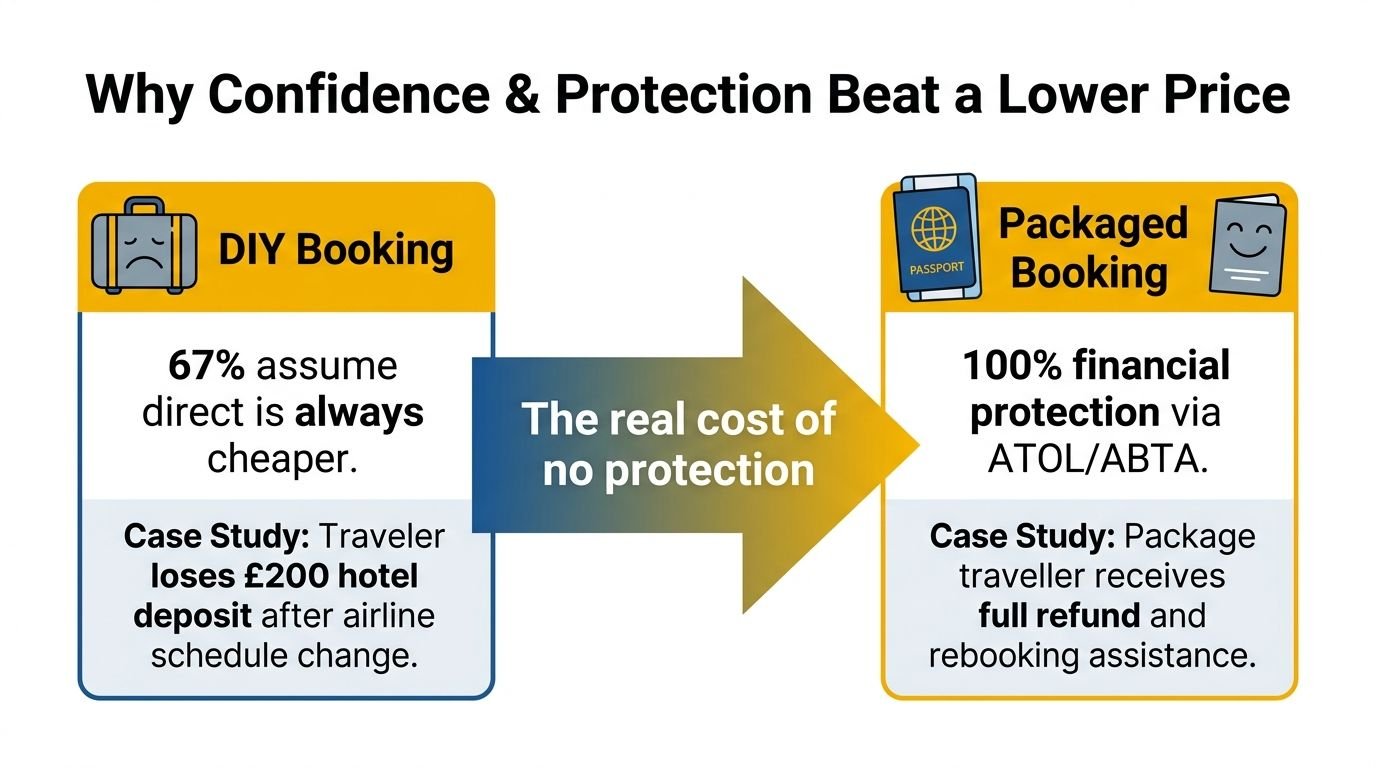
ATOL protects eligible flight-inclusive arrangements. Organisers also need insolvency security for packages, while credit-card protection may provide another route for eligible purchases. Treat these as different safeguards, not as interchangeable badges.
The right price question: What are you paying to remove the risk of coordinating the trip alone?
A modest package margin can buy a clear point of contact, coordinated changes and a route to refund or repatriation if the organiser fails. For a complicated journey, that certainty belongs in your budget alongside the hotel and transport costs.
For practical guidance on one common road-trip risk, see this car-rental insurance explainer.
Where Self-Drive Multi-Day Tours Fit In
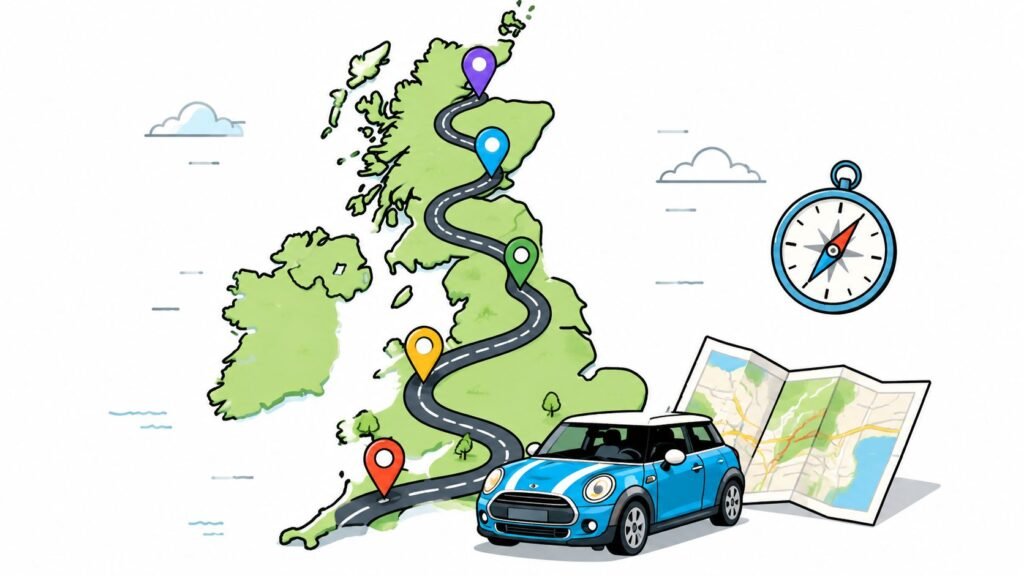
A self-drive holiday may feel independent once you are behind the wheel, yet the booking can involve several connected decisions. The more regions, countries and suppliers your route includes, the less sensible it becomes to treat each reservation as a separate task.
A multi-day itinerary might combine car hire, accommodation, ferries, attraction tickets and route planning. If at least two relevant travel services are combined for the same trip under the Package Travel Regulations, the arrangement may fall within the package framework. The legal outcome depends on how the services are selected, sold and contracted, so ask the provider to state its role clearly before you pay.
The hidden work behind “just driving”
Separate bookings leave you responsible for the connections between them:
- Ferry timing: A late arrival can affect hotel check-in and the following day's route.
- Country requirements: Vignettes, toll systems and driving rules differ by destination.
- Roadside assistance: Rental cover may exclude some regions or types of breakdown.
- Supplier failure: If one reservation collapses, you must find a replacement without disrupting the rest of the itinerary.
- Route realism: Two stops can look close on a map while roads, borders and scenic detours make the drive impractical.
The enjoyable part is driving. The fragile part is coordinating every dependency.
Why a specialist operator earns its margin
A specialist self-drive operator can combine those moving parts into one planned experience. BTOURS offers self-drive multi-day tours with selected accommodation, mapped routes, planned stops and support, while leaving you free to explore by car. Before booking, confirm whether your specific arrangement is a package, identify the organiser and check what ATOL or other insolvency protection applies under its terms.
That is the practical value of an operator. You keep the freedom to stop for a coastal view, village lunch or unexpected detour, while someone else handles the avoidable planning friction that can unsettle a complex road trip.
Choosing the Right Provider for Your Next Trip
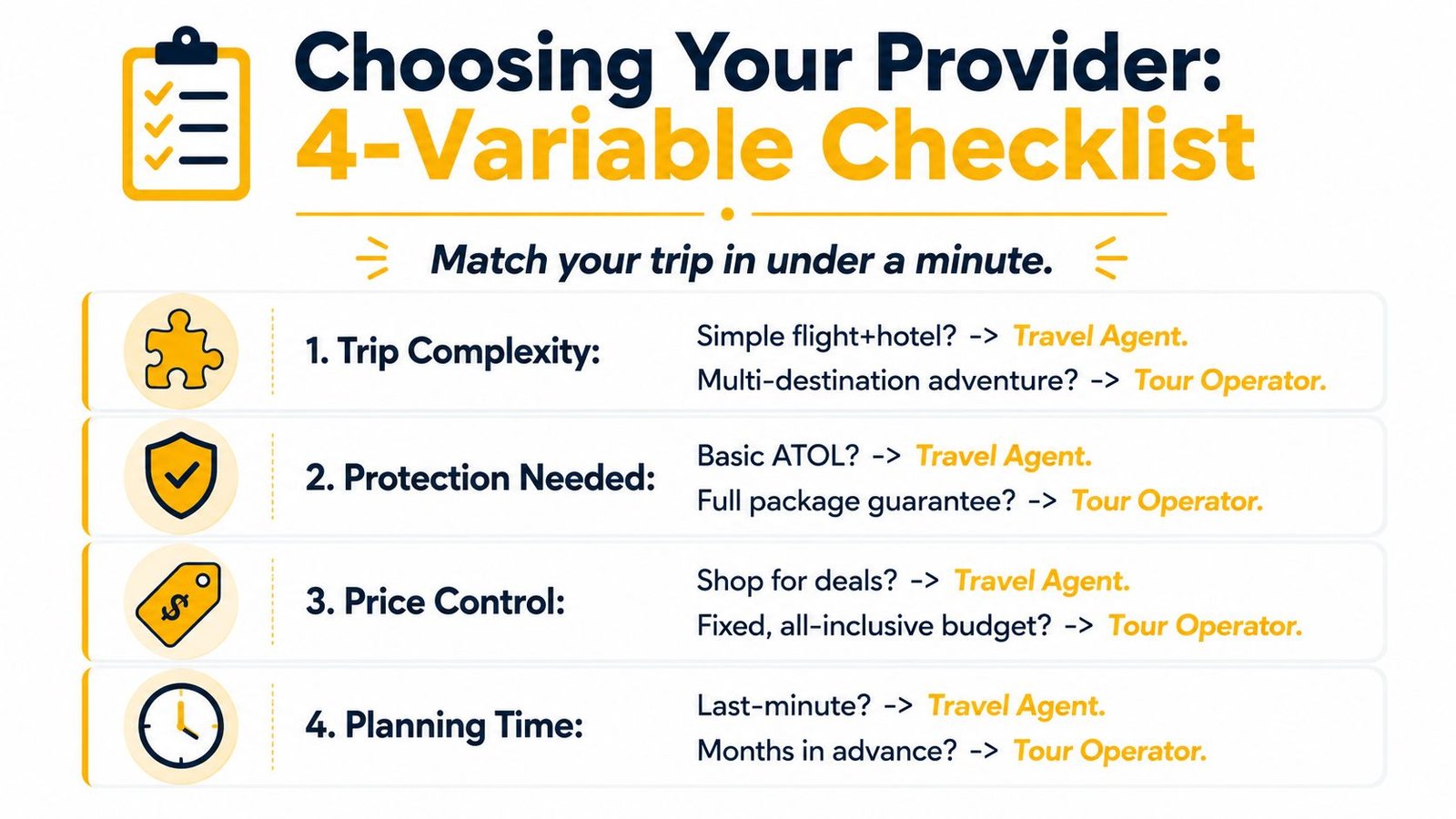
You can make the decision quickly by testing four variables: trip complexity, number of components, cross-border travel and your appetite for managing logistics.
Start with the components
One standalone service, such as a flight-only booking, generally points towards a travel agent or direct supplier. Once you combine at least two travel-service types for the same trip, and the trip lasts at least 24 hours or includes overnight accommodation, check whether the UK package rules apply using the consumer explanation of package holidays.
Then test the trip shape
Use this quick mapping:
- City break: Choose a travel agent when you want broad flight and hotel comparisons. Choose a package when one organiser combines the components and you want clearer responsibility.
- Guided group tour: Choose a tour operator because route control, guides and group logistics are central to the product.
- Multi-country self-drive: Choose a specialist self-drive tour operator such as BTOURS when border crossings, accommodation changes and route planning create too many dependencies.
- Tailor-made honeymoon: Choose a tour operator that can organise the complete itinerary and confirm the relevant insolvency and flight protection.
- Simple cruise booking: Either model can work. An agent may offer comparison and advice, while an operator may sell a broader package around the cruise.
If you're comparing software or platforms used by travel businesses rather than choosing a holiday provider, this guide to comparing top tour booking platforms can help you assess the operational side separately.
You should also inspect the provider's terms. Some businesses can act as agents for named suppliers in one booking and package organisers in another. Don't infer legal responsibility from the brand name alone.
Take three actions before paying
- List every component: Write down flights, accommodation, car hire, ferries, transfers, activities and significant visitor services.
- Confirm the legal structure: Ask whether the booking is a package or linked travel arrangement under the 2018 regulations, and request the organiser's details.
- Verify membership and protection: Check relevant ABTA or AITO membership claims, confirm ATOL details where flights are included, and read the cancellation and insolvency wording.
For inspiration on a more structured hosted itinerary, review this small-group Ireland coastal tour visual. The decisive answer is simple: use an agent for choice across straightforward components, and use an operator when the trip's complexity makes coordination and protection the priority.
BTOURS creates curated self-drive road trips, multi-day journeys and city breaks across Britain, Ireland, the Nordics and Greece, combining selected accommodation, mapped routes and destination support. If your next holiday involves several stops or a cross-border driving plan, visit BTOURS to explore an organised route that keeps the freedom of independent travel.