You're comparing Ireland holidays and finding yourself caught between two imperfect choices. A self-drive trip promises freedom, yet the thought of navigating narrow rural roads, booking several small hotels, and judging whether a passing place is a passing place can take the shine off the plan. A large coach removes much of that work, but it can also mean fixed stops, rushed photographs, and too little time in the places you came to experience.
Small group tours in Ireland offer a practical middle path. You share transport and local knowledge, while keeping a more human pace and access to roads, villages, walks, and experiences that don't suit a full-size coach. The important question isn't how many people sit in the vehicle. It's whether the itinerary gives you fewer one-night stops, more regional overnights, and enough time to experience Ireland rather than merely cross it.
Why Small Group Touring in Ireland Feels Different
You might begin with a map covered in hopeful marks. Dublin, Galway, Connemara, the Cliffs of Moher, Dingle, Killarney, Cork, perhaps Donegal too. Then the practical questions arrive. Where should you stay between the headline destinations? How long will a coastal road really take? Can your hire car reach that viewpoint, and where will you leave it when the road narrows?
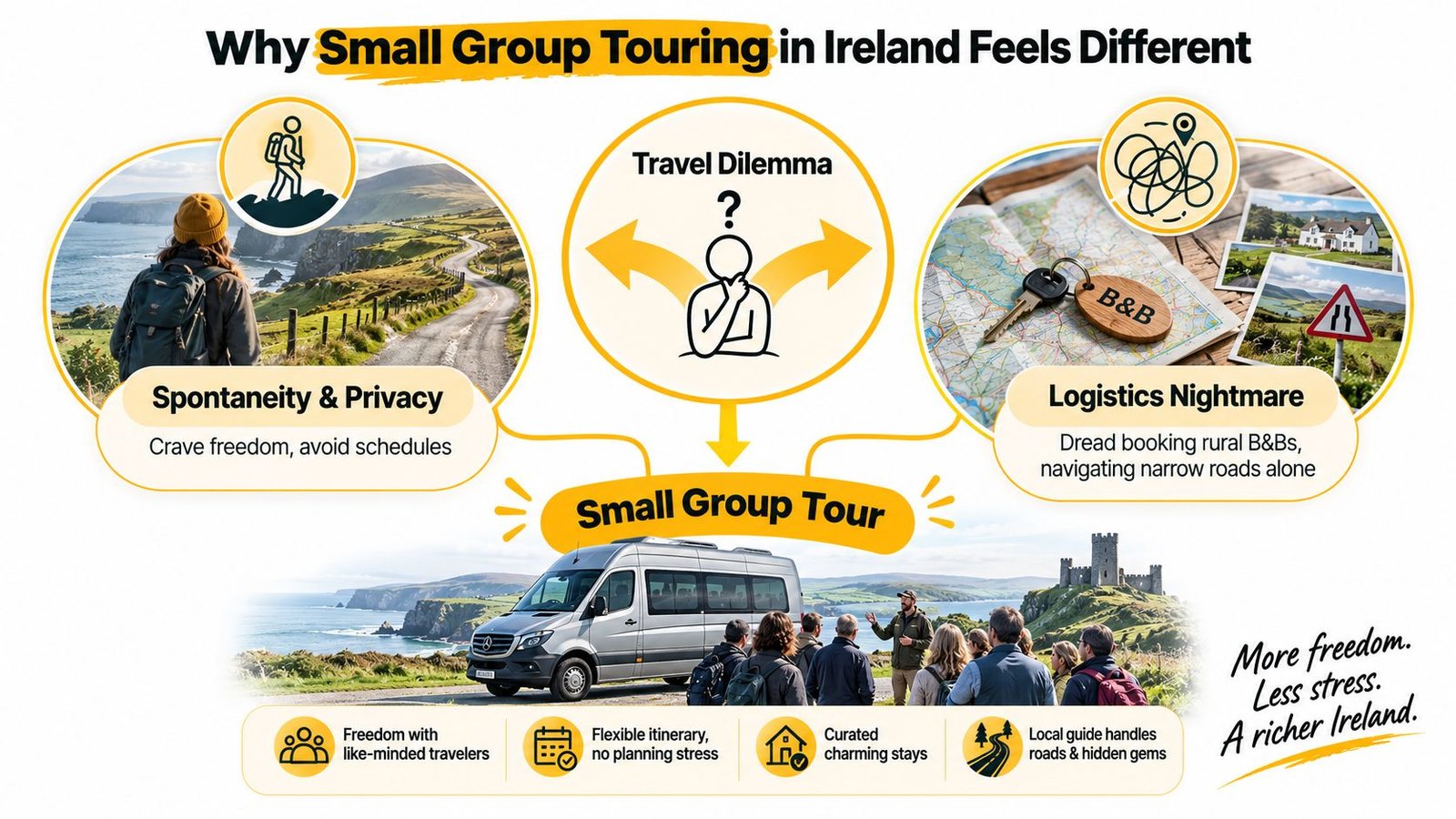
Independent travel gives you privacy and spontaneity, but rural Ireland asks for concentration. A route that looks short on a map can include winding lanes, slow farm traffic, limited parking, and roads where turning around isn't straightforward. A guided large-group tour solves the navigation problem, yet its vehicle and timetable may prevent the guide from lingering when the scenery deserves more than a quick stop.
The landscape shapes the itinerary
Ireland rewards regional travel. The Dingle and Beara peninsulas aren't just scenic lines to tick off. They're places where an overnight stay lets you walk a headland, return to a harbour as the light changes, and eat without watching the clock for a long transfer.
The same logic applies to heritage and community experiences. A family-run pub may have room for a modest party but no practical way to host a full coachload. A popular heritage attraction may also manage visitor numbers, making advance organisation and a suitable group size more important than a glossy itinerary.
The useful definition of small group isn't “more luxurious”. It's “small enough to shape the route around the place”.
That difference becomes clear on the road. A smaller vehicle can pause at a scenic lay-by without creating the same disruption as a large coach. A guide can explain local history while everyone is still together, then suggest a short walk suited to the weather and the group. You're still travelling to a plan, but the plan has room to breathe.
This is why the strongest small group tours Ireland offers aren't built around squeezing in every county. They use pacing, access, and confidence as design principles. You get the structure of a guided journey without giving up every unscripted moment.
What Small Group Touring Actually Means in Ireland
“Small group” isn't a universal legal category, so read the operator's stated maximum rather than relying on the label. One Irish operator describes a maximum of 26 guests, with a separate mini-group limit of eight guests in its smaller format, showing how widely the term can be used in practice. You can verify that example in the operator's published tour structure.
Ireland also uses a clear transport threshold. Vehicles carrying more than eight passengers for reward fall within the large public service vehicle classification described by the Irish Department of Transport. That distinction matters because your vehicle affects road access, luggage space, boarding time, and the feel of every stop.
Read the vehicle description carefully
Use the following categories as a planning guide, not as a fixed national standard.
| Group Size | Vehicle Type | Access Capability |
|---|---|---|
| Up to 8 guests | Small passenger van | Easiest for intimate stops, narrow approaches, and quick changes |
| 9 to 16 guests | Minibus or compact touring vehicle | Strong balance between comfort, guide access, and regional roads |
| 17 to 24 guests | Mid-size coach or mini-coach | More capacity, but greater limits at small lay-bys and village venues |
| 25 guests or more | Larger coach format | Efficient for established attractions and straightforward road corridors |
The numbers above describe useful buying categories, while the operator's own maximum remains the detail to confirm. Fáilte Ireland's group-organiser guidance shows that attractions may work with minimum group sizes such as 10, 12, 15, or 20, and may divide larger parties into groups of 30 for guided visits. The Fáilte Ireland Meitheal guide demonstrates why a tour's group mechanics matter beyond the vehicle itself.
Guided does not always mean escorted
A guided small group tour normally includes a driver-guide or separate guide who manages the route, timing, and commentary. A self-drive small group package is different. You travel with your own party, follow a curated itinerary, and receive support or route information without joining a shared vehicle.
Both models can work well. Couples and solo travellers often value the social ease of an escorted tour. Multi-generational families may prefer a private arrangement, while confident drivers who want freedom can choose a self-drive route with accommodation already organised.
Before booking, ask for the exact maximum number of guests, vehicle model, luggage arrangement, and whether the guide drives throughout. Those details tell you much more than a phrase such as “luxury small group”.
Benefits That Go Beyond the Brochure
The strongest reason to choose a small group tour isn't a softer seat. It's trip design. A slower route can reduce backtracking, keep overnight income in more regions, and make room for experiences that disappear when every day is built around a distant hotel.
Fáilte Ireland's reporting records 6.2 million tourist trips to the Wild Atlantic Way in 2023, with almost 2 million more tourist visits than in 2013. The same reporting describes the route as a major tourism engine, generating substantial revenue and supporting employment. You can explore the underlying decade of impact in Fáilte Ireland's Wild Atlantic Way report.
Overnight stays change the experience
A rushed itinerary can show you a remarkable number of viewpoints while giving you very little time in any one community. A small group route can instead use Galway, Westport, Dingle, or Killarney as bases, allowing a morning walk, a local meal, or a weather-led change of plan.
That approach also fits the wider conversation about destination management. A 2025 parliamentary discussion on day-trip coach tourism raised the question of whether journeys from Dublin to the west should place greater emphasis on longer stays. Fáilte Ireland has also highlighted the value of coach and group visitors outside the busiest period because they tend to stay longer and travel more widely.
A better small group itinerary isn't the one with the longest attraction list. It's the one that gives each region enough time to feel distinct.
Access and local contact become more realistic
Restricted or delicate sites often require advance planning, and some coastal approaches don't suit a large vehicle. A compact group can make a booking for a guided walk, artisan visit, or local demonstration without turning the experience into crowd management.
The same applies to ordinary social moments. A pub session, a family-run guesthouse, or a conversation with a craft producer works best when the party can fit comfortably into the setting. That's not a promise that every tour includes a hidden local encounter. It is a structural advantage that operators can use when they build the itinerary carefully.
The footprint is easier to manage
One smaller vehicle, fewer repeated arrivals, and longer stays can reduce the pressure created by constant day-tripping. It won't remove tourism impacts, and responsible behaviour still matters, but a route with fewer rushed stops gives communities more control over how visitors arrive and spend time.
Ask operators how they spread nights across regions, whether they use locally owned accommodation, and how they handle popular sites. Their answers reveal whether “small group” is a meaningful operating choice or just a marketing phrase.
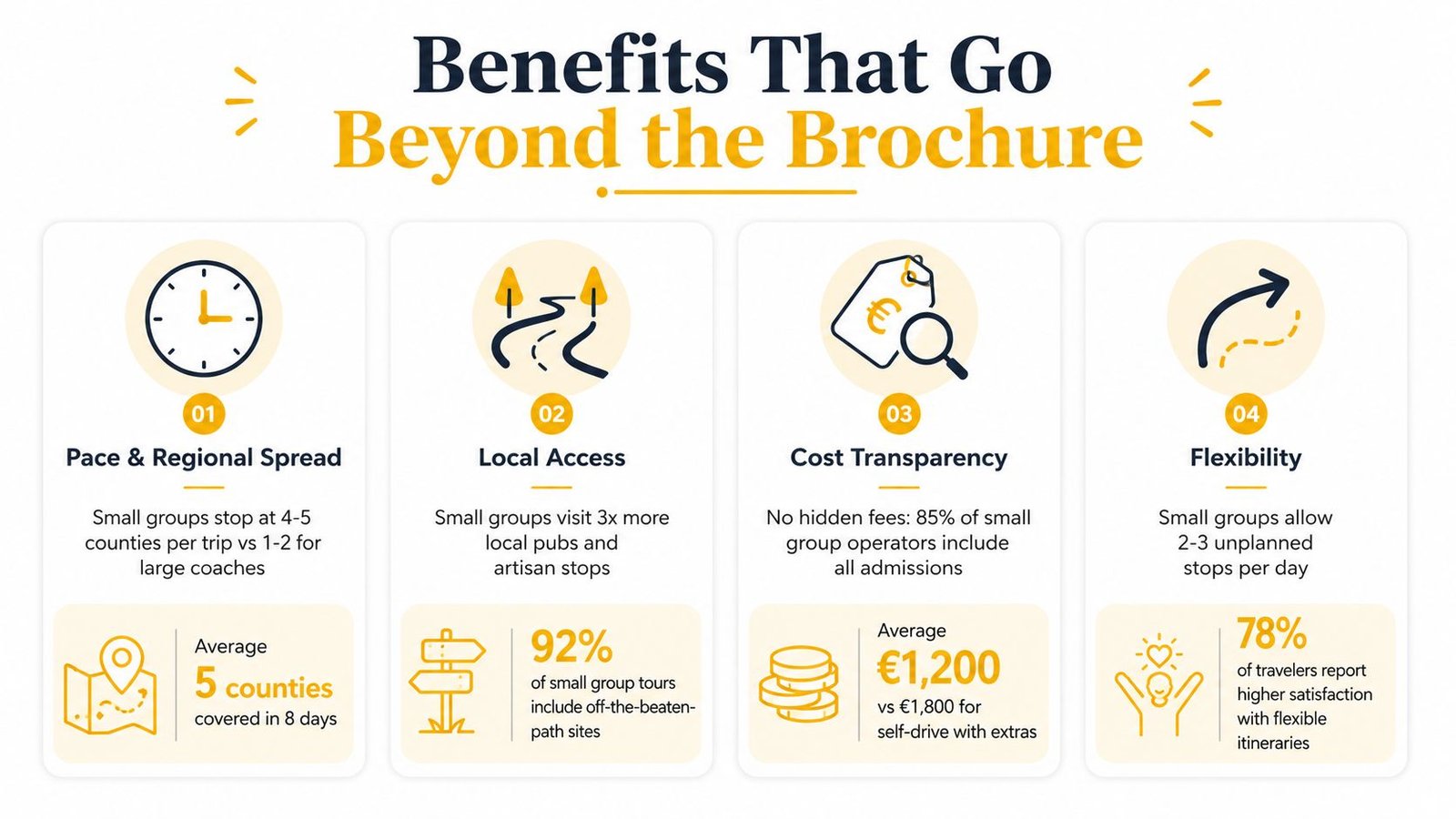
A short visual summary can help when you're comparing brochures, but don't accept unsupported figures in promotional material. The useful evidence is the published group cap, the overnight pattern, and the actual daily route.
How Small Group Tours Compare with Self-Drive and Large Coach Options
Ireland suits more than one travel style. A nervous driver may need a fully organised route, while an experienced traveller may care most about choosing a beach walk after breakfast and changing plans when the weather shifts. The right comparison starts with the day you want to have, not the lowest headline price.
Some categories below are intentionally qualitative. Operators price routes differently, and there isn't a reliable universal daily average for every format.
| Format | Group Size | Avg. Driving/Day | Flexibility | Pace | Cost/Day (€) | Best For |
|---|---|---|---|---|---|---|
| Small group tour | Small shared party, often capped by operator | Managed by guide | Moderate | Usually balanced | Varies by inclusions | First-time visitors wanting structure and company |
| Self-drive | Your own party | Chosen by you | High | Self-directed | Varies with car, rooms, fuel, and activities | Confident drivers and repeat visitors |
| Private driver-guide | Your own party | Managed for you | Very high | Tailored | Premium and quote-based | Families, couples, and travellers seeking privacy |
| Large coach tour | Larger shared group | Fixed route and schedule | Lower | Efficient, sometimes rushed | Varies by package | Travellers prioritising a set highlights circuit |
Small group touring
This format removes the most tiring logistics while preserving some flexibility. You can listen to a guide's explanation of a ruined abbey, ask for a food recommendation, and share the road with other curious travellers. The compromise is that you still follow a group timetable and may need to adapt to different walking speeds.
Self-drive
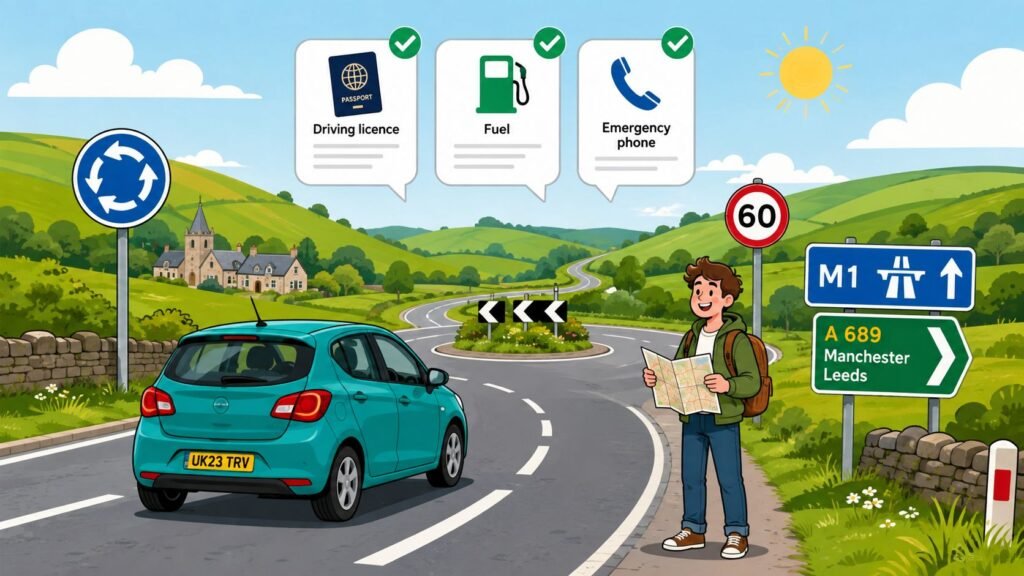
Self-drive gives you the greatest control over meal times, photo stops, and route changes. It also places navigation, parking, fuel, insurance, and rural-road decisions on you. If you're considering this model, keep a practical UK road-trip driving guide beside your Ireland planning notes, while remembering that Irish roads and local signage still require their own attention.
Private driver-guide
A private driver-guide works particularly well when travellers have different mobility needs or a family wants door-to-door ease. You can spend longer at a favourite site, skip an attraction that doesn't appeal, and shape the route around interests such as genealogy, gardens, food, or walking.
Large coach travel
Large coaches can cover classic attractions efficiently and offer a reassuringly organised experience. They're less suited to tiny villages, narrow coastal approaches, and itineraries built around spontaneous pauses. Choose this option knowingly, especially if your priority is seeing the major sights within a tight schedule rather than settling into each region.
A Day-by-Day Wild Atlantic Way Itinerary You Can Steal
An eight-day route needs discipline. You can't comfortably treat the entire west coast as a series of quick photo stops, so this version uses a clear southbound arc and accepts that some areas belong on a future journey.
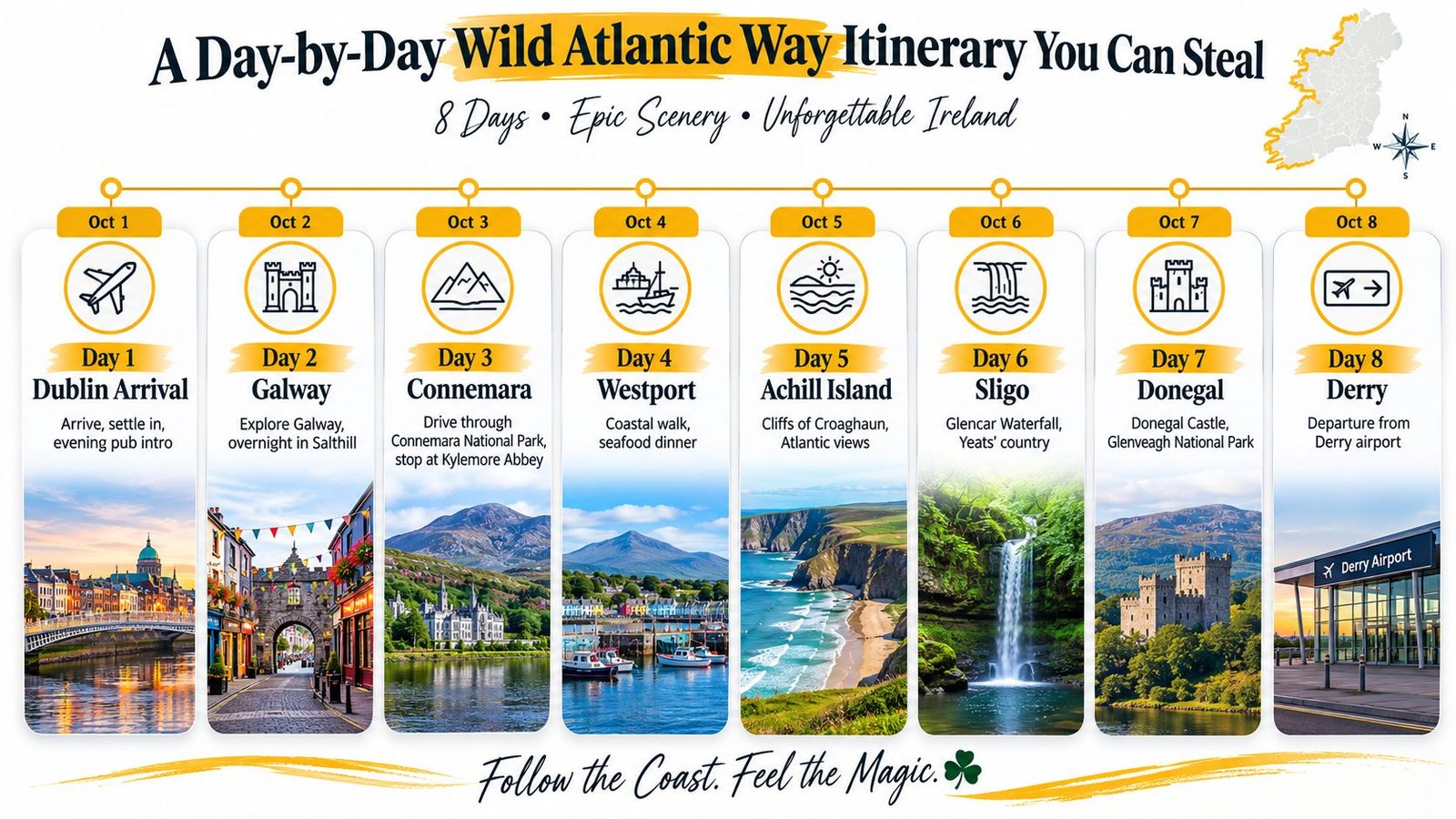
Day 1 Dublin arrival
Arrive, settle into a central hotel, and keep the first evening gentle. A short walk around the historic centre followed by a relaxed pub meal gives you an introduction without turning jet lag into a full-day problem.
Choose a comfortable city hotel with easy access to your next morning's departure point. If you're travelling with a guide, confirm the collection arrangements before dinner.
Day 2 Galway city
Travel west to Galway and spend the afternoon on foot. Explore the Latin Quarter, browse local shops, and listen for live music rather than treating Galway as a corridor to somewhere else.
Stay in Galway or nearby Salthill. One substantial base here makes the next day's Connemara loop more enjoyable, because you won't need to check out before experiencing the scenery.
Day 3 Connemara
Give Connemara a full day. The route can include Connemara National Park, Kylemore Abbey, quiet lakeside roads, and a short bog or woodland walk selected according to weather and ability.
A local experience might be a food stop with regional produce or a visit to a craft workshop. The point is to let the scenery dictate the rhythm instead of measuring success by distance.
Day 4 The Cliffs of Moher and the Burren
Head south through the Burren towards the Cliffs of Moher. Start early enough to enjoy the cliffs without making the entire day a queue, then allow time for the limestone terrain, stone walls, and small settlements beyond the main viewpoint.
Stay in Clare or continue towards a suitable western base. A seafood dinner or an evening coastal walk gives the day a proper ending.
Day 5 Dingle Peninsula
Use Dingle as more than a lunch stop. Drive the peninsula at a measured pace, pause at beaches and viewpoints, and leave room for a village café or a short walk when the weather allows.
A two-night approach is ideal if your schedule permits, but even one well-planned base is better than crossing the peninsula while watching the clock. Choose a characterful guesthouse or comfortable local hotel within walking distance of the town centre.
Day 6 Ring of Kerry
The Ring of Kerry deserves attention to direction, traffic, and stopping points. A guide can manage the route while you focus on the lakes, mountain passes, villages, and coastal views.
Stay in or near Killarney, where you can choose between a quiet evening and a short walk in the national park. A local restaurant or traditional music session adds texture that a roadside lunch can't provide.
Day 7 Killarney to Cork
Spend the morning on a Killarney experience such as a park walk, then travel towards Cork at a sensible pace. Depending on your interests, you might include a heritage visit, a harbour town, or a food-focused stop rather than adding another distant landmark.
Stay in Cork for a final urban evening. It gives the route a change of mood and avoids making departure morning part of a long cross-country transfer.
Day 8 Departure
Allow generous time for the airport or onward connection. If you're departing from Dublin, plan the transfer before adding any final attraction. A journey that ends calmly will feel better than one that turns the last day into a gamble.
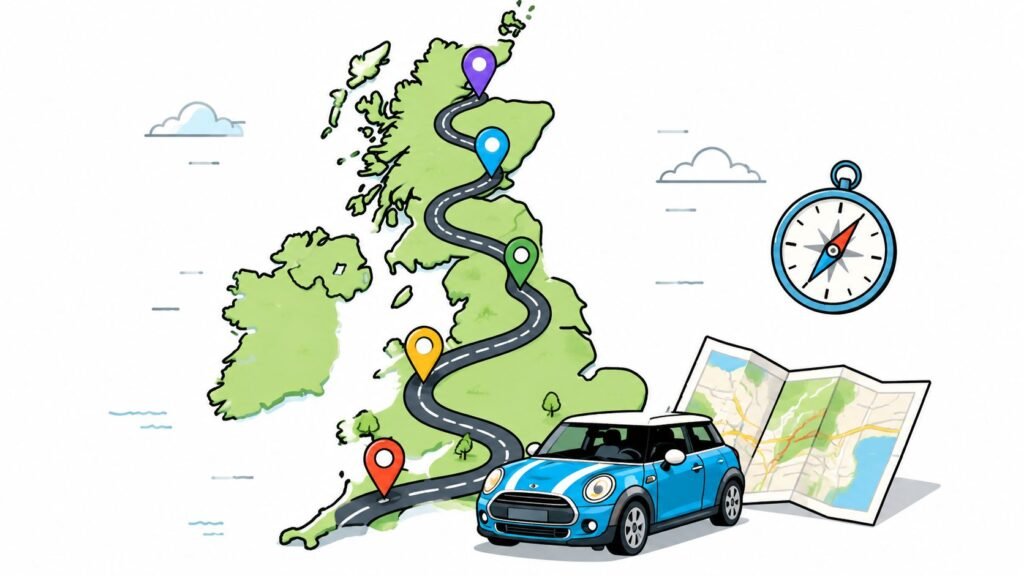
For independent planners, a road-trip planning illustration can help organise bases, driving legs, and activity choices. For a shared tour, use the same logic when assessing the operator's published route.
How to Choose and Book a Reputable Operator
A couple planning Ireland shortlisted three operators. One brochure promised a “small group” without stating the maximum. Another listed attractive hotels but moved guests almost every night. The third answered direct questions clearly, supplied a sample itinerary, and explained what would happen if weather disrupted a coastal activity.
That comparison matters more than the brochure photographs. A responsible operator should be able to tell you who drives, where you sleep, what you pay for, and how the route changes when conditions require it.
Ask the questions that expose the design
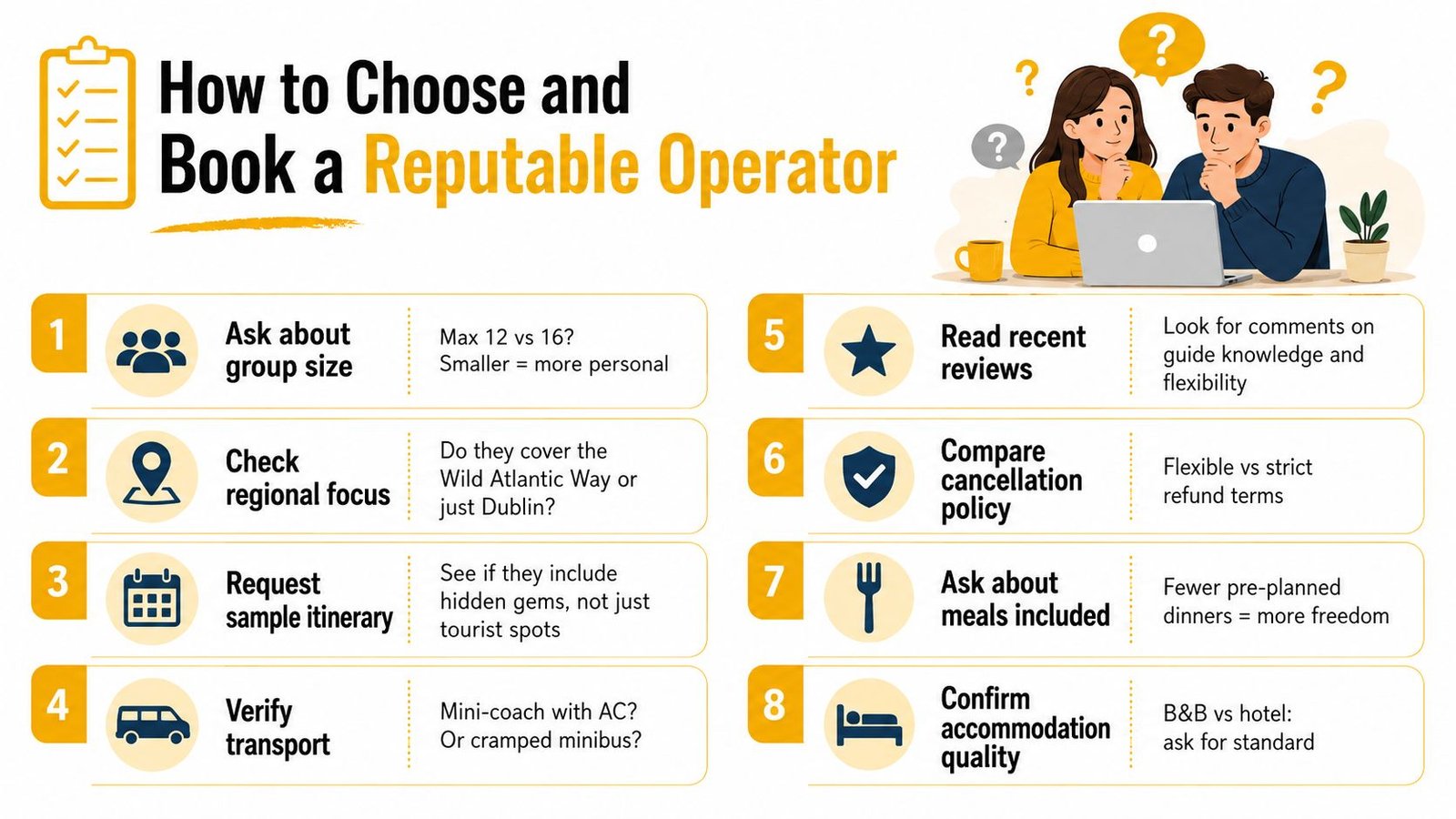
Send the same questions to every operator on your shortlist:
- Confirm the maximum: Is the group cap written into the booking terms, and does it apply to every departure?
- Inspect the overnight pattern: Do you stay two or three nights in regional bases, or repack constantly?
- Check guide credentials: Who drives and guides the tour, and what licences or qualifications apply?
- Verify recognition: Is the business connected with a recognised industry body or approved by Fáilte Ireland?
- Request inclusions: Are admissions, breakfasts, transfers, luggage handling, and activities included?
- Read the cancellation policy: Look for clear dates, fees, postponement rules, and supplier terms.
- Ask for current references: Reviews should discuss guide knowledge, timing, accommodation, and flexibility, not just scenery.
- Clarify the vehicle: Ask for the vehicle type, luggage capacity, air conditioning, and accessibility arrangements.
A credible company won't treat these questions as difficult. It may not be able to guarantee every restaurant or weather-dependent stop, but it should explain the decision-making process.
Watch for attractive vagueness
Be cautious when the operator avoids stating a maximum group size, uses “luxury” without naming the vehicle, or shows a route with no accommodation detail. A low deposit isn't automatically a bargain if the cancellation terms are severe or the advertised hotel standard changes by departure.
Before paying, save the final itinerary and inclusions list. Check the departure point, luggage rules, room basis, meal arrangements, travel insurance requirement, and contact number for support during the trip.
If the operator won't put the important promises in writing, don't rely on the promise.
Costs, Best Seasons, and When Small Group Touring Is Worth the Premium
Small group pricing reflects more than vehicle size. Accommodation in popular coastal regions is limited, compact vehicles and qualified guides need to be scheduled, and a carefully paced route may require rooms in places with fewer alternatives. An industry outlook from AIB on coach and golf tourism describes capacity constraints alongside continuing tourism demand, which helps explain why access can influence price.
Don't treat the following table as a price list. Without a verified market dataset for universal daily rates, the useful comparison is relative value.
| Season | Avg. Price Per Person / Day | Accommodation Availability | Crowd Levels |
|---|---|---|---|
| Peak summer | Usually highest | Most constrained in popular regions | Busiest |
| Shoulder season | Often better value | More choice | Generally calmer |
| Quieter periods | Can be attractive where departures operate | Wider choice, but fewer scheduled options | Quietest, with more limited services |
A package may cover transport and guiding only, provide accommodation and breakfast, or include admissions and selected meals. Compare the complete package rather than the transport line. Self-drive travellers should also account for car hire, fuel, parking, tolls, accommodation, and the time spent managing each detail.
Decide whether the design earns its price
A premium makes more sense when it buys a materially better route. Look for a genuinely small cap, at least some two-night regional stays, and daily driving that leaves space for walking, food, and conversation. Those are design signals, not luxury labels.
Peak availability can be especially difficult along the Wild Atlantic Way, so travellers with fixed dates should ask about confirmed rooms rather than assumed room blocks. Shoulder-season travel may offer a calmer experience, but weather, daylight, attraction opening times, and departure schedules still need checking.
If Ireland is part of a wider relocation or retirement plan, you may also find it useful to read Expat Global Medical's guide to retiring overseas for broader questions around healthcare and international planning. It isn't a tour-pricing source, but it belongs in the preparation conversation for longer stays.
For self-drivers comparing vehicles, keep this European car-rental guide alongside your route notes. The right vehicle choice should support the roads you intend to use, not merely the largest luggage requirement.
Planning Your Ireland Journey with BTOURS
The trip-design principles above point towards a clear choice: select a route that gives regions enough time, states its group or vehicle arrangements plainly, and supports you when the road plan changes.
BTOURS offers self-drive and multi-day Ireland itineraries, including Dublin-based journeys and Wild Atlantic Way routes. Its published approach combines accommodation, breakfast, and a self-guided itinerary, making it suitable for travellers who want an organised framework while retaining control over each day's pace. For visitors who prefer a private format, a listed Ireland tour has a maximum group size of five, which sits at the intimate end of the small-group spectrum.
Match the product to your confidence
First-time visitors who want structure can use a prepared route to avoid unnecessary backtracking. Repeat visitors may prefer the flexibility of a self-drive itinerary that leaves more room for local walks, food stops, and personal interests.
Practical support matters too. BTOURS describes vetted accommodation partners, detailed digital roadbooks, and 24/7 roadside assistance for self-drivers as part of its support approach. Those features address the operational worries that often make rural Ireland feel harder than it looks on a map.
Before booking, compare the route's overnight pattern with the principles in this guide. If you're weighing a compact luxury trip against a longer regional journey, this five-day luxury Ireland itinerary offers another useful reference point for thinking about what can realistically fit into a shorter visit.
Start by reviewing the itinerary library, then ask for a tailor-made quote if your dates, walking level, or preferred regions don't match a published route. The easiest first step is to decide whether you want shared guidance, private transport, or self-drive independence, and then judge every itinerary by its pacing.
BTOURS offers curated self-drive and small-group-style Ireland journeys built around regional stays, clear roadbooks, and practical support. Visit BTOURS to review the Ireland itinerary library, request a tailor-made quote, or choose a scheduled departure that gives you more time to experience the route.