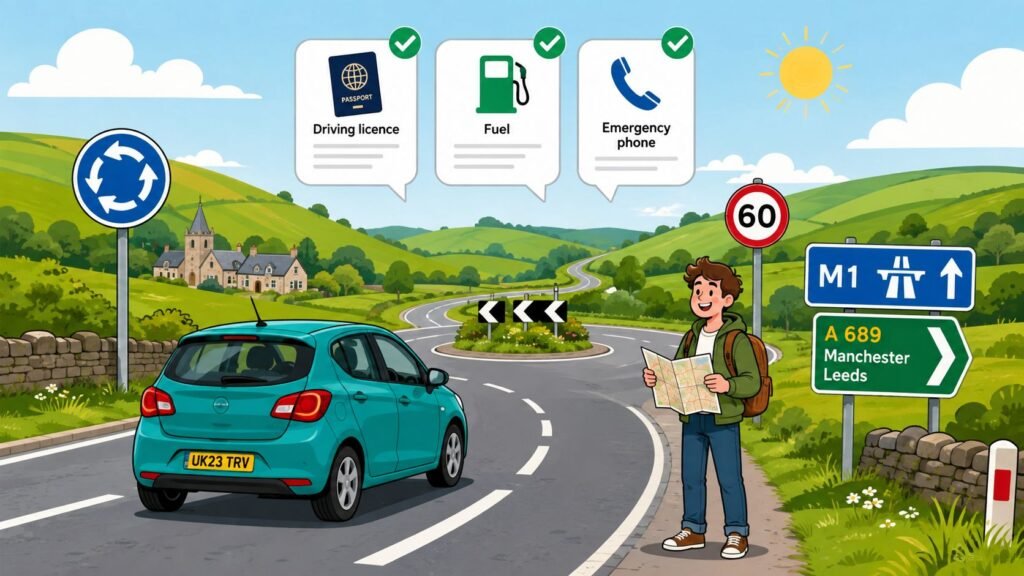
You've landed, cleared arrivals, found the hire desk, and signed the paperwork. The car feels familiar until the first few minutes on the road. You remember to stay left, then a roundabout appears sooner than expected, the sat-nav starts speaking over itself, and the road changes from a wide approach lane to a narrower local street just as you're trying to read signs.
That moment is where most UK driving nerves show up. Not because the roads are impossible, but because several small decisions arrive at once. Good self-drive travel in Britain usually comes down to three habits. Prepare before you move off, hold a calm road position instead of reacting late, and slow down early when the road, weather, or junction ahead feels unclear.
That matters on a network this busy. In Great Britain, motor vehicle traffic reached 342.6 billion vehicle miles, 1.9% higher than the previous year and 1.2% above pre-pandemic levels, according to UK road traffic statistics. For visitors, that's a practical reminder that motorways, main A-roads, and approaches to towns stay active enough that lane discipline, speed control, and forward planning make a real difference.
The most enjoyable UK road trips don't begin with bravado. They begin with the basics handled properly. Licence and insurance ready. Vehicle condition checked. First route programmed. Parking plan in mind. Fuel or charging sorted. A little extra time built into day one.
That's also where a self-drive operator like BTOURS fits naturally. Carefully planned routes, handpicked stays, and support behind the scenes make it easier to explore at your own pace without turning every junction into a test. If you want the freedom of Britain's villages, coastlines, castles, and mountain roads, the trick isn't to drive aggressively. It's to drive early, calmly, and with a plan.
1. Mastering Left-Side Driving and Road Positioning
The first challenge isn't speed. It's placement.
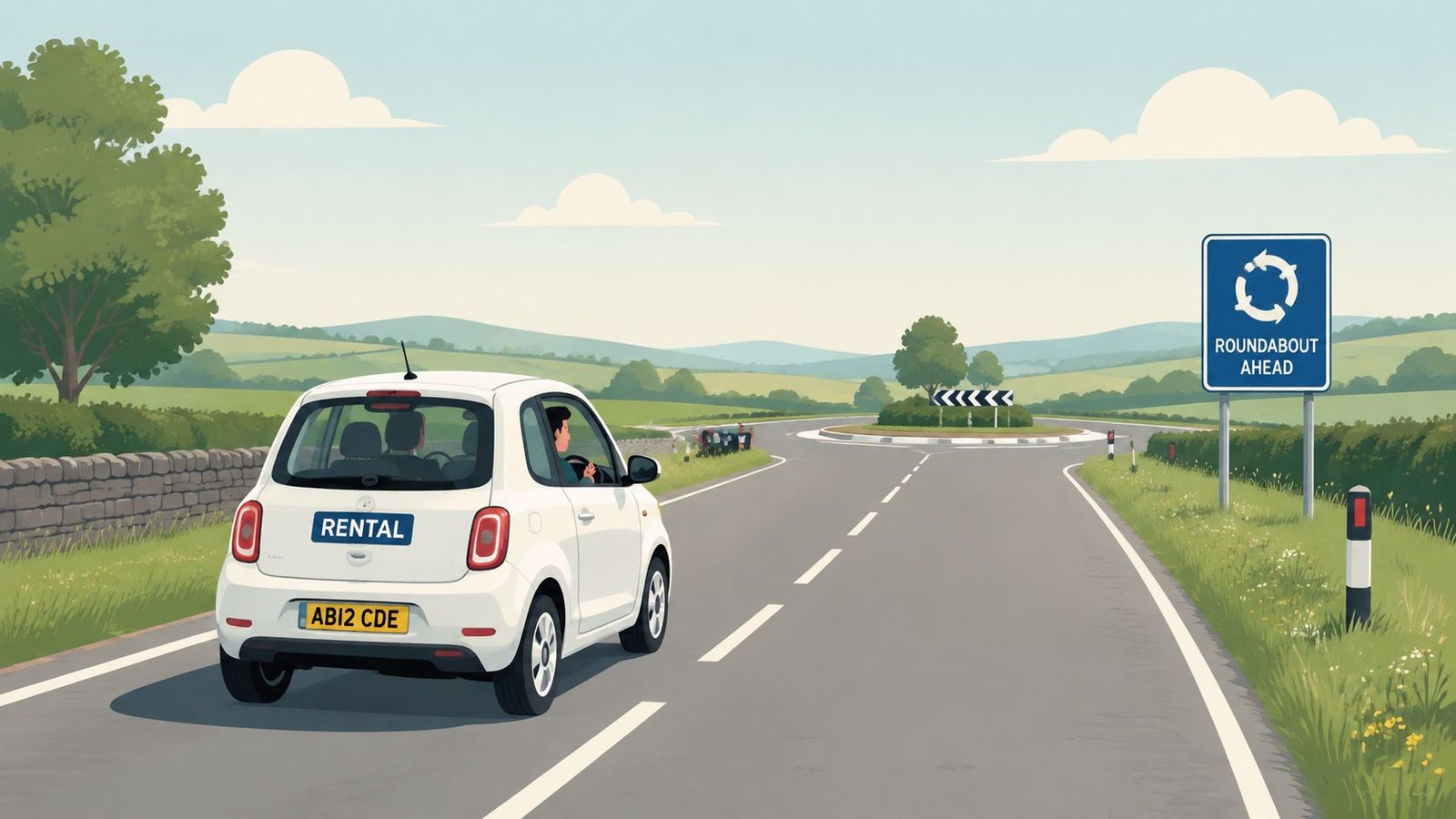
Most visitors can remember “drive on the left” while they're saying it out loud in the car park. The harder part comes a few minutes later, when you pull away from a junction, meet an empty road, or turn into a service station and your old habits try to take over. On BTOURS Scottish Highlands routes, many travellers settle into the rhythm on quieter roads first, then feel ready for busier sections later in the same day.
What helps in the first hour
Use the left kerb as your visual anchor. If the car starts drifting, don't stare at the centre line and overcorrect. Keep your eyes further ahead and let the left edge of the road remind you where the car belongs.
An automatic hire car can reduce mental load for visitors who don't normally drive manual. That matters on the first day, because road position, mirrors, signs, and roundabouts already ask for plenty of attention. If your BTOURS itinerary starts in a rural area, use that first stretch to get comfortable before attempting a motorway or busy town centre.
Practical rule: Your first wrong turn is cheaper than your first rushed correction. Miss the turn, stay calm, and let the route reset.
Position before pace
Left-side driving gets easier when you build a repeatable routine.
- Pull away deliberately: After every stop, remind yourself which lane you need before releasing the brake.
- Enter roundabouts left and circulate around them: Don't focus on the centre island. Focus on your lane and exit.
- Keep left unless overtaking: This habit matters on both local roads and motorways.
- Give day one more time: On a BTOURS self-drive journey, the first day shouldn't be overloaded with too many miles or tight arrival windows.
On Highland routes, visitors often adapt well by treating the opening leg as a practice drive rather than a distance target. That approach works. Confidence usually builds from steady repetition, not from forcing yourself through the hardest road conditions immediately.
2. Understanding UK Road Signs and Markings System
UK signs reward quick recognition. Once their visual language becomes familiar, unfamiliar roads feel easier to read from the hire-car collection onward.
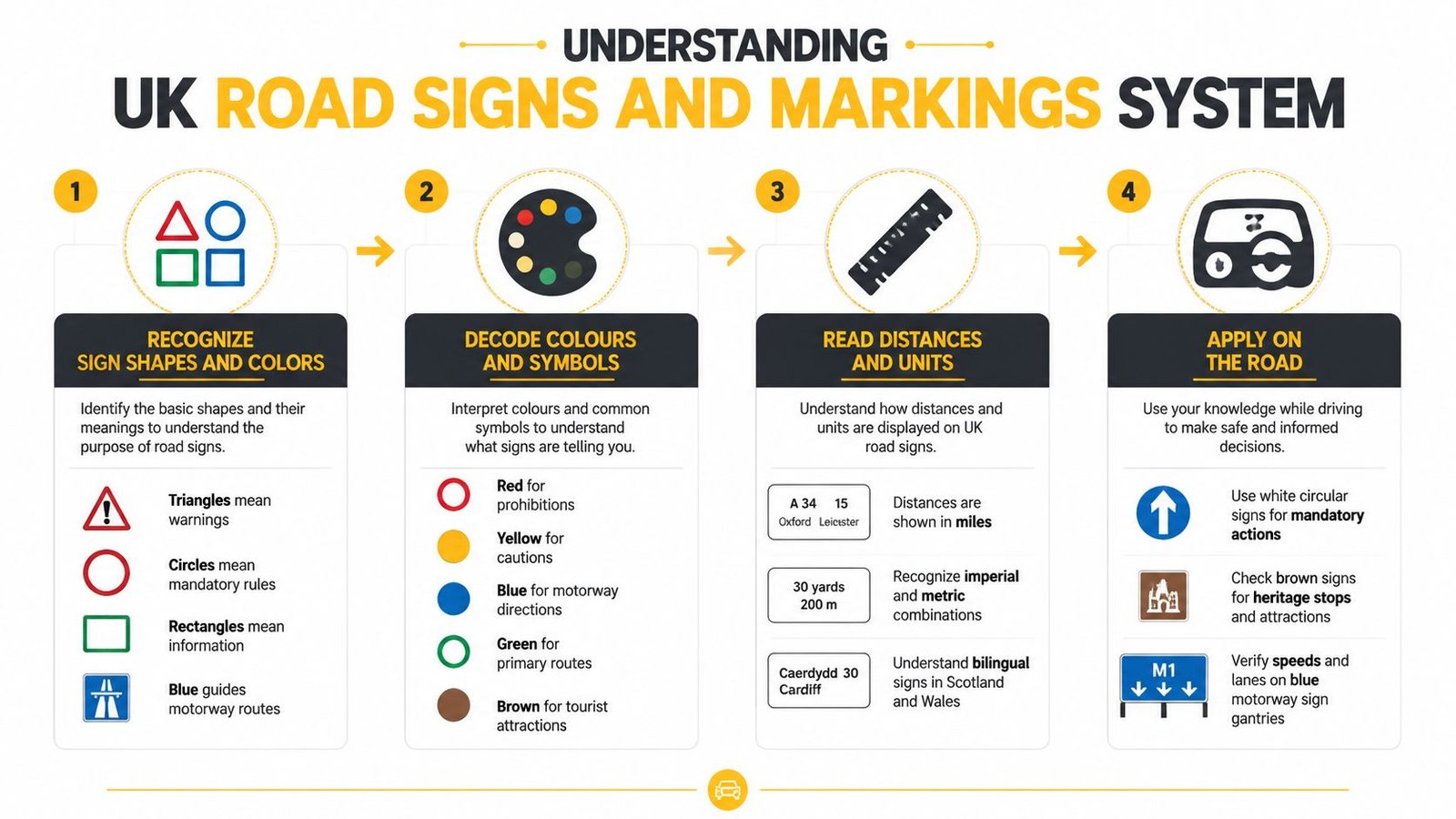
Triangles warn you. Circles usually set requirements or restrictions. Rectangular signs provide information. Blue signs matter on motorways because they show routes, exits, and services, giving you time to choose the correct lane.
Read shape first, words second
On BTOURS Royal Indulgence routes, drivers often leave larger roads for attractions or hotels. Identify the sign shape, locate the place name, then confirm the lane decision. This sequence reduces late braking and hurried lane changes.
If a sign feels crowded, read the route number and place-name shape first. Wales and parts of Scotland may have bilingual signs, so allowing extra time is safer than trying to translate every word while moving.
Brown tourist signs can change a scenic self-drive day. In Scotland and northern England, they point toward castles, heritage sites, viewpoints, and gardens that may sit just beyond the main route. On a Highlands itinerary, check whether your schedule has room before following one, because a worthwhile detour still needs a safe arrival plan.
Markings that catch visitors out
Road markings carry information that signboards may not repeat. Distances use miles, and speed uses miles per hour. If you normally drive in kilometres, avoid mental conversion while moving. Treat the posted figure as the number that governs your decision.
Use this quick check before junctions:
- Watch lane arrows early: They can identify turn-only lanes well before the junction.
- Prepare from blue signs: Choose your lane and reduce speed before the final approach.
- Follow brown signs selectively: Use them when your route has enough time for an unplanned stop.
- Read markings over general expectations: Painted arrows and lane signs take priority when they differ from a standard pattern.
Visitors often enjoy UK roads more once signs become part of the journey rather than background scenery. A BTOURS route may lead through a simple transfer, then reveal a viewpoint or historic site through a brown sign. Keep the decision deliberate: check mirrors, confirm the turn, and leave space before slowing.
Practical reminder: Read signs early, then make one clear lane decision..eth
3. Navigating UK Roundabouts with Confidence
Roundabouts worry people before the trip, then become routine once the method clicks.
The key is simple. Slow down, look right, choose your lane early, and don't improvise halfway round. Most mistakes happen because drivers arrive too fast or decide too late. That's especially true on unfamiliar local roads between towns, where several exits can appear close together.
A visual refresher helps before you set off:
A calm method that works
On many BTOURS country routes, you'll meet a mix of standard roundabouts and mini-roundabouts in towns. Treat both as decision points, not speed-maintaining curves. Enter only when traffic from the right has cleared and you can commit cleanly.
A practical lane guide for ordinary roundabouts is:
- Left lane: Usually for the first exit or exits to the left.
- Middle or left lane: Often suitable for straight ahead, depending on markings.
- Right lane: Usually for later exits or going further around.
Road markings always override generic rules, so trust painted arrows and lane signs when they're present. If you miss the exit, keep going around and take the next chance safely.
Go slower than you think you need to. Roundabouts punish indecision more than low speed.
Later in the section, if you want a moving example, this short video is useful for visual learners:
What visitors get wrong
On BTOURS routes between handpicked accommodations, the most common issue isn't forgetting left-side driving. It's entering a roundabout while still trying to read hotel directions, lane arrows, and sat-nav prompts at once.
UK collision guidance supports that emphasis on decision points. Speed-related factors were assigned to 52% of fatal collisions in Great Britain, with exceeding the speed limit recorded in 29% of fatal collisions, while mobile-device use was recorded in 3.2% of fatal collisions and 2% of fatal or serious collisions, according to reported road casualty risk behaviour data. For travellers, that means junctions, lane changes, and unfamiliar turns deserve more attention than novelty alone.
4. Motorway Driving Etiquette and Safety Protocols
Collecting a hire car in London can feel demanding, but the motorway often becomes the clearest part of a BTOURS journey. Once you settle into left-side lane discipline, the main task is managing speed, spacing, fatigue, and changing traffic conditions.
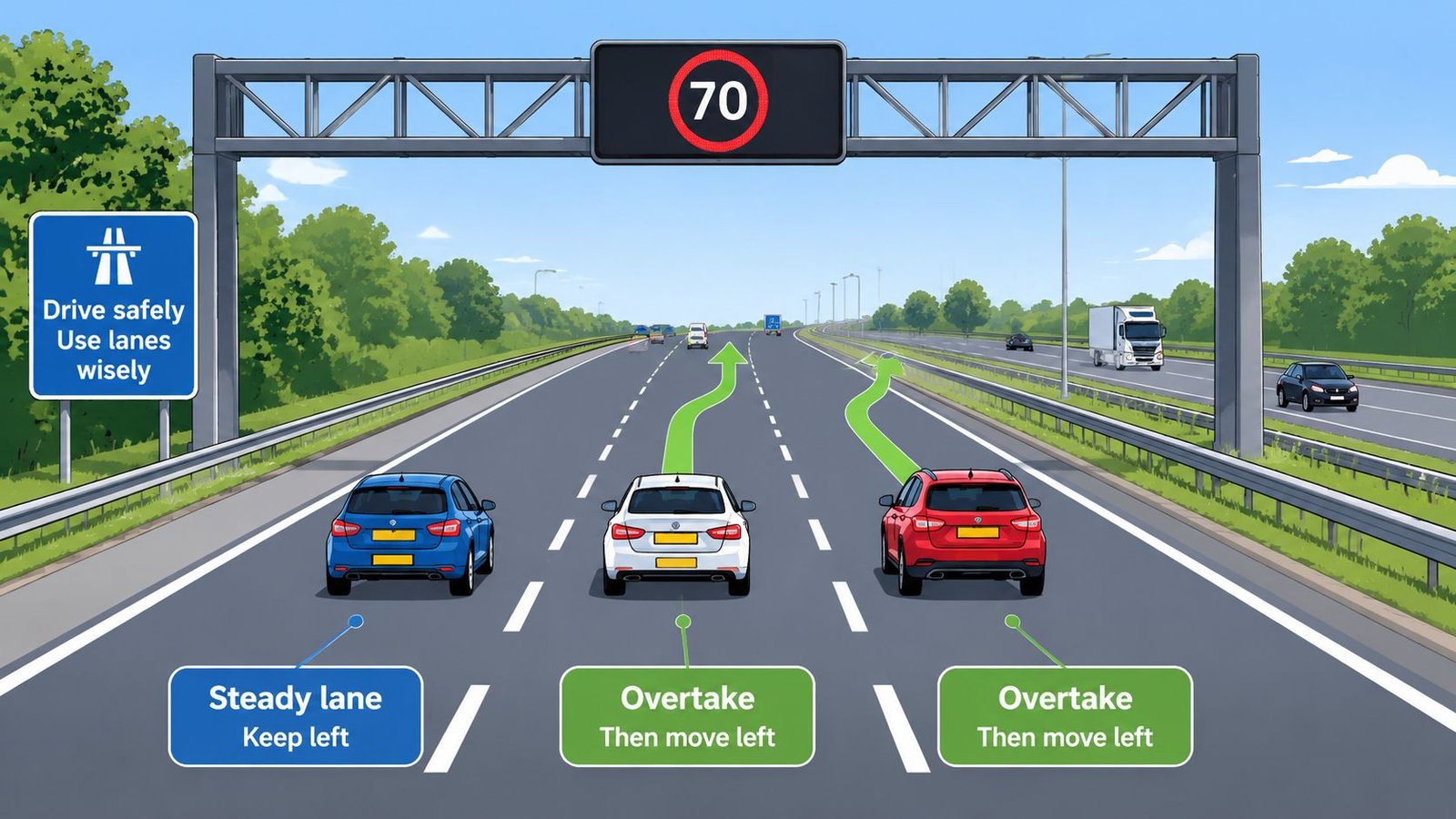
The left lane is the default lane on UK motorways. Use the right-hand lanes to overtake, then return left when you have completed the pass. Staying in the middle lane because it feels comfortable restricts other drivers and can lead to unnecessary close following or late lane changes.
A practical motorway checklist
On a BTOURS Scottish Highlands itinerary, routes such as the M6 and M74 may cover the longer distance before the scenery changes to rural roads. Use that motorway stretch to establish a steady routine:
- Keep left by default: Check mirrors before moving out, signal early, overtake smoothly, and return left without lingering.
- Leave a generous gap: Space gives you time to respond to rain, roadworks, sudden braking, and traffic waves.
- Plan service stops: Use motorway services before fatigue becomes distracting, particularly after collecting the car or completing a long scenic drive.
- Read electronic signs: Variable speed limits and lane instructions apply as soon as they are displayed.
- Protect your attention: Set navigation before joining the motorway, and handle route changes only when safely parked.
A missed exit is manageable. Continue on the motorway and follow the next safe opportunity rather than cutting across lanes or braking sharply.
What works and what does not
Consistent driving works better than trying to recover lost time. Tailgating, abrupt lane changes, and skipping breaks make the next part of the journey harder, especially when a motorway leg leads into an unfamiliar exit, urban ring road, or rural A-road.
Reported Great Britain road safety figures include 1,538 fatalities, 29,918 people killed or seriously injured, and 127,883 casualties of all severities in collisions, with 4 road fatalities per billion vehicle miles travelled, according to Great Britain road safety statistics. The figures reinforce a defensive approach.
On a BTOURS route leaving London or heading north into Scotland, arriving slightly later and rested is a better outcome than maintaining schedule through stress. Save your concentration for the narrow lanes, weather changes, scenic viewpoints, and final parking stop that make the self-drive worthwhile.
5. Traffic Laws, Insurance, Speed Limits, and Enforcement
Before leaving the hire-car depot, complete two checks: confirm the documents and record the vehicle's condition. Carry your driving licence, and keep an International Driving Permit with it if your home licence requires one for travel. Store the rental agreement where you can reach it without unpacking the car.
Photograph the hire car from several angles, including the wheels, bumpers, windscreen, and visible roofline. This takes little time and gives you a clear record if damage is questioned at the final return.
Rules that change a day's plans
Keep phones, tablets, sat navs, and other data-capable devices untouched while driving or riding. UK law prohibits holding and using them, with an offence carrying 6 penalty points and a £200 fine. The maximum fine can reach £1,000, or £2,500 for lorry or bus drivers, according to UK mobile phone driving law.
Set navigation before joining the road. If the route needs correcting, stop legally and safely first. A scenic BTOURS drive may tempt you to photograph a viewpoint or answer a message, but the safe choice is to finish the manoeuvre, park, and then use the device.
Check the speed signs whenever a route crosses a national boundary. The built-up area default is 30 miles per hour in England, Scotland, and Northern Ireland, and 20 miles per hour in Wales, according to UK speed limit guidance. A BTOURS itinerary entering Wales therefore requires a deliberate reset, particularly through villages and town streets.
A practical compliance check
Use this routine before the first scenic leg:
- Confirm insurance: Check the excess and what the rental policy includes.
- Keep paperwork accessible: Place documents where they can be reached at a roadside stop.
- Separate driving from alcohol: Finish the day's driving before a distillery visit or countryside lunch.
- Expect enforcement: Cameras and police checks reward steady compliance, not last-minute braking.
The same planning applies when comparing smaller vehicles. This guide to UK electric moped legal requirements provides context on insurance and road-use compliance. Knowing these boundaries before collecting the car leaves more attention for motorways, single-track roads, changing weather, and the final parking decision.
6. Parking Regulations and City Centre Navigation
The last half-hour can test a driver more than a scenic route. After collecting a hire car and covering motorways or narrow country roads, you may reach a city as traffic builds, streets tighten, and parking signs change from one block to the next.
Parking often decides whether a UK road-trip day finishes calmly. BTOURS Royal Indulgence London itineraries may include accommodation with parking arranged, which removes much of that uncertainty. If parking is not included, choose a paid multi-storey car park rather than guessing at kerbside restrictions in an unfamiliar centre.
The low-stress city approach
Street parking suits drivers who have already checked the local rules. Otherwise, set up a destination car park before entering the busiest streets, follow the signs, park legally, and continue on foot or by public transport.
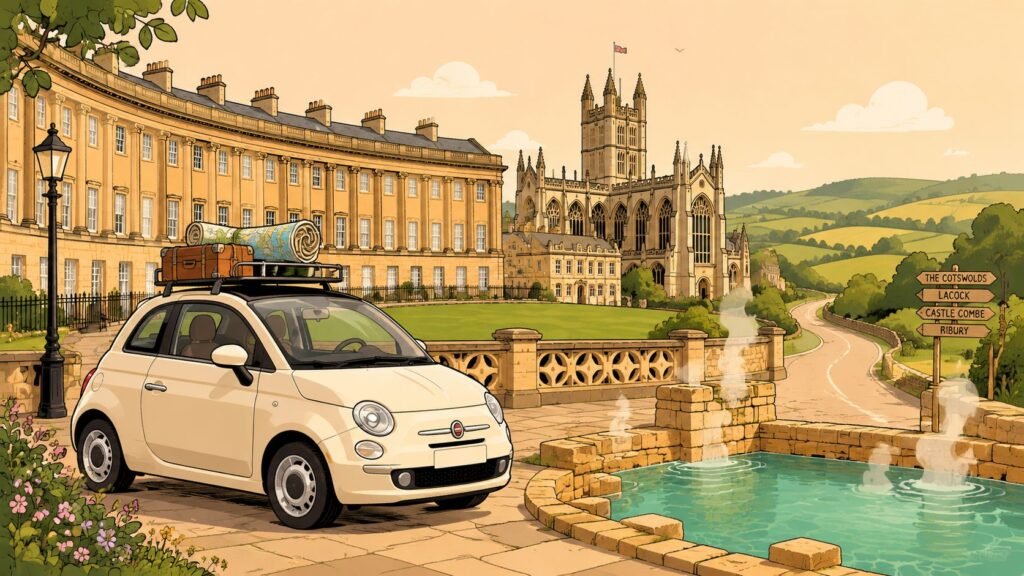
That choice works well in Bath, Edinburgh, and approaches to central London, where historic layouts can be awkward for a modern hire car. Treat a city stop as the end of a driving leg, not another route-finding exercise. A planned parking stop leaves time for the destination. This Bath city break vintage car view reflects the arrival travellers want, while the practical version begins with knowing where the car will stay.
Parking mindset: An unclear space is a reason to move on. Choose a location whose restrictions and payment terms are clear.
Practical habits that save hassle
- Reserve where possible: Check parking apps before departure, especially for a city-centre arrival.
- Read every sign before leaving the car: Confirm the permitted hours, payment method, and any permit or vehicle restrictions.
- Photograph the signs and your payment confirmation: Keep a record when restrictions are time-based.
- Confirm hotel parking: Ask the property in advance whether spaces are available and whether they must be reserved.
- Allow arrival time: Rushing can lead to yellow-line stops, bus-lane errors, or wrong turns on one-way streets.
If a scenic BTOURS route ends in a city, make the parking decision before the final approach. Once the car is secure, dinner, a riverside walk, or an old-town stroll becomes the reward, rather than another circuit of crowded blocks.
7. Managing Fuel, Electric Charging, and Vehicle Maintenance
Collecting a hire car in a city and heading towards the Highlands changes how you plan fuel. Petrol and diesel are widely available on mainland UK routes, but waiting for the next obvious station can create problems on a long rural stretch. A BTOURS Scottish Highlands route may lead from a larger town into scenic country where the next convenient stop is farther away than expected.
Keep the car ready, not just moving
Refuel while the gauge still gives you options. Do it before an evening arrival, an island crossing, or a long detour through sparsely populated countryside. Larger villages and towns are practical stopping points, whereas a small scenic settlement may have limited opening hours or no suitable facility.
Electric cars need the same forward planning with less room for improvisation. Set charging stops before departure and check that they suit the route, the vehicle, and your likely arrival time. Cold weather and steep roads can reduce the battery range faster than a flat motorway journey, so leave a sensible reserve rather than planning to arrive at a charger with little capacity remaining.
Use this quick routine:
- Top up in larger towns: Rural villages may not match your timing or vehicle needs.
- Confirm the rental return rules: Check whether the car must return with a particular fuel or charge level.
- Inspect tyres and visible damage: A short walk-around can reveal a problem before it affects a remote leg.
- Save breakdown contacts twice: Keep the numbers in your phone and on paper in case the battery fails.
Technology helps, but preparation matters more
Driver-assistance systems can reduce fatigue, provided you understand their limits. In UK data, 25% of drivers with these systems say they use them regularly or often, while 33% never use them. Although 82% report feeling safer with ADAS, and 55% say it helped prevent a collision in the past year, it remains support rather than a substitute for attention, according to IAM RoadSmart reporting on ADAS use.
Ask the hire company to demonstrate adaptive cruise control, collision warnings, and lane-keeping support before leaving the collection point. Test the settings while stationary. Discovering unfamiliar controls halfway through a wet motorway section adds avoidable distraction.
For broader electric touring comparisons, top EV road trip cars 2026 provides context on vehicle choice. Your daily success still depends on charger planning, realistic range, and keeping the car ready for the next BTOURS route stage.
8. Weather Adaptations and Seasonal Driving Challenges
Collecting a hire car in sunshine does not guarantee a dry day ahead. A BTOURS route can cross open moorland in mist, reach a coastal road in strong wind, and finish near a busy town as daylight fades. Treat each change as a reason to adjust speed, spacing, and timing.
If the road becomes harder to read, make the decision early: slow down, leave more room, and remove distractions. Arriving later is safer than holding to a timetable that no longer suits the conditions.
What changes with weather
Wet roads require earlier braking and smoother steering. Rain also reduces visibility, while spray from larger vehicles can briefly obscure the lane. On exposed coastal and upland roads, gusts may move the car sideways, especially when passing a lorry or crossing an open stretch.
Before leaving for a BTOURS Highland or countryside route, check the forecast and review it again before taking a long scenic detour. Poor conditions may justify a shorter driving day or a more sheltered route. That choice protects time for walking, viewpoints, and the final stop rather than turning the drive into an exhausting test.
Use these habits throughout the year:
- Use dipped headlights in poor visibility: Make the car easier for other drivers to see.
- Pack layers and basic emergency items: Staying warm while waiting for assistance is safer than driving when tired or uncomfortable.
- Reduce speed early in rain: Adjust before bends, standing water, or spray become immediate problems.
- Pause if conditions feel wrong: A café stop can prevent a stressful hour behind the wheel.
Don't let scenery pressure your judgement
A famous route can create its own pressure. Travellers may continue because the day was planned around a particular viewpoint, even after wind, rain, or mist changes the risk.
If a BTOURS journey through upland Scotland, rural Wales, or a coastal section in Ireland becomes difficult, stop, wait, or reroute. The route remains worthwhile when you reach its highlights alert and comfortable. Build flexibility into the day, especially before the final parking stop, because weather can make a short approach slower and less predictable.
9. Navigating Narrow Roads, Single-Track Routes, and Rural Driving
Collecting a hire car is straightforward until a scenic route narrows to one lane. On single-track roads and tight country lanes, progress depends on reading the road early, choosing a safe meeting point, and giving other drivers time. These conditions are common on parts of the Highlands, remote Wales, and coastal approaches that were never widened for modern traffic.
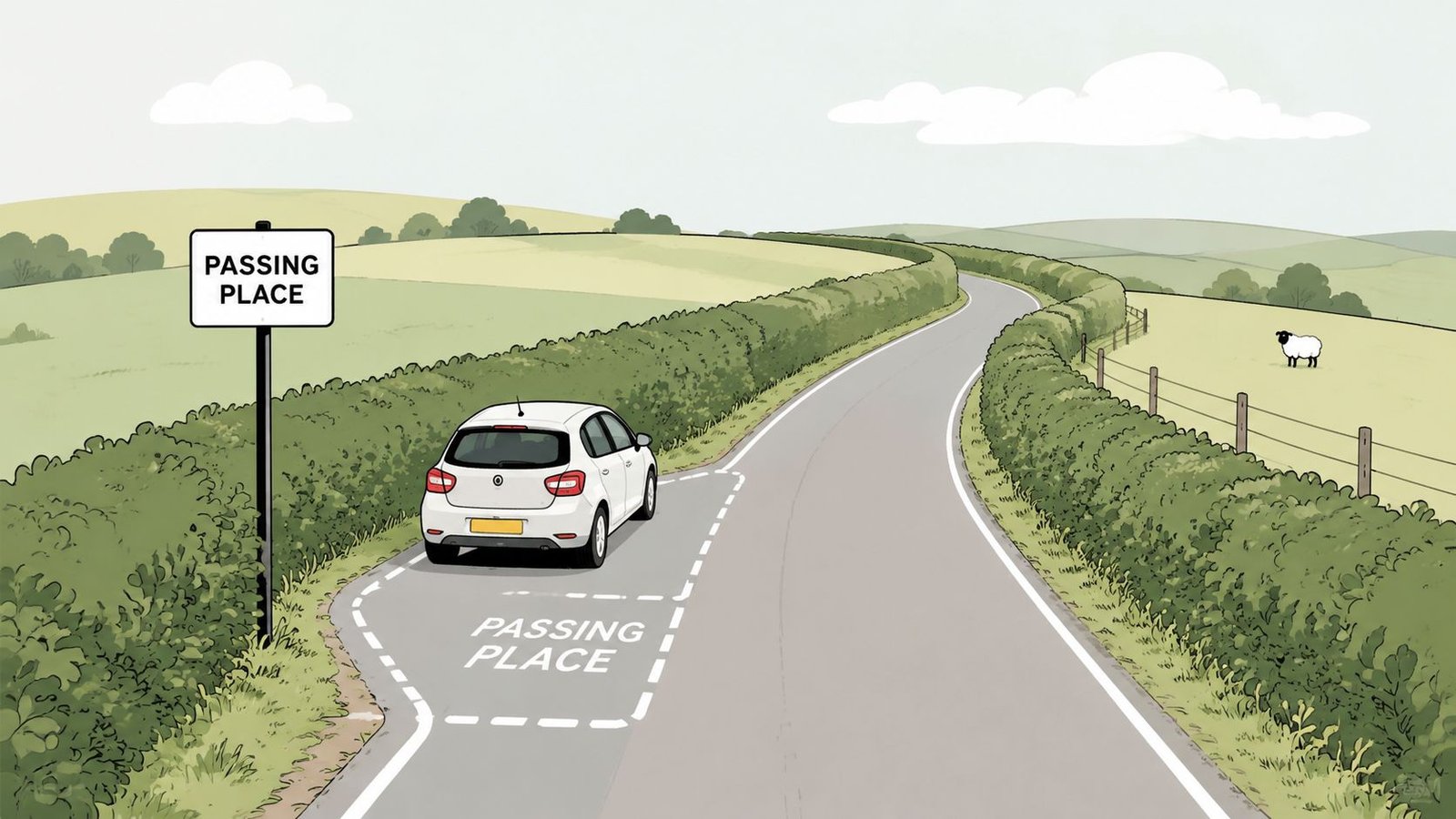
Passing-place etiquette
On BTOURS Scottish Highlands routes, passing places are working parts of the road. Use one to let oncoming traffic through or to allow a faster local driver to pass. Pull fully into the space when safe, and never stop there for photographs. If no passing place is close, slow down early and agree who has the better route to a wider section.
Keep your speed low enough to stop within the visible road. On Glen Coe approaches and exposed rural stretches, hold a steady position with room to move rather than driving hard against the verge. Continuous edge-hugging can bring the tyres close to drains, loose gravel, stone walls, or soft ground.
The same patient approach suits the Penzance to Land's End coastal road route. Scenic roads reward observation more than speed, particularly when the next bend hides a cyclist, tractor, or oncoming car.
Rural habits that protect the day
- Stop within what you can see: Treat blind bends and brows as possible hazards.
- Scan for meeting points: Identify wider sections before committing to a narrow stretch.
- Expect animals: Sheep, deer, and cattle can enter the road without warning.
- Let locals pass safely: They may know the route well and have a faster, more confident pace.
- Keep the phone out of reach: Set navigation before moving, then focus on road position.
UK driver behaviour findings report mobile-phone use while driving, including both hand-held and hands-free use, according to self-reported driver behaviour findings. Even hands-free directions can divide attention on a narrow lane. Pull into a safe place before changing the route, taking a photograph, or checking the final parking stop.
10. Using Navigation Technology and Route Planning for Scenic Self-Drive Journeys
Collect the hire car, set the destination, and check the route before leaving the depot. A navigation app should support your decisions, not choose every road automatically. The quickest option may use an awkward rural lane, miss a worthwhile viewpoint, or leave too little time for the final parking stop.
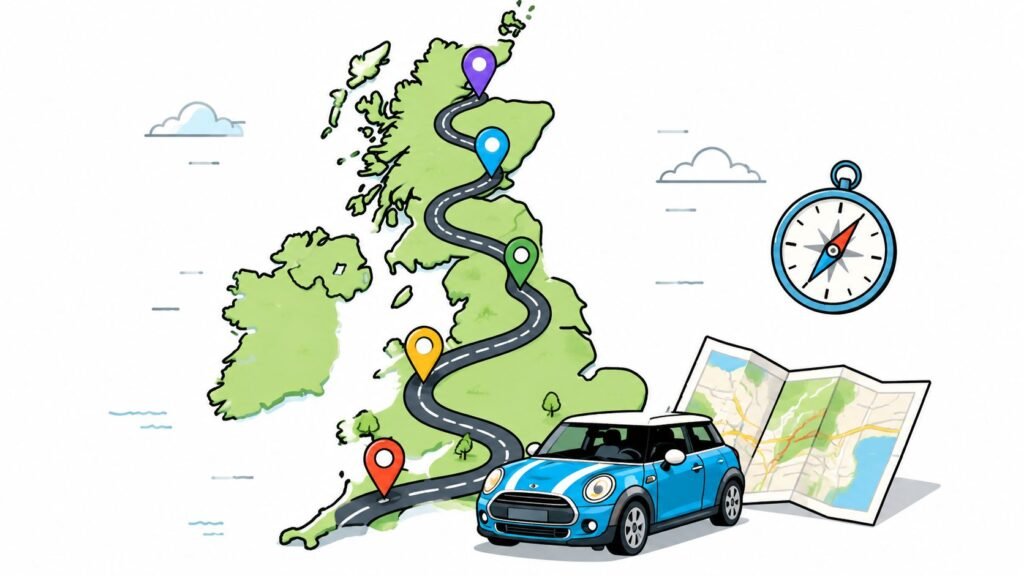
A practical BTOURS route plan combines the main journey with selected stops. Save the hotel, lunch village, viewpoint, and fuel or charging point before departure. The UK road trip planner illustration shows the principle clearly: scenic travel works better when the route is chosen in advance.
UK drivers commonly rely on phone-based navigation, while separate dashboard units are less common, according to RAC findings on sat-nav use. Travellers should therefore prepare for postcode entry, phone mounting, and offline access rather than assuming every road will have a reliable signal.
Use navigation without surrendering judgement
Before joining a motorway, confirm the next major junction and rest stop. On a scenic single-track route, check whether the suggested road suits the hire car and your confidence level. A few saved alternatives can prevent a rushed decision when weather, traffic, or a temporary closure changes the plan.
- Download offline maps: Cover remote parts of Scotland, Wales, and coastal areas before setting off.
- Choose one primary app: Switching repeatedly between apps can create wrong turns.
- Save landmark details: A postcode may lead near a property rather than to its entrance.
- Mark the final approach: Rural hotels and parking areas can be difficult to identify after dark.
- Set routes while stationary: Pull into a safe place before changing destinations or adding stops.
Voice guidance reduces screen checking, but it does not replace road signs or observation. Screenshots of a hotel entrance, car park, or rural turn-off can help when reception disappears. Keep the phone mounted and leave the route alone while the car is moving.
For longer self-drive trips, a GPS car tracker with route history can provide extra context on vehicle location and completed routes. Use it as a record-keeping tool, while route choices remain based on road conditions, legal access, and the day's driving limits.
10-Point Comparison: Driving in the UK
| Topic | Implementation complexity | Resource requirements | Expected outcomes | Ideal use cases | Key advantages |
|---|---|---|---|---|---|
| Mastering Left-Side Driving and Road Positioning | Low–Medium, short learning curve (1–2 hrs) | Quiet roads for practice, GPS, optional automatic car | Confident left‑lane positioning and safer driving | International visitors, first-day self‑drive tours | Improved safety once adapted; better visibility |
| Understanding UK Road Signs and Markings System | Medium, requires study and attention | Road sign guide, observation time, practice | Faster hazard recognition and compliant routing | New UK drivers, urban and rural navigation | Standardised, quick visual cues; consistent guidance |
| Navigating UK Roundabouts with Confidence | Medium–High, varies by roundabout type | Practice time, lane guidance, low‑traffic practice | Smooth entry/exit, reduced conflicts at junctions | Routes with frequent roundabouts, town driving | Efficient traffic flow; natural calming; high throughput |
| Motorway Driving Etiquette and Safety Protocols | Medium, high‑speed discipline needed | Knowledge of lane rules, mirrors, rest planning | Efficient long‑distance travel and safer high‑speed driving | Long transfers, intercity travel on M‑roads | Fastest routes; predictable patterns; services available |
| Traffic Laws, Insurance, Speed Limits, and Enforcement | Medium, legal compliance required | Valid licence, insurance, documentation, awareness | Legal compliance, fewer fines/points, clearer responsibility | All drivers, international visitors, rentals | Legal protection; enforced safety standards |
| Parking Regulations and City Centre Navigation | Medium, local rules vary and can be complex | Parking apps, payment methods, time allowance | Avoidance of fines, predictable city access | City breaks, central hotel stays | Multiple payment options; regulated availability |
| Managing Fuel, Electric Charging, and Vehicle Maintenance | Medium, planning essential for range and service | Fuel/charging apps, maps of stations, maintenance contacts | Reliable range, fewer breakdowns, planned stops | Long rural routes, EV road trips | Predictable fuel network; growing EV infrastructure |
| Weather Adaptations and Seasonal Driving Challenges | Medium, seasonal prep and caution needed | Winter kit, tyres, weather apps, emergency supplies | Safer driving across seasons; reduced weather risk | Winter/highland travel; variable‑season itineraries | Preparedness reduces incidents; enables seasonal trips |
| Navigating Narrow Roads, Single‑Track Routes, and Rural Driving | Medium–High, technical positioning and etiquette | Low speeds, local route knowledge, passing‑place skill | Safe passage on single‑track roads; access to remote sites | Highlands, coastal lanes, rural scenic routes | Access to remote scenery; calmer, authentic routes |
| Using Navigation Technology and Route Planning for Scenic Self‑Drive Journeys | Low–Medium, setup and map prep required | GPS/smartphone, apps, offline maps, chargers | Efficient scenic routing, fewer navigation errors | Scenic self‑drive, remote areas with limited signal | Real‑time updates, POIs, offline capability |
Make Every Mile Safer and More Memorable
The best UK road trips usually feel relaxed by design, not by luck. Before you leave the hire car park, get the essentials in order. Confirm your licence and insurance documents are where you can reach them. Photograph the car's condition. Pair your phone, mount it properly, and download offline maps. Add your first hotel, planned fuel or charging stop, and a practical backup stop if the day runs slower than expected.
Then do one more thing that people skip. Sit still for a minute and look at the route in plain language. Are you starting with a city exit, a motorway, a rural road, or a roundabout-heavy stretch? Knowing the character of the first leg matters more than knowing every later detail. It settles your pace from the beginning.
A strong departure routine is simple:
- Licence and paperwork ready: Don't bury them in luggage.
- Hire car checked and photographed: Note any marks before departure.
- Navigation prepared in advance: First destination loaded, offline backup saved.
- Fuel or charging plan identified: Don't leave it until the gauge drops.
- Weather reviewed: Especially for upland, coastal, or rural driving days.
- Emergency contacts stored: Rental assistance and accommodation numbers should be easy to find.
Once you're moving, keep the safety rules equally simple. Stay left. Read signs early. Obey displayed limits. Leave more space than you think you need in rain, traffic, or on unfamiliar roads. Take breaks before fatigue starts making your decisions slower. On rural single-track roads, use passing places properly and never treat them as photo bays. If conditions feel unsafe, stop and reset rather than pressing on to protect a timetable.
The legal side matters too. Keep your phone out of your hands while driving. Treat alcohol as off-limits until the car is parked for the day, especially since drink-drive limits are not uniform across the UK. England, Wales, and Northern Ireland use 80 milligrams of alcohol per 100 millilitres of blood, 35 micrograms per 100 millilitres of breath, and 107 milligrams per 100 millilitres of urine, while Scotland uses lower limits of 50 milligrams per 100 millilitres of blood, 22 micrograms per 100 millilitres of breath, and 67 milligrams per 100 millilitres of urine, according to official UK drink-drive limit guidance. The practical answer for a road trip is straightforward. If you're driving, don't drink.
The encouraging truth behind all driving in UK tips is that most visitors adapt faster than they expect. The first roundabout feels awkward. The first narrow lane feels too small. The first city parking sign feels overcomplicated. Then the habits settle. You start reading the road earlier, placing the car more naturally, and slowing down before the difficult bits instead of inside them.
That's when self-drive travel in Britain becomes what people hope it will be. A flexible way to move between castles, coastlines, villages, gardens, pubs, mountain roads, and old market towns without being rushed through any of them. Preparation doesn't reduce freedom. It creates it.
For travellers who want that freedom with a carefully arranged route behind it, BTOURS is one practical option. Thoughtful self-drive planning, well-chosen stays, and support around the journey can make the road feel less uncertain and a lot more enjoyable.
BTOURS creates self-drive road trips, multi-day journeys, and curated city breaks across England, Scotland, Wales, Ireland, the Nordics, and Greece. If you want a route that blends practical driving support with handpicked stays and flexible touring, visit BTOURS and explore the journeys that fit the way you like to travel.