Most advice about Greece in May gets it backwards. People sell it as a beach month first, then act surprised when the sea still feels cool and the trip works better as a mixed itinerary, not a sun-lounger marathon. If you want the trip to feel sharp, relaxed, and worth the mileage, May is when you go for roads, ruins, tavernas, and one good coastal base, not endless island-hopping for the sake of it.
That's the advantage for independent travellers. Greece in May gives you spring weather, stronger daylight, and the country before peak summer pressure takes over, so you can move more freely and see more without cooking in the heat. It also means you can build a route that combines Athens, the mainland, and one island stay, instead of forcing every day to be a beach day.
Why May is Greece's Best-Kept Secret
May works because it refuses to pretend to be July. The country is open for serious travel, the weather is still comfortable for moving around, and you get a month that feels active without the heavy summer grind. For self-drive travellers, that matters. You can cover ground without constantly planning around heat, queues, and exhausted service.
The month also has its own local rhythm. May 1, Protomayia, is a national public holiday tied to spring traditions and labour politics, and the day carries a long civic history in Athens, where May Day became linked to workers' rights as well as older seasonal customs (Juniper Tours).
The case for travelling before summer crowds
Greece does not only come alive in high summer. In May, heritage sites are easier to enjoy, walking feels more humane, and everyday life is still visible instead of being buried under peak-season tourism. You get the country in motion, not just the version built for mass arrivals.
May also has real historical weight. The Battle of Gravia and the Battle of Valtetsi sit in the month's memory and give it a stronger national frame than casual visitors usually expect (Greek City Times, Hellenic Army General Staff). That gives the month more than good weather. It gives it context.
Practical rule: If your trip is built around movement, not just beach time, May beats peak season almost every time.
That is why a mixed itinerary works so well. Spend time in Athens, drive the mainland, add one island base, and you get the shoulder-season advantage where it counts most, in the freedom to stop, detour, eat late, and keep the trip varied. If you are packing for a route that mixes city walks, ferry days, and a bit of coast, smart beach packing hacks are useful because May travellers need flexible kit, not a bag built for one type of holiday.
What to expect from the mood on the ground
May trips feel lived-in, not staged. Cafés are open, the countryside still shows spring colour, and the country has not yet settled into the summer routine of queues, heat, and hurried service. That is exactly why I would choose it for a driving trip.
You still get the sunshine people come for, but you earn it differently. You are not buying a beach holiday that happens to include ruins, you are choosing a travel month that rewards curiosity and gives you room to move.
Understanding the May Climate and Regions
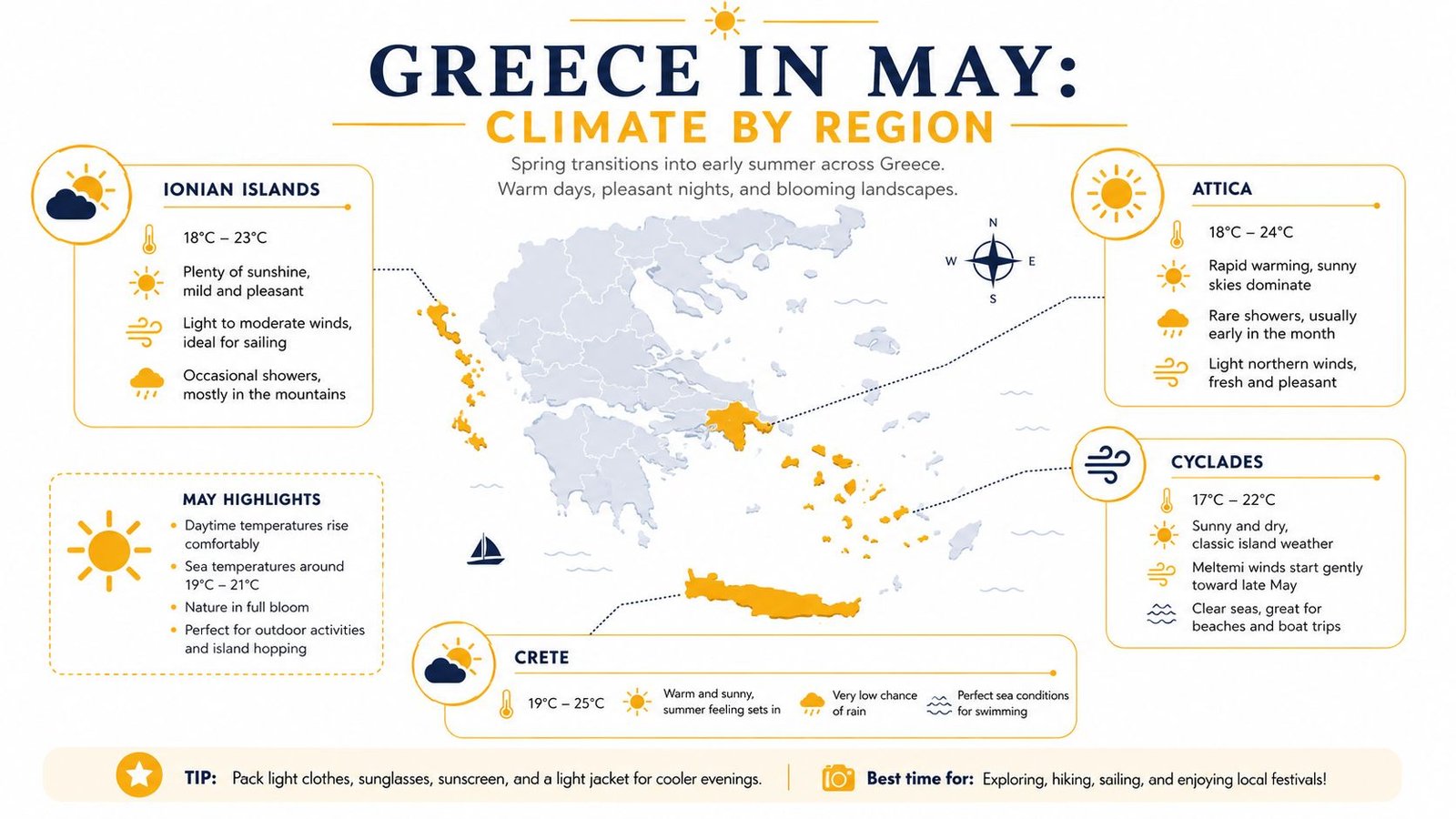
May in Greece is not one weather story, it's several. Athens has a rapid shoulder-season transition, with daily highs climbing from about 22.2°C to 27.2°C over the month and lows rising from about 12.2°C to 17.2°C, while cloud cover falls from roughly 33% to 22% (WeatherSpark). That means the first half of the month feels gentler for city wandering, and the second half starts pushing harder towards early-summer conditions.
Athens and the mainland are not the same experience as the islands
Athens is the place to start if you want to walk a lot without suffering for it. The long-term climate record for the city has been tracked since the 19th century in the National Observatory of Athens archive, which is useful because it underlines just how established this shoulder-season pattern is (National Observatory of Athens). For practical planning, that matters more than romantic talk about “Mediterranean warmth.” You want a city that behaves well for museums, rooftop dinners, and archaeological wandering, and Athens does that in May.
The mainland also handles road travel well at this time of year. The roads feel less punishing, the hills stay greener for longer, and long drives into the Peloponnese or north towards central Greece are easier to enjoy before the heat sets in. I'd choose May for a driving holiday here without hesitation.
Standout point: Early May is for walking and cultural stops, later May is for longer outdoor days and more exposed ruins visits.
The climate also helps explain why Greece is often promoted as a shoulder-season destination at this point in the calendar. UK-facing travel guidance for May points to around 23 mm of monthly rainfall, about 10 hours of sunshine per day, and a very high UV index, which means the month can feel mild but still be harsh under direct sun (Weather2Travel). That combination is exactly why I keep saying this is not just a beach month. Dry air and long daylight make sightseeing easy to overdo unless you respect the sun.
Regional differences change how the month feels
The islands and coasts don't all warm up at the same pace. The Ionian side usually feels greener and softer, the Cyclades look sharper and drier, and the Aegean can feel more exposed to wind even when the air is pleasant. That's why the month suits flexible travellers, not rigid ones. If your idea of a perfect day involves long lunches, short swims, and plenty of driving stops, May delivers.
The sea is where expectations need adjusting. Much of Greece still has cool sea temperatures around 17–20°C in May, which means swimming is possible but not yet reliably warm (Santorini Dave). Treat coastal days as a bonus, not the whole point. If you want beach-first certainty, you're too early.
How to read the month properly
Think in layers. Athens early in the month is ideal for museums and old neighbourhoods, the Peloponnese is excellent for driving and heritage stops, and islands work best when you accept that you may be choosing scenery and atmosphere over warm-water certainty. The sweet spot is matching the region to the kind of day you want.
If you want a simple rule, use this one. Cooler start, warmer finish, drier conditions throughout, and beach weather that improves but never fully turns into mid-summer luxury. Pack for motion, not for one static mood.
Island Hopping vs Mainland Road Trips
Most trips either get brilliant or get messy. In May, I'd choose the mainland for a first-timer who loves variety, and the islands for a traveller who already knows they want slower days, sea views, and a softer pace. Island hopping can still work, but the ferry rhythm is less forgiving than it is in summer, so you need a cleaner plan and less improvisation.
Why the mainland usually wins in May
A rental car on the mainland gives you real control. You can leave Athens, push into the Peloponnese, stop at ruins without queue fatigue, and build days around villages rather than timetables. That's the smarter move if you care about seeing more of Greece rather than merely ticking off famous names.
The mainland is also kinder to mixed interests. One morning can be archaeological, the next scenic, and the evening can end in a village taverna where nobody cares if you arrived late. You can't replicate that level of freedom when every transfer depends on a ferry window.
Where island hopping still makes sense
I still like island time in May, but only when it's treated as part of a broader route. A single island base works better than chasing three or four in a row, because the shoulder-season trade-off is exactly what you'd expect, more calm and less speed. That means you can enjoy the views without building your whole trip around transport logistics.
There's a practical reason to keep this simple. If you want an idea of how coastal road journeys can be stitched together with scenery and detours, the route framing in this coastal road reference shows the kind of flexible travel pattern that suits May better than frantic island rotation.
Pick one island to slow down on. Don't try to make every ferry day feel productive.
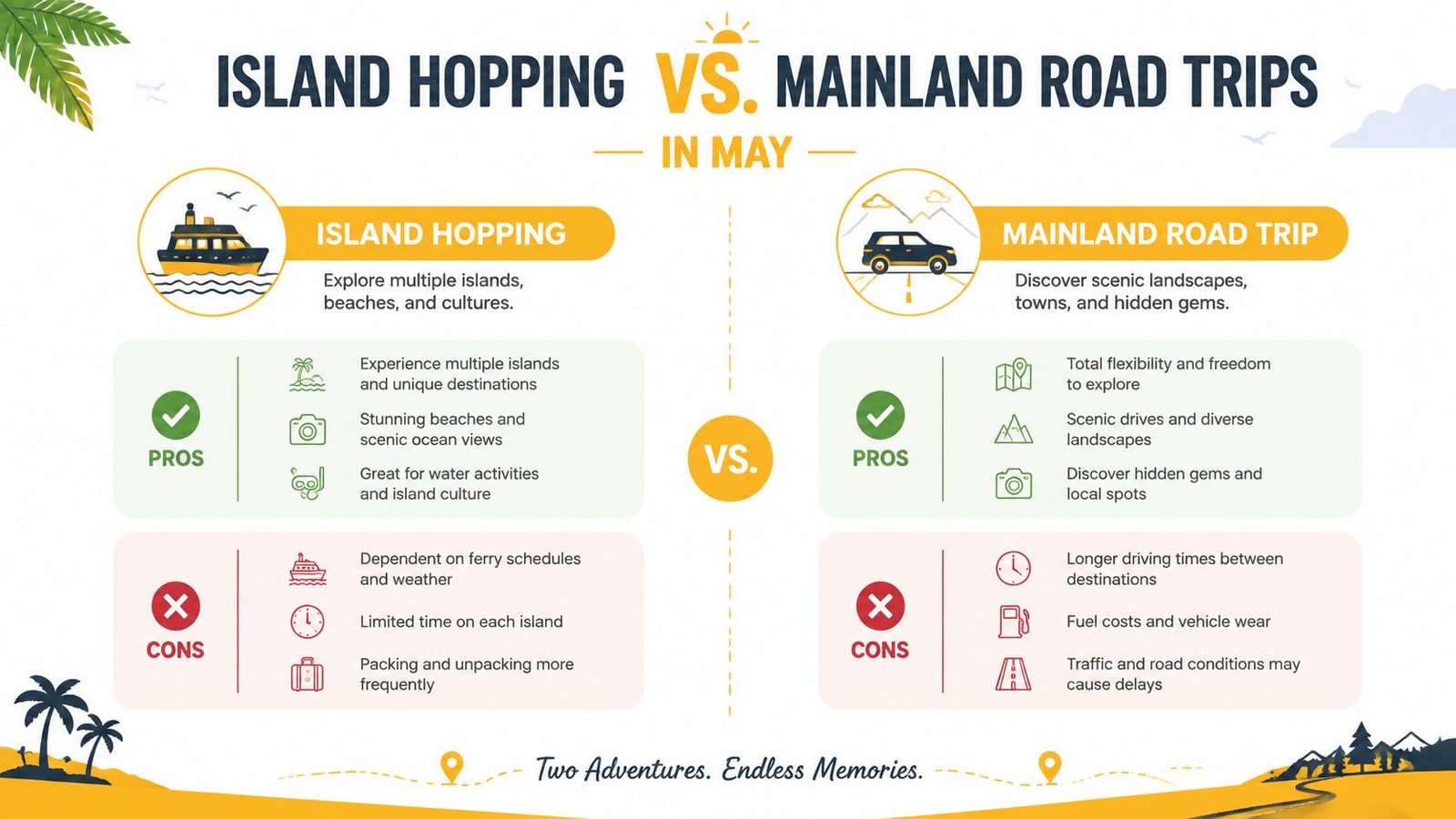
The balance is simple. Island hopping gives you variety and the classic Greek-water fantasy, but you give up certainty and spend more time watching schedules. Mainland road trips give you flexibility, better mileage from each day, and easier access to history and inland scenery. In May, flexibility usually wins.
My blunt recommendation
If you've never driven Greece before, start on the mainland and add one island at the end. If you already know the ferry network and you're happy to keep plans loose, a single-island stay can be perfect. What I would not do is turn May into a ferry-heavy sprint and then complain that the holiday felt fragmented.
The best itineraries in this month respect the season. They move, but they don't rush.
Curated Self-Drive Itineraries for History and Nature
If you want Greece in May to work properly, build around roads first and ferries second. These two routes fit the month because they use the weather to your advantage, put the best heritage stops in a logical order, and leave room for long lunches and unhurried evening drives. Both are strong because they do not waste the shoulder season.
Peloponnese History and Highlands
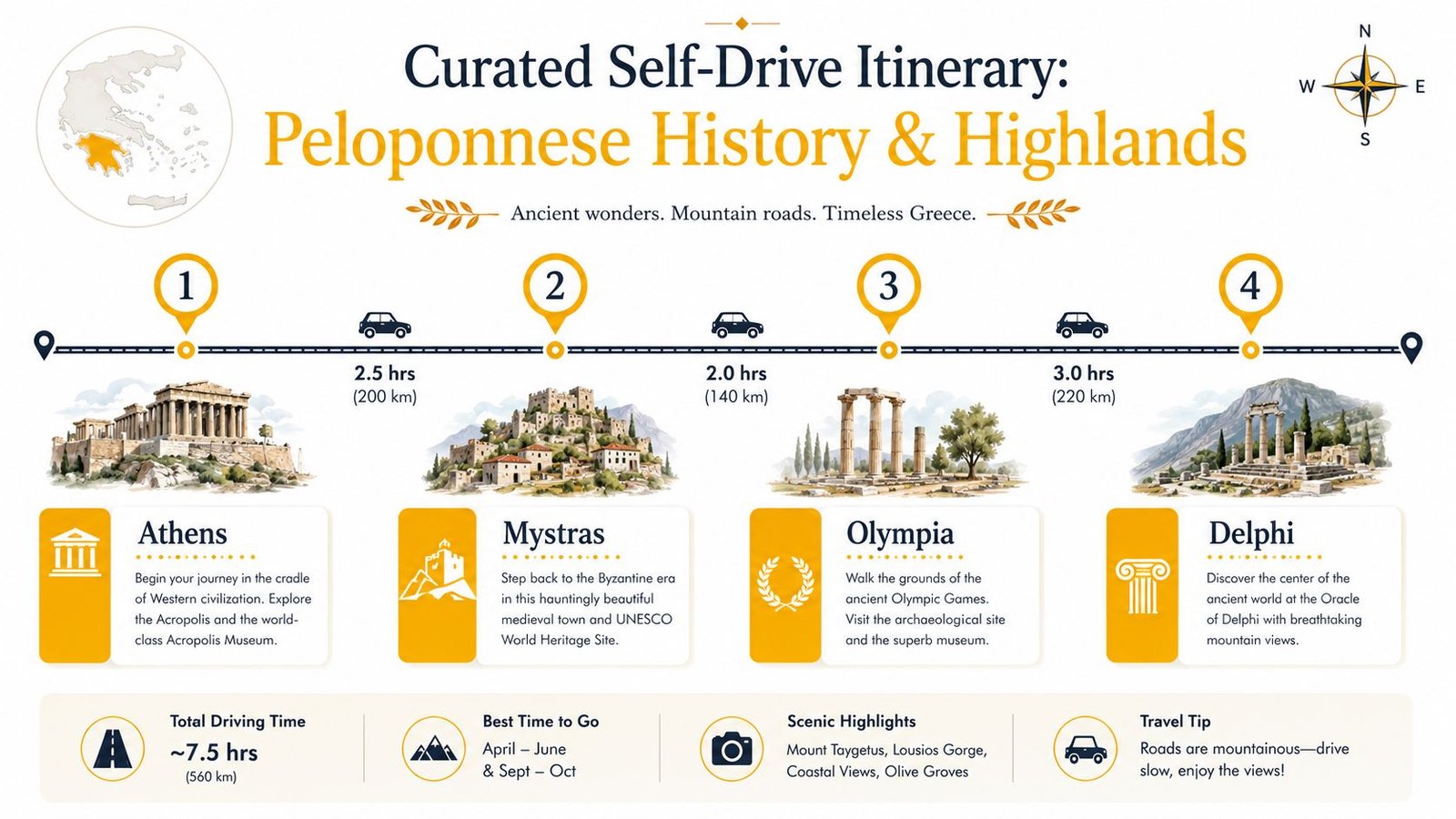
Start in Athens and drive south. The route works because the first days give you the capital's energy, then you leave the city behind before heat and traffic become a drag. Base in Nafplio for a gentler coastal stop, then push inland for Mycenae and the stone villages of Arcadia. This is the route I'd choose if I wanted Greece to feel layered, not rushed.
My advice is to keep the days purposeful. Athens is for an early start and a decent hotel, Nafplio is for a slower evening, Mycenae is for the historic anchor, and Arcadia is where the trip shifts from monuments to mountain atmosphere. The value of May is that you can do all of this without feeling punished by the weather.
A good rhythm looks like this.
- Athens, one night if you're arriving late, two if you want museums and neighbourhood time.
- Nafplio, for a coastal base with an easy pace and simple evening walking.
- Mycenae and the Argolid, for the classic heritage hit without peak-season pressure.
- Arcadia villages, for stone architecture, cooler air, and slower meals.
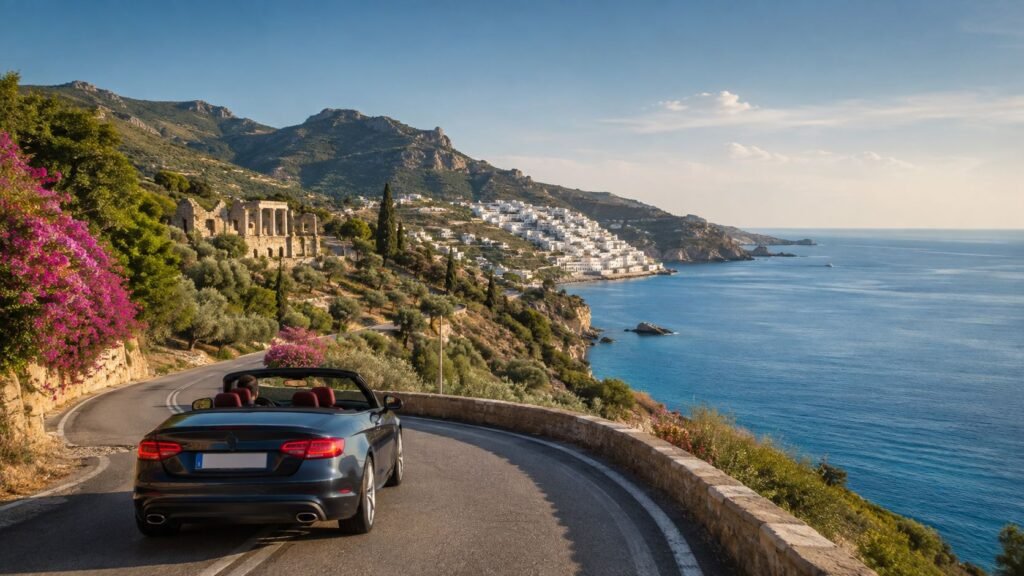
The Peloponnese road visual is useful here because it captures the sort of scenic, coast-to-inland balance that makes the region so satisfying in spring.
Practical rule: If the day includes both archaeology and a mountain road, start early and keep lunch long.
Northern Greece and Meteora
This route is the better choice if you want scale and drama. Thessaloniki gives you a proper city base, while Meteora brings the big visual payoff, with monasteries perched above a setting that feels made for spring light. In May, the route feels fresh instead of austere.
I'd use Thessaloniki as the arrival point because it gives you food, sea frontage, and a smoother launch into the north. Then move on to the monasteries and nearby nature, taking your time with the roads rather than trying to see everything in one sweep. The north rewards travellers who are happy to trade island glamour for real variety.
How to make either route work
Choose one route, then commit. Too many travellers try to mix a Peloponnese loop with a northern run and end up spending the holiday moving bags instead of enjoying places. If you want the trip to feel coherent, keep the driving sequence clean and let each stop do one job well.
You do not need to cram in every famous site. You need a route that feels good at 10 a.m. and still feels good after dinner, and May is the month that lets you do that.
Festivals, History, and Local Culture
May in Greece has a public rhythm that many visitors miss because they stay focused on scenery and temperatures. May 1, Protomayia, changes opening hours, transport, and the pace of the day. It is a public holiday with seasonal and political meaning, so planning around it is not optional if you want the trip to stay smooth. Juniper Tours
The month feels commemorative, not just scenic
The month carries a commemorative tone as well. Greek independence is remembered through May milestones such as the Battle of Gravia on 8 May 1821 and the Battle of Valtetsi on 12 May 1821, which give the month a clear national character. You do not need to shape your whole itinerary around anniversaries, but you should know that May is culturally active, not neutral.
That shows up in spring festivals, village gatherings, and flower customs. If you pass through a smaller town during a village feast, stop for it. That is where Greece in May stops being a pretty backdrop and starts feeling like a living calendar of local habits, not a performance for visitors.
How to behave around local events
Treat May 1 as a holiday first and a travel day second. Some shops will close, some transport will shift, and some services will run at a slower pace. Plan around that reality instead of expecting the day to run on a normal schedule.
I look for the quieter side streets, the flower-filled spaces, and the local tavernas that still feel like neighbourhood businesses rather than tourist production lines. That is the right way to read May. The month rewards travellers who notice what locals are already marking, not those who try to impose a beach-holiday script on it.
If you are keeping valuables close while moving through busy holiday streets, the travel security bag tips are worth using in the same way I would use a reliable day bag. For visual planning, the scenic spring drive route is a useful reminder that May works best when you pair cultural stops with practical movement, not with rushed hopping from one place to the next.
Essential Logistics for the Independent Traveller
May travel in Greece is easy only if you respect the practical realities. Ferries are usable, but they're not something I'd leave to the last minute if the route matters. On the mainland, driving is the stronger option because it gives you freedom, but you still need to accept narrow roads, village parking, and the occasional local who treats every straight stretch like a race start.
Ferries and booking behaviour
Book ferries early when they're part of a fixed route, especially if you're using them to connect islands or to protect a specific schedule. In shoulder season, you have less room to improvise than in high summer, and a missed connection can throw off the whole plan. If your route depends on a ferry, treat it like a timed transfer, not a casual day out.
Accommodation works the same way. Cities and popular coastal bases deserve advance booking, but smaller villages sometimes reward a more flexible approach. I'd still secure the first and last nights in every major trip block, because those are the nights that cause the most stress if left open.
Driving in Greece without making a mess of it
Drive defensively. That's the rule. Narrow roads, tight village turns, and impatient traffic are part of the experience, especially if you're moving between archaeological sites and inland stops, so don't let somebody else's style hurry you into a bad decision.
For packing your valuables and documents, travel security bag tips are worth a look before you leave, because a self-drive trip means you'll constantly be getting in and out of the car with passports, phones, and cards.
Keep cash handy, keep your hotel details easy to reach, and never assume a village centre has generous parking.
The route-style visual is a good reminder that the best road trips work because the logistics are controlled, not because they're chaotic.
What to book and what to leave flexible
Book ahead for major ferry links, first-night stays, and any hotel that has limited parking or a very specific location. Leave room for spontaneity once you're on the road, especially in the countryside where a better lunch spot or a slower detour can improve the day instantly. You want enough structure to avoid stress, and enough freedom to follow the weather and your own mood.
If you're considering a packaged self-drive route rather than building it all yourself, BTOURS offers self-drive multi-day tour itineraries across Greece, which is a sensible option if you want the route logic sorted before you travel. That kind of planning is useful when you'd rather spend your time driving than decoding ferries and room choices.
Packing and Preparation for a Spring Adventure
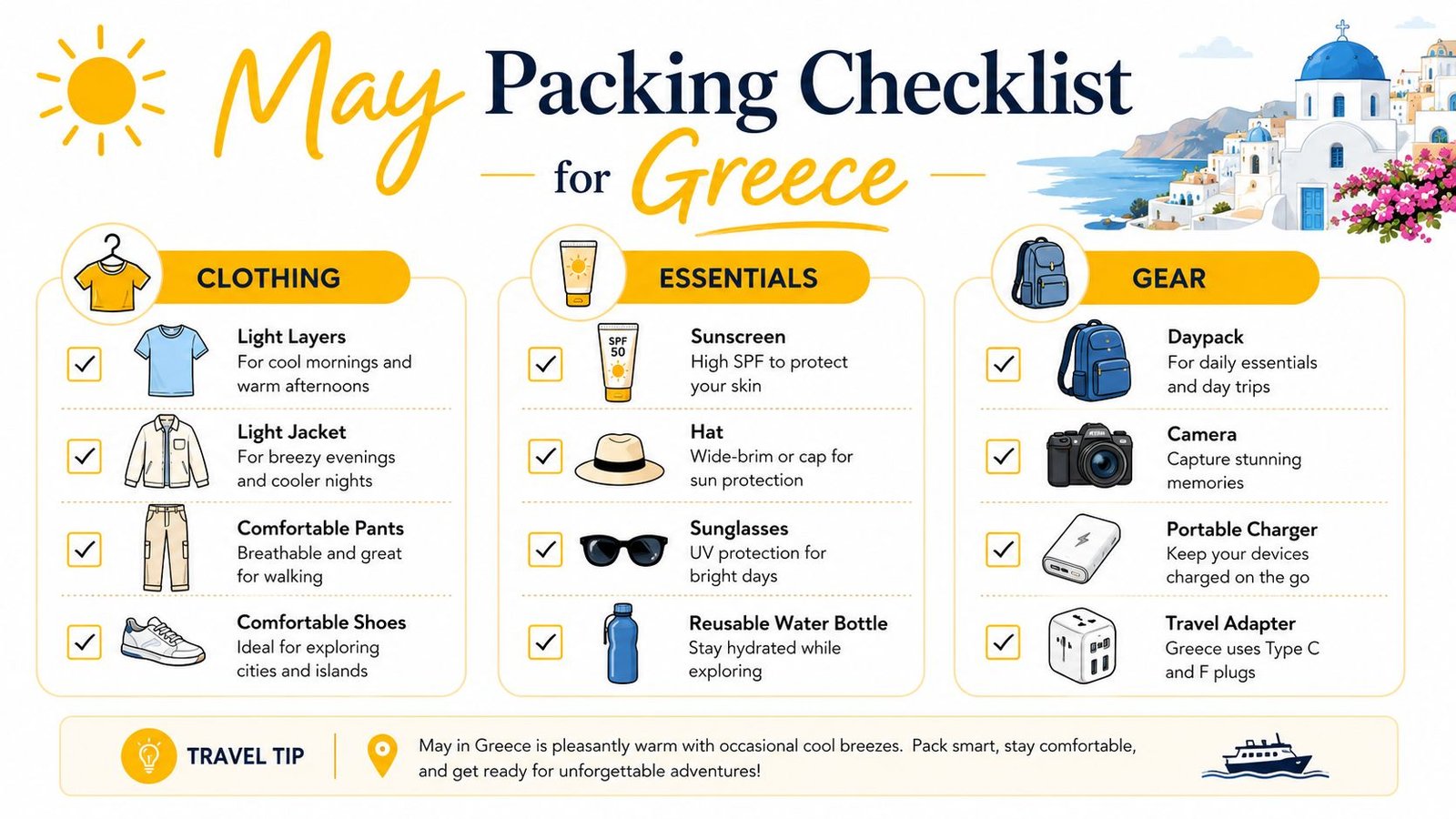
Packing for Greece in May should be deliberate, not optimistic. You need clothes that work in the morning chill, in the midday sun, and in the evening when a coastal breeze can make a terrace feel colder than you expected. This month rewards people who pack for movement, not for a fantasy of constant beach weather.
What belongs in the bag
Start with layers. Bring light clothes for daytime, a jacket for mountain evenings, and footwear that can handle cobbles, ruins, and uneven village streets without ruining the rest of the day. Add the sun basics too, because clear skies and strong daylight can catch you out faster than the air temperature suggests.
- Light layers, because mornings and evenings can feel different from the middle of the day.
- A proper sun hat and sunscreen, because the UV is serious even when the air feels mild.
- Sturdy walking shoes, because ruins, hills, and old towns are not forgiving.
- A small daypack, so you can carry water, cards, and a layer without stuffing pockets.
- A camera or phone charger setup, because you'll use them on a route like this.
Preparation that saves time later
Check your driving documents before you go, and sort your travel insurance with self-drive use in mind. Greece in May is forgiving on the weather side, but the trip still depends on you being organised enough to move smoothly between car, ferry, hotel, and restaurant. On a mixed itinerary, that preparation matters more than overpacking.
The smart way to approach Greece in May is to accept that it is a transitional month and pack accordingly. You are not chasing one perfect climate. You are making room for roads, culture, and a coast that still feels cool enough to keep the trip varied. Weather2Travel is a useful reminder of that split reality, but the practical answer is simple. Pack for layers, movement, and long days outside.
For a trip that gets the pace right, keep your luggage light and your expectations realistic. The month works best for travellers who can handle a cooler shore, a warm inland afternoon, and a few changes of plan without fuss. That is the mix that makes May in Greece work.