
TRAVEL STORIES & GUIDES
Dublin Airport to City Centre Transport: Options Compared

The bags are off the belt, the arrivals hall is behind you, and the exit at Dublin Airport presents a bus stand, a coach bay and a taxi rank in roughly the same line of sight. There's no platform sign, no ticket gate, no departure board for a train into town. That absence is the whole story of Dublin Airport to city centre transport: every option runs on wheels, and every one of them competes for the same road space.
Three questions settle most of it. How many people are travelling, how much luggage is coming with them, and where exactly in the city you're sleeping. Answer those and the choice narrows fast.
Why Dublin Airport Has No Train and What That Means for You
Dublin Airport sits north of the city centre and has no direct rail or metro station. Scheduled buses, coaches, taxis and private vehicles are therefore the principal surface-transport options, and the terminal is built around that reality: signage points to bus zones, coach stands and a taxi rank rather than to a station. The practical effect is simple. You choose your transfer from road-based services, then judge it by arrival time, luggage and the final stop in town.
Volume explains the congestion you may meet. Dublin Airport is very busy, and the pressure is most obvious when several long-haul and short-haul arrivals feed the same arrivals hall and exit doors. When that many people land within the same few hours, the approach roads, the bus lanes and the Port Tunnel all slow down together. A cheap bus fare can become poor value if it means standing with bags in traffic, missing a check-in window or adding a long walk at the other end.
Buses carry a serious share of airport passengers. A historical daa sustainability update recorded that scheduled bus operators accounted for 34% of all airport access trips in 2016, with roughly 2 million more passengers using buses in 2016 than in 2014. Public transport here is a mainstream choice, not the budget afterthought it is at some airports. That matters for planning: the bus network is part of the core transfer system, not a fringe option for people with time to spare.
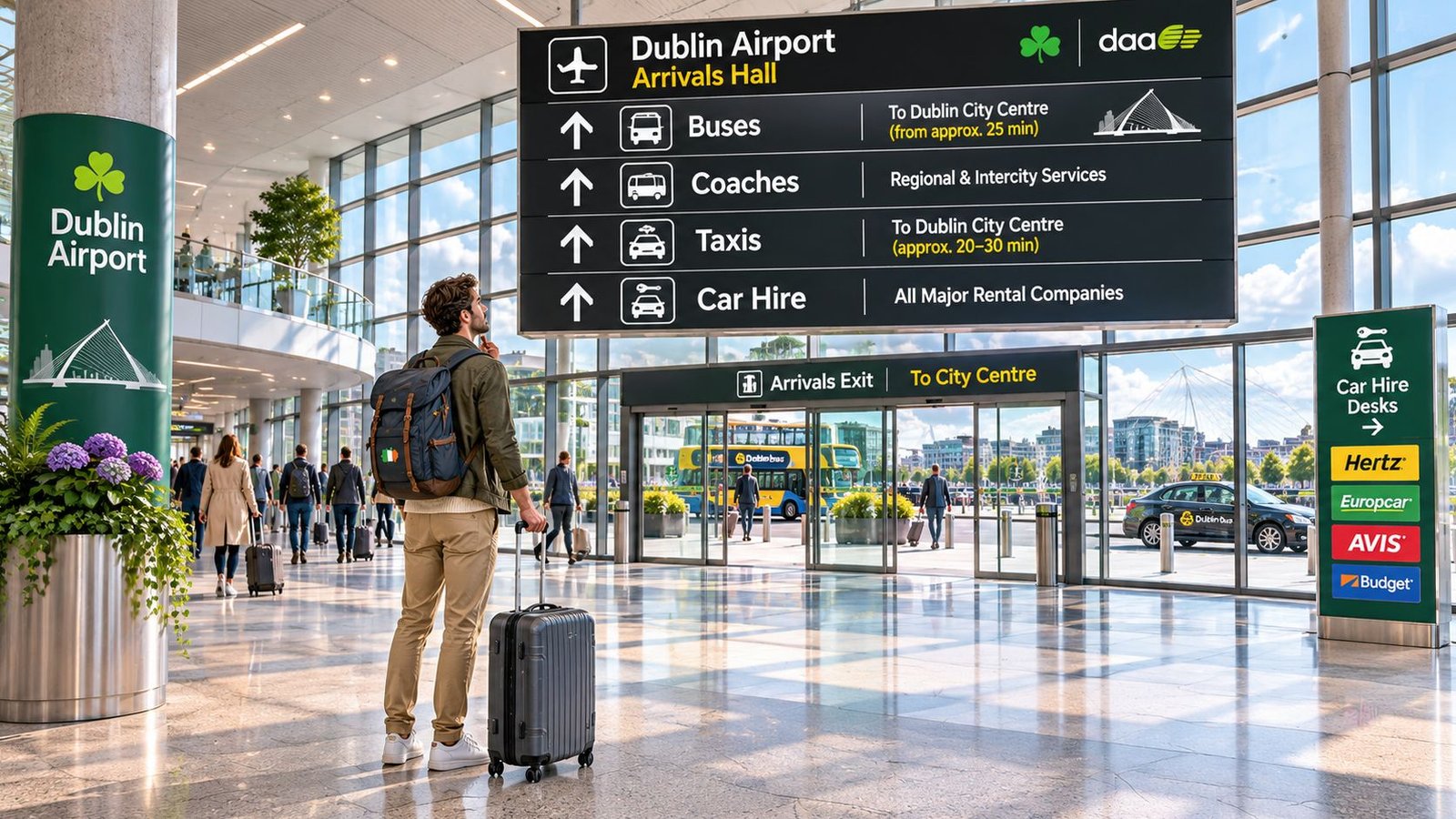
Four options cover almost every trip: Dublin Bus routes 16 and 41, the Aircoach coach, the Dublin Express coach, and a taxi from the rank outside either terminal. Both coaches serve Terminal 1 and Terminal 2, so a landing at either one doesn't force a change of building. Buses and coaches reward travellers who know their stop. Taxis cost more, but they remove the transfer problem when luggage is heavy, the group is larger or the hotel sits away from a coach stop.
The planning rule: compare by terminal, destination stop, luggage and expected traffic, not by headline speed. No rail-style transfer exists here, so the best choice depends on where you're going, not on which poster looks quickest.
The Options at a Glance
| Option | Typical journey time | Indicative one-way fare | Main city stops | Best for |
|---|---|---|---|---|
| Dublin Bus (route 16 or 41) | The slowest of the four in heavy traffic, with frequent stops along the way | €2.60 cash in exact coins, or Leap Card | Stops along the route, including the city centre | Solo travellers on a budget with light luggage |
| Aircoach | Quicker than the city bus, with fewer stops and dedicated luggage space | Low single-digit euros online, higher bought on the day | Multiple city-centre stops | Balance of cost, speed and luggage space |
| Dublin Express | The fastest advertised coach run, traffic permitting | Higher than Dublin Bus, below a taxi fare | More than 15 central stops, including Temple Bar, Trinity College, O'Connell Street and Heuston Station | Hotels near a stop, when speed matters |
| Taxi | Door to door, paced by traffic | Metered, so the final fare rises and falls with congestion | Your hotel entrance | Groups, heavy luggage, hotels far from a coach stop |
Read every journey time as a range, not a promise. A coach that clears the route quickly at 6am can take twice as long at 5pm on a Friday, and the spread exists because all four options share the same roads, the same bus lanes and the same tunnel.
Dublin Bus sets the fare floor, and it's the right answer for a solo traveller with a rucksack and no fixed deadline. The coaches sit above it in price and below it in stopping frequency. Aircoach trades a few euros for luggage racks and a calmer boarding process. Dublin Express sells speed and reach, calling at more than 15 central stops, including Temple Bar, Trinity College, O'Connell Street and Heuston Station, according to Dublin Airport's bus terminal information. That stop list is the detail worth checking before you book anything: if your hotel sits two minutes from a Dublin Express stop, the coach beats the bus even at double the fare, because you skip the walk at the end. The same airport guidance notes that TFI Leap Cards can be bought in both terminals and used across bus, train and tram services, which matters if you'll be moving around the city for several days.
A taxi is the only door-to-door option, and the only one whose price moves with the traffic rather than sitting on a fare board.
Four quick verdicts, one line each:
- Solo, light bag, no rush: Dublin Bus route 16 or 41. Nothing else comes close on price.
- Couple with two heavy cases: Aircoach or Dublin Express. The fare buys luggage space and a shorter walk at the end.
- Group of four: a taxi, because four people share one meter and finish at the hotel door.
- Late-night arrival: route 41 or a taxi, depending on what you're carrying and how far the hotel sits from the bus corridor.
The cheapest option is only cheap if it serves your stop. A €2.60 fare followed by a twenty-minute walk with a suitcase in the rain is worse value than a coach that drops you at the corner.
Dublin Bus for the Lowest Fare
The cheapest way into the city is the standard Dublin Bus single fare of €2.60, with services running approximately every 10 to 15 minutes, according to Dublin Bus's airport hub. That fare wins when you are travelling solo, carrying a rucksack and not trying to protect a fixed arrival time. It becomes weaker value the moment your final stop sits far from the bus corridor, or your bag turns the last walk into a slog.
Route 41 is the one to remember if your flight lands late. It runs 24 hours a day, every day, including weekends, while route 16 runs from approximately 06:00 to 23:30 Monday to Saturday and 08:00 to 23:30 on Sundays, as set out in Dublin Airport's Dublin Bus information. A 1am arrival still has a bus, but the overnight pattern isn't a copy of the daytime one, so confirm the departure you need rather than assuming the route number guarantees a frequency.
Pay before you board if you can. Drivers take coins and need the exact fare; notes and cards aren't an option. A prepaid ticket or a Leap Card solves it, and cards are sold in both terminals.
What the low fare costs you in time
Allow roughly 30 to 50 minutes to reach the city centre on these services. Congestion can push journeys toward an hour on routes serving farther destinations. These buses stop often, and each stop costs a couple of minutes. That may be fine on a flexible first day. It is poor planning before a fixed meeting, a pre-booked tour or a tight onward connection.
The other cost sits at the far end. Stops lie along the route, not at hotel doors, so the last stretch is walked with your bags. On a wet Tuesday with a 20kg case, that walk can undo the saving entirely. A bus ticket is cheap; dragging two cases over wet pavement after a long flight is the hidden price.
The bus is the right buy for a solo traveller with light luggage and time to spare. It's the wrong buy for a tight onward rail connection at Heuston or Connolly.
For a stay of several days, work out whether a Leap Card or a period pass beats paying per trip before you commit to single fares. If your hotel sits near a stopping pattern that suits you, the bus can stay good value all week. If it does not, pay more for a service that ends closer to where you are sleeping.
Coaches and Taxis for Speed, Luggage and Door to Door
A weekday landing at 17:10, two cases, hotel south of the river: the city-bus fare looks cheap until the last walk. Coaches and taxis buy that walk back in different places.
Aircoach publishes typical Dublin Airport to city centre times of 20 to 40 minutes, with online one-way fares from €6. Dublin Express advertises its fastest journeys at 14 minutes, with fares from €9. Those are the operators' own figures, and both assume traffic that cooperates.
A coach using the Port Tunnel can be quick outside peak hours. At 5pm on a weekday, no road vehicle is doing 14 minutes into the centre, whatever the advert says.
Why the stop matters more than the headline time
Coach routes fan out across the city rather than ending at one station, so "city centre" is not a single stop you can book against. Match the route map to the hotel before you pay. A stop five minutes from the door makes a decent fare the right one. A stop 25 minutes away in the rain turns a €9 ticket into a €9 ticket plus a taxi.
Before you buy, confirm three things. The stand: bus zones at Dublin Airport differ by operator, and the airport map gives each service its own zone, so the bay beside the first coach you see may not be yours. The luggage policy: coaches take bags in the hold, but check what is included before you arrive with three cases and a pushchair. The ticket terms: the lower fare is usually the online one, and some tickets are locked to one departure while others can be used on a standby basis.
Book the coach for the stop, not the speed. The stop is what you live with when you get off.
The taxi arithmetic for groups
A taxi is the only option that finishes at the hotel entrance. As a general estimate, a Dublin-city trip often falls around €30 to €45, with the meter moving by distance, time of day and traffic.
For one person that looks steep. Split across four and each person pays about €7.50 to €11.25, which can undercut a €9 Dublin Express ticket per head and removes the walk. The driver loads and unloads the bags. That is the whole case for the group.
The meter keeps running while you sit still. A taxi is the most predictable option only when the roads are moving. In a jam it is the most expensive way to wait.
The extra cost pays off in three situations: a hotel nowhere near a coach stop, an arrival after midnight when coach frequencies thin out, and mobility needs that make boarding a bus with luggage difficult. A solo traveller with a light pack still gets better value on the coach.
If the trip continues by car, the driving in Ireland guide covers what changes once you collect a hire vehicle.
Matching the Option to Your Arrival
A flight landing at 23:40 is a different problem from one landing at 11:00. The late arrival has fewer buses, a longer wait for anything, and a hotel reception that may or may not still be staffed. Route 41 runs through the night, but the route number alone isn't a promise about the service at that hour.
Dublin Airport describes the TFI network as offering frequent and 24-hour connections, yet its own guidance directs passengers to the National Transport Authority's TFI Journey Planner for the service available at a particular time, as set out in Dublin Airport's bus information. That distinction is worth holding onto. A route advertised as 24-hour doesn't guarantee the same frequency, stop pattern or ease of boarding at 3am as at 3pm.
The scenarios that decide it
| Arrival scenario | Best option | Why |
|---|---|---|
| Late-night arrival after route 16 has stopped | Dublin Bus route 41 or taxi | Route 41 runs 24 hours; confirm on the live journey planner |
| Heavy luggage | Aircoach, Dublin Express or taxi | Coaches offer luggage space; taxis avoid stop walks |
| Hotel near Temple Bar, Trinity College or Heuston | Dublin Express | Its stops in these areas may be a short walk away |
| Guesthouse off the bus corridor | Taxi, or coach plus short taxi | Avoids a long final walk |
| Solo light packer with time to spare | Dublin Bus | Lowest fare of the options |
| Tight onward rail connection | Taxi, with a buffer | Bus times vary with traffic |
| Reduced mobility | Taxi or arranged assistance | Confirm arrangements with the airport in advance |
Read the table in this order: arrival time first, bags second, hotel stop third. Arrival time decides what is still running. Bags decide what you can physically board. The hotel stop decides what the journey costs you after the ride ends, because a cheap fare plus a twenty-minute walk with cases is rarely cheap in practice.
Accessibility gets less attention than it deserves. Passengers may walk a fair distance between arrivals, the bus zones and a city-centre stop, and a stop that looks central on a map can still leave a substantial walk or a second connection. Anyone with reduced mobility should arrange assistance with the airport before travel rather than improvising at the stand with bags in hand.
Build a buffer if you have a fixed onward booking. Summer weekends and holiday peaks concentrate demand on the same buses, the same taxi rank and the same road space, so the queue you planned around on a quiet Tuesday is not the queue you will meet on a busy Sunday in July.
Five things worth writing down before you fly:
- Arrival time. Anything after 23:00 narrows the field to route 41, a coach or a taxi.
- Bags. More than one large case per person points away from Dublin Bus.
- Hotel stop. Find the nearest coach stop on a map before choosing an operator.
- Onward connection. A train at Heuston or Connolly deserves a buffer and, if the gap is tight, a taxi.
- Mobility. Arrange assistance in advance and allow for walking between the terminal and the stand.
The cheapest option stops being the cheapest when it fails one of these tests. A solo light packer landing at midday pays the lowest fare and loses nothing. The same fare at midnight can mean a long wait at an exposed stop and a walk at the far end, which is why solo travellers arriving late often weigh the taxi differently and may find staying safe traveling alone abroad useful reading for the wider trip. Once the transfer is settled, the reward is the city itself, and the food of Dublin is worth planning a day around.
Choosing Your Transfer and Planning the Next Leg
Party size, luggage and the last city-centre stop should drive the decision. Two people with one case each can treat a cheaper bus as a sensible starting point. A family with large suitcases, or anyone arriving after a long flight with an early hotel check-in nearby, should give more weight to a coach or taxi. The lowest fare loses value when it adds a long walk, a second connection or a stressed arrival.
Connect the transfer to the rest of the trip before booking it. If the itinerary continues by rail to Galway, Cork or Belfast, check the onward connection first. A delayed flight can put you into the evening peak with far less margin than you planned. A coach that takes 20 minutes at dawn may take twice that when the city empties out at six. On the day, check the live TFI Journey Planner rather than a printed schedule, confirm that your chosen stop serves your hotel, and read the operator's terms before buying a coach ticket online.
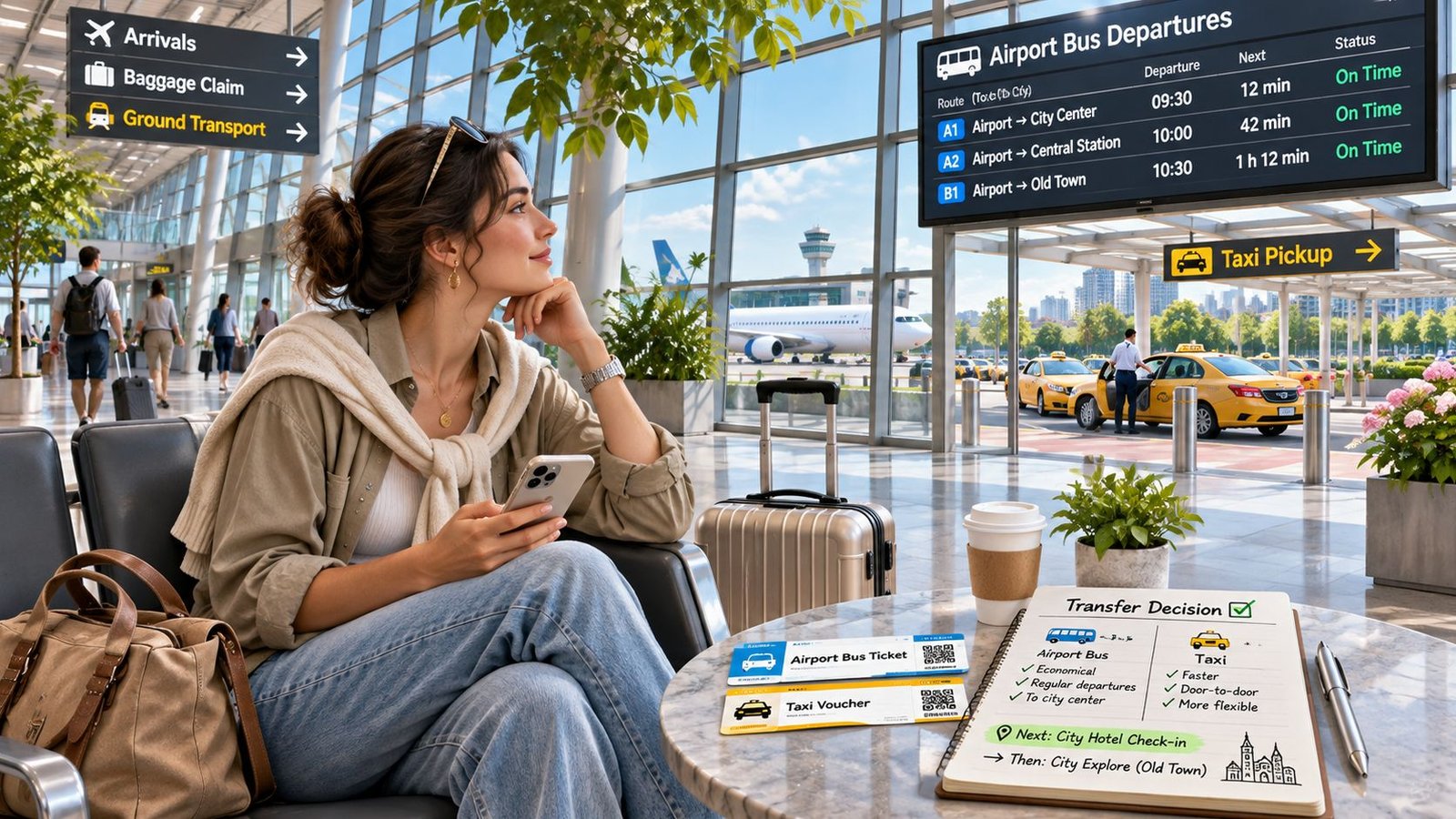
BTOURS plans routes, stays and key travel arrangements in advance for each multi-day trip. Its rail journeys have the timetable details already worked out, and the itinerary explains which tickets, reservations and transfers are included on rail and ferry journeys. Airport or station transfers are included only where they appear in the inclusions or the booking confirmation, so read that document before assuming a transfer forms part of the package. Vehicle hire on a self-drive tour may be included, optional or not included, depending on the tour. Unless porterage is expressly included, travellers should be able to manage their own luggage through stations, ports, hotels and vehicles.
For wider pre-trip paperwork and packing questions, the HeyLocals guide for volunteer travellers sits outside this route-specific decision, but can still help with general preparation.
Ready to stop comparing and start packing? Look at the five-day Dublin city break, check the current inclusions on the tour page, then work backwards from your arrival time to pick the transfer that fits. Booking the trip first and the transfer second is how the good decisions get made.
Links disclosure: This article may contain external links, including affiliate links. If you book or buy through an affiliate link, BTOURS may earn a commission.