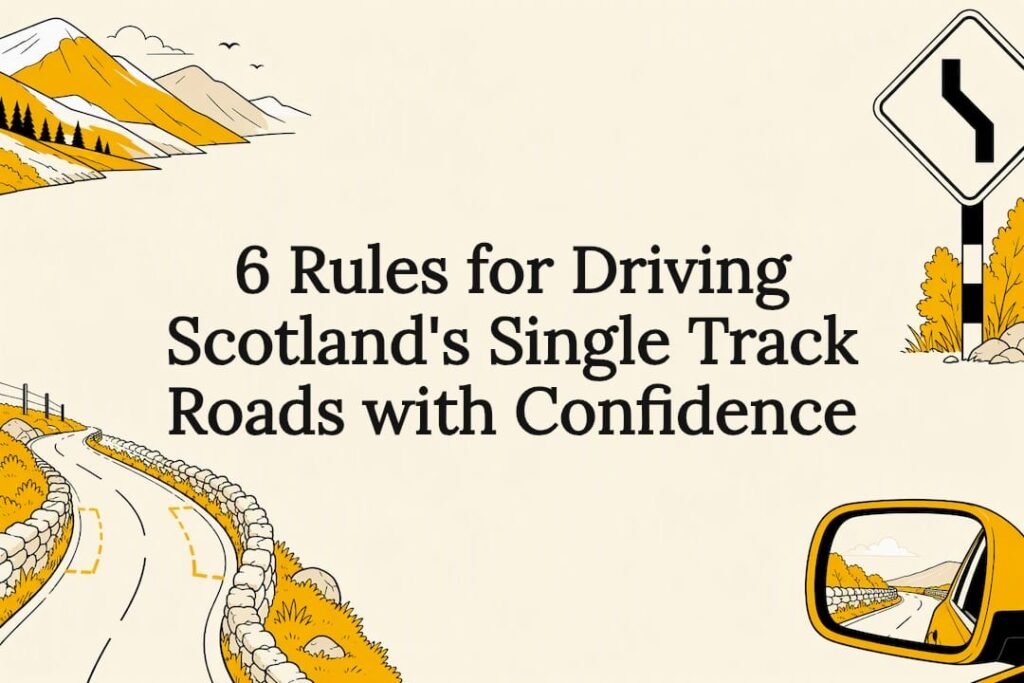
Drive on the left, pull into the first suitable passing place, and treat every blind bend as if something is coming the other way. Expect sheep, cyclists, and the occasional stalled camper van. Fill up your fuel tank whenever you get the chance, build extra time into your day, and when you’re not sure what to do, stop, wait, and wave the other driver through.
What is a single-track road, and why do passing places exist?
A single-track road is exactly what it sounds like: one lane, wide enough for one vehicle, shared by traffic going both directions. There’s no white line down the middle because there’s no room for one. Instead, the road relies on passing places, small widened pull-offs marked with a black-and-white diamond sign, spaced out along the route so two vehicles meeting head-on have somewhere to let each other through.
You’ll recognise them by the sign and by the visibly wider strip of tarmac, sometimes on your left, sometimes on your right. On busy Highland routes they tend to appear at intervals commonly within a few hundred metres; on quieter backroads the distance between them can be significantly longer. Scotland Info Guide notes that passing places are usually staggered on alternating sides, which is exactly why you need to watch both edges of the road, not just one.
Single-track roads survive in rural Scotland for practical reasons, not neglect:
- The terrain is often too steep, boggy, or hemmed in by lochs and hillsides to justify widening.
- Traffic volumes on many rural stretches are genuinely low outside peak summer months.
- Building a full two-lane road through some Highland glens would cost far more than the traffic ever flowing through them could justify.
Academic records on JSTOR trace single-track roads back through generations of rural road-building, long before car ownership was common. They were never designed for two-way traffic in the first place; they were tracks that got tarmacked.
How do you actually drive single-track roads?
The mechanics are simple once you’ve done it a couple of times, but the etiquette matters as much as the technique.
- Use the first passing place you see, don’t hold out for a better one further on. If you spot oncoming traffic and a passing place is within reach, pull in.
- If the passing place is on your right, stop opposite it rather than pulling across the road, and let the oncoming vehicle use it.
- Give way to traffic coming uphill wherever it’s practical to do so; a vehicle climbing a slope has a harder time stopping and restarting than one heading down.
- Reverse to the nearest passing place if you’ve gone past one and traffic is now blocking your path forward. It happens to everyone at least once.
- Slow right down for cyclists, walkers, and horse riders. Leave a wide gap when you pass, and don’t rev past them the moment there’s a gap, wait until it’s genuinely clear.
- Never park in a passing place. It’s not just bad manners, it’s against the rules, and Highland Council is explicit that obstructing one can carry a penalty.
Road Safety Scotland also flags livestock as a routine hazard on these roads, sheep in particular have no road sense whatsoever, so treat any animal near the verge as a reason to slow down well before you reach it.
Speed limits on single-track roads are usually the same national limits as any other rural road, but the road itself won’t let you use them. Blind crests, tight bends, and passing places positioned for slow-speed stopping all mean the sensible speed is far below the legal one. At night, dip your headlights early for oncoming traffic, since full beam on a narrow road is dazzling at close range.
Pro Tip: If you meet another car on a blind bend with no passing place visible, don’t guess. Reverse slowly to the last one you passed rather than inching forward hoping something turns up.
Your pre-drive checklist for single-track roads
A little preparation removes most of the stress before you’ve even left the driveway.
- Fuel up whenever you can. Long stretches of the Highlands and islands have wide gaps between petrol stations, and Road Safety Scotland’s driving leaflet specifically warns visitors to plan around this rather than assume the next station is close.
- Match your vehicle to the road. A compact car is far easier to place accurately than a large SUV or motorhome.
- Practise reversing before you tackle a long single-track stretch in a larger hire vehicle, Highland Council’s motorhome guidance makes this point directly for bigger vehicles.
- Carry a paper map or offline GPS, mobile signal drops out completely in many glens.
- Pack waterproofs, warm layers, and a basic first-aid kit. Weather here changes fast, and so can your plans.
- Build slack into your schedule for weather delays and unplanned stops; rushing is what causes most of the awkward moments on these roads.
What to expect on Scotland’s scenic single-lane routes
Routes like the North Coast 500 mix single-track stretches with narrow bridges, short single-lane sections through villages, and slow approaches near ferry terminals. Expect all of them, often within the same afternoon.
- Summer brings a noticeable jump in motorbikes and camper vans, which eats into overtaking opportunities and fills passing places faster, a pattern Road Safety Scotland notes on the NC500 in particular.
- Weather can turn in minutes: clear views one moment, low cloud and rain the next.
- The NC500 is genuinely rewarding to drive, but it gets busy in July and August, so timing your day and booking overnight stops ahead of time avoids the worst of the congestion.
Curated pacing beats winging it on narrow roads
Route planning is where most of the stress gets solved before you ever touch the wheel. A well-paced itinerary avoids scheduling long single-track stretches for late afternoon, when light is fading and everyone else is also trying to reach their overnight stop. Fewer rushed miles mean fewer awkward reversals.
Road Safety Scotland’s own guidance for visitors covers keeping left, using passing places correctly, giving way on gradients, and staying alert for cyclists and livestock, the exact fundamentals that make single-track driving manageable rather than nerve-wracking.
Local knowledge about which stretches get busy, and when, turns a string of narrow roads into a comfortable day’s drive rather than a guessing game.
A quick note on confidence and courtesy
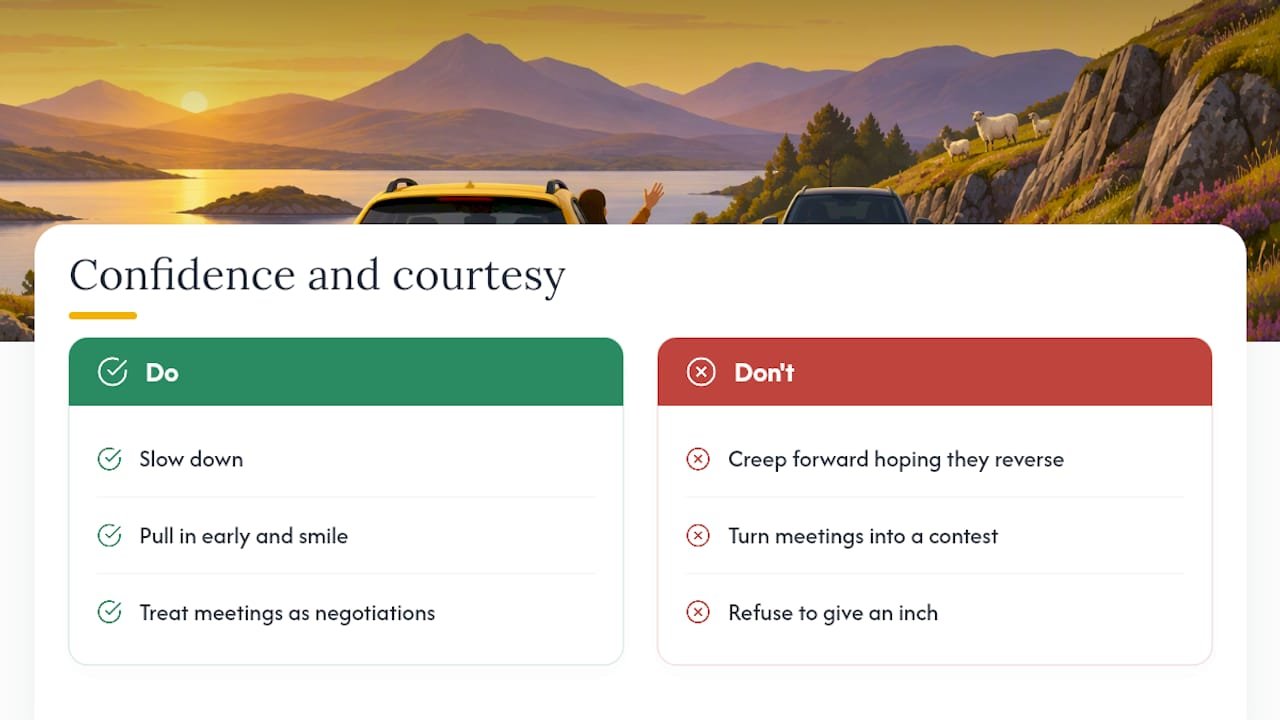
Single-track roads reward patience more than skill. Slow down, wave your thanks, and treat every meeting as a small negotiation rather than a contest.
Do: pull in early and smile. Don’t: creep forward hoping the other driver reverses first, half the standoffs on these roads happen because neither side wants to give an inch.
— Theo
Let a planned route handle the tricky stretches for you
Some companies offer practical alternatives to driving Scotland blind: instead of guessing where the narrow, high-pressure stretches fall in your day, a self-drive itinerary can pace the route so the trickiest single-track sections come when you’re fresh, not fading at 6pm with a ferry to catch.

The Taste of Scotland self-drive tour builds in curated overnight stops and local route knowledge, so you’re not improvising when a passing place is occupied by a camper van at dusk. That same pacing logic runs through BTOURS’ expert pacing approach to scenic, off-the-beaten-path routes generally, and it pairs well with thinking ahead about where you’ll actually sleep each night, something self-catering accommodation guides also stress for multi-day road trips. If you’d rather have the route, the stops, and the timing sorted before you land, browse BTOURS’ Scotland itineraries and start with a quote for your dates.
Sources
For the rules straight from the source, see Road Safety Scotland’s visitor advice and Highland Council’s motorhome and campervan guidance.
- Visiting and driving in Scotland – Road Safety Scotland
- Driving in Scotland information leaflet – Road Safety Scotland
- Enjoying the Highlands in your motorhome or campervan – Highland Council
FAQ
What are the driving etiquette rules for single-track roads in Scotland?
Use the first available passing place, give way to traffic coming uphill where practical, and never park in a passing place. Road Safety Scotland also asks drivers to slow down for cyclists, walkers, and livestock, and to reverse to the nearest passing place if you’ve missed one.
How difficult is it for Americans to drive in Scotland?
The main adjustment is driving on the left and getting used to narrower roads, which feels awkward for the first hour and then becomes routine. Single-track roads add a layer of etiquette rather than technical difficulty, most visitors find it manageable within a day once they’ve practised pulling into a few passing places.
What is the speed limit on a single-track road in Scotland?
Single-track roads carry the same national speed limits as other rural roads, but blind bends, livestock, and narrow passing places mean the sensible speed is usually well below the legal limit. Treat the posted limit as a ceiling, not a target.
Is the NC500 a difficult drive?
The North Coast 500 is scenic and rewarding rather than technically difficult, though it gets busy with motorbikes and camper vans in peak summer months, which can make passing places harder to find quickly. A paced NC500 itinerary with planned overnight stops takes most of the pressure off timing.