A combined Scotland and Ireland trip works best over 10 to 14 days, flying into Dublin, driving the Wild Atlantic Way, crossing to Scotland, then finishing in the Highlands or Edinburgh. Ten days is the practical minimum; anything shorter turns the trip into an airport shuttle with photo stops. The single biggest decision is how you cross: take the ferry if you want your car with you, or fly and re‑rent to sidestep cross‑border insurance headaches entirely.
Sample Scotland and Ireland itinerary options for 7 to 21 days
The right length depends on how much driving fatigue you’re willing to tolerate versus how many regions you want to tick off. Below are three tested structures, each built around minimising backtracking and giving at least one full day per major stop rather than a string of one‑night stands.
Compact 7 to 10 day Ireland and Scotland road trip
This version accepts that you’ll see one region well in each country rather than a highlights reel of both. It suits travellers who’ve already done a broader trip elsewhere or who simply have limited leave.
- Day 1 to Day 4, Ireland: Fly into Dublin, spend one night in the city, then drive to Galway (about 2.5 hours) and use it as a base for two nights exploring the Cliffs of Moher and Connemara.
- Day 5, transfer day: Drive north to Belfast (roughly 3 hours from Galway) or fly directly Dublin to Edinburgh/Glasgow if you’re not keen on the long drive.
- Day 6 to Day 9, Scotland: Cross by ferry or land in Glasgow, spend two nights in Edinburgh, then two nights in the Highlands (Inverness or Fort William as your base).
- Day 10: Fly home from Edinburgh or Glasgow.
This itinerary keeps driving to under four hours on any single day and treats the ferry or flight crossing as its own dedicated travel day, not something squeezed in after a full day of sightseeing.
Balanced 10 to 14 day itinerary for Ireland and Scotland
This is the version most self‑drive travellers end up building, and it’s the one that gets recommended most often because it genuinely balances pace against coverage.
- Days 1 to 6, Ireland: Dublin (2 nights) for the city and Trinity College, then the Wild Atlantic Way through Galway and the Cliffs of Moher (2 nights), finishing in Killarney or Dingle (2 nights) for the Ring of Kerry.
- Day 7, crossing day: Drive to Belfast or Larne (around 2.5 to 3 hours from Killarney), take the ferry to Cairnryan, or fly from Dublin, Shannon, or Belfast to Edinburgh or Glasgow.
- Days 8 to 13, Scotland: Edinburgh (2 nights) for the Old Town and Castle, then north through Glencoe to Skye (2 nights), and Inverness or Loch Ness (2 nights) before looping back south.
- Day 14: Depart from Edinburgh or Glasgow.
For anyone building this route themselves, our Edinburgh city break guide covers where to base yourself for the castle and cobbled‑street days, and the scenic Highland drives piece is worth reading before you commit to the Skye leg, since some of the “shortcuts” on a map take three times longer than they look.
Relaxed 3‑week self‑drive plan across both countries
Three weeks lets you stop apologising to yourself for rushing through places. It also opens up Northern Ireland’s Causeway Coast and inter‑island ferries that simply don’t fit a two‑week plan.
- Week 1, Ireland’s south and west: Dublin, then south to Kilkenny and Waterford, across to Killarney and Dingle, up through Galway and Connemara.
- Week 2, Northern Ireland and the crossing: Causeway Coast, Giant’s Causeway, Belfast, then the ferry from Belfast or Larne to Cairnryan (or fly from Belfast to Glasgow).
- Week 3, Scotland in depth: Glasgow or Edinburgh, then a slower run through Glencoe, Skye (three or four nights instead of two), and the North Coast 500 loop if time allows, finishing back in Edinburgh.
Extra days in this version go almost entirely to Skye and the west coast, since that’s the region travellers most often say they wished they’d given more time. If you’d rather slow down the Irish side instead, our Ireland hidden gems guide has quieter alternatives to the Ring of Kerry crowds. Booking a specific overnight base rather than a generic town matters too, and our regional guide to staying in Ireland breaks down which of the eight main bases suits which kind of itinerary.
Ferry or flight: how to cross between Ireland and Scotland
There’s no shortcut here, only a trade‑off between convenience and time. No ferry runs directly from Dublin or Rosslare to Scotland. If you’re travelling from the Republic, you first have to drive north to Belfast or Larne for a ferry, or fly instead.
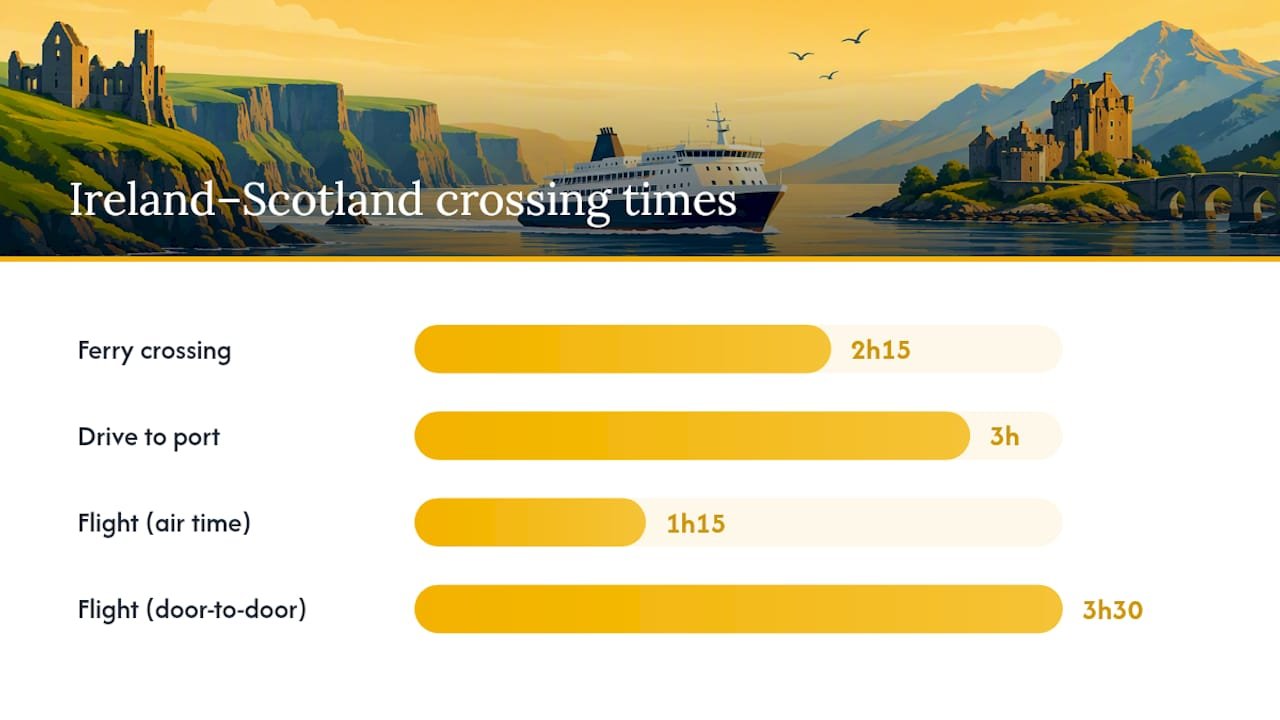
Ferry option. Stena Line’s Belfast to Cairnryan crossing takes around 2 hours 15 minutes, and the Larne to Cairnryan route runs slightly longer at roughly 2 hours 30 minutes. Both carry vehicles, which is the whole point if you want to keep driving the same car once you land in Scotland.
- Best for: families and anyone with a car full of luggage who doesn’t want to unpack and re‑pack a second hire vehicle.
- Watch for: ferry fares and sailing frequency shift with the season, and summer weekend crossings sell out car spaces well before the passenger seats fill up.
- Reality check: add the drive to Belfast or Larne first. From Killarney that’s close to three hours before you even reach the port.
Flight option. The flight itself between Dublin or Shannon and Edinburgh or Glasgow takes just 1 to 1.5 hours. Door‑to‑door, though, budget 3 to 4 hours once you factor in airport transfers, check‑in, and security on both ends.
Quick comparison: a ferry crossing runs about 2h15 to 2h30 gate‑to‑gate but adds hours of driving to reach the port; a flight is barely 90 minutes in the air but rarely beats the ferry once transfers and security queues are added in.
- Best for: solo travellers, couples on a tight schedule, or anyone happy to hire a fresh car in Scotland.
- Watch for: you’ll need a second rental agreement, which usually means a second deposit and a second round of paperwork.
The decision rule is straightforward: take the ferry if you genuinely need your car with you the moment you land in Scotland; fly and hire again if you’d rather avoid the insurance and cross‑border complications that come with driving one hire car across two jurisdictions.
Driving and rental car rules for a two‑country road trip
Most UK and Irish rental companies simply don’t allow a car hired in Ireland to be taken into Great Britain, and vice versa, without specific written permission and extra cover. This isn’t bureaucratic fussiness. Insurance underwriters price a policy around a defined territory, and crossing outside it can void your cover completely if something goes wrong.
That’s why independent itinerary guides consistently recommend treating Ireland and Scotland as separate rental systems rather than trying to keep one car for the whole trip. Dropping a car in Belfast or Dublin and picking up a fresh one in Glasgow or Edinburgh costs a bit more in admin, but it removes the single biggest source of rental disputes on this route.
Before you hand over a card for a booking, run through this with your European breakdown & emergency travel kit handy to ensure safety and compliance on the road.
- Declare the cross‑border leg explicitly when booking, even if you’re only driving from the Republic into Northern Ireland.
- Get written confirmation, not just a verbal assurance, of exactly which borders the policy permits.
- Check the excess on both the collision cover and any third‑party liability; cross‑border add‑on soften carry a higher excess than standard cover.
- If you’re leasing a vehicle long‑term, check VE103 documentation requirements for taking a vehicle across into another jurisdiction.
- If you must keep one car for the whole trip, use a local hire company that states cross‑border travel is permitted in its terms, not one that simply doesn’t mention it.
Pro Tip: Ask the rental desk to print the cross‑border permission on your rental agreement itself, not just email it. A printed clause is far easier to produce at a roadside check or in a dispute than a forwarded confirmation email you can’t find on your phone.
Currency, budgets and the best time to visit Scotland and Ireland
Ireland uses the euro; Scotland uses the pound sterling. Cards are widely accepted in both countries, including at most petrol stations, but rural filling stations, small B&Bs, and pay‑and‑display car parks in the Highlands and along the Wild Atlantic Way still sometimes want cash only. Carry a small amount of each currency rather than relying entirely on contactless.
Rough daily budgets, per person, sharing a car and a room:
- Low: £60 to £80 per day, mixing hostels, self‑catering, and modest pub meals.
- Mid‑range: £100 to £150 per day, covering three‑star B&Bs, a mix of pub and restaurant meals, and standard fuel costs.
- Comfort: £180 and up, with boutique stays, guided experiences, and the occasional splurge dinner.
Ferries or short intercountry flights add a separate line item, typically £40 to £120 per person depending on how far ahead you book.
Seasonal snapshot: May to September is the primary window for weather and daylight, with long summer evenings giving Highland drivers extra buffer for delayed arrivals. Shoulder months, April and October, bring thinner crowds and lower accommodation rates, but shorter daylight tightens your driving window, especially in the far north of Scotland.
Winter travel is possible but demands respect for early sunsets and the odd closed rural road, particularly on Skye and in the west of Ireland.
Booking checklist: what to book first for your combined itinerary
Book in this order, and you’ll avoid the classic mistake of locking in flights before checking whether your preferred crossing date even has ferry space left.
- International flights first. Your inbound and outbound dates anchor everything else, so confirm these before touching anything else.
- The intercountry transfer next. Whether that’s the ferry or the internal flight between the two countries, this segment sells out fastest in peak season and dictates your whole middle section.
- Overnight stays in busy areas. Edinburgh during festival season and Killarney in July both fill up months out; lock these before car hire.
- Car hire for each country separately, confirming cross‑border terms if you’re doing anything other than a clean split.
- Timed tickets last, for castles, distilleries, or guided tours that require a specific slot.
Two pacing rules make the difference between a smooth trip and a stressful one: treat the transfer day between countries as a full travel day with nothing else scheduled, and never book a long drive for the day you land. Build in one buffer day per country, ideally somewhere flexible like a coastal town, so a delayed ferry or a foul weather day doesn’t collapse the rest of your plan.
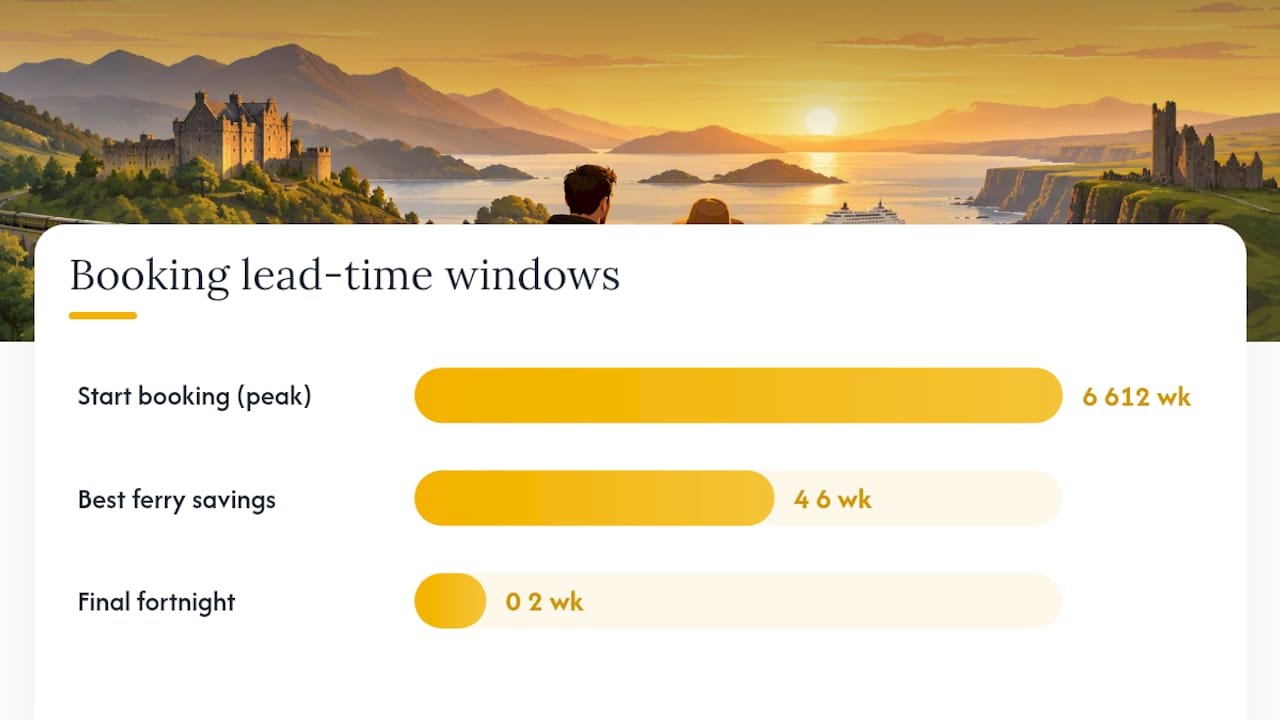
For peak summer travel, start booking 6 to 12 weeks out. Ferry fares often drop 15 to 30% when booked four to six weeks ahead rather than in the final fortnight, and the same early‑booking logic applies to internal flights between Dublin and Edinburgh or Glasgow.
Pro Tip: Book your accommodation in Skye and Killarney before you finalise anything else in the middle of the trip. These two spots sell out disproportionately early relative to everywhere else on a standard route.
Why local knowledge changes how this itinerary actually feels
Route planning on paper and route planning that accounts for how Highland roads and rural Irish lanes actually drive are two different skills. A drive that Google Maps says takes 90 minutes can easily take two hours once you account for single‑track sections, sheep, and the inevitable stop for a view you didn’t know was coming.
Membership in the Adventure Travel Trade Association reflects a broader commitment to high self‑drive planning standards that catch these gaps before they ruin a day. Building an itinerary that works isn’t just about picking pretty towns; it’s about:
- Sequencing driving days so nobody’s white‑knuckling a Highland pass after a long ferry crossing.
- Choosing accommodation that’s actually convenient for the next day’s drive, not just the prettiest listing online.
- Knowing which “must‑see” stops are worth the detour and which ones cost you two hours for a mediocre photo.
If you want a tailored pace, curated local lodging, and support if something goes wrong on the road, a bespoke self‑drive service takes on the planning risk that a DIY spreadsheet itinerary can’t fully account for.
What this itinerary style gets right, and where it can go wrong
The strongest argument for the 10 to 14 day structure isn’t romantic, it’s mechanical: it’s the shortest window in which the transfer day, the inevitable weather delay, and at least one “we need a rest day” morning all fit without cannibalising sightseeing time. Shorter trips don’t fail because travellers see less. They fail because the itinerary has zero slack, so one delayed ferry sailing turns into a cancelled Highland day.
Where conventional advice falls short is the assumption that a single hire car should carry you across both countries. It’s the tidiest idea on paper and the one most likely to produce a dispute at a rental desk over insurance territory. Splitting the rental, or flying and re‑renting, costs a little more admin but removes a real point of failure.
If there’s one thing to prioritise above the map itself, it’s pacing discipline: pick fewer overnight bases, not more regions. Every itinerary that’s gone wrong in the retelling had the same root cause, someone tried to fit one extra town in in a country where the roads simply don’t move that fast.
— Theo
Let BTOURS turn this route into a booked trip
Building the itinerary is one thing. Chasing down ferry timetables, cross‑border rental terms, and accommodation that’s actually well‑placed for tomorrow’s drive is another job entirely, and it’s the part most self‑planners underestimate. Specialised services build personalised self‑drive itineraries with handpicked accommodation and on‑trip support, so the planning risk sits with experienced planners rather than you at 11pm trying to find a Skye guesthouse with parking.

This suits travellers short on planning time, and anyone who wants off‑the‑beaten‑track routes without losing the comfort of a properly booked bed each night. Options like Wild Atlantic Way or the Edinburgh leg of a combined trip can be built around your pace rather than a fixed template. Visit the self‑drive tours page to see current routes, or get in touch to request a bespoke Scotland and Ireland plan built around the dates and regions you actually care about.
Official pages to check before you travel
- Gov confirms entry requirements and current fees for eligible travellers, including US nationals.
- Stena Line’s Cairnryan to Belfast route page lists current crossing times, vehicle policy, and fares.
- Re‑check both close to your travel dates, since enforcement details and fares change.
Sources
FAQ
How many days do you need to see Ireland and Scotland?
Ten days covers a compact route with one region per country, but 14 days is the sweet spot for a balanced trip covering Dublin, the Wild Atlantic Way, Edinburgh, and the Highlands without rushing. Three weeks lets you add Northern Ireland or slow down further in Skye.
Can I do Scotland and Ireland in one trip?
Yes, and it’s a common combined‑trip route, provided you plan the crossing properly. Most travellers either take the Belfast to Cairnryan ferry, which runs about 2 hours 15 minutes and carries vehicles, or fly between Dublin and Edinburgh or Glasgow and hire a fresh car on arrival.
What’s the best month to go to Ireland and Scotland?
May to September gives you the most reliable weather and the longest daylight for driving, which matters most in the Scottish Highlands. Shoulder months like April and October bring thinner crowds and lower accommodation costs, at the price of shorter driving windows.
What is the best way to plan a trip to Ireland and Scotland?
Book flights first, then lock in the intercountry transfer (ferry or flight) since it sells out fastest in peak season, followed by accommodation in busy areas and car hire for each country separately. Treating Ireland and Scotland as separate rental systems rather than one continuous hire avoids the most common cross‑border insurance problems. Services like BTOURS handle this sequencing and the accommodation selection as part of a bespoke self‑drive itinerary.
Do I need a visa or entry authorisation to visit the UK from the US?
US nationals need an electronic travel authorisation (ETA) before entering the UK, which permits stays of up to six months. Apply well ahead of your Scotland leg, since this is separate from any entry requirements for Ireland.