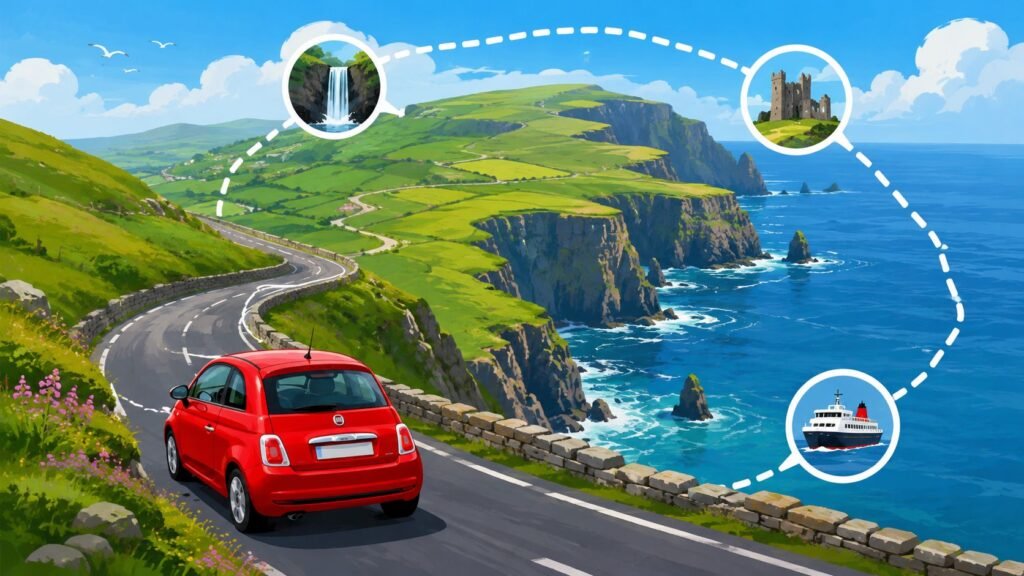
You're at the gates of Killarney National Park with the engine running, the map open, and a coach already edging onto the N71. The Ring of Kerry looks manageable on paper, yet the question isn't whether you can drive 179 kilometres. It's whether you want to spend the day chasing viewpoints, waiting behind buses, and eating lunch in the car.
A good Ring of Kerry itinerary matches the route to your pace. Choose a tight clockwise one-day sprint, a two-day loop with the Skellig Ring, or a three-to-five-day stay that gives the coast, villages, beaches, and weather room to breathe. I'll give you departure times and practical cut-off points, because pacing matters far more than collecting every stop.
Standing at the Start of Ireland's Most Iconic Loop
The first decision is made before you leave Killarney. If you start late, the route dictates your day. If you start early, you dictate the route.
For a one-day circuit, leave at 08:00 and drive clockwise. That puts you on the N71 before the main coach flow develops and gives you a realistic chance of reaching the Atlantic side while your energy is still high. This is the fast option, and it works only if you accept short visits, a disciplined lunch, and no casual detours.
The two-day version is my preferred choice for most independent travellers. Spend the first day crossing the mountain scenery towards Kenmare and continuing along the southern coast, then sleep near Waterville. Use the second day for Cahersiveen, Valentia Island, and the Skellig Ring, with time for a longer walk or a proper meal.
A three-to-five-day version suits travellers who want the route to feel like a holiday rather than a driving challenge. Couples can add atmospheric evenings and Killarney's heritage sights. Families can shorten each driving leg and keep a spare afternoon. Photographers can return to the same scenery in different light instead of accepting whatever weather appears at the first viewpoint.
Planning rule: Decide how many hours you want in the car before choosing how many stops you want on the map.
Kerry supports longer stays. The county welcomed 628,000 overseas tourists and 1.3 million domestic tourists in 2023, with average stays of 5 nights for overseas visitors and 3.7 nights for domestic visitors, according to Fáilte Ireland's Kerry tourism facts. The Ring works best as the spine of that stay, not necessarily as one exhausting loop.
Before choosing your overnight stops, you need to understand what the 179 km feels like on the ground.
What the Route Looks Like on the Ground
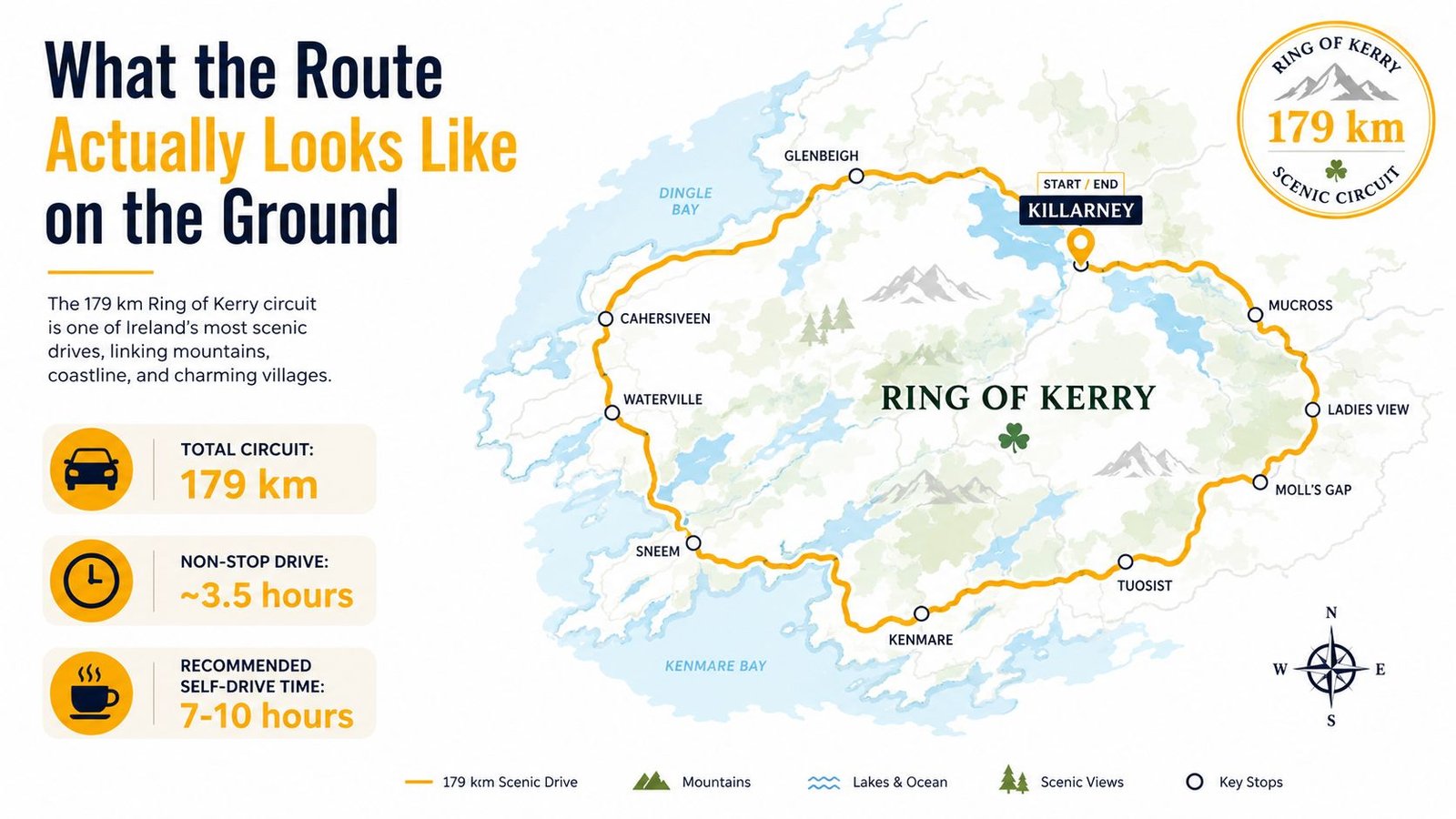
Stand at Killarney's start point and the 179-kilometre, 111-mile circular route looks manageable. The loop around the Iveragh Peninsula, outlined in the route overview on Wikipedia, is short enough to drive without stopping. Scenic roads turn that distance into a full-day plan.
Non-stop driving takes around 3 to 4 hours, with route guidance estimating roughly 3 hours 30 minutes of moving time. Add viewpoints, short walks, parking, lunch, village traffic, and coach queues, and a sensible self-drive day requires 7 to 10 hours, according to Outbound Lynx's Ring of Kerry driving guide.
The main road shape
From Killarney, the N71 climbs through Killarney National Park towards Kenmare. Moll's Gap and the Bog Village area include narrow stretches where coaches and larger vehicles occupy much of the road. Hold your pace and expect delays rather than trying to make up time.
From Kenmare, the N70 runs clockwise through Sneem, Caherdaniel, Waterville, and Cahersiveen before turning north towards Killarney. The R567 Skellig Ring branches towards Valentia Island, Portmagee, and Atlantic-facing cliffs. It deserves a separate time allowance, not a quick side trip. My Irish Cousin's self-drive advice also treats the detour as a meaningful addition to the loop.
Why the route takes all day
Villages slow the N70, coastal sections tighten the driving line, and every clear viewpoint creates another stop. Coach traffic commonly builds from mid-morning and is strongest between 11:00 and 14:00. Leave before 09:00 to reach the first viewpoints while the road remains easier, a timing recommendation supported by Outbound Lynx's route timing guidance.
High summer puts the most pressure on famous viewpoints. Shoulder-season drives often feel calmer, although weather and reduced operating schedules require closer planning. Use the 179 km figure to understand the loop's shape, then build your itinerary around available hours.
The Classic One-Day Ring of Kerry Itinerary
This is the strict version. Leave Killarney at 08:00, drive clockwise, and keep every stop purposeful. It follows the classic circuit rather than trying to force the Skellig Ring into a day that already has enough mileage.
| Time | Stop | Drive to Next | Activity |
|---|---|---|---|
| 08:00 | Killarney | 1 hour 30 minutes to the park viewpoints | Leave via the N71 while the road is moving freely |
| 09:30 | Torc Waterfall and Ladies View | 1 hour to Moll's Gap | Take quick photographs and a short walk |
| 10:30 | Moll's Gap and Gap of Dunloe view | 1 hour 30 minutes to Kenmare | Use the lay-by, then continue before traffic thickens |
| 12:00 | Kenmare | 1 hour to Sneem | Coffee, toilets, and a short town break |
| 13:00 | Sneem village | 1 hour 30 minutes to Caherdaniel | Walk the village centre and keep lunch timing on track |
| 14:30 | Caherdaniel | 1 hour to Waterville | See the Daniel O'Connell heritage before moving on |
| 15:30 | Waterville | 1 hour 30 minutes to Cahersiveen | Lunch, promenade, and the Charlie Chaplin statue |
| 16:30 | Cahersiveen | 1 hour 30 minutes to Killarney | Take the Ballycarbery Castle viewpoint, then begin the return |
| 18:00 | Killarney National Park western entrance | End of loop | Re-enter the park and finish in Killarney |
The schedule is tight because every stop has a job. Torc Waterfall and Ladies View deliver the Killarney scenery early. Moll's Gap gives you the mountain crossing. Kenmare breaks the morning, while Sneem and Caherdaniel give the southern coast its character. Waterville is the sensible lunch point, and Cahersiveen provides the final historical and coastal glimpse before you head back.
If time slips, skip the Kerry Bog Village and the Kerry Cliffs turn-off first. They're among the most photographed additions, but neither deserves a late-day scramble that leaves you driving tired. The Kerry Cliffs belong on the two-day version, where they can be enjoyed properly.
How to keep the day moving
Park decisively, carry water, and don't turn every viewpoint into a full walk. Keep a simple offline route plan, and if you're coordinating connectivity, planning a road trip for work offers useful preparation ideas for staying organised on the road.
This one-day plan is realistic because it leaves out the Skellig Ring. Add a detour and the schedule stops being a plan. It becomes a gamble.
A Slower Two-Day Loop with the Skellig Detour
The two-day itinerary fixes the main weakness of the fast loop. You still cover the route efficiently, but you stop asking the Atlantic coast to fit into the final frantic hours of the day.
Choose Kenmare or Waterville as your split point. I favour Waterville for travellers who want the Skellig Ring, because the second morning begins close to the western peninsula rather than requiring you to retrace the southern coast.
Day one from Killarney to Waterville
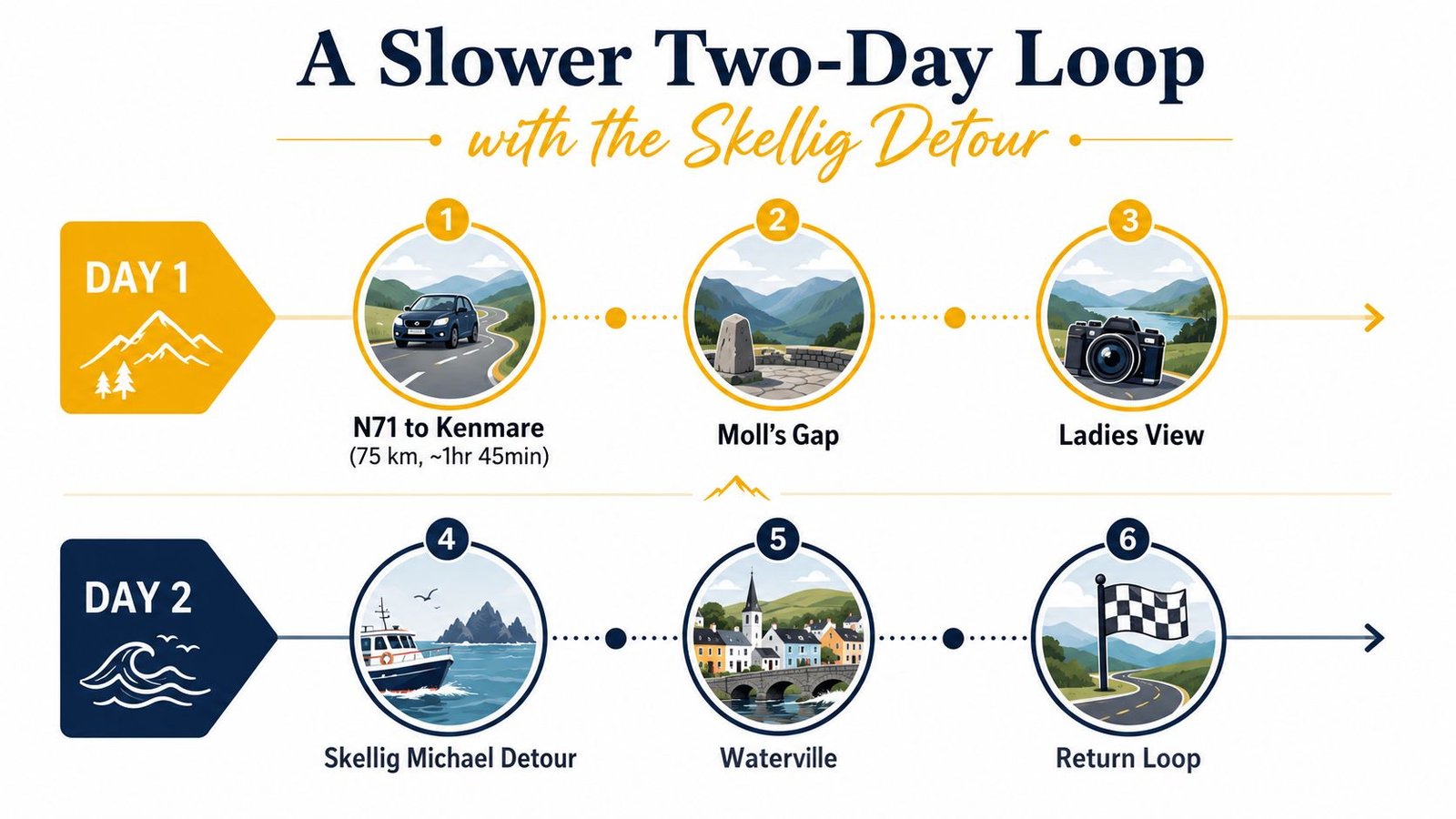
Leave Killarney via the N71 and make the mountain section your morning. The drive to Kenmare is about 75 km and roughly 1 hour 45 minutes, allowing for the slower scenic road, as set out in the Irish Road Trip's Ring of Kerry planning guide.
Stop at Moll's Gap and Ladies View, but don't overstay. Kenmare makes the natural coffee and lunch pause, followed by the shorter N70 stretch towards Waterville. That section is about 55 km and roughly 1 hour 20 minutes. Arrive with enough daylight for the promenade, a quiet drink, or a relaxed dinner.
Day two on the Atlantic side
Start in Waterville and continue through Cahersiveen to Valentia Island. The ferry from Reenard Point costs roughly €9 each way and saves about 30 km compared with driving via Portmagee Bridge. Check the sailing arrangements before you leave, then use Valentia for a slower morning rather than treating it as a tick-box detour.
The Skellig Ring is the day's main event. Allow about 1.5 to 2 hours for the detour itself, without pretending that the cliffs, viewpoints, and photographs will be instant stops. If you're hoping to take a boat trip to Skellig Michael, arrange that separately and build the day around the sailing, not around an overloaded road map.
My preferred rhythm: Spend the first night near Waterville, take the Skellig coast early on day two, then return through Killorglin to Killarney.
The return section is about 85 km and roughly 2 hours. That leaves room for a slow lunch at Quaid's in Cahersiveen and a sunset walk on Bray Head, subject to weather, daylight, and ferry timing. This version feels longer on paper but less tiring in practice, because the most demanding coastal choices no longer compete with the whole southern loop.
Three to Five Days for Couples, Families, and Photographers
Extra days should create branches, not empty hours. A longer Ring of Kerry itinerary works when each traveller type uses the time differently.
Couples benefit from atmosphere. Give the Skellig Ring its own day, pause at Coomakista Pass near sunset, and reserve dinner at Dooley's in Waterville. Use another half-day for Muckross House in Killarney rather than trying to squeeze it into the main coastal circuit.
Families need predictability. Keep driving legs below two hours where possible, choose stops with obvious toilets and space to move, and protect one afternoon as a buffer for tired children or unsettled weather. Kells Sheep Centre and Pat O'Brien's Kerry Bog Village offer more practical interest for younger travellers than another viewpoint, while Rossbeigh and Derrynane provide beach time when conditions are safe.
Photographers should resist the temptation to cover more ground. Four or five days allow repeat visits to Lough Leane at golden hour, the Kerry Cliffs at blue hour, and the boreen towards Glanleam Beach on Valentia. A spare weather day is more valuable than another rushed village stop.
| Day | Couples Focus | Family Focus | Photographer Focus |
|---|---|---|---|
| Day 1 | Killarney National Park and Muckross House | Short park visits and an easy afternoon | Lough Leane light and forest details |
| Day 2 | Kenmare, Sneem, and a coastal dinner | Kenmare with a flexible family meal | Painted villages and mountain viewpoints |
| Day 3 | Skellig Ring and Coomakista sunset | Cahersiveen, beach time, and a slow lunch | Kerry Cliffs and Atlantic weather |
| Day 4 | Waterville and Bray Head | Rossbeigh or Derrynane, with a recovery afternoon | Valentia Island and Glanleam Beach |
| Day 5 | Optional Dingle Peninsula swap | Optional Dingle Peninsula swap | Weather-backup landscapes and repeat viewpoints |
Families should pack for motion sickness, because the narrow, winding sections can challenge passengers who cope well on motorways. A practical family road-trip visual guide can also help you set expectations before the children see the route as one continuous car journey.
The Dingle Peninsula is an excellent optional fourth-night swap for all three groups. Choose it when you want a quieter Wild Atlantic Way extension, not because you feel obliged to add another famous loop.
Self-Drive Essentials from Parking to the Ferry
The N70 and N71 are scenic two-lane roads, not motorways. That distinction changes how you drive. You'll share the road with coaches, cyclists, farm vehicles, and visitors who stop suddenly when a view appears.
In July and August, coach convoys commonly occupy the route between 10:00 and 16:00, so the practical answer is simple: leave at 08:00. Use the spaces at Torc Waterfall and the Moll's Gap lay-by early, then move on before the road becomes a procession.
Parking and passing
Pull-ins are frequent but not always signed. When a wider gravel space appears, reverse into it so you can rejoin uphill without stalling or swinging across the road. Never stop on a bend, and don't assume the car behind you can see around a coach.
The single-lane stretches near Moll's Gap and the Bog Village reward calm driving. If another vehicle has committed to a narrow section, wait. A few minutes of patience is cheaper than a damaged wing mirror and a ruined morning.
For families, plan snacks and entertainment before leaving town. These parenting hacks for long car rides are useful beyond the Ring, especially when children are facing winding roads and irregular stop times.
Ferry, fuel, and cold-weather planning
The Valentia Island ferry from Reenard Point runs every 20 minutes in summer, accepts standard cars, and avoids the longer route via Portmagee Bridge. Confirm the operating timetable before committing to it, especially outside the main season.
Fuel up in Killarney, Kenmare, or Cahersiveen. Stations become less convenient as you move onto the western detours, so don't let the fuel warning light become part of the itinerary.
Winter can bring ice around Moll's Gap and reduced daylight of under 8 hours, making a counter-clockwise low-season loop useful for better morning light on the Atlantic side. Before collecting the vehicle, review practical driving tips for an Irish road trip, then choose an automatic if narrow-road hill starts are outside your comfort zone.
Why Shoulder Season Beats the Famous Version
The most enjoyable Ring of Kerry itinerary usually depends on timing, not ambition. I'd choose late April to May or mid-September to early October over July and August for most self-drivers.
Demand remains substantial outside midsummer. CSO visitor figures recorded 772,800 foreign visitors in August 2025 and 460,300 in November 2025, showing that Irish travel demand continues beyond the classic summer window, as reported through Fáilte Ireland's visitor numbers dashboard. The shoulder season isn't empty, but it gives independent drivers a better chance of enjoying viewpoints without turning each stop into a parking negotiation.
Peak coach traffic is most disruptive around the midday window, especially on the N70 and N71. In shoulder season, the road generally feels less pressured, and the famous stops become less about managing other vehicles and more about looking at the scenery.
| Factor | Jul to Aug Peak | Late Apr to May or Mid Sep to Oct Shoulder |
|---|---|---|
| Road feel | Busy around major viewpoints and coastal corridors | Usually calmer, with more space to pause |
| Best strategy | Start early and keep moving | Plan for flexibility, but still avoid late arrivals |
| Accommodation | Greater pressure on popular bases | More choice outside the busiest dates |
| Dining | Reserve popular restaurants ahead | Easier to find suitable tables, subject to local opening days |
| Ferry planning | More frequent summer service | Check reduced off-season timetables |
| Weather | Longer daylight, but changeable coast remains possible | More variable conditions and occasional fog on high passes |
Fog on higher passes can be more common before 09:00 in the shoulder season, so don't blindly copy a summer start. A later departure may produce better visibility, provided you're willing to accept less time before afternoon traffic.
My recommendation is blunt. Take fewer stops, start at the right time for the weather, and let the 179 km loop unfold without a stopwatch dictating every photograph.
Booking Your Self-Drive the Smart Way
Book the vehicle before you build the route around it. For peak travel dates, reserve a compact car or small SUV at least 8 weeks ahead. For May or October departures, book as soon as the dates are fixed, because Killarney rental availability can thin quickly.
Use one of three accommodation patterns:
- Killarney townhouse: Best for a one-day clockwise start and a separate day in the national park.
- Kenmare or Waterville B&B: The practical choice for a two-day loop, with the overnight placed close to the route.
- Sneem and Valentia pairing: Better for a three-to-five-day stay, reducing the temptation to drive back and forth.
Skellig Michael landing permits open on the last Tuesday in February for the May to September season and can sell out for July within hours. Treat the boat booking as the fixed point, then shape your road days around it. Weather can still affect departures, so don't make the rest of your holiday so rigid that one cancellation breaks the whole plan.
A self-drive specialist can package car hire, ferries, accommodation, and Wild Atlantic Way extensions into Dingle or the Beara Peninsula. BTOURS offers Ireland self-drive tours that include the Ring of Kerry coastal road, Portmagee, Skellig Chocolate, the Kerry Cliffs, and an overnight stay in County Kerry. If you're travelling with several people, a clear guest guide setup can also keep arrival details, parking instructions, and ferry notes in one place.
Before accepting the rental terms, review this car rental insurance guide, then confirm excess cover, ferry permission, and the collection depot's opening hours.
BTOURS can turn this Ring of Kerry plan into a complete Ireland self-drive journey, combining handpicked accommodation with car hire, coastal routing, and extensions to places such as Dingle or the Beara Peninsula. Visit BTOURS to shape the loop around your pace, whether you want one focused driving day or several unhurried nights on the Wild Atlantic Way.