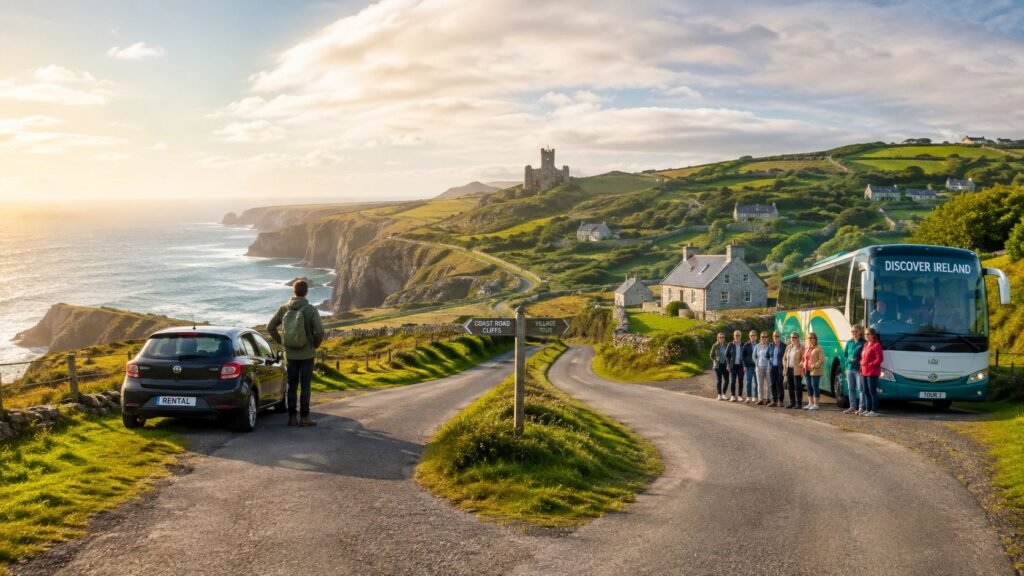
You're sitting with two tabs open and a half-built itinerary in your head. One tab shows a coach tour with hotels, meals, and transfers already sorted. The other is a map, a rail timetable, a rental car quote, and a long list of places you'd love to stop if only the day didn't run away from you.
That's the core independent travel vs group tours decision. It isn't about who's “right”. It's about which style fits the trip you're taking, the time you've got, and the kind of stress you're willing to carry.
In the UK, this choice matters more than many realise because travel is often assembled piece by piece. VisitBritain says UK residents made 103.9 million overnight domestic trips in 2023 and spent £25.1 billion, and domestic trips recovered to 97% of 2019 volumes in 2023, which tells you how normal self-booked travel still is in Britain. The scale of that market explains why so many travellers default to planning their own route, even when a group package might be better value for a specific journey. VisitBritain domestic tourism statistics

If you're weighing London, the Highlands, Cork, or the Wild Atlantic Way, start with the key question. Do you want control, predictability, social ease, or minimum hassle? Once you answer that, the right format usually becomes obvious.
The Great Travel Debate for UK and Ireland Adventures
A couple planning their first proper Scotland trip often starts the same way. One person wants the romance of a self-drive route, stopping for coffee in tiny towns and staying longer when the view is good. The other wants the clean confidence of a coach tour, where the hotel is booked, the luggage is handled, and nobody has to argue with Google Maps after dark.
That's why this isn't a simple independent versus group question. It's a choice between different travel personalities, and the trip itself can push the answer in either direction. A compact city break in Edinburgh doesn't ask the same thing of you as a five-day loop through the Scottish Highlands, and a softly planned Ireland escape is a different beast again.
The decision is bigger than logistics
People talk about itineraries, but the deeper issue is experience design. Independent travel gives you room to linger, detour, and change your mind. Group tours give you structure, shared momentum, and less day-to-day friction.
Practical rule: if the trip involves lots of unknowns, decide whether you want to solve them yourself or pay someone else to do it.
That's the cleanest way to frame the debate. The value of a trip isn't just the headline price or the number of sights. It's how much decision-making you want on your holiday, and how much you want removed from it.
A self-drive trip through Wales can feel brilliant when every stop is part of the fun. It can also feel exhausting when you're juggling parking, check-in times, and dinner reservations after a long road day. A group tour can feel restrictive on a postcard route, then feel like a relief when you realise nobody has to organise the ferry, the transfers, or the hotel sequence.
London city landmarks are easy to fold into either style, but the experience changes fast once you leave the city. That's the point. The style you choose shapes the rhythm of the whole holiday, not just the transport.
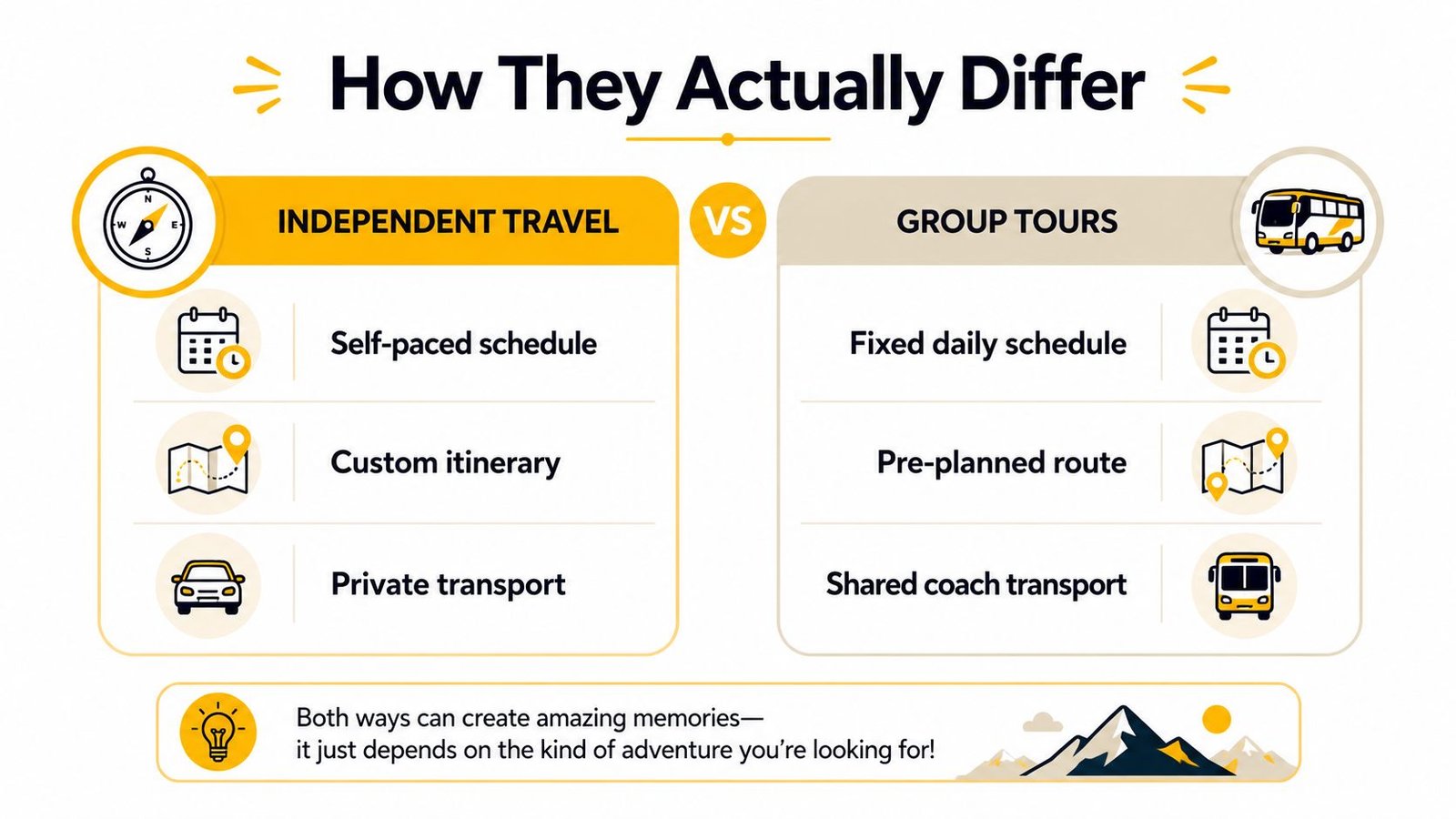
How Independent Travel and Group Tours Actually Differ
The biggest mistake people make is comparing the two styles only by surface labels. Independent travel isn't just “freedom”, and group tours aren't just “fixed”. The core difference is how each one handles your time, your attention, and your energy across the day.
A day in each style looks completely different
On an independent trip, you can leave late, stop for an unscheduled lunch, reverse the route if the weather turns, or add a village because someone at breakfast mentioned it. That flexibility is especially useful on multi-stop itineraries, and Great Britain's rail network helps explain why. It covers about 15,800 route miles and carried 1.6 billion passenger journeys in 2023/24, which is why point-to-point self-planned movement works so well for city links and rail-based loops. Great Britain rail network figures
On a group tour, the day starts when the tour starts. The coach leaves, the schedule runs, and your job is to be ready. You don't waste energy coordinating the route, but you do live inside a timetable that isn't yours. That usually means fixed meal times, tighter windows at attractions, and fewer moments to stop just because the light is good.
The hidden time costs are real
Independent travel asks you to do the work before the trip starts. You research routes, compare hotels, check ferry or rail timings, and think through contingencies. That work can be enjoyable, but it's still work.
Group tours move that burden off your desk. You trade away some control, but you get a cleaner holiday flow. For many travellers, that trade is worth it when the route is complex, the trip is short, or the destination is spread out.
If you hate fiddly admin, a good tour operator isn't selling transport. They're selling back your planning time.
That's why the same route can feel liberating in one format and tiring in another. The Scottish Highlands reward slowness and improvisation. The Wild Atlantic Way rewards curiosity and the willingness to stop often. But if you want to cover a lot of ground without becoming your own travel manager, a group format starts to look attractive very quickly.
Social energy and personal space matter too
Independent travel lets you choose who you spend the day with. That matters if you want quiet, romance, or family-only time. Group tours create instant companionship, which can be a gift if you're travelling solo or just don't want the trip to feel like a series of private logistics tasks.
The downside is simple. On a group tour, you don't get to rewrite the day because you're tired. On an independent trip, you can, but you have to carry the consequences. That difference affects every photo stop, meal break, and overnight decision.
The Real Cost Comparison Most Guides Overlook
The lazy version of this debate says independent travel is cheaper and group tours are pricier. That's too crude to be useful. The comparison is a stack of costs, and in the UK that stack can shift quickly because transport, parking, accommodation, and timing all pull in different directions.
Hidden costs change the outcome
A self-planned trip can look inexpensive until you add rail fares, fuel, parking, congestion-related charges, and peak-season hotel rates. Some routes are still a bargain on your own, especially if you're travelling off-peak and keeping the itinerary tight. Others become expensive because you're paying for lots of moving parts one by one.
Group tours often win on value when they bundle several of those pieces together. Accommodation, transfers, and route planning are folded into one rate, and the operator can negotiate in ways an individual traveller usually can't. That matters most when the itinerary is long, remote, or awkward to stitch together.
Cost Factors by Travel Style
| Cost Factor | Independent Travel Impact | Group Tour Impact |
|---|---|---|
| Rail fares | Can be efficient on point-to-point routes, but pricing depends on booking timing and fare structure | Usually bundled or replaced by coach transport |
| Fuel | Gives you freedom, but every extra detour adds cost | Included in the package price |
| Parking | Adds friction and extra expense in cities and busy tourist areas | Usually avoided or minimised |
| Congestion-related charges | Can bite hard in urban routes and make a city stay pricier than expected | Often absorbed into the tour's logistics |
| Peak-season accommodation | Flexible, but rates can climb fast on popular dates | Operators may secure pre-negotiated rates |
| Planning time | You spend your own time comparing, booking, and troubleshooting | Someone else carries that burden |
| Route changes | Easy to adapt without reworking a whole contract | Hard or impossible once the tour is set |
The part many overlook is that time has value. If you enjoy planning, self-booking is part of the fun. If you don't, then two hours comparing hotel options can feel like a tax on the holiday before it's even started. Group tours are often paying for predictability, not just transport.
Trip length changes the maths
A short city break often rewards independence because you can keep the route simple and use public transport or walk. A longer road trip changes things. The more nights, transfers, and attraction bookings you stack up, the more likely it is that a packaged itinerary gives you better overall value.
That's why there's no honest one-size-fits-all answer. A three-night London break and a seven-day Scottish Highlands circuit belong in different economic buckets. The smarter move is to compare the full cost stack, not just the headline price of the hotel or the tour.
Choosing the Right Style for Your Trip Profile
The easiest way to choose is to stop asking which style is “better” and start asking what kind of trip you're taking. The route, the length, the people you're travelling with, and your tolerance for uncertainty matter more than ideology. Once those are clear, the answer usually isn't ambiguous.
Match the style to the route
Short city breaks with dense public transport usually favour independence. You can walk, use trains or buses, and avoid paying for a vehicle that sits idle half the day. Remote, multi-region trips are different. Once the route involves repeated luggage moves, tricky station changes, or long stretches between major stops, the case for a structured tour gets stronger.
Families and mixed-age groups should be even more honest. If one person wants flexibility and another wants no friction, the trip can become a negotiation before it starts. Group travel reduces those arguments, while independent travel lets you shape the pace around the slowest or most tired traveller.
Use these questions before you book
- How much planning do I enjoy? If booking details drain you, lean towards a tour or a curated self-drive option.
- Do I need social company? If yes, group travel gives you that from day one.
- Will I move around a lot? The more stops you add, the more useful pre-arranged structure becomes.
- Am I comfortable making decisions on the road? If not, independent travel can turn into low-grade stress.
- Do I care more about spontaneity or certainty? That answer usually settles the debate.
A road trip through the Cotswolds is often a strong independent choice because the villages invite wandering and the distances are manageable. A bigger cross-country itinerary can be the opposite. If you're working on a route like the Wild Atlantic Way planning ideas are usually worth comparing with the shape of the journey, not just the destination list.
Best fit rule: if the trip depends on spontaneity, choose independence. If it depends on smooth execution, choose structure.
Think in terms of travel personality
Some people want to curate every meal, stop, and detour. Others want to arrive, relax, and let the trip unfold. Neither is superior. The mistake is forcing yourself into the wrong format because it sounds more adventurous or more organised on paper.
The right style is the one that matches your actual habits. If you like making your own calls and don't mind minor chaos, independent travel will feel natural. If you hate friction and want to spend less time managing the holiday than living it, group tours start to look very sensible.
Routes Where Each Travel Style Truly Shines
Some itineraries practically announce their preferred format. Self-drive routes with scenic pull-offs, small villages, and shifting weather tend to reward independent travellers. Spread-out journeys with long connective stretches, complicated transfers, or attraction access issues often reward the structure of a tour.
Independent travel excels where detours matter
The North Coast 500 in Scotland is a classic case because the best parts are often the pauses between the headline stops. Independent travel lets you linger when the road opens up, skip a stop that doesn't appeal, or add an unscripted meal in a place you hadn't planned to love. The Wild Atlantic Way in Ireland works the same way, especially if you want time for beaches, small harbours, and local detours that don't fit neatly into a coach timetable.
The Cotswolds also suit self-drive travellers who like a slower circuit. Village-to-village movement is part of the pleasure, and a rigid tour can flatten that experience. If you're shaping a South Wales route, planning a South Wales road trip can be useful because it sits naturally alongside the kind of flexible stops that make independent driving worthwhile.
Group tours win when logistics become the attraction
There are journeys where the structure is the value. Multi-day Highland rail journeys work better when someone else has thought through the connections. Northern Ireland coastal touring can also benefit from pre-arranged access and local direction, especially if you want to spend less time managing transport and more time absorbing the scenery.
An Ireland ring tour is another case where group format can outperform pure self-planning. The farther and more spread out the route, the more likely it is that the bundle of transport, timings, and local knowledge beats a self-built version on convenience. That's also where a tour can prevent the trip from becoming a sequence of small booking chores.
From London to Stonehenge by bus tour is a good reminder that some landmarks are easier when transport is already solved. For travellers who want a broad overview rather than a driving puzzle, that simplicity can be the whole point.
Different routes reward different moods
A self-drive route gives you room for serendipity. A tour gives you momentum. If your trip is about discovery, scenery, and freedom to stop, the independent side usually wins. If your trip is about seeing a lot without carrying the load, group structure is the sharper tool.
The best clue is the geography itself. Compact, well-connected areas invite independent movement. Spread-out, logistics-heavy routes often make the case for a tour without much effort.
The Hybrid Approach That Gives You the Best of Both
The old split between independent travel and group tours is too rigid for how people travel now. The smarter middle ground is a curated self-drive trip, where the route, hotels, and local suggestions are prepared for you, but your day still belongs to you. That model keeps the freedom while stripping out a lot of the friction.
Why the middle ground works
Pure independent travel can be exhausting when the planning load piles up. You can spend hours comparing hotel quality, guessing at drive times, and trying to work out where the worthwhile stops are. A curated self-drive itinerary solves that by front-loading the decisions and removing a lot of guesswork.
BTOURS operates in that space by building self-drive multi-day tours and personalised road trip itineraries rather than fixed group coach holidays. That kind of format suits travellers who want to move independently but still want help with route logic, accommodation choice, and the practical shape of the trip.
The benefits are practical, not abstract
- Freedom without chaos: You keep your own pace, but you're not starting from a blank page.
- Support without a crowd: You get planning help and local suggestions without spending the holiday on a coach.
- Flexibility without the admin burden: The core route is ready, but you can still linger, detour, or skip a stop.
That blend is especially useful for travellers who know what they want from a road trip but don't want to become a part-time travel planner. It also suits couples and families who care about pace, comfort, and reliable logistics more than about building every detail themselves.
If you're travelling with friends or a partner and want a sense of company without committing to a full package atmosphere, staying safe in group travel is worth reading alongside the usual route research. The point isn't to copy a group model. It's to borrow the bits that reduce stress.
The hybrid model works because it respects how people really travel. They want choice, but not endless decision-making.
That's why this format keeps growing in appeal. It gives you the confidence of a plan and the pleasure of travelling on your own terms. For many UK and Ireland trips, that's the sweet spot.
Your Action Plan for Booking the Perfect Trip
Start with the route, not the ideology. If your trip is short, urban, and easy to move around, independent travel may suit you best. If it's spread out, time-sensitive, or heavy on transfers, group structure or a curated self-drive model will usually save you hassle and sometimes money.
Use a simple booking workflow
- Define your priorities. Decide whether you care most about flexibility, simplicity, social company, or total control.
- Map the route. Look at how many stops, transfers, and moving parts the trip really has.
- Compare the full cost stack. Include transport, parking, accommodation, and the time you'll spend organising everything.
- Choose the right format. Pick independent travel, a group tour, or a hybrid based on the route, not on habit.
- Check quality, not just price. Cheap accommodation or a bargain tour isn't a win if it wastes your time or energy.
- Book the core pieces early. The best routes and room types go first, especially in busy travel periods.
For independent trips, focus on timing and flexibility. Book the essential pieces early, then leave room for one or two adjustable decisions if that's part of the fun. For group tours, read the itinerary line by line and pay attention to meal structure, free time, and what's included.
If you're packing documents and travel cards for a route that crosses borders or uses multiple bookings, a travel-ready passport wallet keeps the essentials together and saves rummaging at check-in. Small organisation choices matter more than you might admit, especially when you're moving between trains, cars, and hotels.
Watch for these red flags
A tour that looks cheap but leaves too much out can become poor value fast. An independent route that assumes unrealistic drive times can do the same. If a hotel chain, transport leg, or attraction visit looks awkward on the map, trust that instinct and check again.
The strongest trips are the ones that match your temperament. If you want movement and freedom, build for that. If you want ease and certainty, buy that. If you want both, choose a curated self-drive trip and stop pretending you have to live inside one camp forever.
If you want a UK or Ireland trip that's shaped around your pace rather than someone else's timetable, BTOURS builds self-drive itineraries that do the route planning for you while leaving the day open to explore. Visit BTOURS to see how a curated road trip can give you the freedom of independent travel with less of the planning strain.