
UK forecourts offer four main fuel families: petrol (mostly E10, with E5 as a premium option), diesel (B7 or paraffinic HVO), gaseous fuels like LPG and CNG, and electric charging. The one rule that matters more than any other: use whatever your manufacturer specifies, check the pump label and filler cap before you fill, and use the gov.uk compatibility checker if you’re ever unsure. Fuel labelling exists specifically to stop you making an expensive mistake.
What fuel types are available at UK filling stations?
Walk onto any UK forecourt and you’ll typically see three or four nozzles: standard unleaded, diesel, and increasingly an EV charge point tucked at the edge of the site. That’s the everyday picture. Behind it sits a wider set of options that most drivers never touch but ought to recognise.
Petrol dominates the pumps, split mainly between E10 (the standard 95 RON unleaded) and E5, sold as a premium grade at higher RON ratings. Diesel comes chiefly as B7, the EN590 standard blend, though paraffinic diesel (also called HVO or XTL) is turning up at more sites each year. Liquefied petroleum gas, or LPG, still exists but only at a small fraction of stations. Compressed natural gas is rarer still, mostly limited to fleet depots rather than public forecourts. Hydrogen refuelling exists in the UK, but only at a handful of dedicated sites, largely serving fleet and demonstration vehicles rather than the general public.
Then there’s electric charging, which isn’t a “fuel” in the traditional sense but has become a genuine forecourt fixture, from supermarket car parks to motorway service stations with bays of rapid chargers.
Availability tracks geography closely:
- Supermarket and motorway forecourts: near universal petrol and diesel, growing EV charging, almost never LPG or hydrogen.
- Independent rural forecourts: reliable petrol and diesel, occasional LPG, charging infrastructure still patchy in remote areas.
- Urban filling stations: the fullest range, including most LPG sites and virtually all hydrogen points where they exist at all.
- Fleet depots and specialist sites: where you’ll find CNG and most hydrogen dispensers, rarely open to casual passers-by.
If your journey depends on anything beyond petrol, diesel or a rapid charger, check availability before you set off rather than assuming the next town will have it.
Petrol grades explained: E10, E5 and what the octane numbers mean
Two things distinguish one petrol from another: how much ethanol it contains, and its octane rating. Get both wrong and you’re either damaging an older engine or paying extra for nothing.
Since 2021, E10 has been the standard 95 RON unleaded across almost every UK forecourt, containing up to 10% ethanol. Before that, standard unleaded was E5, capped at 5% ethanol, and E5 hasn’t disappeared. It’s still sold, usually as the “super” or premium option at a higher RON rating and a higher price. Some vehicles, particularly classics, motorbikes and a minority of older cars built before the early 2000s, aren’t approved for E10 and need to stick with E5. The gov.uk compatibility checker will tell you in seconds which category your vehicle falls into if you’re not certain.
RON stands for research octane number, and it measures how resistant a fuel is to knocking, that uncontrolled early ignition that damages high-performance or highly tuned engines. Standard unleaded sits at 95 RON. Premium fuels, branded variously by different retailers, run at 97 to 99 RON.
Here’s the part most drivers get wrong: higher octane doesn’t mean more power or better economy for every car. It matters when your engine is specifically designed for it, typically high-compression or turbocharged performance engines where the manufacturer states a minimum RON requirement.
Higher octane makes a measurable difference when:
- Your handbook specifies a minimum RON above 95.
- You hear knocking or pinking on standard fuel.
- You drive a performance or heavily tuned engine.
For everyday family cars running on standard unleaded, testing by consumer body Which? shows only marginal fuel-economy differences between standard and premium grades, with the bigger gains reserved for engines the manufacturer actually specifies for higher octane. Pumps display both the ethanol content (E5 or E10) and the RON figure clearly on the nozzle, part of the same labelling system designed to stop confusion at the point of fill.
Diesel blends: B7 and the rise of paraffinic diesel
Standard UK diesel isn’t pure mineral diesel any more. It’s B7, meaning it contains up to 7% biodiesel (FAME) blended into conventional diesel under the EN590 standard, and that’s what comes out of the vast majority of diesel pumps you’ll use.
The newer entrant is paraffinic diesel, sold under names like HVO (hydrotreated vegetable oil) or XTL. Chemically, it behaves differently from B7 diesel because it’s produced through hydrogenation rather than transesterification, giving it better cold-weather stability and, in many cases, a lower carbon footprint depending on the feedstock. It’s still a minority product on UK forecourts, more common at fleet depots and specific retailers than your average town garage.
Why the distinction matters for your fuel choice:
- B7 diesel works in virtually all diesel engines from the last two decades without modification.
- Paraffinic diesel (HVO/XTL) is generally compatible with modern diesel engines, but always check the manufacturer’s guidance first since approval isn’t universal across every model.
- Mixing concerns are rare in practice since both are diesel fuels, but retailers are required to label dispensers clearly precisely because consultation responses flagged public confusion over renewable content in diesel blends.
- Older diesel vehicles, particularly pre-2000s models, may need to check compatibility with any biodiesel content above minimal levels.
The confusion isn’t really about performance. It’s about renewable content and what’s actually in the tank, which is exactly why nozzle labelling now spells out the blend rather than leaving drivers to guess.
Alternative fuels: LPG, CNG and hydrogen in practice
LPG remains the most accessible alternative fuel, but “accessible” is relative. Roughly 1,400 LPG refuelling points exist against around 8,350 total UK filling stations, and LPG uptake among UK cars has stayed under 1% for years. Converting a petrol engine to run on LPG is possible and can cut fuel costs, but you’re accepting a real trade-off in refuelling convenience, especially on rural routes.
CNG sits even further from the mainstream, largely confined to commercial fleets and depots rather than public forecourts. Hydrogen refuelling exists at only a small number of UK sites, mostly serving demonstration and fleet vehicles.
Practical planning notes:
- Don’t assume LPG or CNG will be available outside major towns; map stations before you travel.
- A converted LPG vehicle usually retains its original petrol tank, giving you a fallback fuel.
- If you’re renting a vehicle in the UK, confirm which fuel it actually takes. Alternative-fuel rentals are unusual but not unheard of.
Electric and hybrid vehicles: when you’re charging, not filling
Not every “fuel type” question ends at a nozzle. Battery electric vehicles (BEVs) never visit a forecourt for fuel at all, they charge exclusively via a plug, from a home wallbox to a motorway rapid charger. Hybrid electric vehicles (HEVs) run on petrol or diesel with a battery that recharges through braking and the engine itself, meaning you’ll never plug one in. Plug-in hybrids (PHEVs) sit in between: they carry a larger battery for short electric-only trips but still need regular forecourt visits for petrol or diesel once that charge runs out.
For PHEV drivers, forecourt fuel choice follows exactly the same rules as any conventional petrol or diesel car, check the manufacturer’s specified grade and RON requirement. The difference is planning: get the electric range wrong on a long trip and you’re back to relying on fuel economy figures that assume a charged battery, not an empty one.
Pro Tip: Before a long UK road trip in a PHEV or BEV, map rapid chargers along your route rather than relying on your destination having one. Motorway services are generally reliable; rural B-roads are not.
- BEV: charges only, no forecourt fuel needed.
- HEV: petrol or diesel only, battery self-charges.
- PHEV: needs both charging and occasional forecourt fuel.
How to check which fuel your car takes
Misfuelling is entirely avoidable once you know where to look, and the checks take under a minute.
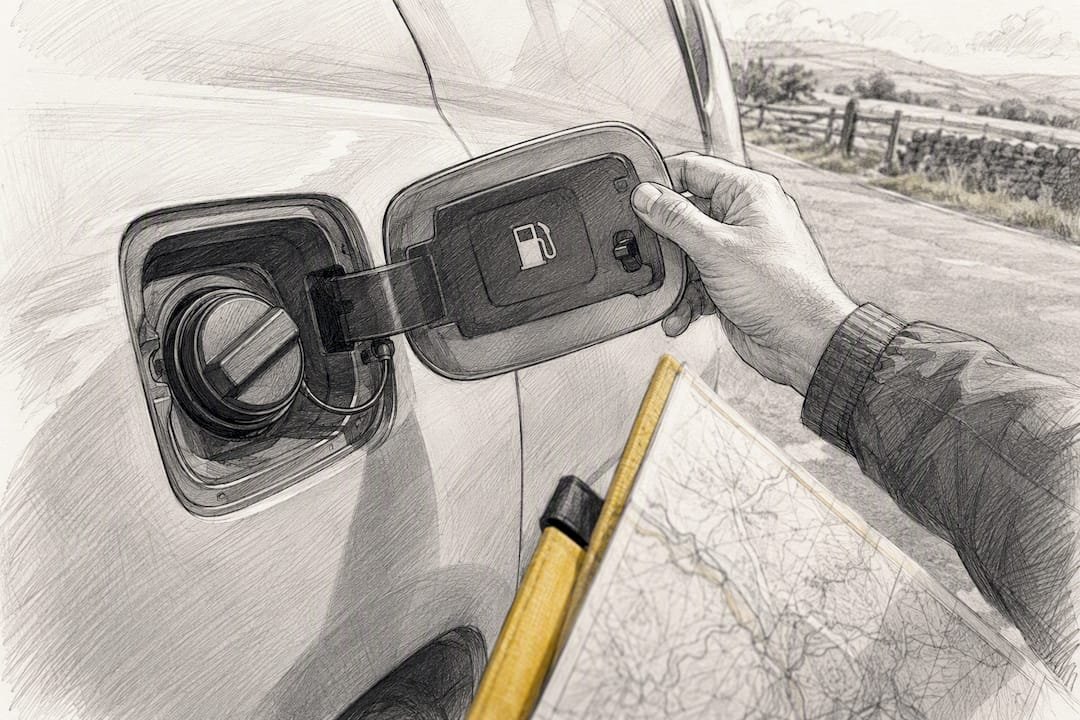
- Check your vehicle’s filler cap first. Since the introduction of the Alternative Fuel Labelling regulations, manufacturers must display a fuel identifier close to the filler cap on new vehicles, showing exactly which fuel and blend the car takes.
- Read the owner’s manual if the filler cap label is unclear or the car predates the regulations. It will state the minimum octane and whether ethanol content above 5% is approved.
- Match it against the pump label. Dispensers and nozzles now carry the same standardised identifiers, circular symbols marking petrol grades (E5, E10) and diesel types (B7, XTL) so you can cross-check in seconds.
- Use the gov.uk checker or ask staff if anything still looks ambiguous, particularly with an unfamiliar rental car or an older vehicle.
The whole point of standardised labelling is that you shouldn’t need to guess. Match the symbol on the nozzle to the symbol on your filler cap, and the fuel is right, no manual required at the pump itself.
This system exists because misfuelling was common enough to justify mandatory labelling across nozzles, dispensers and vehicles alike, not just a courtesy sticker.
Choosing the right fuel: cost, performance and emissions
The manufacturer’s recommendation is the floor, not a suggestion you can quietly ignore. Running lower-octane fuel than specified over time can cause knocking and, in some engines, long-term wear. Running it occasionally by accident won’t destroy your engine, but making a habit of it is a false economy.
Premium, higher-octane fuel earns its extra cost in specific circumstances only: your handbook states a minimum RON above 95, you’re driving a performance or turbocharged engine, or you’re hearing knocking on standard fuel. Outside those cases, Which? testing found the fuel-economy gains from premium petrol are marginal for most everyday cars, meaning you’re often paying a premium price for a benefit your engine was never built to use.
Emissions considerations add another layer. Paraffinic diesel (HVO/XTL) can offer a lower carbon footprint than standard B7 depending on the feedstock used, and it’s worth choosing where it’s available and your manufacturer approves it. For petrol vehicles, there’s currently no equivalent renewable substitute in mainstream circulation on UK forecourts.
Pro Tip: If you’re not sure whether your car benefits from premium fuel, try one full tank of it and note whether you notice smoother running or fewer knocking sounds under load. If nothing changes, save the money.
- Follow the manufacturer’s minimum octane, always.
- Reserve premium fuel for cars that specify it or show knocking symptoms.
- Choose paraffinic diesel over B7 where approved and available, for the emissions benefit.
What to do if you put the wrong fuel in
Don’t start the engine. That single decision determines whether you’re looking at a draining and a clean, or a full engine rebuild.
- If you’ve put petrol in a diesel tank (or vice versa), leave the vehicle where it is, don’t turn the key, and call breakdown assistance or a garage immediately.
- If the engine’s already running, switch it off the moment you realise, even mid-manoeuvre on the forecourt.
- Expect a specialist fuel drain, typically completed within a few hours, rather than a full engine strip, provided you haven’t driven on the wrong fuel.
Costs and timescales vary by garage and how far you drove before noticing, but consumer guidance consistently points to the same first move: stop, don’t start, call for help.
Planning ahead when you’re renting or driving long distances
Fuel logistics matter most when you’re covering ground you don’t knowwhether that’s a Highland loop or an Irish coastal route. Confirm your rental car’s fuel type and filler-cap label the moment you collect the keys, map charging or LPG stops if your route runs through rural stretches, and keep breakdown or garage numbers handy for the fuel type you’re actually using.
Our guide to driving in the UK covers these checks in more depth for visitors unfamiliar with British forecourts.
Let BTOURS handle the fuel logistics for you
Reading through all of this is exactly the kind of groundwork that eats into the time you’d rather spend actually planning the trip itself. Some self-drive itinerary providers incorporate fuel and charging stops into their route planning, taking into account vehicle types and refuelling needs along the way.

That’s the practical difference between researching forecourt locations yourself for a week-long Highland or Irish route and having someone map it before you set off. BTOURS’ self-drive tours across England, Scotland, Wales, Ireland and Greece pair expert route planning with curated accommodation, so the logistics around fuel stops sit alongside everything else, pacing, sights, places to stay, rather than something you’re left to solve alone at a service station. If you’re weighing up a longer route, our UK road trip planner is a good place to see how stage lengths and fuel stops fit together in practice. To start building an itinerary around your own dates and interests, get in touch through Btours and tell us the route you’re picturing.
A practical view for anyone planning a UK drive
Most misfuelling stories start the same way: someone assumed rather than checked. The labelling system exists precisely because assumption is where things go wrong, and it takes seconds to cross-check a filler cap against a nozzle. If you’re planning a longer route, factor fuel and charging availability into your stage lengths the same way you’d factor in opening hours or scenic stops, because running short on either costs you far more time than checking ahead ever would.
— Theo
Sources
For anything fuel related, the primary sources are worth bookmarking rather than trusting secondhand summaries.
Gov.uk’s E10 petrol explained page carries the official vehicle compatibility checker along with specific guidance for classic and older vehicles. The Alternative Fuel Labelling regulations page sets out exactly what identifiers must appear on nozzles, dispensers and filler caps. For a broader consumer view that mirrors the categories covered here, the RAC’s fuel guide is a solid independent reference, and RAC’s LPG guide covers conversion costs and refuelling network limits in more detail than space allows here.
- E10 petrol explained
- PIR – the Alternative Fuel Labelling and Greenhouse Gas Emission (Misc Amendments)
FAQ
Should I use E5 or E10?
Use E10 unless your vehicle manufacturer specifically states otherwise. It’s the standard 95 RON unleaded at nearly every UK forecourt, and the gov.uk compatibility checker confirms in seconds whether your car needs E5 instead, which mainly applies to classics and some pre-2000s models.
What are the four types of petrol?
UK forecourts typically offer standard E10 unleaded (95 RON), E5 premium unleaded at higher octane ratings (97 to 99 RON), and in some cases separate super-unleaded blends marketed by individual retailers. The key distinctions are ethanol content (E5 versus E10) and octane rating, not four entirely separate fuel categories.
Is unleaded 95 and E10 the same?
Yes, in current UK practice. Standard 95 RON unleaded has been E10 (up to 10% ethanol) since it became the default grade in 2021, replacing the previous E5 standard at that octane level.
What is the best type of fuel to use in the UK?
The best fuel is whatever your manufacturer specifies, checked against the filler-cap label and the pump identifier before you fill. For most drivers that means standard E10 petrol or B7 diesel, with premium or paraffinic alternatives reserved for vehicles that specifically call for them. BTOURS builds these compatibility checks into its self-drive itineraries so travellers aren’t left guessing at unfamiliar forecourts.