The Slea Head Drive is a circular coastal route about 47 kilometres long that starts and finishes in Dingle town, tracing the Wild Atlantic Way around the tip of the Dingle Peninsula. Driven without stopping it takes about an hour, but that misses the point entirely. Set aside a half day at minimum, and 3 to 5 hours if you actually want to see anything. A full day or two is the better option if the weather cooperates and you’re not rushing to Killarney by dinner.
What is the Slea Head Drive and where does it start?
Dingle town is both the start and finish line. The loop runs anticlockwise or clockwise along the R559, hugging the coast past Ventry, Slea Head, Coumeenoole, Dunmore Head and Dunquin before cutting back through Gallarus and Milltown to return to Dingle. It’s a small, self-contained slice of the Slea Head Drive, which itself forms part of the much longer Wild Atlantic Way that stretches from Donegal to Cork.
Three things matter before you turn the key.
- Direction changes seasonally. Between late June and 11 September, a summer traffic-flow scheme puts the route on a mandatory clockwise system during set hours, with staffed checkpoints on the busiest stretches, according to the Discover Kerry driving advisory.
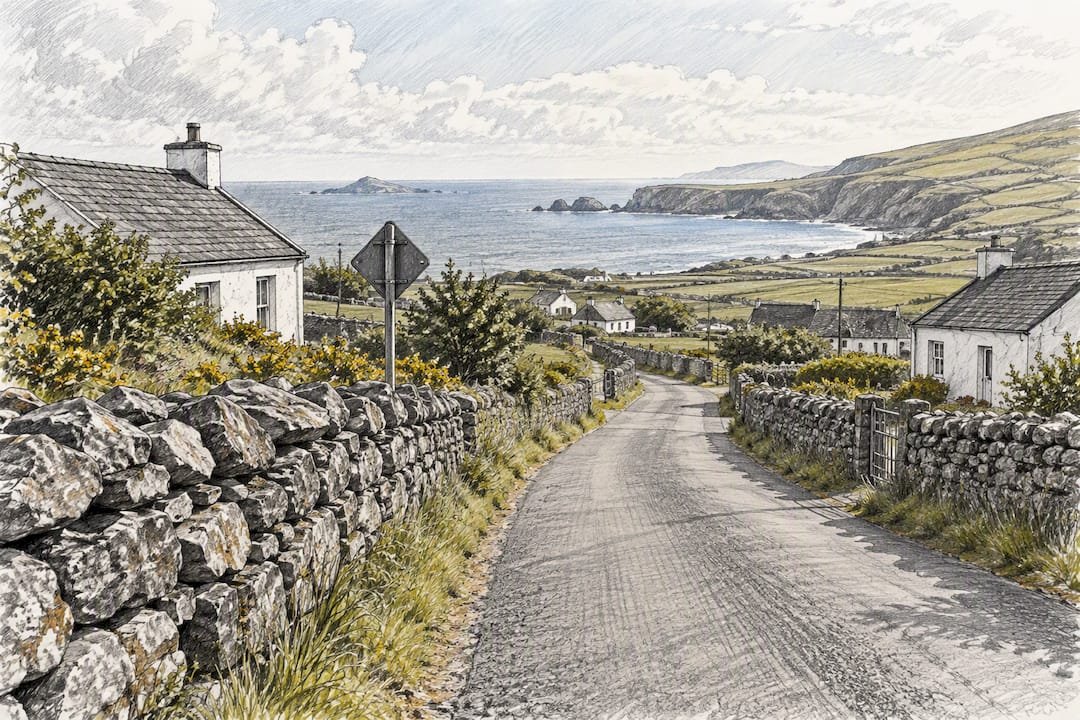
- The roads are narrow and cliff-hugging, often down to a single lane with grass verges and drystone walls close on both sides. Standard rules of the road apply: drive on the left, and give way where the road narrows to one car’s width.
- Sat Nav lags behind reality. Google Maps and most GPS units don’t reflect the seasonal one-way scheme, so local signage takes priority over any app whenever the two disagree.
Think of the route as a smaller loop hanging off the bigger Wild Atlantic Way spine. If you’re already driving that coastal road north or south through Kerry, Slea Head is the detour that makes the whole trip worthwhile. A quick glance at any road map before you leave Dingle will show the R559 curling out toward Ventry and looping back through Ballyferriter, which is really all the orientation you need.
Best stops on the Slea Head loop, in driving order
Here’s the loop as you’ll actually encounter it, driving clockwise out of Dingle. Each stop has its own rhythm, and knowing what to expect at each one saves time and avoids the parking scrums that build up by midday.
- Dingle town. This is your last stop for fuel, a proper coffee, and a working toilet before the narrow stretches begin. Petrol stations, supermarkets and paid car parks cluster around the harbour, so top up here rather than hoping for a garage further round.
- Ventry (Ceann Trá). A long, gently curving beach with a car park right off the road, Ventry is the easy warm-up stop. It’s a good five-minute leg-stretch rather than a destination in itself, with a couple of pubs and a shop nearby if you need supplies.
- Fahan, Dunbeg Fort and the beehive huts. Scattered along this stretch are Iron Age promontory forts and clochán beehive huts, some on private land with a small entry fee. Fifteen minutes is enough unless you’re genuinely into archaeology, in which case give it thirty.
- Slea Head viewpoint (Ceann Sléibhe). This is the postcard shot: the Blasket Islands rising out of the Atlantic, often with a Celtic cross statue in the foreground. Pull-ins are small and fill fast in summer, so if the first one’s full, there’s usually another within a few hundred metres.
- Coumeenoole Beach (Com Dhíneol). A crescent of sand backed by dramatic cliffs, familiar to anyone who’s seen Ryan’s Daughter or, more recently, Star Wars: The Last Jedi. A stepped path leads down from the small car park, but strong currents make swimming inadvisable here regardless of how inviting it looks from above.
- Dunmore Head. The westernmost point on the Irish mainland, and one of the quieter stops precisely because it needs a bit more effort. A 1.6-mile loop walk takes you out along the headland with sweeping Blasket views, and there’s an honesty box at the car park asking for a small donation, typically around €1, to help maintain access.
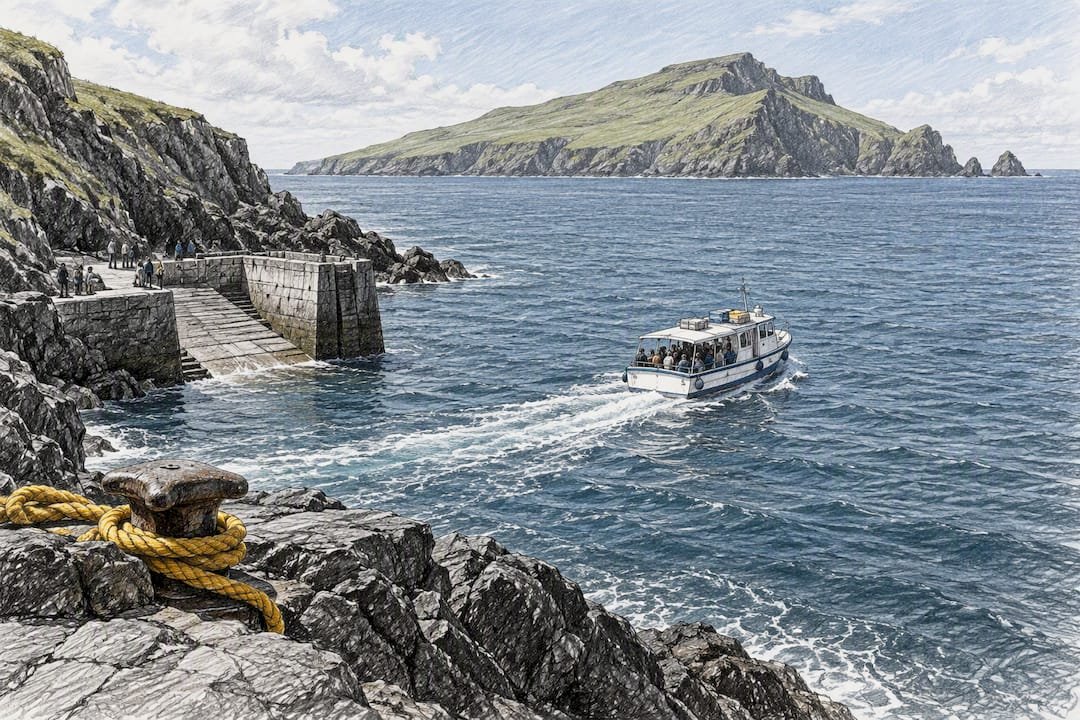
- Dunquin Pier (Dún Chaoin). A dramatic zigzag path drops steeply to a small stone pier, historically the departure point for the Great Blasket Island and still used by the seasonal ferry. Park in the clifftop car park and walk down. Do not attempt to drive the track itself: it’s steep, narrow, and a well-documented cause of vehicle damage for tourists who misjudge it.
- The Blasket Centre (Ionad an Bhlascaoid Mhóir). Just up the road in Dunquin village, this museum tells the story of the Great Blasket’s former island community through exhibits, recordings and a genuinely moving short film. It’s also where you’ll find current ferry timetables if you’re considering the crossing.
- Gallarus Oratory. One of Ireland’s best-preserved early Christian structures, a dry-stone chapel shaped like an upturned boat and still watertight after roughly 1,200 years. A small visitor centre sits at the entrance, and the walk to the oratory itself takes barely five minutes.
Pro Tip: Visit Coumeenoole and Dunmore Head earlier in the day rather than mid-afternoon. Both have small car parks that fill quickly once coach tours reach the peninsula, and arriving before 11am on a summer day usually means an easy spot rather than a wait.
The whole stretch from Ventry to Gallarus runs through Gaeltacht villages where Irish remains the everyday language on shopfronts and road signs. It’s worth slowing down for that alone, not just the scenery.
How do I drive the Slea Head Drive safely?
Most of the trouble on this route comes from a handful of avoidable mistakes, not the road itself.
- Follow the signage, not your app. The seasonal clockwise system exists because two-way traffic on single-lane cliff roads creates gridlock and near-misses. Turn off turn-by-turn navigation once you’re on the loop and read the physical signs instead.
- Expect local and farm traffic going the “wrong” way. Residents, delivery vans and farm vehicles are exempt from the visitor flow rules, so don’t assume every oncoming car is in the wrong.
- Larger vehicles face real restrictions. During the managed summer period, coaches and campervans are subject to directional limits at certain hours, and some of the narrowest stretches near Slea Head itself are genuinely unsuitable for anything wider than a standard car.
- Give walkers and cyclists a proper berth. The route is popular with both, and passing at speed on a blind bend is how accidents happen. Slow right down, leave as much space as the road allows, and wait if there isn’t room to pass safely.
- Never drive down to Dunquin Pier. It bears repeating: park at the top and walk. The path is steeper and narrower than it looks from a photo.
The seasonal one-way scheme typically runs from late June to 11 September, with staffed points active during peak hours. Outside that window, the road reverts to normal two-way driving, which changes your planning if you’re travelling in shoulder season.
How long does the Slea Head Drive take and where should I park?
Driven with no stops, the loop takes about an hour. That’s the wrong number to plan around. Most visitors need 3 to 5 hours to properly enjoy the main stops, and a relaxed day or two suits anyone who wants to walk the Dunmore Head loop, linger at the Blasket Centre, or add a ferry crossing.
- Parking at Coumeenoole and Dunmore Head is limited to small roadside car parks with no expansion room, so both fill by late morning in July and August.
- Dunquin’s clifftop car park serves both the pier viewpoint and the Blasket Centre, and it’s the one place where walking down rather than driving down is non-negotiable.
- Dingle town has several paid car parks near the harbour, the cheapest and most reliable base for fuelling up and using facilities before or after the loop.
- Start early in summer. Setting off from Dingle by 9am, ahead of the coach tours, is the single best way to avoid congestion at the popular viewpoints.
Sample Slea Head Drive itineraries for every pace
Not every visitor has the same amount of time, so here are three ways to run the loop depending on what you’re working with.
- Half-day version (roughly 3 hours). Pick two or three highlights rather than trying everything. Slea Head viewpoint, Coumeenoole Beach and Gallarus Oratory cover the essentials and get you back to Dingle for a late lunch.
- Full loop, 3 to 5 hours. Start in Dingle, allow 15 minutes at Ventry, 20 at the beehive huts, 20 at Slea Head viewpoint, 30 at Coumeenoole (including the walk down), an hour at Dunmore Head if you’re doing the headland walk, 20 at Dunquin Pier, an hour at the Blasket Centre, and 20 at Gallarus. That adds up close to five hours once you build in driving time between stops.
- Relaxed 1 to 2 day plan. Do the loop as above on day one, then use day two to tack on the Conor Pass or Inch Beach, both a short drive from Dingle and easy additions if you’re staying overnight anyway.
Fuel up in Dingle before you leave; there are no reliable petrol stations on the loop itself. Toilets are scarce beyond Dingle and the Blasket Centre, and in July and August it’s worth booking a Dingle dinner table in advance rather than hoping for a walk-in.
Can I take a ferry to the Blasket Islands from Dunquin?
A seasonal passenger ferry runs from Dunquin to the Great Blasket Island roughly between spring and autumn, weather permitting, with exact dates and departure times best checked directly with the ferry operator or the Blasket Centre before you travel. The island itself has minimal facilities: no shop, no café, just walking trails, seabirds and the ruins of the abandoned village. If you’re set on going, allow extra time in your itinerary and book ahead in peak season, since crossings are weather-dependent and can fill up or cancel at short notice.
Where should I eat and stay near Slea Head?
Dingle town is the obvious base, and for most visitors the only sensible one. It has the peninsula’s best concentration of restaurants, cafés and pubs with evening food, plus guesthouses and small hotels within easy walking distance of the harbour.
- Book accommodation ahead in July and August. Dingle’s rooms sell out well in advance during peak season, and last-minute options thin out fast.
- Small cafés along the loop often close seasonally, so don’t count on a coffee stop at Ventry or Dunquin outside the main summer months. Always check opening times before you set off.
- Guesthouses and B&Bs scattered around Dingle town and its outskirts tend to have more flexible availability than the handful of larger hotels, and often work out better value for a one or two-night stay.
If you’re curious about the wider food culture that shapes menus around the peninsula, this guide to local gastronomy is worth a read before you go.
Why proper sequencing beats winging it on Slea Head
Most people treat Slea Head as a photo-stop checklist and end up losing an hour circling for parking they’d have found easily an hour earlier. Sequencing the day around when car parks actually fill, rather than the order stops appear on a map, is the difference between a relaxed loop and a stressful one. Building itineraries like this across Ireland can add value: the difference lies not just in knowing the road exists, but also in understanding how timing affects the experience at places like Coumeenoole.
The peninsula rewards travellers who slow down for the Gaeltacht villages and the archaeology, not just the clifftop views. Rushing it to tick a box is the single most common way to waste a genuinely special day.
— Theo
Plan your Dingle drive without the parking guesswork
Some specialised tour operators build personalised self-drive itineraries across Ireland, including routes through the Dingle Peninsula, with the sequencing, timing and accommodation arranged in advance. Rather than working out for yourself when Coumeenoole fills up or which Dingle guesthouse still has rooms in August, you get a route built around it, curated stays booked in, and support on hand if plans need to shift mid-trip.

This is one option among many for seeing Slea Head, not the only way to do it: plenty of travellers happily plan the loop themselves using guidance like the sections above. But if you’d rather hand the logistics to someone who’s already worked out where the day gets stuck, BTOURS’ Wild Atlantic Way itinerary is built around exactly that stretch of coast, with route planning, curated stays and on-trip support included. Have a look through the self-drive tour options and get a feel for how a planned route compares with going it alone.
Where to check current Slea Head Drive information
For up-to-date details on seasonal traffic dates, always check the Dingle Peninsula Tourism Alliance’s driving guidance and Discover Kerry’s seasonal advisory before travelling, since exact dates shift slightly year to year. Confirm ferry and museum opening times directly with the Blasket Centre or ferry operator, particularly outside peak summer months.
Sources
- Slea Head Drive one of Ireland’s most scenic roads Dingle Peninsula Wild Atlantic Way.
- Driving on the Dingle Peninsula — Dingle Peninsula Tourism Alliance
- Slea Head Driving Route for Summer — Discover Kerry blog
- Slea Head Drive guide — The Irish Road Trip
- Slea Head Drive 2026: Best Stops on the Dingle Peninsula — InBetweenTravels
FAQ
Is the Slea Head Drive worth it?
Yes. It packs beaches, Iron Age forts, an early Christian oratory, and one of Ireland’s most photographed coastal viewpoints into a single 47 km loop. Few routes in Ireland deliver this much variety in such a short distance.
Is Slea Head Drive difficult to drive?
It’s manageable for any confident driver, but expect narrow single-lane sections, tight bends and cliff-edge drops with minimal barriers. Following the seasonal clockwise system and local signage rather than Sat Nav makes the trickiest stretches far less stressful.
How long does it take to do the Slea Head Drive?
Non-stop, the loop takes about an hour, but allowing 3 to 5 hours is the realistic minimum if you want to stop at the main viewpoints and beaches. A relaxed visit with a proper walk at Dunmore Head or a Blasket Centre stop can easily fill a full day.
Is the Ring of Kerry a better experience than the Slea Head Drive?
They’re different trips rather than one being objectively better: the Ring of Kerry is a much longer loop with grander mountain and lake scenery, while Slea Head is a compact, dramatic coastal detour you can comfortably finish in half a day. Many visitors do both, and BTOURS’ Ring of Kerry itinerary is worth comparing directly against Slea Head if you’re deciding which to prioritise with limited time.