You can do the Connemara Loop as a long day trip from Galway, but two days gives you room to actually enjoy it. The core route runs Galway to Clifden via the N59, out to Sky Road, on to Kylemore Abbey, along Killary Fjord, and back through Maam Cross. Leave Galway before 9am, drive Sky Road clockwise, and build in far more time than the map suggests for narrow roads and photo stops.
Connemara loop overview: distances and driving time
The Connemara Loop covers roughly 93 km (58 miles), starting and finishing at Maam Cross. Driven straight through with no stops, that’s about 1 hour 45 minutes behind the wheel. Nobody actually drives it that way, and you shouldn’t either.
Once you factor in the places worth stopping for, the real number shifts considerably. A shortened version hitting only the essentials takes several hours. A full day covering the major highlights, Sky Road, Kylemore, Killary, and a beach stop, takes significantly longer once you’re parked, walked, photographed, and back in the car. Plenty of official guides and regional tourism pages go further and recommend two full days to see the loop properly without feeling rushed, which matches what most seasoned visitors report back after trying to cram it into one afternoon.
Galway city is the natural launch point for most travellers, sitting close enough to the loop’s edge that you’re on the N59 within twenty minutes of leaving the centre. Some drivers prefer to start from Clifden itself if they’re already staying in Connemara, which shaves an hour or more off the total driving time and lets you tackle Sky Road first while you’re fresh.
Two variants change the shape of the trip:
- The southern coast detour: a diversion off the main loop toward Roundstone and Dog’s Bay, adding perhaps 45 minutes to an hour but trading crowds for quiet white sand.
- The Killary Fjord leg: the northern stretch through Leenane, generally considered the more dramatic of the two and rarely skipped even on a tight schedule.
Most itineraries pick one detour rather than both unless you’ve committed to the two-day version. Trying to squeeze in Roundstone, Killary, Kylemore, and Sky Road inside a single day is the single most common planning mistake people make with this route, and it’s exactly why the two-day option keeps showing up in local recommendations.
One-day Connemara road trip itinerary from Galway
A single day works if you’re disciplined about timing and realistic about what you’ll skip. Here’s the order that keeps driving distances sensible and avoids doubling back.
- Leave Galway by 8.30am. This isn’t paranoia, it’s traffic management. Coach tours tend to hit Kylemore Abbey and Clifden from mid-morning onward, and an early start puts you ahead of that wave at every major stop.
- Drive the N59 to Clifden (roughly 80 minutes). Stop briefly if you like, but save your time for Sky Road just beyond it.
- Sky Road loop from Clifden (allow 45 minutes to 1 hour). Drive it clockwise, park at the main viewpoint, and take in the Atlantic and the islands beyond Clifden Bay before heading back into town.
- Clifden for an early lunch (45 minutes). The town has enough cafés and pubs that you won’t struggle for a decent feed before the long middle stretch of the drive.
- Kylemore Abbey (1 to 1.5 hours). Budget more time here than you think you need. The Victorian walled garden alone can absorb half an hour if the weather’s playing along.
- Killary Fjord and Leenane (45 minutes to 1 hour). Pull over at the viewpoints along the N59 as it tracks the fjord; this stretch is often the most photographed part of the entire loop.
- Maam Cross and the Quiet Man Bridge (20 to 30 minutes). A short, easy stop to stretch your legs before the final run back to Galway.
- Return to Galway (about 1 hour from Maam Cross).
If you’re running behind by early afternoon, cut Sky Road down to a single viewpoint stop rather than the full loop, or skip the Quiet Man Bridge entirely. Both are recoverable losses; running out of daylight on the Killary stretch is not.
Pro Tip: Fill your tank in Clifden or Maam Cross before continuing. Rural fuel stations along this route close early and are easy to miss once you’re focused on the scenery, and running low with no signal to check the next station is a genuinely bad afternoon.
Parking at Sky Road’s main viewpoint is informal roadside space, so pull in fully rather than leaving your car half on the tarmac. At Kylemore, the car park is well signed and rarely full outside peak summer weekends. Watch for single-track sections on the approach to Leenane, where oncoming traffic means someone has to reverse to a passing place, ideally not you if you’re on the outside edge above the fjord.
Two-day Connemara itinerary: where to stay and how to pace it
Splitting the loop over two days turns a rushed checklist into an actual holiday. It also lets you add Connemara National Park and Diamond Hill, which most one-day itineraries have to drop.
Clifden works well as a base if you want restaurants, a livelier evening, and easy access to Sky Road first thing. Letterfrack suits travellers prioritising the national park and Kylemore, since both sit within a ten-minute drive and you can walk Diamond Hill without an early alarm.
- Day one: Galway to Clifden via the N59, Sky Road at a relaxed pace (late afternoon light works particularly well here), settle into your overnight base, and take an evening walk or dinner in Clifden itself.
- Day two: Kylemore Abbey first thing before coach groups arrive, then Connemara National Park and Diamond Hill for a couple of hours, followed by Killary Fjord and Leenane on the way back, with Maam Cross as your final stop before Galway.
- Evening options: Clifden has the wider spread of restaurants; Letterfrack is quieter but closer to the park gates for an early trail start.
Photography works best in the low light either side of midday, so a two-day structure lets you hit Sky Road and Killary at golden hour rather than fighting harsh midday glare against the water.
Key stops explained: what to see and how long to allow
Sky Road is the loop’s signature viewpoint, a narrow coastal circuit just outside Clifden with sweeping views over Clifden Bay and the offshore islands. Drive it clockwise; this keeps the seaward edge on the passenger side along the narrowest stretch, which improves sightlines for the driver and makes the best views easier to take in without craning across the car. Parking is roadside at the main viewpoint. Allow 45 minutes to an hour.
Clifden is Connemara’s largest town and the practical hub of the whole trip, good for lunch, fuel, cash machines, and the last reliable mobile signal before some of the quieter stretches. It also doubles as your access point for Sky Road. Give it 30 to 45 minutes if you’re just passing through, longer if you’re overnighting.
Kylemore Abbey is a Victorian Gothic building on the shore of Kylemore Lough, now a Benedictine abbey with a walled Victorian garden a short shuttle ride from the main house. Between the abbey, the lakeside walk, and the garden, allow 1 to 1.5 hours. It’s the busiest single stop on the loop, so arriving before 10.30am or after 2.30pm avoids the worst of the coach traffic.
Connemara National Park and Diamond Hill sit near Letterfrack and offer the loop’s best short hike. Diamond Hill is a well-built path with a looped summit trail, and the return walk typically takes around two hours, making it an accessible summit for reasonably fit walkers rather than a technical mountain route. The visitor centre has trail maps and toilets, useful if you’re breaking up a long driving day.
Killary Fjord and Leenane form the loop’s northern edge, where the road tracks Ireland’s only true fjord past small settlements and sheep-dotted hillsides. Roadside viewpoints along the N59 give you the classic shot without leaving the car, but Leenane itself has boat tour operators running short cruises out onto the fjord if you want to get on the water rather than just look at it. Allow 45 minutes for viewpoints alone, longer if you’re booking a boat trip.
Roundstone, Dog’s Bay, and Gurteen Beach make up the southern detour, and they’re worth the extra driving time if beaches matter to you. Dog’s Bay and Gurteen sit back to back on a narrow isthmus, giving you white sand and turquoise water that looks more Caribbean than Atlantic on a clear day. The southern coast route is consistently quieter than the fjord road, which also means better light for photography without other cars in every frame.

Maam Cross and the Quiet Man Bridge mark the traditional start and end point of the loop, and the bridge itself is a short, easy photo stop tied to the 1952 film that put this stretch of road on the map for a certain generation of visitors. There’s a small facilities stop nearby, useful as your last break before the run back into Galway.
Practical driving and safety tips for narrow Connemara roads
Connemara’s roads are the whole point of the trip, but they demand a different driving style than motorway habits allow for. Most of the loop runs on the N59, a well-surfaced main road, with several single-track sections branching off it, particularly around Sky Road and parts of the southern coast detour.
- Use passing places properly. On single-track stretches, pull into the nearest passing bay on your left as soon as you see oncoming traffic, rather than expecting the other driver to reverse.
- Drive Sky Road clockwise. This puts you on the inland side of the narrowest section, which local driving guidance consistently recommends for both safety and sightlines.
- Ignore sat-nav shortcuts. Stick to the N59 and marked R-roads. GPS apps sometimes route you down moreens that are technically shorter but unsuitable for a standard hire car, and getting stuck on one costs far more time than the “shortcut” saves.
- Fill up early. Rural fuel stations along this route often close by early evening, so top up in Clifden or Maam Cross rather than waiting.
- Park sensibly at viewpoints. Pull fully off the carriageway even at informal roadside stops; a car half on the road on a blind bend is a hazard for everyone behind you.
Speed limits drop sharply through villages and on the tightest coastal bends, and it’s worth treating the signed limit as a ceiling rather than a target given how often the road surface and visibility change without warning. After heavy rain, watch for standing water and boggy verges on the quieter southern roads; the ground here doesn’t drain quickly.
Pro Tip: Download offline maps before you leave Galway. Mobile signal drops out completely in several stretches around Killary and the southern coast, and losing navigation mid-drive on a single-track road is worse than losing it on a motorway.
When to visit Connemara: weather, seasons and packing
May and September are the best months to visit, giving you milder weather, longer daylight, and noticeably fewer coaches than peak summer. Winter has its own stark appeal, but that’s balanced against shorter days and the very real chance that small guesthouses and rural restaurants close between October and mid-March.
Connemara’s Atlantic climate changes its mind constantly. Expect sun, rain, and wind within the same afternoon regardless of season, and pack accordingly rather than trusting the morning forecast.
- Waterproof jacket and trousers, not just a showerproof coat
- Layers you can add or shed quickly as temperature swings
- Sturdy walking shoes, even if Diamond Hill is your only planned hike
- A portable power bank, since charging opportunities thin out on the more remote stretches
- Offline maps downloaded in advance for the mobile signal gaps
Rainfall is a near-constant feature rather than an occasional inconvenience here, and the difference between an enjoyable day and a miserable one usually comes down to what’s in your bag, not the forecast itself.
Getting to Connemara: airports, car hire and transport
Galway is the practical gateway, and Ireland West Airport Knock sits around an hour’s drive north, while Shannon Airport is roughly 1 hour 15 minutes south. Dublin Airport works too, but it adds another two hours or more of driving before you even reach Galway city.
- Car hire: choose a smaller car if you can. Anything oversized struggles on the narrower stretches around Sky Road and the southern detour, and check your excess and insurance cover carefully before signing.
- Public transport: Citylink buses run from Galway toward Clifden, but they follow the main N59 only and won’t get you to Sky Road, Diamond Hill, or the beaches without a taxi or further arrangement at the other end.
- Parking: main sites like Kylemore Abbey have proper car parks; roadside viewpoints like Sky Road don’t, so allow extra care pulling in and out.
- EV charging: charging points thin out fast once you’re past Clifden, so plan around that if you’re driving electric rather than assuming you’ll find one when needed.
The cultural and historical backdrop that shapes Connemara
Connemara sits within Ireland’s Gaeltacht, one of the country’s official Irish-speaking regions, and while everyone you meet speaks English fluently, road signs and place names appear in Irish first. Learning a handful of words, sláinte for cheers, go raibh maith agat for thank you, tends to go down well and costs nothing.
The landscape itself carries centuries of history that shape what you’re driving through. The Twelve Bens mountain range dominates the interior views for most of the loop, and the bog land either side of the N59 was shaped by turf cutting that’s still practised in parts today. Kylemore Abbey’s own story runs from a wealthy Victorian family home to a wartime refuge for Benedictine nuns fleeing Belgium, which explains why a building that looks like a fairytale castle ended up as a working abbey and school.
Maam Cross and the Quiet Man Bridge tie into more recent cultural memory, anchoring this stretch of road to the 1952 film that introduced much of America to rural Connemara long before the region became a road trip fixture. None of this needs research beforehand. Even a passing awareness of it turns the drive from scenery into something with a bit more weight behind it.
Where to eat on the Connemara road trip route
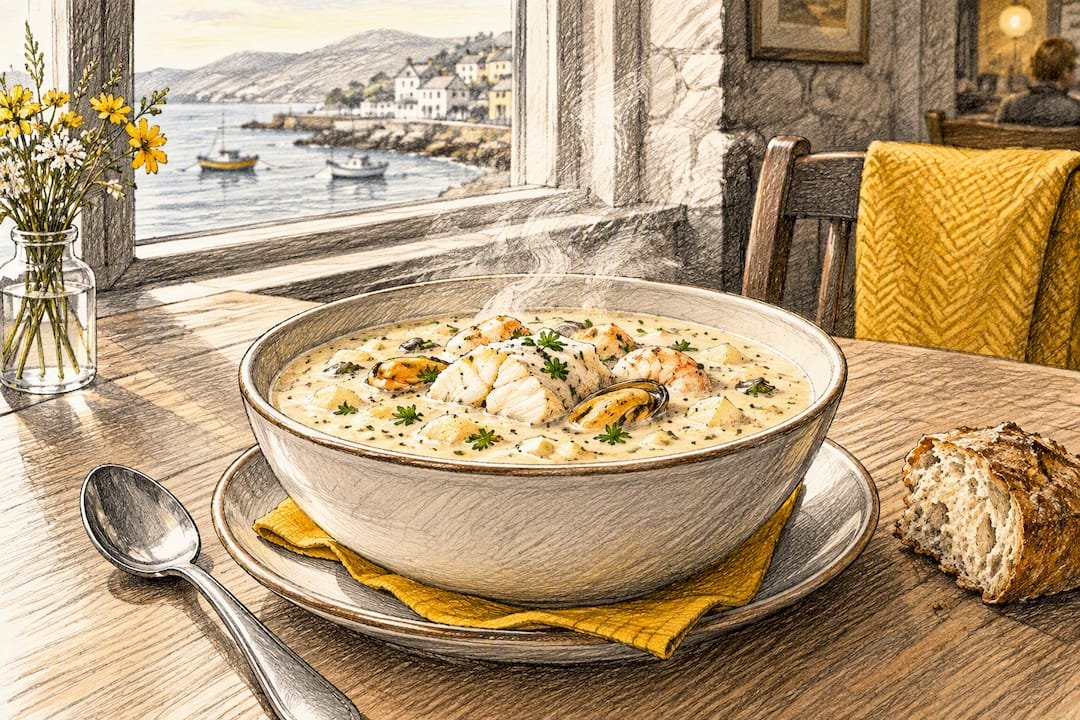
Clifden carries the weight of feeding most travellers on this loop, and it does the job well with a genuine spread of pubs, cafés, and seafood restaurants clustered within a five-minute walk of each other. Fresh seafood is the obvious order here, particularly chowder and locally caught fish, given the town’s position between the mountains and the Atlantic.
Leenane and Roundstone offer smaller but worthwhile options if you time your stops right. A pub lunch in Leenane overlooking Killary Fjord makes for one of the more memorable meals on the route, less about the menu and more about where you’re sitting while you eat it. Roundstone has a couple of good cafés that suit a coffee stop before or after Dog’s Bay.
Outside these towns, options thin out fast. Maam Cross has limited food facilities, mostly a stop for something quick rather than a proper sit-down meal, so plan your main meals around Clifden or Leenane rather than assuming you’ll find something along the quieter stretches. If you’re doing the two-day version, book dinner in Clifden or Letterfrack ahead in July or August, when the town’s limited restaurant capacity fills up faster than visitors expect.
Accommodation along the Connemara loop
Clifden has the widest range, running from budget guesthouses and hostels through to well-regarded boutique hotels, and its size means you’re rarely stuck without an option even in busier months. Letterfrack is smaller and quieter, with a handful of guesthouses and one or two hotels that suit travellers prioritising the national park over evening nightlife.
Beyond the two main towns, small B&Bs and farmhouse stays are scattered along the N59 and around Roundstone, often the better choice if you want a genuinely local welcome rather than a standard hotel room. Booking ahead matters more than people expect here, since rooms in Clifden and Letterfrack sell out during peak summer weekends and shrink significantly in availability once winter closures begin.
For travellers weighing where to base themselves against the wider Wild Atlantic Way, it’s worth looking at regional accommodation options across Ireland before committing to a single town, particularly if Connemara is one stop on a longer coastal trip rather than the whole itinerary.
Beyond the drive: hiking, boating and other activities
Diamond Hill remains the obvious pick for anyone wanting more than a roadside photo, and its two-hour return walk suits most fitness levels without requiring hiking experience. Connemara National Park has shorter looped trails too, useful if two hours feels like too much on a tight one-day schedule.
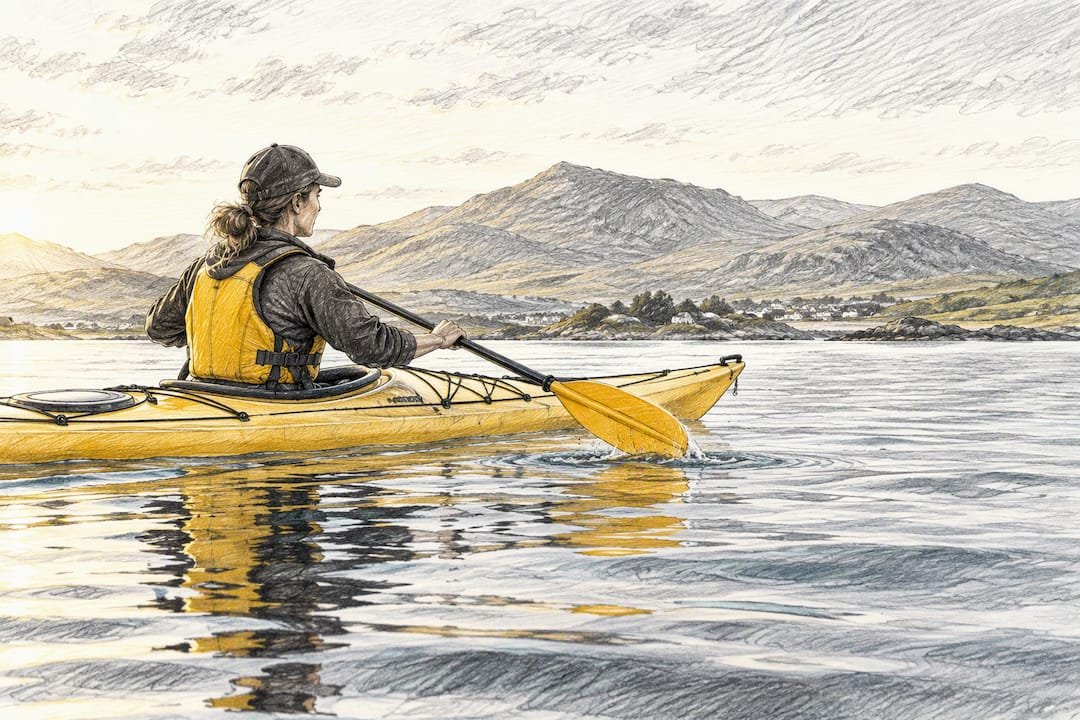
Killary Fjord opens up beyond the viewpoints if you book a short boat tour out of Leenane, giving you a water-level view of the mountains that the road simply can’t match. Kayaking operators work parts of the coastline around Roundstone in calmer months, a good option if you fancy getting properly onto the water rather than just admiring it from the shore.
Cycling is increasingly popular on quieter stretches of the loop, particularly the southern coast road around Roundstone, though the same single-track etiquette that applies to cars applies doubly to cyclists sharing that space with passing traffic. None of these activities require advance planning beyond a rough idea of timing, but boat tours in particular are worth booking ahead in peak summer.
Accessibility notes for travellers with mobility needs
Diamond Hill’s main path is well constructed and manageable for many visitors with moderate mobility, though the gradient toward the summit loop steepens enough that it isn’t suitable for wheelchairs or those with significant mobility restrictions. The lower, flatter sections nearer the visitor centre offer an easier alternative if the full summit route isn’t realistic.
Kylemore Abbey has done more than most sites on the loop to accommodate visitors with mobility needs, with accessible pathways around the main grounds and lake walk, though the walled garden’s more distant sections involve some uneven terrain. Sky Road and most roadside viewpoints are drive-up stops with minimal walking required, making them genuinely accessible regardless of mobility, though parking itself is informal rather than marked with designated accessible bays.
Beaches at Dog’s Bay and Gurteen involve a walk across sand from the car park, which can be difficult terrain for wheelchairs or those with limited mobility. It’s worth calling ahead to Kylemore Abbey or the national park visitor centre directly if specific accessibility needs are part of your planning, since facilities and path conditions can shift with weather and maintenance work.
Local festivals worth building your trip around
Clifden’s biggest annual draw is its traditional pony show and community festival in August, which brings a genuinely local atmosphere to the town but also means accommodation books out well in advance if your travel dates overlap with it. Roundstone hosts smaller community events through the summer months tied to its long-standing traditional music and arts scene.
Connemara’s Gaeltacht status means Irish-language cultural events crop up through the year, particularly around traditional music sessions in Clifden’s pubs, which run informally on many summer evenings without needing a ticket or advance booking. If a festival isn’t the point of your trip, it’s still worth checking Clifden’s event calendar before booking accommodation, since a single overlapping weekend can be the difference between an easy booking and a fully sold-out town.
Why a tailored Connemara itinerary beats a rushed one
Connemara punishes anyone who treats it as a box to tick. The distances on the map look modest, 93 km sounds like nothing, but the driving conditions, the weather, and the sheer number of places worth stopping mean this route rewards patience over ambition. Most people who try to cram Sky Road, Kylemore, Killary, and a beach into one afternoon come away having properly seen about half of it.
The gap between what a quick search tells you and what actually works on the ground is where local knowledge earns its keep. Knowing that Kylemore gets swarmed by coaches from 10.30am, or that Sky Road’s clockwise direction isn’t a minor preference but a genuine safety consideration, comes from repeated exposure to the route rather than a single glance at a map. Personalised self-drive itineraries can include local detail like timed bookings to dodge coach windows, dining reservations arranged ahead, and accommodation picked for its position on the route rather than just its star rating.
[Author bio for Theo to be added here, along with relevant credentials and expertise in travel and itinerary planning.]
None of this replaces the freedom of driving yourself. It just removes the guesswork around timing, booking, and the dozen small decisions that separate a good Connemara day from a frustrating one.
— Theo
Book a Connemara road trip with local support built in
Planning this route yourself is entirely doable with the timings and stops above, but Services exist for travellers who’d rather skip the research and booking admin and just show up to a route that’s already sorted. Such offerings include personalised self-drive itineraries across Ireland, including Connemara-style routes, with curated accommodation, local knowledge on timing around coach traffic, and support on the road if plans need to shift.

This suits travellers who want the independence of driving themselves without losing the evenings to hunting for a Clifden dinner reservation or discovering a guesthouse is fully booked mid-trip. It’s a particularly good fit for anyone combining Connemara with a wider Irish loop, since a themed multi-day itinerary handles the whole route rather than just one region. Explore BTOURS’ self-drive tour packages to see how a personalised Ireland itinerary comes together, or start with the main BTOURS site to browse sample routes and get a feel for how the planning process works before committing to dates.
Essential official pages to check before you go
- Connemara National Park: current trail conditions, opening times, and Diamond Hill route details straight from the visitor centre.
- Connemara Loop | Galway Tourism: regional overview confirming the loop’s main highlights and Galway as the standard starting base.
- Connemara Loop Drive itinerary and map: a downloadable route breakdown useful for cross-checking stop order and distances before you set off.
Sources
- Connemara Loop Guide (With Map and Itinerary)
- Best Time to Visit Connemara (2026): Weather, Crowds & Prices | Tripbase
- Connemara Scenic Drive: The Sky Road, Kylemore Abbey and Best Stops – Get Car Hire
- Connemara National Park
FAQ
How long does it take to complete the Connemara Loop drive?
Driving the loop non-stop takes about 1 hour 45 minutes for the roughly 93 km route. With stops at the main highlights, plan on 4 to 6 hours for a shortened version or a full day of 6 to 7 hours plus to see everything without rushing.
What is the most scenic drive in Ireland?
Connemara is regularly ranked among Ireland’s most scenic drives, largely thanks to Sky Road’s coastal views and the Killary Fjord stretch near Leenane. The Wild Atlantic Way as a whole offers stiff competition, and BTOURS covers notable stops along that route if you’re weighing Connemara against the wider coastal drive.
Is Connemara worth seeing on a road trip?
Yes. Connemara packs mountains, fjords, beaches, and a genuine Gaeltacht culture into a compact, drivable region, which is rare even by Ireland’s standards. The trade-off is variable weather and narrow roads, both manageable with the right pacing and driving approach.
How close is Connemara to Galway?
Galway city sits right at the edge of the loop, with the N59 carrying you into Connemara proper within about 20 minutes of leaving the city centre. That proximity is why Galway remains the standard base for both day trips and multi-day Connemara itineraries.
Should I do the Connemara Loop clockwise or anticlockwise?
Direction matters most specifically on Sky Road, where driving clockwise keeps you on the safer inland line through the narrowest section. For the rest of the main loop, either direction works, though starting from Galway naturally sets you up to tackle Sky Road first while you’re fresh.