For most visitors, a clockwise 3 to 7 day circular self-drive route based from Windermere or Keswick gives the best balance of scenic driving and walking time. Book your first two nights near your arrival hub before mapping the rest, and treat parking as the thing that will actually shape your day, not the driving itself. Everything below expands that into workable itineraries.
Lake District road trip itineraries: 3, 4 and 7 days
The right length depends on what you actually want from the trip. A 3-day loop suits anyone who has flown into Manchester and wants the highlight reel without burning a week. A 7-day circuit suits people who’d rather sit by Ullswater for an afternoon than tick off a list. Here’s how each plays out on the ground.
The 3-day highlights loop
This route assumes you’re based in Windermere and prioritises efficiency over lingering. Early starts matter here, since the roads fill up fast after 10am in peak season.
- Day 1: Windermere to Ambleside to Grasmere. Start at Windermere for a lake view, drive north to Ambleside for coffee, then push on to Grasmere for a short walk around the village and a stop at the famous gingerbread shop. Back to Windermere by early evening.
- Day 2: Windermere to Keswick via Kirkstone Pass. This is your big scenic drive day. Cross Kirkstone Pass early, before coach traffic builds, then continue to Keswick for lunch and a walk along Derwentwater. Overnight in Keswick to avoid a late drive back.
- Day 3: Keswick to Coniston via Honister Pass. Honister in the morning light, a stop at Buttermere, then loop south to Coniston for the afternoon before heading back to Windermere or on to your departure point.
Pro Tip: Book your Kirkstone or Honister crossing for before 9am. Both passes turn into slow-moving queues of caravans and cyclists by mid-morning, and the light for photographs is better anyway in the first two hours after sunrise.
The 4-day moderate-pace loop
Add a day and the whole trip changes character. You get one proper hike and an evening somewhere quieter than Windermere, which tends to be the trip most families remember more fondly than the rushed version.
- Day 1: Arrive, settle into Windermere or Bowness, gentle walk along the lake shore, early dinner.
- Day 2: Drive to Ambleside, then Grasmere, with a longer stop for a low-level walk near Easedale Tarn (about 2 hours round trip). Continue to Keswick for the night.
- Day 3: Full day around Keswick and Derwentwater, including Honister Pass and a detour to Buttermere. This is the day for a proper hike if the weather allows, Catbells is the classic low-effort, high-reward option.
- Day 4: Drive south via Coniston, stopping at Tarn Hows, then loop back through Hawkshead, a genuinely quiet village most 3-day itineraries skip entirely, before returning to your hub.
Total driving across the four days runs to roughly 120 to 140 miles, which sounds modest until you factor in single-track sections where 20 miles can take an hour.
The 7-day circuit (or a Lakes 100 variant)
A week lets you treat the Lakes 100, a signposted 100-mile scenic circuit joining the district’s best-known roads, as a loose backbone rather than a race. Spread it across the full week and you can add rest days, full-day lake experiences, and detours to quieter valleys like Wasdale.
- Days 1 to 2: Windermere and Bowness, including a boat trip on Windermere itself and a relaxed day with no driving beyond the town.
- Day 3: Ambleside and Grasmere, extended walking, overnight in Grasmere.
- Days 4 to 5: Keswick, Derwentwater, Buttermere via Honister, with a full day allowed for Catbells or a Derwentwater lake cruise. Two nights here.
- Day 6: Wasdale via Hardknott and Wrynose passes, for confident drivers only, then double back or continue to Coniston.
- Day 7: Ullswater, often called the quietest of the major lakes, with a steamer trip and a slow drive home via the A592.
This pace keeps daily driving under 30 miles on most days, which matters more than it sounds. The Lake District National Park’s own advice on getting around makes clear that congestion, not distance, is the thing that eats your day.
Which scenic drives and mountain passes suit your car?
The Lakes 100 is the single most useful planning tool for anyone building their own route. It’s a signposted 100-mile driving loop linking the district’s best-known roads and passes, and using it as a skeleton for your itinerary means you’re never doubling back over ground you’ve already covered.
Three passes come up in almost every conversation about Lake District driving, and they are not interchangeable in difficulty.
- Kirkstone Pass, linking Ambleside and Ullswater, is the most forgiving of the three: steep in places, but wide enough for most standard hire cars and well signposted.
- Honister Pass, between Borrowdale and Buttermere, is narrower and steeper, with gradients that catch out drivers unfamiliar with manual gearboxes on descent.
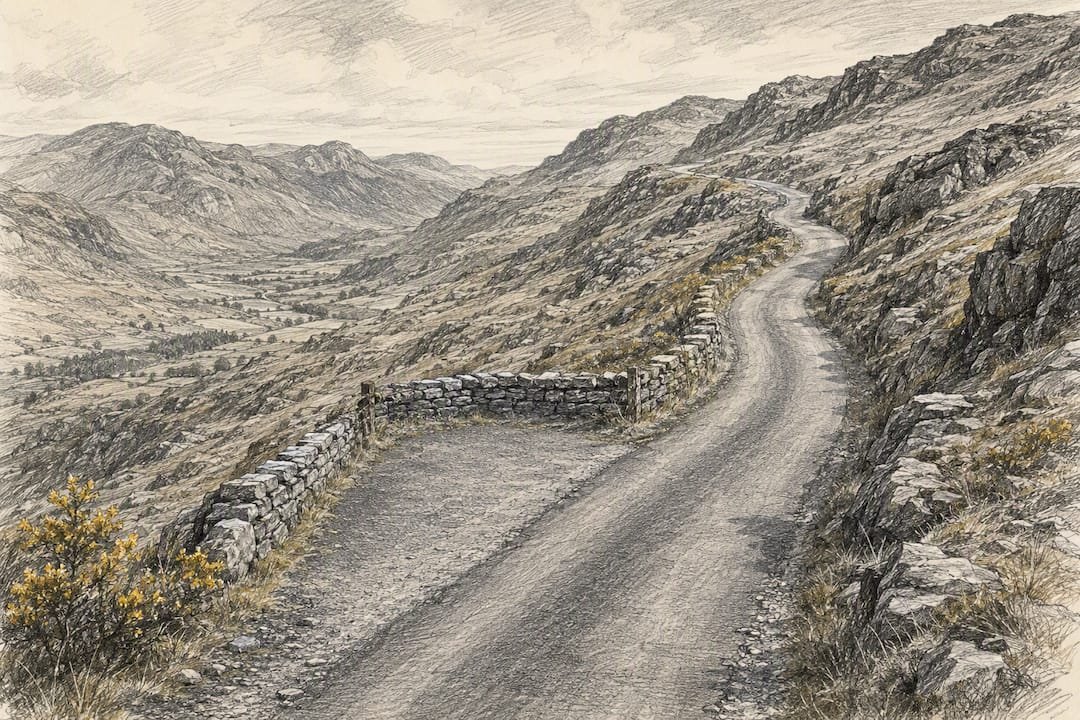
- Hardknott and Wrynose Passes, the toughest pairing in the district, combine hairpin bends with gradients over 30% in sections. These are genuinely unsuitable for larger vehicles, and car rental guidance for the region specifically recommends a smaller hire car for single-track lanes like these.
Drive Hardknott and Wrynose west to east if you want the sun behind you for photographs in the morning, and skip them entirely after heavy rain or in low winter light. Skip any pass, frankly, if you’re driving anything wider than a standard family hatchback or towing a caravan. Gradient and width matter more on these roads than horsepower ever will, and driving guidance for the Lakes makes the same point about narrow rural lanes generally.
A significant portion of the Lakes 100’s route runs through single-track sections, which is the main reason a 100-mile loop realistically takes two to three driving days rather than one.
Direction matters less for Kirkstone and Honister, both are manageable clockwise or anticlockwise, but for Hardknott and Wrynose together, most local guides favour driving west to east for gentler ascents and a genuinely dramatic final descent into Little Langdale.
What are the driving rules and planning basics for visitors?
Driving on the left is the first adjustment for international visitors, and it compounds quickly on narrow lanes where instinct under pressure defaults to home-country habits. Roundabouts give priority to traffic already on the roundabout, approaching from your right, and single-track roads run on a strict etiquette: whoever reaches a passing place first waits, and whoever is closer to one reverses if a car appears coming the other way.
- Drive on the left; give way to traffic from the right at roundabouts.
- On single-track lanes, pull into passing places rather than expecting oncoming traffic to reverse for you.
- Never park in a passing place, even briefly, it blocks the only place another driver can pass.
- Check your rental agreement’s excess and any restrictions on driving the Hardknott/Wrynose pairing, some insurers exclude it.
If you’re driving on a non-UK licence, the Gov confirms the UK recognises many foreign licences for up to 12 months, though non-English licences may need a 1949 or 1968 International Driving Permit, and many rental firms ask for one regardless of the legal minimum. Sort this before you fly, not at the rental desk.
For car hire, a smaller vehicle, a supermini or small hatchback rather than an SUV, handles the single-track network far better, and Manchester Airport is the most practical pickup point for most international arrivals given its road links into the district. Fuel is genuinely scarce once you’re off the main routes, so fill up in Windermere, Keswick, or Ambleside before heading into remote valleys like Wasdale or Buttermere.
Pro Tip: Don’t trust your sat-nav’s arrival time on rural lanes. The National Park’s own guidance notes that sat-navs routinely underestimate travel times here, so add 20 to 30% to any estimate and navigate by village postcodes rather than the shortest-route suggestion, which often puts you on a pass your car shouldn’t attempt.
Which towns and lakes should you build your route around?
Windermere and Bowness form the busiest hub in the district, and for good reason: boat trips run regularly across the lake, and the towns have the widest choice of accommodation and restaurants. Arrive before 10am or after 4pm if you want to avoid the worst of the crowds, particularly in July and August.
- Windermere and Bowness: boat cruises across England’s largest lake, best visited early morning or early evening to dodge peak crowds.
- Ambleside and Grasmere: compact, walkable, with short lakeside and woodland walks under two hours; Grasmere’s gingerbread shop is a genuine institution, not just a tourist trap.
- Keswick and Derwentwater: a proper market town with supermarkets, fuel, and outdoor shops, plus lake launches and easy access to Catbells and Borrowdale.
- Coniston: quieter than Windermere, strongly linked to Arthur Ransome’s Swallows and Amazons and Donald Campbell’s water speed record attempts.
- Ullswater: often the pick for travellers who want lake scenery without the crowds, with a steamer service running the length of the lake.
- Wasdale: the wildest of the valleys, home to England’s deepest lake and its highest mountain, and a genuine detour rather than a drive-through.
Each of these deserves at least half a day; treating them as a checklist to photograph and leave is the single most common mistake in rushed itineraries.
When is the best time for a Lake District road trip?
April through October covers the practical window for most visitors, with July and August bringing the warmest weather, typically 15 to 21°C, and by far the heaviest traffic. Spring tends to run drier on average, though the district’s weather is genuinely changeable day to day, and a bright morning can turn to drizzle by lunch regardless of the month.
Late-season trips, October into November, lose daylight fast and some minor roads and passes become less reliable in poor weather, so build in flexibility rather than a fixed pass crossing on your last day. May, June and September are the shoulder-season sweet spot: fewer coaches, still-long daylight, and a reasonable shot at the drier stretches spring is known for.
Rather than fighting the changeable weather, plan around it the way locals do; a similar month-by-month logic applies to seasonal travel planning generally. Shoulder months consistently deliver a better ratio of good conditions to crowd levels than peak summer.
What are BOATs, UCRs, and TROs on Lake District roads?
Not every track on the map is legally open to vehicles. A BOAT (Byway Open to All Traffic) permits motor vehicles, a UCR (Unclassified County Road) may or may not, and an ORPA (Restricted Byway) generally does not. Lake District National Park guidance sets out these designations clearly, along with the responsibilities that come with driving any of them.
Traffic Regulation Orders (TROs) add another layer: some unsealed routes close seasonally, Rusland Pool has a known seasonal closure, and others like Gatescarth Pass require a permit rather than being open to all comers. TROs can close routes seasonally or permanently, so check current status before mapping any unsealed section into your route.
- Never assume a track shown on an older map or app is still legally open to vehicles.
- Follow the Green Road Drivers Code of Conduct: stick to the route, avoid verges, and never widen a track to pass.
- Report damaged or blocked routes to the National Park rather than attempting to clear or reroute around them yourself.
Pro Tip: If in doubt, don’t. The reputational and environmental cost of driving a closed BOAT far outweighs the ten minutes saved over a legal alternative.
What should you pack for a self-drive Lakes trip?
Layers are non-negotiable, waterproofs, a warm mid-layer, and proper walking shoes even if you’re only planning short strolls between drives. Weather here shifts within hours, not days.
- Waterproof jacket, spare layers, and sturdy footwear for short walks in changeable conditions.
- A paper map as backup, plus the OS Maps app downloaded for offline use before you lose signal.
- A list of village postcodes for sat-nav, since some hamlets don’t register cleanly, and What3Words for precise trailhead or parking locations.
- Fill your fuel tank in main towns; expect mobile signal gaps in valleys like Wasdale, Buttermere, and much of the Hardknott approach.
How should you pace each driving day?
A rough 60/40 split between driving and stopping keeps most itineraries enjoyable rather than exhausting. Overpacking the schedule is the single biggest complaint from first-time visitors who tried to do too much in too little time.
- Aim to be moving by 9am on pass days, before tour coaches and cyclists build up.
- Treat any stop under 45 minutes as a photo stop, not a walk; save proper hikes for a single dedicated afternoon per leg.
- The best light for photographs at Kirkstone, Honister, and Tarn Hows comes in the first two hours after sunrise or the last hour before sunset, not midday.
- If you’re behind schedule, cut a pass crossing before cutting a meal stop or a walk; the roads will still be there next time.
Why Theo and BTOURS know this route better than most guides
Theo has spent years mapping self-drive routes across the UK, Ireland, and Greece, with a particular focus on where paced itineraries beat rushed ones. There are services offering personalised route planning, handpicked accommodation, and on-trip support, backed by membership of the Adventure Travel Trade Association.
- A planned itinerary accounts for parking pressure points before you hit them, not after.
- Pacing built around real drive times, not sat-nav estimates, avoids the late-arrival scramble.
- Weather-flexible alternates mean a closed pass or a washed-out walk doesn’t derail the day.
Where to park and when to use the bus instead
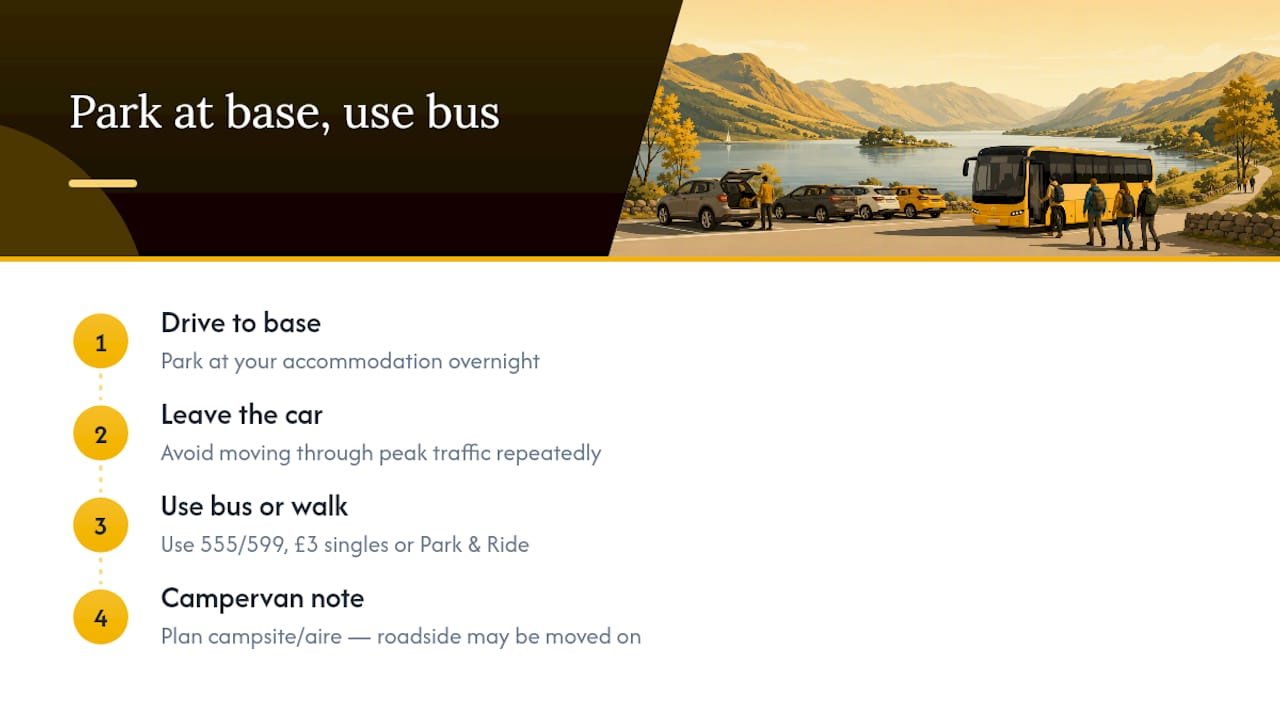
Parking, not distance, is what actually limits a Lake District day. Windermere, Ambleside, and Keswick all fill their central car parks by mid-morning in July and August, and village-centre streets simply cannot absorb peak-season traffic. The National Park’s own position is blunt on this: traffic and parking are the biggest constraint most visitors face, and sustainable alternatives are actively recommended over driving everywhere.
Core bus routes, particularly the 555 and 599, link the main towns and popular trailheads without the parking headache, and capped £3 single fares on some core routes make hopping off the driving route for a single attraction genuinely cheap. Park & Ride and Dayrider tickets work well on the busiest days, particularly around Bowness and Ambleside, where you can leave the car at accommodation and use the bus for a single congested leg.
If you’re travelling by campervan, be aware that parking on the highway isn’t an automatic right; vehicles causing an obstruction can be required to move on, and this applies to overnight parking in laybys as much as daytime stops. Plan proper campsite or aire stops rather than relying on informal roadside parking.
The practical rule: drive to your base for the night, then use buses or short walks for the busiest single destination each day rather than moving the car repeatedly through peak traffic.
Where to stay along a Lake District driving route
Windermere and Bowness offer the widest range of accommodation, from budget guesthouses to lakeside hotels, and make sense as a base for the first and last nights of most itineraries given proximity to Manchester and the M6. Keswick works as a natural second base, central enough for Honister, Buttermere, and Derwentwater without the Windermere crowds.
Grasmere and Ambleside suit travellers who want a quieter overnight without sacrificing walkability, both have a compact centre you can explore on foot after a driving day. Coniston and Ullswater offer a genuinely different pace again, smaller guesthouses and farm stays rather than hotel chains, and tend to suit the 4 and 7-day itineraries better than the 3-day rush.
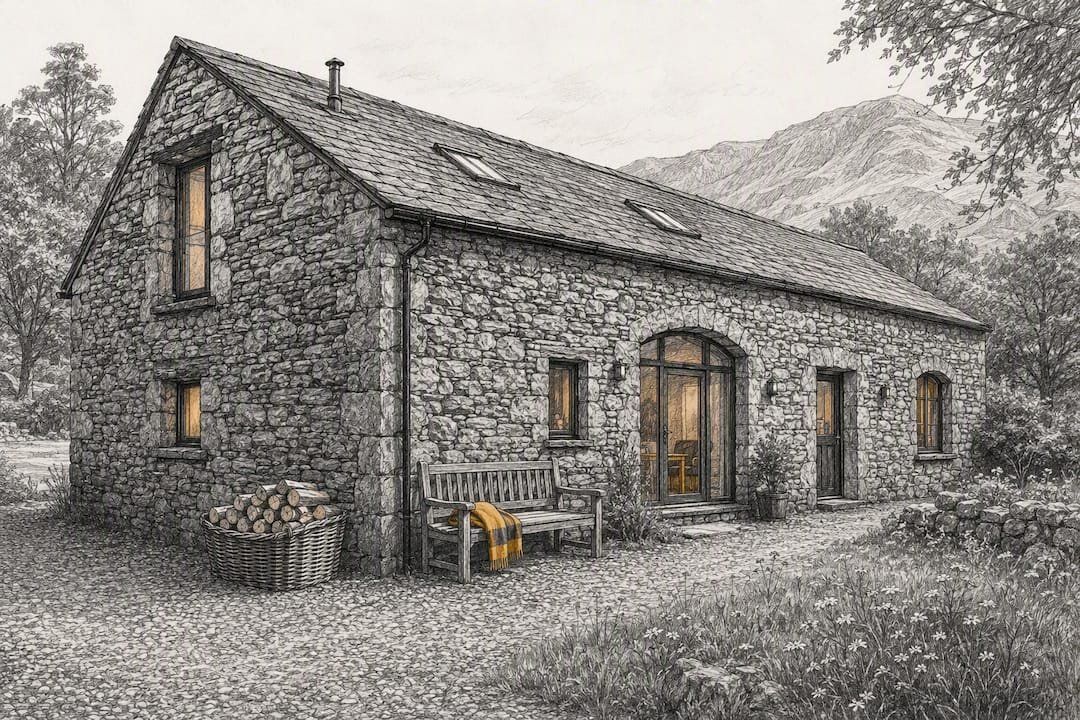
Booking two nights in one location rather than moving every night cuts unpacking time and gives you a full day to explore without driving. This matters more than it sounds. A one-night stop means you’re loading the car again the next morning before you’ve properly settled, and it’s the single most common source of trip fatigue reported by first-time Lakes visitors. Handpicked, character accommodation, a converted barn in Borrowdale rather than a chain hotel by the motorway, tends to be the detail people remember longest after a trip, far more than any single view or photograph.
Whichever base you choose, book ahead for July and August; the district’s accommodation sells out weeks in advance during peak season, and last-minute options push you further from your planned route than you’d like.
Where to eat and take a break on the drive
Keswick functions as the district’s most complete food stop, with supermarkets for picnic supplies, proper cafés, and a genuine choice of restaurants for an evening meal after a full day on the passes. It’s worth stocking up here before heading into remoter valleys, where options thin out fast.
Ambleside and Grasmere both punch above their size for cafés, small enough to feel local rather than touristy, and good for a mid-morning coffee break between driving legs. Grasmere’s gingerbread shop is worth the queue at least once. Bowness has the widest evening dining choice, useful if you’re basing your first or last night there.
Once you’re off the main routes, options drop sharply. Buttermere and Wasdale each have a single pub serving food, and both get busy in peak season, so don’t plan a specific mealtime around them without a backup. Pack a flask and snacks for pass days; there’s genuinely nowhere to stop between Kirkstone’s summit and Ambleside, or partway through the Hardknott and Wrynose crossing.

How do you drive narrow, winding Lake District roads safely?
Single-track roads demand a different driving rhythm than most visitors are used to. Slow down before a blind bend, not after you’ve committed to it, and treat every crest and corner as if something could be coming the other way, because on roads like Hardknott, it usually is.
Passing places exist specifically so two vehicles can pass safely; use the nearest one the moment you spot oncoming traffic, and don’t wait until you’re already alongside them. If you’re closer to a passing place behind you than one ahead, reverse back to it rather than forcing the oncoming driver to do the same manoeuvre on a blind bend.
Steep descents on Honister and Hardknott catch out drivers unfamiliar with engine braking; drop into a low gear before the descent rather than riding the brakes the whole way down, which can lead to brake fade on a long drop. Cyclists and walkers share these same narrow roads, often around blind corners, so keep speeds well below the posted limit regardless of what it technically allows.
Why I’d rather take the long way to Ullswater than fight for a parking spot at Windermere
I’ve watched enough itineraries fall apart to know the mistake is almost always the same: cramming in one more “must-see” instead of accepting that a quieter village, seen properly, beats a famous viewpoint seen through a windscreen while circling for parking. Choosing Glenridding over Bowness on a busy August afternoon isn’t a compromise, it’s usually the better trip.
The practical lesson is that a personalised itinerary earns its keep precisely on the days that go wrong, when a pass is shut, a car park is full, and the plan needs to flex without falling apart.
— Theo
Let BTOURS plan your Lake District self-drive so you don’t have to
Some companies offer custom itineraries that account for parking pressure points, pass conditions, and wet-weather backups, built around how you want to pace the trip.
Some self-drive itineraries come with handpicked accommodation along the route, flexible pacing that adjusts to weather or energy levels, and on-trip support if a road closes or a plan needs to change mid-journey. Services like these help avoid common issues on DIY trips such as guessing which car park will have space, discovering a pass is shut after driving to it, and scrambling for same-day alternatives when rain closes in. Providers building routes to a high standard, including membership in the Adventure Travel Trade Association, offer such comprehensive planning for trips of varying lengths.
If you’d rather start from a properly built plan than a blank map, see what to look for in a self-drive tour package before you book, and get your route and dates checked against real-time pass and weather conditions.
Sources
- Gov
- Getting to and around – Lake District National Park
- Car rental in Lake District (2026) – Driving Guide