You've landed at Athens Airport with a suitcase in one hand and a car-hire confirmation in the other. The obvious question is sitting there beside the baggage carousel: are Greek roads going to make this holiday liberating, or exhausting?
For a Peloponnese road trip, the answer is firmly liberating, provided you plan around the roads rather than pretending every journey takes as long as it looks on a map. The peninsula connects ancient sites, mountain villages, beaches and working towns across a large, varied terrain. A car lets you reach the hidden coves of the Mani, vineyards around Nemea, hill villages above Nafplio and the Diakofto railway route without being tied to bus timetables or organised excursions.
The roads are generally better than their reputation suggests. Greek transportation research examined 6,020.3 km of Peloponnese roads, with 4,598.8 km classified at an appropriate or higher category than expected, producing a 76.4% road suitability index in the regional road-network study. That doesn't mean every lane is easy. It means a well-planned route can support proper regional touring, not just short transfers between nearby resorts.
Why the Peloponnese Is Made for a Self-Drive Holiday

The car earns its keep
The classic sights are only the start. Organised tours can take you to Ancient Corinth, Mycenae and Epidaurus, but they won't give you the same freedom to stop at a roadside viewpoint, linger over lunch in a mountain village or change direction when the coast looks too good to ignore.
The peninsula works particularly well for travellers who want variety without island-hopping. In one organised loop, you can combine the Corinth Canal, the citadel at Mycenae, Nafplio's harbour, Byzantine Mystras, the stone villages of the Mani and the beaches around Messinia. The road system has historical importance for exactly this reason, it joins destinations that are spread across the mainland rather than clustered in one resort zone.
My practical rule: book overnight bases first, then fit the sights around them. Don't choose hotels simply because they look attractive on a map.
Good roads, uneven progress
The Athens to Corinth corridor is the efficient opening leg. A UK travel guide places Athens Airport to the Isthmus of Corinth at 112 km and about 1 hour 15 minutes, Corinth to Nafplion at 67 km and about 1 hour, and Nafplion to Sparta at 120 km and about 1 hour 40 minutes in its Peloponnese road-trip route. Those times make sense on the main network.
Progress slows sharply on rural mountain roads and in the Mani Peninsula. Many are sealed, but they can be narrow, dusty and windy, with blind bends and villages that demand patience. The sensible approach is to cluster nights in Nafplio, Kardamyli, Pylos or another strong base instead of changing hotels every evening.
That balance is the secret. The Peloponnese is compact enough to make a satisfying loop, but rich enough to reward two weeks. A car doesn't just save time. It gives you control over where the day ends.
UK Driving Rules and Road Safety Essentials
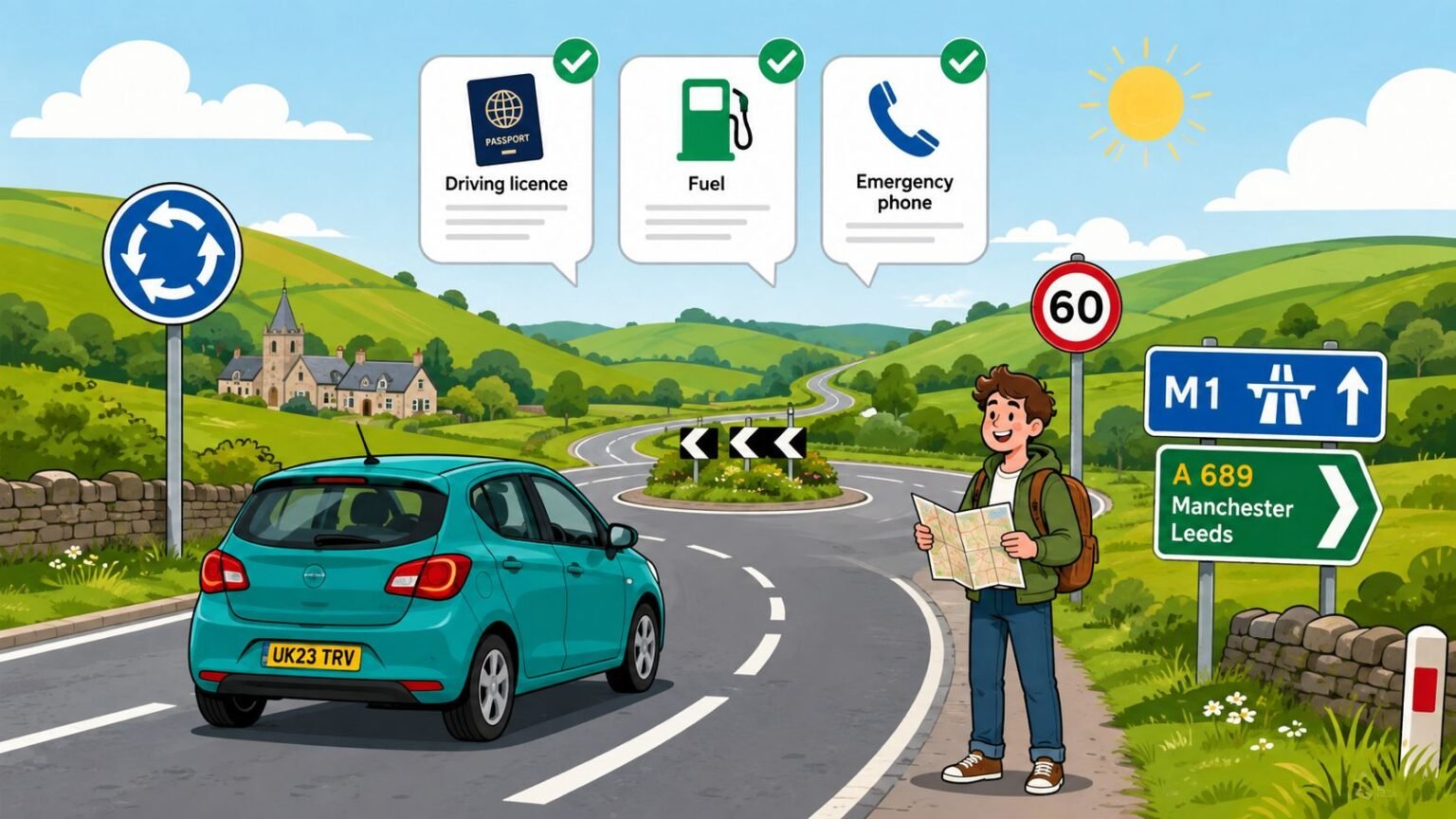
A UK traveller can drive in Greece with a UK photocard driving licence, according to UK government travel advice for Greece. Check the hire company's conditions before departure, carry your passport and confirm that the licence details match the booking.
Greece drives on the right. Give the first motorway exit, roundabout and overtaking manoeuvre your full attention. Overtaking takes place on the left. The blood alcohol limit for private drivers is 0.05%, as stated in the RAC's Greece driving guidance. Leave the taverna wine until the car is parked for the night.
UK Driving in Greece Quick Reference
| Rule | UK Standard | Greek Requirement |
|---|---|---|
| Driving side | Left | Right |
| Overtaking | Usually on the right | On the left |
| Built-up speed limit | Commonly 30 mph zones, depending on signs | 50 km/h in towns |
| Motorway speed | Varies by road and signs | 110 to 130 km/h on motorways |
| Seat belts | Compulsory | Compulsory |
| Minimum driving age | Commonly 17 for a car licence | 18 |
| Alcohol limit | Different UK limits apply by nation | 0.05% for private drivers |
The UK government's practical Greek driving guidance confirms the 50 km/h town limit, the 110 to 130 km/h motorway range, compulsory seat belts and the rule that children under five must not sit in the front passenger seat in its Greece holiday driving document. Local signs take priority whenever they set a lower limit.
Drive for the road you have
Main routes can feel easy until a short diversion becomes a winding mountain climb. Rural traffic includes scooters, farm vehicles, coaches and animals. Some drivers overtake assertively, while vehicles behind may follow closer than you expect in Britain.
Keep your speed steady, check the mirrors often and let faster traffic pass when there is a safe opportunity. Avoid unfamiliar mountain roads after dark. A regional road-safety study recorded 906 injury road accidents in the Peloponnese area in 2013, including 113 fatal crashes, while Greece recorded 799 fatal road accidents nationwide that year, with 241 attributed to excessive speeding in the Greek road-safety analysis. The figures are historical, but they support practical planning: allow recovery time, reject unrealistic arrival targets and approach every blind bend carefully.
Use this UK road-trip driving reference before collecting the car, then plan each day around the road conditions rather than the map distance. The Peloponnese rewards drivers who leave room for delays. A car gives you control over where the day ends, which matters when a scenic route takes longer than expected.
Choosing Your Peloponnese Itinerary Length
There isn't one correct duration. A short trip can cover the major eastern landmarks, while a longer holiday lets you stop treating the peninsula as a checklist and start using it as a place.
The most useful benchmark for a classic loop is roughly 500 to 700 km over a week, with daily legs of 80 to 150 km, according to Frommer's Peloponnese planning guidance. Smaller cars suit narrow village approaches and winding roads better than oversized SUVs.
Peloponnese Itinerary Lengths Compared
| Itinerary | Best For | Trade-off |
|---|---|---|
| 5 days | First-time visitors with limited leave | Fast eastern loop, with the Mani and western coast left out |
| 7 days | Travellers wanting the major highlights and a southern coast | Adds the Mani and Pylos, but requires a disciplined route |
| 10 days | Couples, photographers and history-focused travellers | More relaxed bases, with time for villages, beaches and detours |
Five days means deliberate compromises
A five-day route should run Athens, Corinth, Nafplio, Mycenae, Epidaurus, Olympia and back towards Athens. It works for a first taste, but you'll drive most days and spend more time choosing what to omit than discovering everything.
Don't attempt to squeeze in Monemvasia, the Mani and Messinia as well. You'd convert good sightseeing into long transfers and arrive at each place already thinking about the next departure.
Seven days gives you the right shape
Seven days is the practical middle ground. You can spend two nights around Nafplio, reach Mystras and Sparta, stay in or near Kardamyli, continue towards Pylos and return through the western interior. The route touches the headline ancient sites while still allowing beaches and proper meals.
For many UK travellers, this is the point at which a self-drive holiday feels complete rather than rushed.
Ten days changes the mood
Ten days lets you split the holiday into an eastern leg and a western leg. Add a slower base in Kardamyli or Pylos, keep a night for Monemvasia or Kalamata, and allow time for small roads that aren't worth taking on a five-day schedule.
Families should favour ten days if children dislike frequent car changes. Couples who photograph scenery, eat slowly or enjoy village walks will also get more from the extra time.
The Classic Eastern Loop Day by Day
The eastern loop is the cleanest introduction to the peninsula. It combines the easiest arrival corridor with the strongest concentration of ancient and Byzantine sights, then finishes among the Mani's coastal roads.
Route plan
| Day | Route | Distance | Drive Time | Key Stops |
|---|---|---|---|---|
| 1 | Athens Airport to Corinth and Nafplio | 112 km to the Isthmus, then onward | About 1 hour 15 minutes to the Isthmus, plus stops | Corinth Canal, Ancient Corinth, Nafplio |
| 2 | Nafplio area | Local driving | Keep it flexible | Mycenae, Epidaurus, Nafplio harbour |
| 3 | Nafplio to Sparta and Mystras | 120 km to Sparta | About 1 hour 40 minutes to Sparta | Langhda Pass, Mystras, Sparta |
| 4 | Sparta to the Mani | Variable | Allow a full day | Kardamyli, Areopoli, Diros Caves |
| 5 | Mani northwards and return towards Athens | Variable | Long return day | Coastal villages, optional Monemvasia |
Day 1 and Day 2
Collect the car at Athens Airport and take the motorway towards the Corinth Canal. The transfer to the Isthmus is 112 km and about 1 hour 15 minutes according to the route timings in this self-drive guide. Stop at the canal, then continue to Ancient Corinth before heading to Nafplio.
Give Nafplio two nights. On the second day, visit Mycenae early, continue to Epidaurus for the theatre and sanctuary, then return for a late lunch around the old harbour. This order avoids trying to treat three major stops as quick photo opportunities.
Day 3 and Day 4
Leave the coast and climb inland towards Mystras and Sparta. The route through the Langhda Pass brings tighter bends, changing elevations and the possibility of slow local traffic. Mystras deserves more attention than Sparta itself, especially if you enjoy layered history and atmospheric ruins.
From Sparta, continue south towards the Mani. Kardamyli is the easier base for a first visit, with a relaxed village feel and access to coastal walks. Areopoli suits travellers who want stronger tower-house architecture and easier access to the Diros Caves. Don't try to cover every beach between them in one afternoon.
Day 5 and the return
Use the Mani coastal road for the journey north, stopping when the scenery earns it rather than chasing a strict arrival time. Monemvasia works as an optional detour, but it makes the return day much more demanding, so only add it if you start early and accept a late airport-area arrival.
The return towards Athens via the Sparti to Athens motorway is the functional finish, not the scenic highlight. If your flight is early, sleep near the airport rather than gambling on a mountain-to-terminal drive.
The Western Loop Through Olympia and Messinia
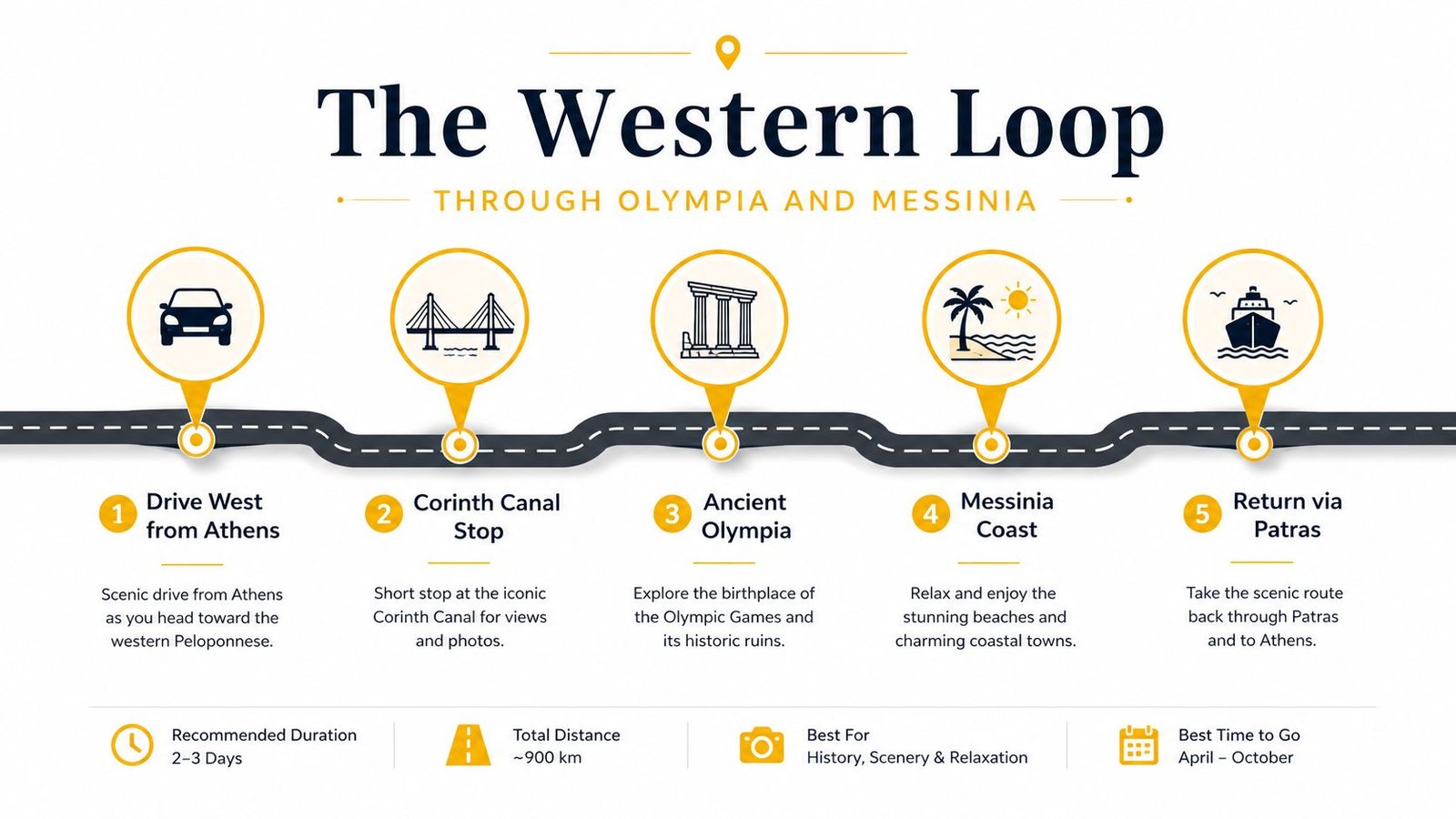
The western Peloponnese feels less like a sequence of famous stops and more like a long, open coastal journey. Use it instead of the eastern circuit if beaches and Messinian scenery matter more to you, or add selected sections when you have enough time.
From Athens to Olympia
Drive west from Athens towards the Rio-Antirrio crossing, then continue south through the western interior. The journey is less immediately efficient than the Athens to Corinth corridor, so don't schedule a full archaeological day after an overambitious transfer.
Base yourself near Ancient Olympia and give the site and museum proper attention. Olympia is more rewarding when you arrive with time to walk between the ruins, rather than treating it as a roadside tick.
From there, head south towards Pylos and the sandy curve of Voidokilia Beach. This is one of the western route's strongest contrasts, ancient history gives way to open coast, shallow water and a slower afternoon.
Messinia needs a base, not a drive-by
Stay around Pylos town for atmosphere and easy evening meals, or choose Costa Navarino if you want a resort-style stay. Spend the next day around Navarino Bay, Methoni Castle and the southern Messinian coast. Fresh octopus, local olive oil and a long lunch fit the setting far better than trying to eat between hurried viewpoints.
The driving challenge comes when you leave Pylos for Kalamata through the Taygetos foothills. Mountain roads can be narrow and winding, and the route demands concentration. Allow the day to be about the transition, not just the destination.
Return options
From Kalamata, reconnect with the eastern route at Sparta, or head north via Tripoli. The choice depends on what you've already seen. If the western loop stands alone, return via Patras and consider the ferry connection for a wider mainland journey.
The route below is deliberately swappable. Replace the eastern loop's Mani section with Olympia and Pylos, or use the western coast as the slower second half of a ten-day trip.
Car Hire, Ferries, and Fuel Logistics
The car is the backbone of this holiday, so treat the booking like part of the itinerary rather than an administrative afterthought. Collecting at Athens Airport is simplest for most UK visitors, and UK-facing Peloponnese travel guidance recommends pre-booking the vehicle.
Choose a compact or mid-size hatchback. It will be easier in old-town lanes, village approaches and tight parking areas than a large estate car. Ask for unlimited mileage and a full-to-full fuel policy, then photograph the vehicle before leaving the depot.
Documents and hire conditions
A UK photocard licence is accepted for driving in Greece under the relevant UK guidance. Keep your passport with it, and check the rental company's rules if your licence isn't a current photocard. Ask specifically whether the hire contract permits every road on your planned route, particularly rougher Mani approaches and any unsealed access roads.
Insurance deserves more attention than the headline rental price. Basic collision damage waiver can still leave a substantial excess, so compare the rental company's cover with a standalone excess policy from the UK. This car-rental insurance explainer is useful when checking what the counter staff are offering.
Ferries and fuel
There aren't many ferry decisions inside the main Peloponnese loop. Ferries become relevant if you add island detours such as Kythera or Antikythera, or if you continue through western Greece on the Patras to Ancona route. Check vehicle space and sailing times before locking in accommodation, particularly where a missed sailing would strand the rest of the route.
Fuel stations become less frequent in the Mani and on quieter inland roads. Fill up in a substantial town before a remote section, and don't rely on finding a late-night petrol station beside the coast. Carry a payment card and some cash for smaller rural forecourts.
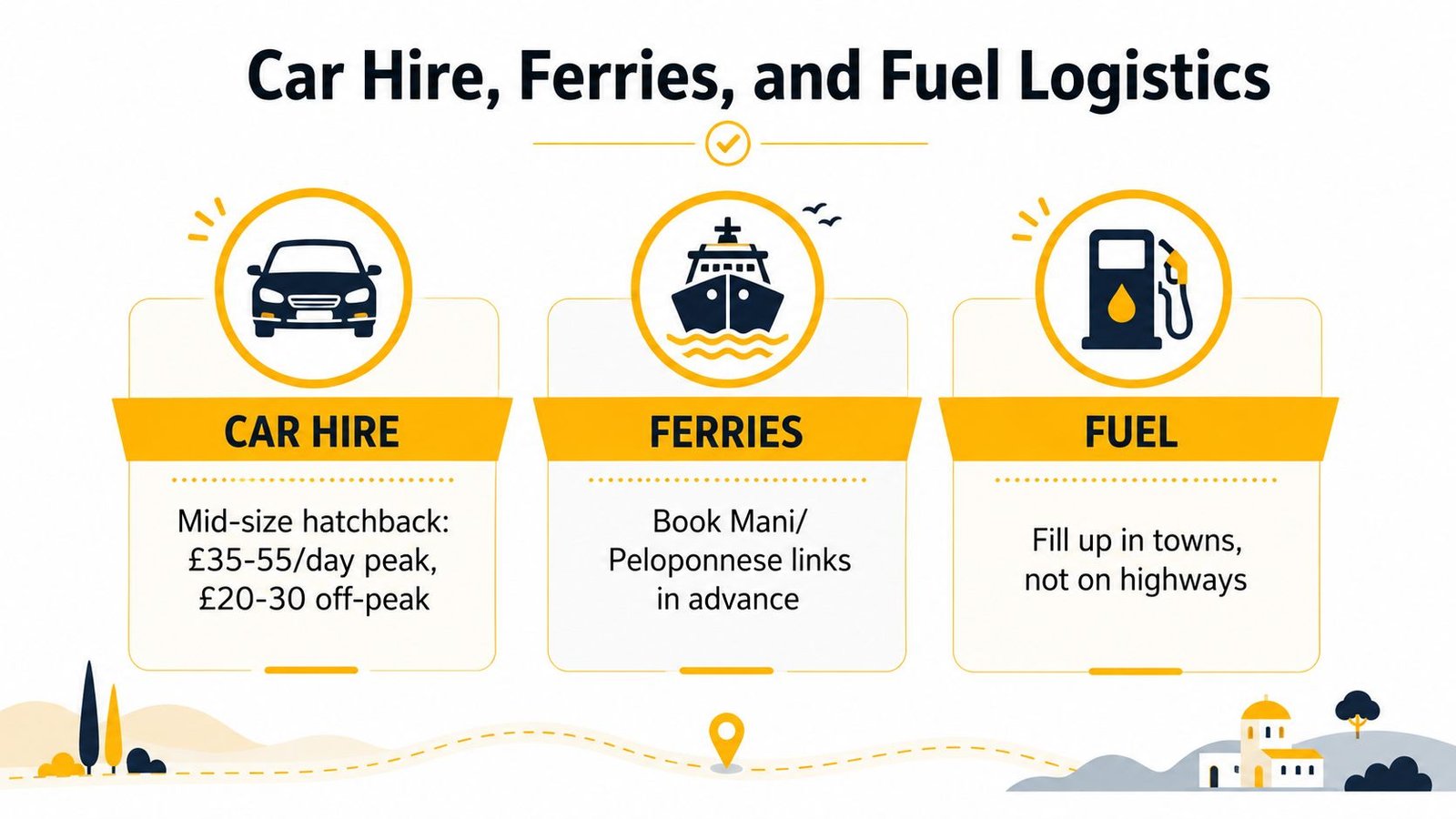
Fuel rule: refill when the tank is comfortably above half on remote coastal and mountain days. The five minutes you spend fuelling in town can prevent a stressful detour later.
Don't build a detailed fuel budget around a guessed pump price. Rates change by location and date, and your actual cost depends on the vehicle, route and driving style. Budget by expected distance, then leave room for scenic detours.
Where to Stay and What to Eat Along the Way
Accommodation works best when it follows the road. An attractive hotel in the wrong town can create a tiring evening transfer, while a simple family pension in the right base can make the entire route feel easier.
Start in Athens with a night in Plaka or Koukaki if your arrival time makes immediate collection inconvenient. Both areas give you food, metro access and a manageable departure the next morning. Once you collect the car, avoid keeping it in central Athens unless you need it there.
Bases that earn their place
Nafplio deserves a proper stay in the old town, preferably with a sea-facing room or easy access to the harbour. Nafpliotiko suits travellers looking for a characterful central base, while Nissia Traditional Residences offers a different style and budget position. Check parking before confirming, because old-town charm often comes with narrow approaches.
In the Mani, choose a stone tower house or family-run pension in Kardamyli or Areopoli. Kardamyli is my preference for a first visit because it makes unhurried coastal days easier. Areopoli has a stronger architectural edge and works well if Diros Caves and the southern Mani sit high on your list.
For the western route, stay in Pylos town if you want evening life and a local feel. Choose Costa Navarino for a deliberate splurge, especially if the road trip needs a few nights of comfort between long driving days.
Eat region by region
Food should change with the surroundings. Around Corinth, look for pasta dishes and local produce. Nafplio is the place for shrimp spaghetti, bougatsa and harbour-side meals. In the Mani, order hearty stews cooked in wood-fired ovens and regional sweets such as syllabub. Messinia is all about excellent olive oil, fresh seafood and the pastry traditions found across the southern mainland.
A useful primer before you go is this Greek olive oil guide, particularly if you want to understand why the oil served at a simple taverna can be a highlight rather than a table condiment.
Taverna etiquette is relaxed, but don't expect rural kitchens to run on London hours. In the shoulder season, smaller places may close early or serve a limited menu, so ask your accommodation host where locals eat and book ahead when a village has only a few options.
Accommodation and Regional Food by Itinerary Leg
| Itinerary Leg | Where to Stay | Must-Try Dish | Budget Tier |
|---|---|---|---|
| Athens arrival | Plaka or Koukaki apartment | Simple Greek breakfast and bougatsa | Mid-range |
| Corinth and Nafplio | Old-town boutique stay in Nafplio | Shrimp spaghetti | Mid-range to premium |
| Mystras and Sparta | Small guesthouse near the historic sites | Wood-fired stew | Budget to mid-range |
| Mani | Stone house or family pension in Kardamyli or Areopoli | Mani stew and local sweets | Mid-range |
| Olympia and Pylos | Pylos town house or Costa Navarino | Octopus with Messinian olive oil | Mid-range to premium |
Seasonal Timing and Final Planning Tips
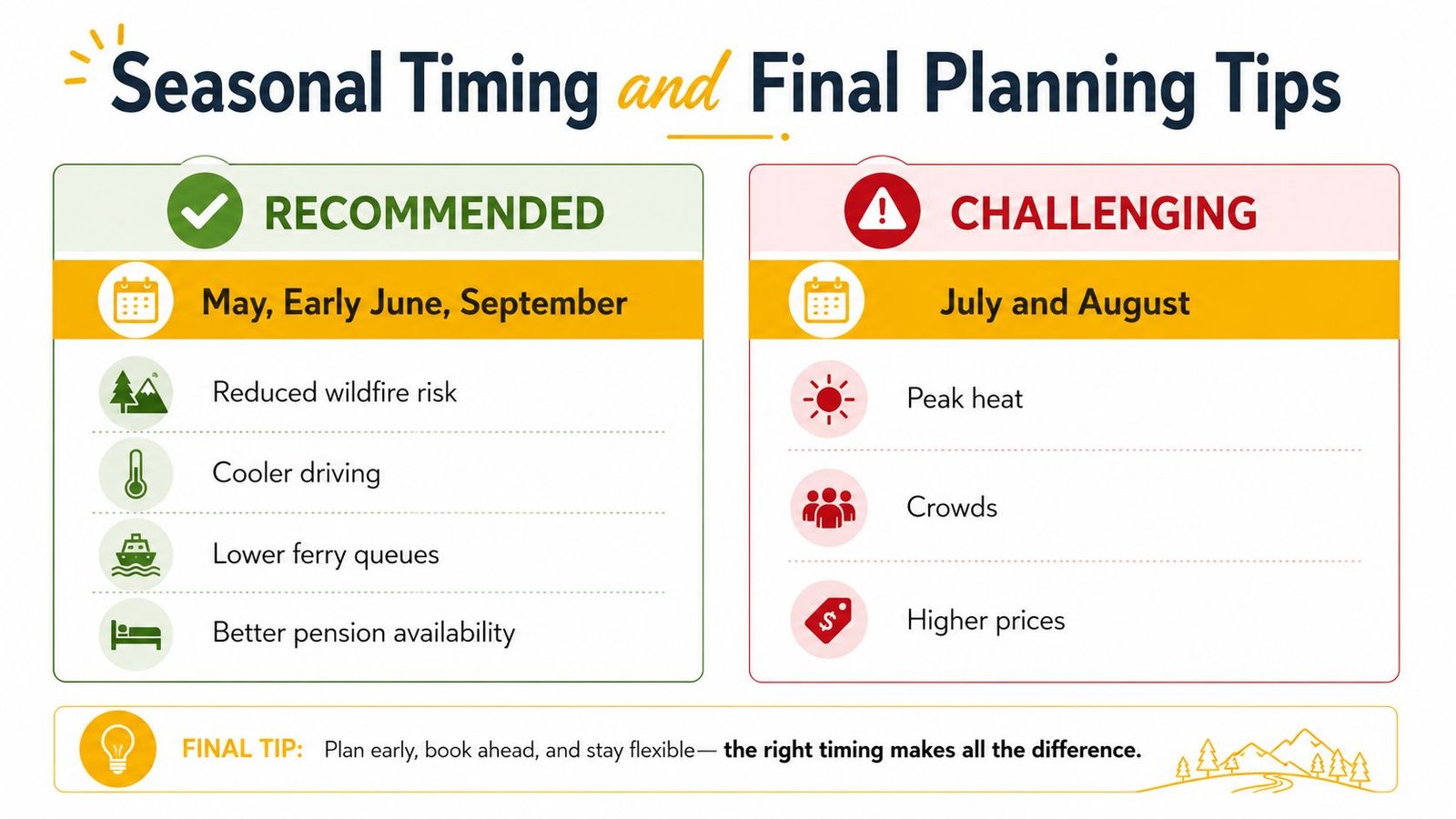
Book May, early June or September for the best balance of comfortable driving, available accommodation and manageable ferry demand. Cooler weather makes long mountain roads easier, while Mani pensions usually have more choice than during the busiest summer weeks.
July and August suit a beach-led itinerary, but prepare for stronger heat and busier resort towns. Nafplio is especially crowded at weekends, and the Assumption period around 15 August can disrupt room availability and sightseeing plans. Greece also faces a high wildfire risk from April to October, so check local alerts before setting out and obey every road closure or evacuation instruction.
The shoulder season is no longer a quiet fallback. Peloponnese tourism is attracting more visitors outside the traditional peak, as reported in this regional tourism update. Reserve popular stays early, particularly if your route includes Nafplio, the Mani or a limited ferry connection.
Departure checklist
- Documents: Check passport validity, carry your UK photocard licence and confirm whether your circumstances require an International Driving Permit.
- Health cover: Take your EHIC or GHIC card and arrange suitable travel insurance.
- Ferries: Pre-book vehicle space for Kythera or Antikythera detours. Do not assume you can board on arrival.
- Navigation: Download Google Maps areas for offline use before leaving Athens.
- Payments: Carry cash for smaller petrol stations and rural tavernas.
- Vehicle: Confirm parking, mileage limits, fuel policy and permitted roads with the hire company.
Use this UK road-trip planning illustration to check the practical details. Book the car first, reserve Nafplio for your opening two nights, then shape the rest around your preferred pace. Leave room to choose between the eastern loop, western coast and a slower Mani stay rather than fixing every night before you understand the driving distances.
BTOURS offers curated Greek self-drive itineraries, including a seven-day Peloponnese route with accommodation and a rental car arranged around the journey. Visit BTOURS to organise your chosen route with selected stays and planning support through arrival.