You've landed at Heathrow or Athens, opened two rental quotes, and thought the choice would be simple. Both cars appear to cost about the same. Then the desk agent explains the deposit, the excess, the fuel arrangement, the cross-border permission and the charge for returning after hours. Suddenly, the cheaper quote has become the less predictable one.
That's the challenge behind choosing the best car rental companies in Europe. A strong brand isn't the one with the lowest search result. It's the one that gives you the right car, explains the financial exposure clearly, supports your route across borders and handles a disagreement properly if a damage charge appears after you've gone home.
The UK market is mature enough to expose the differences. IBISWorld estimates the UK car rental and leasing industry at £22.1 billion in 2025, with 3,489 businesses and revenue growth of 3.0% CAGR over the previous five years. In BTOURS planning work for Britain, Ireland and Greece, I judge every reservation against six practical tests: fleet reach, pricing transparency, insurance clarity, fuel and mileage rules, dispute handling and digital experience.
Two Quotes at the Airport and the Question That Follows
At a Heathrow counter, the first traveller has a compact booked through a broker. The screen showed an attractive daily rate, but the voucher leaves the excess in a separate document and says the fuel policy depends on the supplier. The second quote costs a little more, yet the collection location, deposit, mileage terms and return instructions are visible before payment.
Neither traveller is necessarily getting a bad deal. They're buying different levels of certainty.
That distinction matters even more in Athens. A small airport surcharge, a prepaid fuel option or a cross-border restriction can alter the economics of a route through mainland Greece and the islands. A vehicle that looks suitable online may also be too large for a village road, too small for luggage or unavailable for a ferry crossing.
For a traveller planning a self-drive holiday, the counter is where weak booking information becomes expensive. I've seen clients focus on the daily rate while overlooking the amount held on their card, the definition of “damage”, or whether the rental desk has recorded a pre-existing mark.
BTOURS rule: A quote is only competitive when you can explain what you'll pay, what you may owe and who will help if the final charge is wrong.
This guide ranks the major names rather than producing a neutral directory. Enterprise, Hertz, Europcar, Avis and Sixt all have reasons to earn your attention, but none deserves automatic trust on every route. Brokers can also work brilliantly, particularly when they expose several suppliers in one search, but their post-rental support depends on the company providing the car.
The six tests stay consistent throughout:
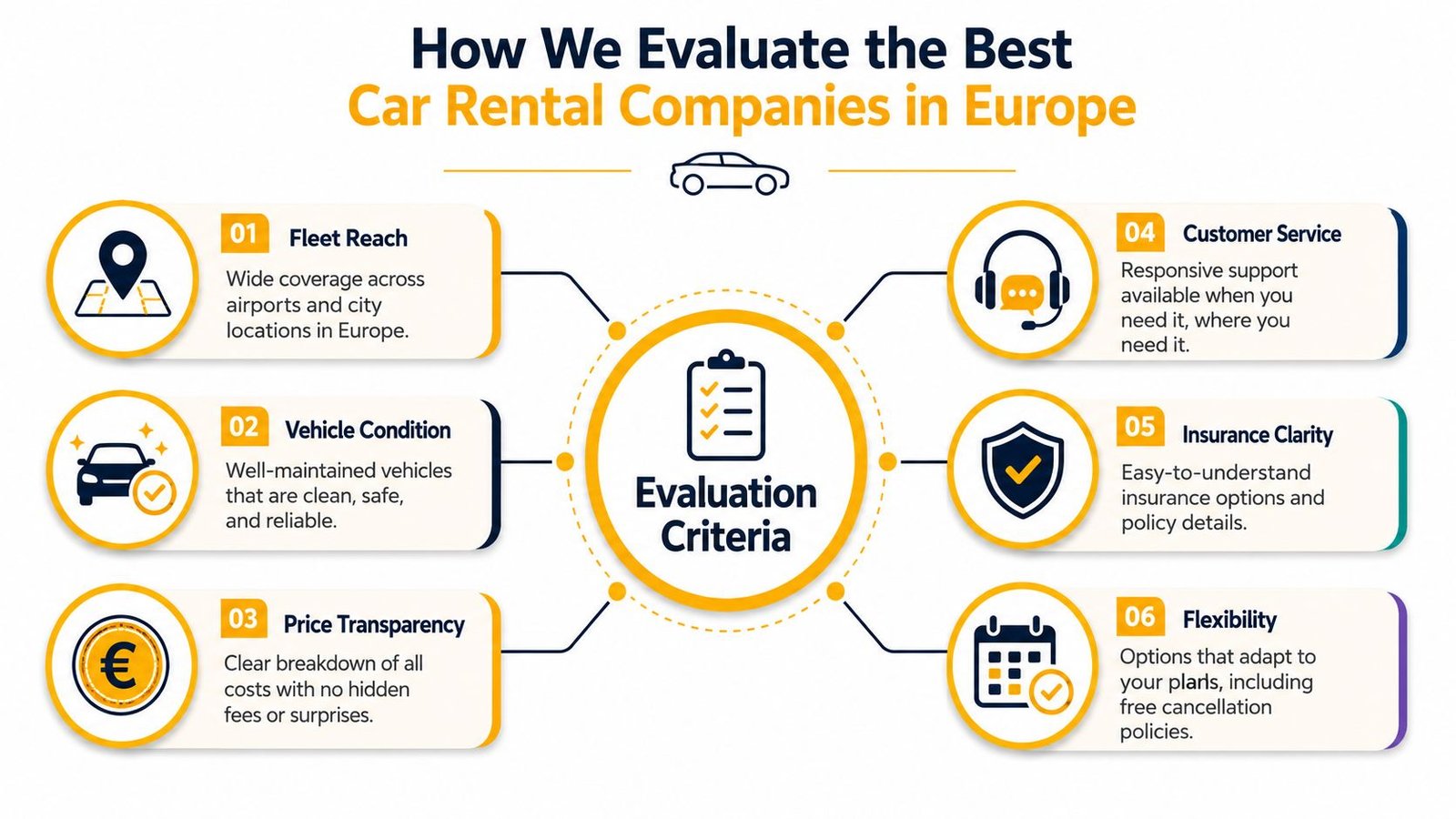
- Fleet reach: Can you collect and return conveniently across airports, city centres and regional destinations?
- Pricing transparency: Are taxes, deposits, one-way charges, late collection fees and border permissions clear before payment?
- Insurance clarity: Do you understand the excess, exclusions and optional protection?
- Fuel and mileage: Will full-to-full apply, and does the booking include enough mileage for your route?
- Dispute handling: Can you challenge a damage, toll or refund issue with usable evidence?
- Digital experience: Can you amend the reservation, present the voucher and get help from your phone?
For visual context on an England road trip, this London and England travel image reflects the kind of itinerary where a convenient urban collection can be more useful than an airport-only branch. The best choice depends on the route you'll drive, not the logo you recognise first.
How We Evaluate the Best Car Rental Companies in Europe
A rental company earns a place on a shortlist when it performs before, during and after collection. The daily rate starts the comparison, but it doesn't finish it.
The UK market shows why distribution and digital access matter. Mordor Intelligence projects online channels to account for 67.5% of UK rental revenue in 2025, while off-airport and downtown locations hold 53.5% of revenue share. The same source estimates England's share of UK rental revenue at 74.8% in 2025, which reinforces the value of a broad network rather than a narrow airport presence.
Fleet reach and vehicle condition
A useful fleet isn't just large. It has the right categories at the right pickup point. A couple touring the Cotswolds needs a compact automatic with sensible luggage space. A family driving Crete needs room without an unwieldy SUV. A multi-country route needs a vehicle whose contract permits every border on the itinerary.
I also care about the handover standard. The booking may promise a category rather than a specific model, so the collection team must provide a clean, roadworthy car and record existing damage accurately. The six-criteria visual below includes vehicle condition, even though the core commercial test also covers reach and availability.
Price transparency and insurance clarity
A transparent quote tells you more than the headline rate. It identifies the required deposit, the excess, taxes, additional-driver charges, airport fees, one-way costs and any permission needed for a different country.
Insurance language deserves the same scrutiny. “Protection included” doesn't tell you whether glass, tyres, underside damage or theft carry separate exclusions. You should know whether an optional product reduces the rental company's excess, reimburses you later, or adds another layer of cover.
Fuel and mileage rules
Full-to-full is usually straightforward. You collect a full tank and return it full, keeping the refuelling receipt where possible. Prepaid fuel can suit a rushed return, but convenience doesn't automatically make it cheaper.
Mileage needs equal attention. A long route through France, Italy or the Greek mainland can expose a restrictive allowance that looked harmless for a short airport transfer. I treat mileage as part of the route design, not as a footnote.
Dispute handling and digital experience
Damage claims, toll notices, unauthorised payments and missing refunds are not rare administrative details. CMA consumer intelligence records deposits, unauthorised payments and failures to refund as 37% of issues, with damage disputes accounting for 19%. That's why a company's evidence process matters as much as its roadside assistance.
The digital test is practical. Can you amend a booking without starting again? Does the app show the exact supplier and protection terms? Can you access the agreement, pickup instructions and support contact when you're standing in a car park with poor reception?
A low price that fails these tests isn't a bargain. It's an unresolved cost transferred to the pickup desk or the return email.
Major Brands and Brokers Compared Across Europe
The big names don't perform identically, and the brokers aren't interchangeable. Use the matrix as a starting point, then read the supplier terms for your exact location and dates.
| Brand / Broker | Fleet Reach | Pricing Transparency | Insurance Clarity | Fuel & Mileage | Dispute Handling | Digital Experience |
|---|---|---|---|---|---|---|
| Enterprise | Strong UK footprint and useful regional coverage | Usually clear, but fuel details need checking | Generally understandable, with excess still requiring attention | Can vary by branch and contract | Strongest mainstream choice for documented follow-up | Functional and dependable |
| Hertz | Excellent airport and city presence across Europe | Premium positioning can mean higher deposits | Clear products, but counter pressure around waivers can arise | Check mileage and fuel line by line | Established process, though escalation can feel formal | Strong loyalty and booking tools |
| Europcar | Very good Schengen and cross-border reach | Competitive, but prepaid terms need close reading | Read exclusions carefully | Confirm border, fuel and mileage conditions | Adequate, dependent on country and branch | Solid, with variation by market |
| Avis | Broad corporate and airport network | Consistent quote structure | Professional presentation, but don't assume low exposure | Verify one-way and mileage conditions | Reliable corporate channels | Polished and familiar |
| Sixt | Strong in Germany and Greece, less convincing at some UK airports | Often easy to navigate online | Can be clear, but premium categories raise the stakes | Check category-specific rules | Good when documentation is complete | Best overall digital experience |
| Auto Europe | Broad through partner suppliers | Often competitive and comparison-friendly | Broker terms require careful supplier review | Depends on the underlying operator | Depends on supplier and broker route | Easy comparison workflow |
| Rentalcars.com | Extensive inventory across Europe | Convenient, but supplier details can sit behind the booking flow | Read protection and excess terms independently | Supplier controls the operational policy | Not uniform across providers | Very easy to search and amend |
| DiscoverCars | Wide local and international inventory | Strong price visibility at comparison stage | Check reimbursement and supplier conditions | Varies materially by partner | Supplier-dependent | Useful mobile-first search |
Enterprise remains my safest mainstream recommendation for many UK routes because the branch network and post-pickup communication tend to be practical. The trade-off is inconsistency in how clearly individual locations explain fuel arrangements.
Hertz works best when you value a recognisable airport operation, a broad fleet and loyalty benefits. Expect a more premium commercial approach, particularly around deposits and excess protection. Avis has similar appeal for corporate travellers who prefer predictable processes, especially on one-way Scottish journeys.
Europcar earns its place for travellers moving through continental Europe. Its cross-border reach suits a Schengen itinerary, but the booking must state which countries are permitted. Sixt is the brand I choose when the mobile journey matters. Its German strength and Greek coverage are useful, and the online experience is often cleaner, although I wouldn't select it blindly for every UK airport.
A broker doesn't own the entire rental experience. It presents a supplier's inventory, collects or passes on booking information and may sell protection separately. If the vehicle develops a dispute, the supplier usually controls the inspection, charge and initial evidence.
For travellers deciding between a vehicle and a driver for a resort transfer, this guide to private transfer vs hire car offers a useful comparison of convenience, control and responsibility. That decision can save more frustration than switching between two similar rental brands.
Best Picks for UK, Ireland and Greece Self-Drive Routes
The right operator changes with the pickup point. A brand that works well at Heathrow may be a poor choice for a small Greek island, where a local desk can understand ferry logistics and village access better.
| Region | Top Pick | Pickup Point | Best Vehicle Class | Watch Out For |
|---|---|---|---|---|
| UK | Enterprise | Heathrow or Edinburgh | Compact automatic or estate | Confirm fuel terms and after-hours return |
| UK | Sixt | Heathrow or Edinburgh | Compact or premium compact | Airport availability and category substitution |
| Scotland | Avis | Edinburgh, with one-way return planning | Compact or intermediate | One-way fees and remote return conditions |
| Ireland | Hertz or Europcar | Dublin Airport | Compact automatic | Airport pricing and insurance excess |
| Ireland | Dooley or Carhire.ie | Cork or Shannon | Manual economy | Local terms, mileage and deposit requirements |
| Greece | Autounion or Avance | Downtown Athens or Heraklion | Compact manual or automatic | Tourism-related airport surcharges |
| Crete | Autounion or Avance | Heraklion city or airport after comparison | Compact or small SUV | Ferry use and damage documentation |
Britain and Ireland
For Heathrow, I favour Enterprise when the route prioritises straightforward support and easy onward travel. Sixt is a strong alternative for a polished digital booking and a newer-feeling category, subject to actual branch availability. At Edinburgh, both can work well for Highland circuits, while Avis deserves attention when you need a Scottish one-way route.
Ireland needs a sharper distinction. Dublin Airport is where Hertz and Europcar are most useful for travellers who want a familiar airport operation and a broad choice of categories. Cork and Shannon can reward a comparison with Dooley or Carhire.ie, particularly for a manual economy car, but read the local deposit, mileage and return conditions before booking.
If you're planning a more indulgent Scottish itinerary, Northern Spain Travel's Scotland self-drive guide is a helpful source of route inspiration before you choose the vehicle. A dramatic Highland route often needs less car than travellers expect, but more luggage discipline.
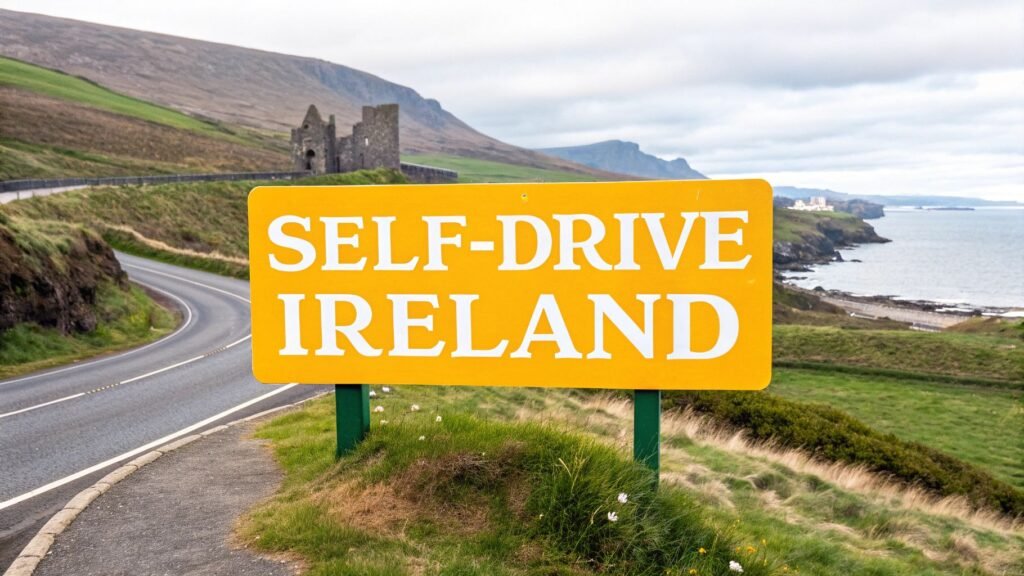
This Ireland castle and scenic coast image captures the type of route where a compact car and patient daily pacing beat a large vehicle.
Greece
In Athens, compare downtown collection with the airport before you pay. Downtown can avoid airport-specific charges, while Heraklion branches may be more convenient than an airport desk for a Crete itinerary. Autounion and Avance are my consistent local-facing choices for Crete, especially when the route includes villages rather than only resort roads.
The Greek gotcha is the ferry. A car collected on one island may not be authorised on another island or mainland ferry route, even if the map makes the journey look simple. Get written approval before boarding, and never assume that a broker's “Greece” search result includes ferry permission.
Insurance, Fuel and Mileage Decisions That Change the Bill
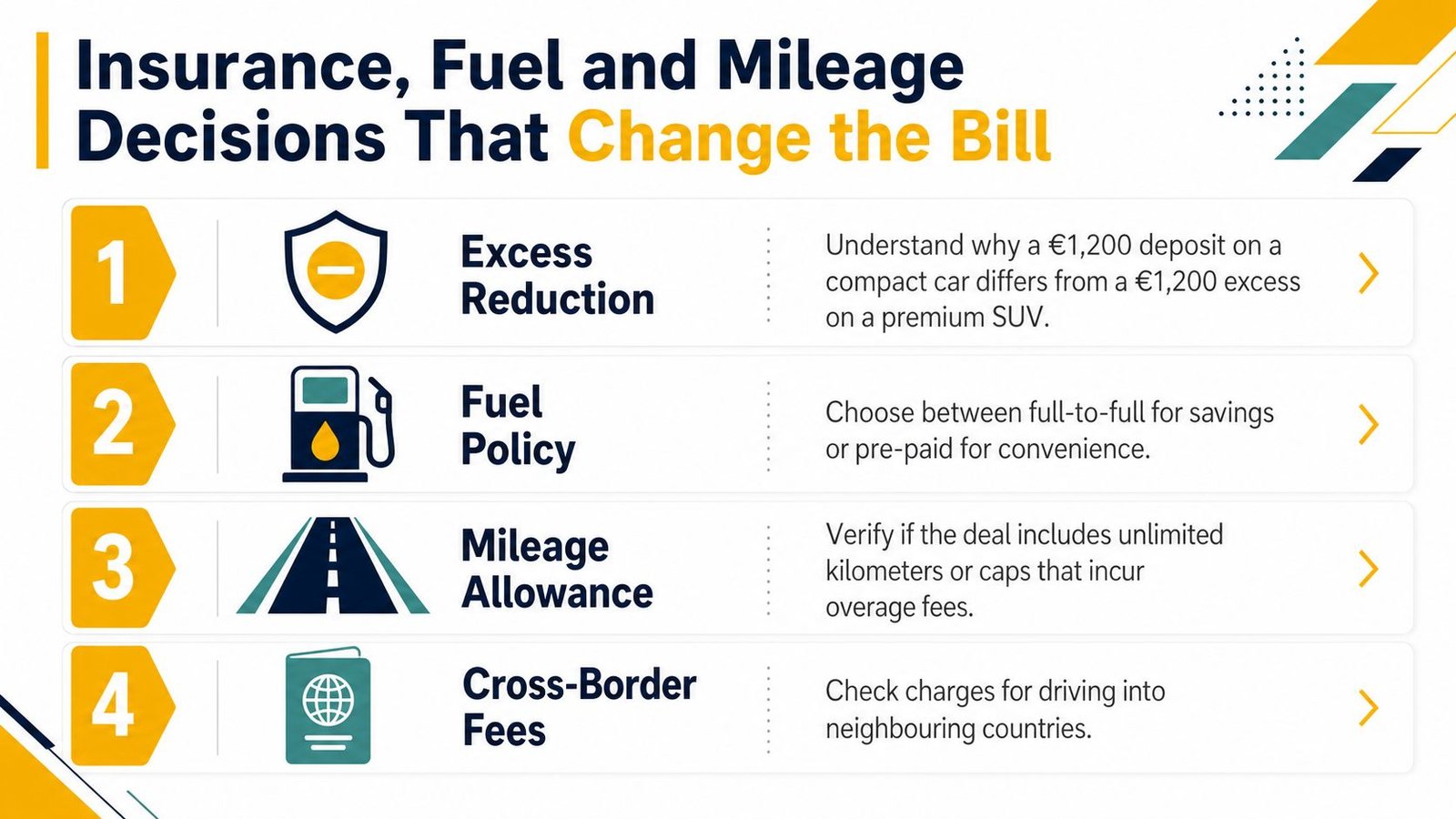
The rental bill is set by four choices made before collection. I treat them as route-planning decisions, because the cheapest headline rate can become expensive once protection, fuel and distance are included.
Deposits and excess serve different purposes
Deposits and excess sound similar on a quote but serve different purposes. The deposit secures the company's position on your card, while the excess defines your potential liability if the vehicle is damaged. Check both figures before you accept any protection.
Ask these questions at the counter:
- What is the excess? Confirm the exact amount and the events it covers.
- What does the protection exclude? Check tyres, glass, wheels, roof, underside and keys.
- Who pays first? A broker product may reimburse you after the rental company charges your card, rather than preventing the charge.
A compact car with a large deposit is not automatically poorly insured. A lower deposit does not prove full cover. The contract controls the outcome, so read the exclusions and payment process, not just the daily rate.
Fuel rewards preparation
UK guidance commonly describes the full-to-full arrangement. You collect the car with a full tank and return it full. A shortfall can trigger premium fuel pricing and a refuelling service charge of about £10 to £20, according to independent UK fuel-policy guidance.
Photograph the gauge at collection, refuel near the return point, keep the receipt and photograph the gauge again. Prepaid fuel may reduce the pressure of finding a station before an early flight, but include its cost when comparing quotes. Check the branch's written policy too, since the payment method and refund terms can differ.
Mileage can punish an ambitious route
Some UK standard bookings include 100 free miles per day for hires of 1 to 29 days, while longer hires use a 500-mile weekly allowance. Unlimited mileage may require an extra counter fee, and one stated overage rate is 30 pence per mile, as set out in UK rental mileage guidance.
Estimate the route before booking, especially for a journey crossing into France or Italy. A capped allowance that works for an airport hotel will fail on a multi-region holiday. Confirm cross-border permission separately, because mileage terms do not automatically authorise international travel.
Young drivers need a different calculation
Drivers under 25 commonly face a daily surcharge of £15 to £35, and UK rental guidance also reports higher typical excess levels, moving from about £500 to £1,500 towards roughly £1,000 to £3,000. One provider's published rules state that drivers aged 21 to 22 pay £50 per day, while drivers aged 23 to 24 pay £40 per day, with restrictions on vehicle categories and vans, as described in its UK FAQ.
For a younger driver, a modest manual car can make more financial sense than a premium automatic. Check age eligibility before comparing prices. A reservation that appears available online may fail at the desk if the lead driver does not meet the branch's rules.
Booking, Pickup and the Dispute Path Few Travellers Plan For
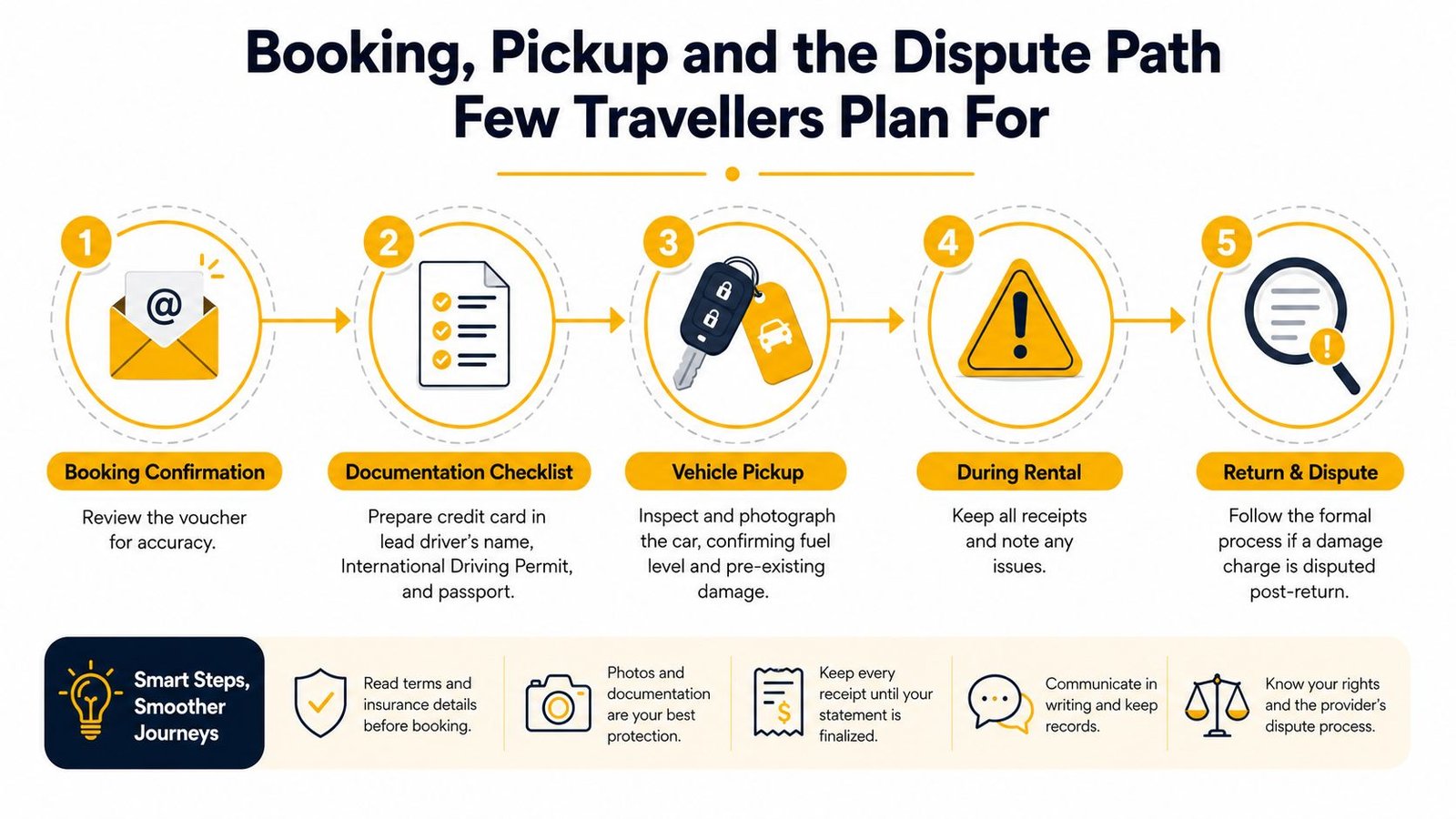
Your evidence trail starts at the booking confirmation, not after you have returned the car. Keep the lead driver's credit card, driving licence, passport, rental voucher and any required permit together before departure. A card in another passenger's name can fail at the desk. For Greece, non-EU licence holders should check whether an International Driving Permit applies to their nationality and route, rather than trusting a generic broker statement.
The handover creates your strongest evidence
Save the voucher offline and carry a printable copy when practical. Mobile barcodes are convenient, but airport Wi-Fi and battery levels can fail. At the vehicle, photograph every side, the roof, wheels, windscreen, dashboard, fuel gauge and odometer before leaving the bay.
Inspect the damage diagram with the staff member. If a scratch appears on the car but not on the form, have it added before driving away. Record the collection time and location, especially when the branch is busy or the return will be after hours.
Counter pressure often takes familiar forms: an upgrade presented as the only comfortable option, fuel pre-purchase described as a discount, or extra cover explained without stating the existing excess. Ask for the revised total in writing before signing. That written price matters more than a hurried verbal assurance.
The return is part of the contract
At return, photograph the vehicle from the same angles. Keep the fuel receipt, parking ticket, toll records and any staff acknowledgement. If you use a key box, photograph the car and the location before depositing the keys.
A later charge deserves a written response, not a telephone argument alone. Request the inspection record, time-stamped photographs, repair estimate, relevant contract clause, fuel calculation and any toll or fine documentation. A chronological file gives the supplier less room to dismiss your complaint as unsupported.
For UK rentals, BVRLA complaints handling may apply. Cross-border European rentals can involve the European Car Rental Conciliation Service. The CMA consumer intelligence report, cited earlier, provides useful background on deposits, refunds and damage charges, so review that guidance before travelling.
For a port arrival, renting a car for Southampton cruise requires checks on terminal access, collection timing and luggage handling. Confirm those details before arrival to avoid a rushed handover.
Keep a practical travel-awareness reference for your rental documents. Document first, complain in writing and escalate through the correct channel.
When an Aggregator or Local Agency Beats the Big Names
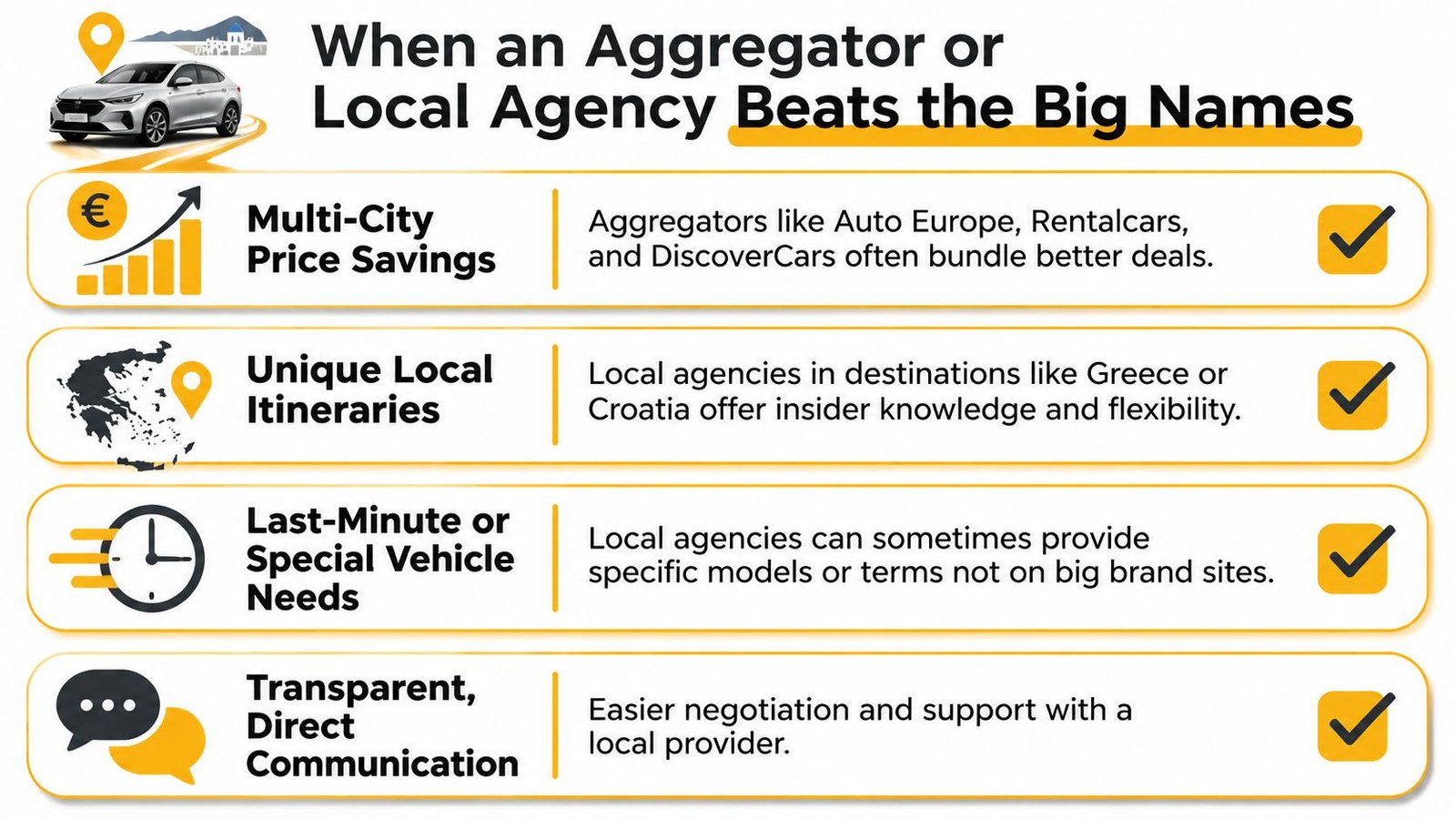
The major brands don't always win. For a single-country itinerary, an aggregator or local agency can offer a better match between the vehicle, the route and the person answering your question.
Which? comparison data published through Skyscanner shows a clear spread in broker performance. Zest Car Rental scored 90%, followed by Auto Europe at 79%, Holiday Autos at 78%, Booking.com and Rentalcars.com at 76%, Expedia at 75%, DiscoverCars.com at 74% and DoYouSpain.com at 72%. Which? specifically recommended Zest in that comparison, with Auto Europe ranked below it on user-experience and value measures.
My checklist is direct:
- One-country route: Start with Auto Europe, Rentalcars.com or DiscoverCars when you'll collect and return within one country and want to compare several suppliers.
- Downtown pickup: Check local agencies when an airport branch adds cost or makes the first driving day awkward.
- Ferry crossing: Ask the agency for written permission before booking. A local Greek operator may explain the restriction more clearly than a global search page.
- Small or specialist vehicle: Local desks can sometimes offer a compact manual, island-sized car or practical regional category that a multinational site doesn't show well.
- Direct communication: Choose the provider that can answer your exact route question in writing, not merely the one with the shortest checkout.
For Greece, BTOURS commonly checks local options for the Cyclades, Crete and the Peloponnese. For Ireland, local comparison is especially useful around the Wild Atlantic Way, where pickup convenience and direct advice can matter more than a familiar logo.
The warning is insurance. An aggregator's protection may be a reimbursement product rather than the supplier's own excess reduction. Read who charges you, who refunds you, what evidence they need and which exclusions apply.
The major brands win decisively for a multi-country tour requiring consistent roadside support, permitted border travel and one contracted insurer. That's where operational continuity beats a tempting local rate.
BTOURS Recommendations and Quick Answers for Self-Drive Travellers
Different travellers need different winners. I'd make these pairings:
| Traveller | Operator choice | Aggregator pairing | Why |
|---|---|---|---|
| Couple on a UK heritage route | Enterprise | Auto Europe for a price check | Convenient regional coverage and sensible compact categories |
| Family touring Greek islands | Avance or Autounion | DiscoverCars for local availability | Better route-specific discussion and practical vehicle choice |
| Solo driver prioritising insurance clarity | Avis or Enterprise | Zest for a comparison benchmark | Easier to compare contract language before collection |
| Multi-country planner | Europcar or Hertz | Rentalcars.com for inventory checking | Broad reach, border permissions and established support channels |
BTOURS arranges self-drive itineraries with accommodation, route planning and car rental options across destinations including Britain, Ireland and Greece. That makes the rental decision part of the journey design rather than an isolated checkout.
Five quick answers
Should I book a ferry-inclusive rental package?
Only when the contract explicitly permits the ferry route, vehicle movement and destination. Otherwise, book the car for one island or mainland region and use passenger ferries or separate transfers.
How early should I reserve for July and August?
Reserve as soon as your route and flight timings are firm. Peak demand reduces the choice of automatic cars, family categories and convenient pickup points, even when a search still shows availability.
Is credit-card rental cover sufficient?
Sometimes, but never assume it. Confirm the countries, vehicle category, exclusions, claim process, excess treatment and whether the card requires you to decline the supplier's protection.
What should I do when a damage claim is disputed?
Request the signed inspection record, time-stamped photographs, repair estimate and contract basis in writing. Send your own collection and return evidence, receipts and a clear timeline, then use the relevant complaint or conciliation route.
Are electric vehicles practical on these routes?
They can work well on planned urban and mainland journeys with reliable charging access. For remote Scottish roads, Greek islands or ferry-heavy itineraries, choose electric only after checking charging locations, vehicle permission and the time available for recharging.
Don't select the cheapest logo. Select the company whose contract matches your route and whose evidence process you'd trust after the return.
BTOURS can help you compare rental arrangements alongside self-drive routes, handpicked accommodation and practical pickup planning across Britain, Ireland and Greece. Visit BTOURS to start designing a road trip with the vehicle, permissions and support checked before you reach the counter.