
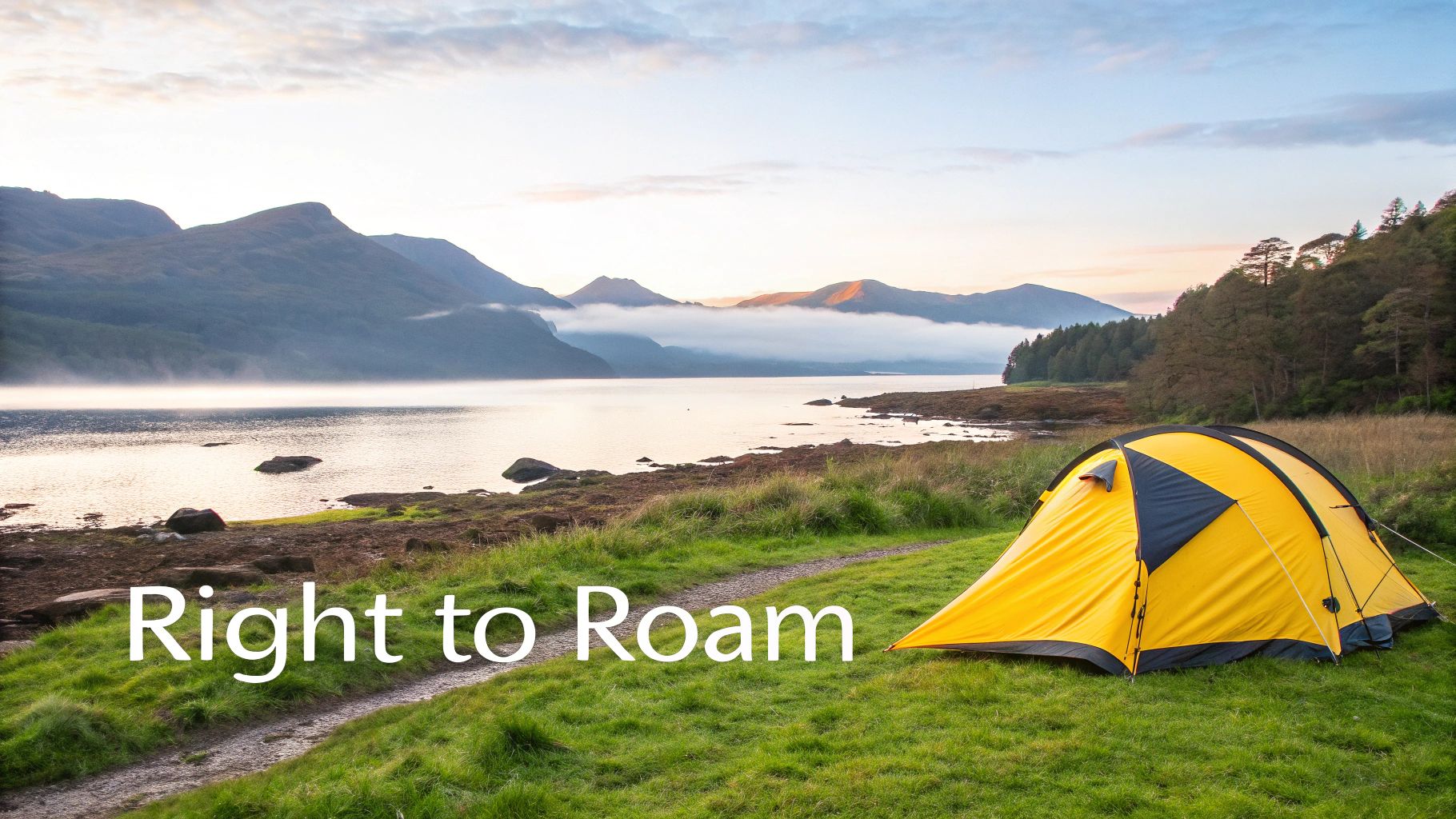
Picture this: you unzip your tent to the quiet majesty of a Scottish loch, the mountains around you still cloaked in the morning mist. This isn’t some far-fetched dream; in Scotland, it's your right. The answer to whether wild camping is legal here is a resounding yes – a freedom that truly sets this nation apart from the rest of the UK.
Your Right to Roam: Understanding Scottish Camping Laws
This incredible opportunity isn’t some loophole or a quietly tolerated tradition; it's written into law. It’s a genuine invitation to get out there and explore the country’s wildest corners, an open door to adventures that connect you directly with the raw beauty of the landscape.
Think of it less as a complex legal document and more like being handed a key. This key unlocks ancient forests, remote glens, and windswept coastlines, letting you experience them in the most intimate way imaginable—under a blanket of stars. It’s a privilege built on a shared agreement between you and the land itself.
The Foundation of Freedom
The legal cornerstone making all this possible is the groundbreaking Land Reform (Scotland) Act 2003. This legislation established statutory rights of access to most of Scotland's land and inland water, fundamentally changing how people interact with the great outdoors. It's a progressive piece of law that empowers everyone to explore.
This Act is more than just words on a page; it's a declaration that Scotland's natural heritage belongs to everyone who respects it. It fosters a culture of trust and shared responsibility, turning every camper into a temporary guardian of the wild.
Following the Act, the Scottish Outdoor Access Code (SOAC) was created to give practical guidance. This isn't a restrictive rulebook but a compass for responsible behaviour. It’s the "how-to" manual for exercising your rights properly, ensuring your adventure leaves no negative impact. Exploring the diverse landscapes of https://btours.com/scotland/ is an experience like no other, and getting to grips with these principles is your first step.
Responsible Access: The Core Principle
The whole idea of wild camping in Scotland hinges on one powerful concept: responsible access. This simple phrase is the heart of the agreement between adventurers and the environment. It means your right to roam is perfectly balanced with your duty to care for the land, its wildlife, and the people who live and work there.
This principle is defined by a few key actions, all detailed in the SOAC:
- Camp in small numbers: This keeps your footprint light and preserves that sense of solitude for others who might follow.
- Stay for a short period: The guidelines suggest moving on after two or three nights to prevent any strain on the environment.
- Leave no trace: This is the golden rule. Everything you pack in, you must pack out, leaving your camping spot exactly as you found it.
The Land Reform (Scotland) Act 2003 is what made wild camping widely lawful across the country, and it led directly to the SOAC. This code sets practical and commonsense limits—like camping short-term and removing all your litter—to ensure the wild stays wild for generations to come.
The Scottish Outdoor Access Code: Your Compass for the Wild
If the Land Reform Act is the legal key that unlocks Scotland's wild spaces, then the Scottish Outdoor Access Code (SOAC) is your ethical compass. Don't think of it as a rulebook waiting to trip you up. Instead, see it for what it is: a shared understanding that helps your adventure exist in harmony with the breathtaking landscape and the people who call it home.
The entire philosophy is built on three simple, powerful principles. Getting to grips with these isn't just about following rules; it's about shifting your mindset. You go from being a visitor to a temporary guardian, ensuring the freedoms you cherish today will be there for every adventurer who follows in your footsteps.
This shared code of conduct is built on what I like to call the "Three Pillars." They're easy to remember and even easier to put into practice once you understand the spirit behind them.
| Core Principle | What It Means for You | Practical Example |
|---|---|---|
| Respect the Interests of Other People | Acknowledging that the wild is a shared space for work, life, and play. | Pitching your tent well away from homes and farm buildings so you're out of sight, and keeping noise to a minimum after dusk. |
| Care for the Environment | Actively working to leave the land exactly as you found it, if not better. | Using a camping stove instead of an open fire to prevent soil damage and wildfire risk. Packing out all your rubbish, including food scraps. |
| Take Responsibility for Your Own Actions | Being self-reliant, prepared, and accountable for your safety and decisions. | Checking the mountain weather forecast, carrying a map and compass (and knowing how to use them!), and telling someone your route. |
By weaving these three pillars into your camping habits, you become part of a community that actively protects the very wildness we seek.
Respect the Interests of Other People
First and foremost, you have to remember that the Scottish wilderness is a living, working landscape. It might feel like you have an entire glen to yourself, but that land is often someone's workplace, backyard, or favourite dog-walking route. Respecting their interests is all about awareness and simple courtesy.
This means giving houses, farms, and roads a wide berth when you pitch your tent. A good rule of thumb I've always followed is to be out of sight and out of mind. Keep the noise down, especially at night—sound travels an incredible distance in the quiet of the countryside. This quiet consideration is a cornerstone of the wild camping laws scotland trusts you to uphold on your own.
Care for the Environment
This is the very soul of the "Leave No Trace" ethos. Caring for the environment is the single most important responsibility you have as a wild camper. It’s a conscious, deliberate effort to make your presence invisible.
Think about it in these simple, practical terms:
- Pack It In, Pack It Out: Absolutely everything you bring with you must leave with you. That includes tiny bits of litter and even food scraps like banana peels. Buried rubbish gets dug up by animals and pollutes the soil.
- Toilet Etiquette: When you're miles from the nearest loo, dig a small hole at least 30 metres from any river or loch. Do your business, bury it properly, and pack out any toilet paper or wipes in a sealed bag.
- Fire Safety: The SOAC strongly urges everyone to use a camping stove over an open fire. The risk of wildfire is very real, particularly on Scotland's peaty ground where a fire can smoulder underground for days. A stove is safer, faster, and leaves absolutely no scar on the land.
The goal is simple: the next person who stumbles upon your beautiful, secluded spot should have no idea you were ever there. Your presence should be as fleeting as the morning mist.
When you follow these guidelines, you're not just avoiding a mess; you're actively protecting the fragile ecosystems that make Scotland so magical.
Take Responsibility for Your Own Actions
The final pillar of the Code is all about self-reliance. The incredible freedom to roam across Scotland comes with a personal duty to be prepared, stay safe, and be accountable for your choices. The weather here can turn on a dime, and in remote areas, help can be hours away.
This means doing your homework. Plan your route, check the forecast religiously, and carry the right gear for all possibilities. You need a map and compass (and the skills to use them!), enough food and water, and proper waterproofs. Always, always let someone know where you're going and when you plan to be back.
Being responsible also means knowing your limits and not taking foolish risks. This self-sufficiency doesn't just keep you safe; it ensures you don’t put a strain on local mountain rescue teams. For anyone exploring the country, this level of preparedness is key, just as it is when planning the perfect road trip. If you need some inspiration, seeing how a well-crafted itinerary like this Taste of Scotland 8-Days Self-Drive Tour comes together shows just how much careful preparation pays off.
Mastering these three principles of the SOAC is the final piece of the puzzle. Once you have, you're ready to head out into the wild, fully equipped with the knowledge to camp with respect and confidence across Scotland.
Finding Your Perfect Spot: Where You Can and Cannot Camp
With the principles of responsible access fresh in your mind, the real adventure begins: finding that perfect patch of earth to call home for the night. Scotland’s wild camping laws open up a vast natural playground, but this freedom is balanced with the wisdom to know where you should—and shouldn't—pitch your tent.
Think of it like this: the landscape has clear green-light areas and a few sensible red-light zones. This isn't about memorising complicated legal maps; it's about learning to read the land itself. The core idea is to stick to unenclosed land—the open, untamed hillsides, forests, and shorelines that are the very heart of wild Scotland.
Identifying Off-Limits Areas
The Scottish Outdoor Access Code is wonderfully clear about the few types of land where access rights, including wild camping, simply don’t apply. Spotting these areas is usually straightforward once you know what you’re looking for. Your adventure should steer well clear of these places.
- Enclosed Fields with Crops or Animals: This is the most obvious one. If you see a field with fences, walls, or hedges that contains crops or livestock like sheep and cattle, it’s a no-go.
- Buildings and Private Gardens: Always keep a respectful distance from houses, farm buildings, or historic structures. The rule of thumb is to camp well out of sight and hearing of any occupied buildings. It’s all about respecting people’s privacy.
- Visitor Attractions: Land that's part of a paid visitor attraction, like the managed grounds of a castle or a formal garden, is also excluded from access rights.
Basically, if the land feels managed, private, or has a specific purpose like farming or housing, it’s not the place for your tent. This is a crucial part of honouring the spirit of the wild camping laws Scotland has so generously put in place.
This simple decision-making flow can help you choose a responsible spot.
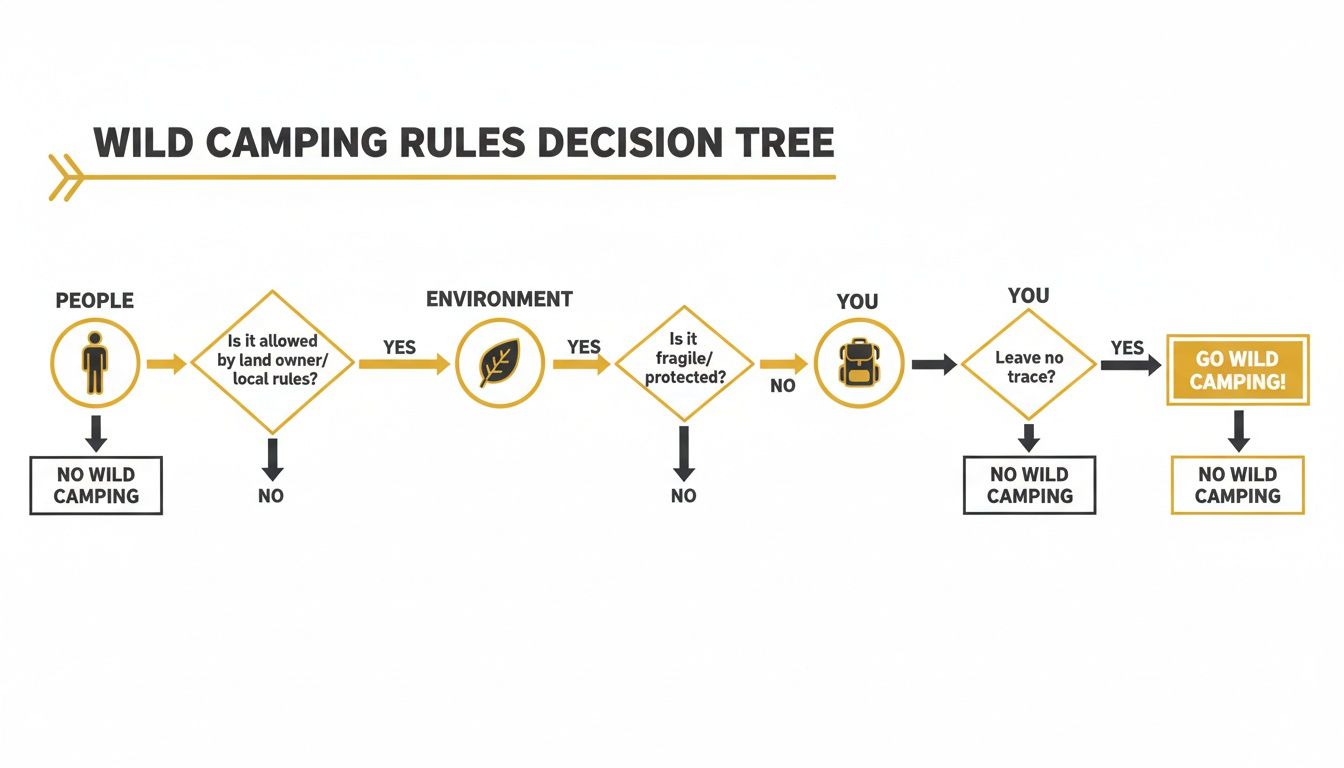
As you can see, responsible camping is all about finding a balance—respecting people, caring for the environment, and taking full responsibility for your own actions.
Embracing the Wild and Open Spaces
Now for the best part: the vast majority of Scotland's countryside that welcomes you with open arms. Your camping playground includes the rolling moorland, ancient Caledonian forests, remote glens, and windswept coastlines. These are the places where the right to roam truly comes alive, offering solitude and breathtaking beauty in equal measure.
When you're searching for that ideal spot, a few practical considerations will make all the difference between a restless night and a magical one.
Think of your chosen spot not just as a place to sleep, but as a temporary custodianship. Your goal is to be a silent guest of the landscape, leaving it as pristine and undisturbed as you found it.
Look for ground that is relatively flat and dry. Pitching in a hollow might seem sheltered, but it can quickly turn into a puddle if it rains overnight—a classic rookie mistake! Camping on higher ground can catch a breeze, which is a lifesaver during midge season but can be a real battle in high winds. The perfect spot often lies somewhere in between: sheltered but not sodden.
It's also vital to camp well away from rivers and lochs, at least 30 metres, to protect these precious water sources from any contamination. This also keeps you safe from any unexpected rises in water levels. While cities like Edinburgh The Athens of the North offer incredible history and culture, the true spirit of Scottish freedom is found far from the urban buzz.
By weaving together your legal knowledge with this practical, on-the-ground awareness, you can confidently find a spot that is not only stunningly beautiful but also completely in harmony with the principles of responsible access. It’s this thoughtful approach that protects the wild for everyone to enjoy.
Navigating Camping Management Zones and Special Rules
While Scotland’s right to roam is a passport to incredible freedom, it’s not an all-access pass to every single square inch of the country. Think of it like this: the whole of Scotland is a magnificent national gallery. You’re free to wander through most of the rooms, but a few of the most popular, precious exhibits have velvet ropes to protect them from overuse.
These "roped-off" areas are what we call Camping Management Zones (CMZs). They aren't there to spoil your adventure; they exist to preserve the very beauty you've come to experience. In a handful of exceptionally popular and fragile places, particularly along easily accessible loch shores, the sheer volume of visitors was starting to take its toll.
These zones are simply a thoughtful conservation tool. They help manage the impact of camping in the busiest hotspots, making sure these iconic landscapes stay pristine for wildlife, locals, and all the campers who will follow in our footsteps.
Understanding the Loch Lomond and The Trossachs National Park Byelaws
The most well-known example of these special rules is found in the Loch Lomond & The Trossachs National Park. Its stunning scenery and proximity to Scotland's biggest cities meant certain areas were feeling the pressure from irresponsible camping. To fix this, seasonal byelaws were brought in.
The rules are pretty straightforward and only apply during the peak season, running from the 1st of March to the 30th of September each year. Within the designated zones during this period, you have two options for camping legally:
- Stay at a designated campsite: These are the formal, managed sites perfect for those who want a few more facilities.
- Book a wild camping permit: This brilliant system lets you camp in a specific permit area on your chosen night. It helps to spread campers out and keep numbers manageable.
The permit system is a simple, low-cost way to get that authentic wild experience while actively helping to protect the park. A little bit of forward planning is all it takes to camp legally and respectfully in one of Scotland’s most treasured landscapes.
Why Do These Zones Exist?
The CMZs weren't created on a whim; they were a direct response to real problems on the ground. Despite the amazing access rights granted in 2003, it became clear that targeted byelaws were needed to manage a few high-traffic areas.
The Loch Lomond & The Trossachs byelaws, introduced in 2017, were a necessary step after park authorities saw a rise in litter, human waste, and antisocial behaviour in popular lochside spots. This was all caused by a small minority of visitors, but it was damaging the area for everyone else. It’s a focused solution to a very localised problem. You can find more insights into these conservation efforts and their impact.
How to Identify and Plan for CMZs
So, how do you make sure you don't accidentally pitch your tent in the wrong place? It all comes down to a bit of planning before you pull on your hiking boots. A quick online check is your best friend, especially if you’re heading to a well-known national park.
- Check Park Websites: The official website for Loch Lomond & The Trossachs National Park has brilliant, detailed maps that clearly mark the boundaries of every CMZ.
- Look for Signage: Once you’re in the area, you’ll find clear signs at car parks and on trailheads letting you know if you are entering a management zone.
- Book Permits in Advance: Permits are easy to book online, but they are limited. It’s a good idea to book ahead, particularly if you’re planning a trip over a weekend or bank holiday.
It’s also really important to remember that these zones cover a tiny fraction of the park. It's estimated that the byelaws affect only about 4% of the national park’s total area. That leaves the other 96% completely open for responsible wild camping under the normal Scottish Outdoor Access Code.
Think of these zones as a small investment in preservation. A few minutes of planning opens up a lifetime of wild, wonderful, and entirely legal camping adventures across the rest of Scotland's magnificent landscapes.
These rules aren’t a barrier. They are a sign of just how much Scotland values its natural treasures. By respecting them, you become a partner in protecting the wild for everyone.
Becoming a Guardian of the Wild: Responsible Camping in Action
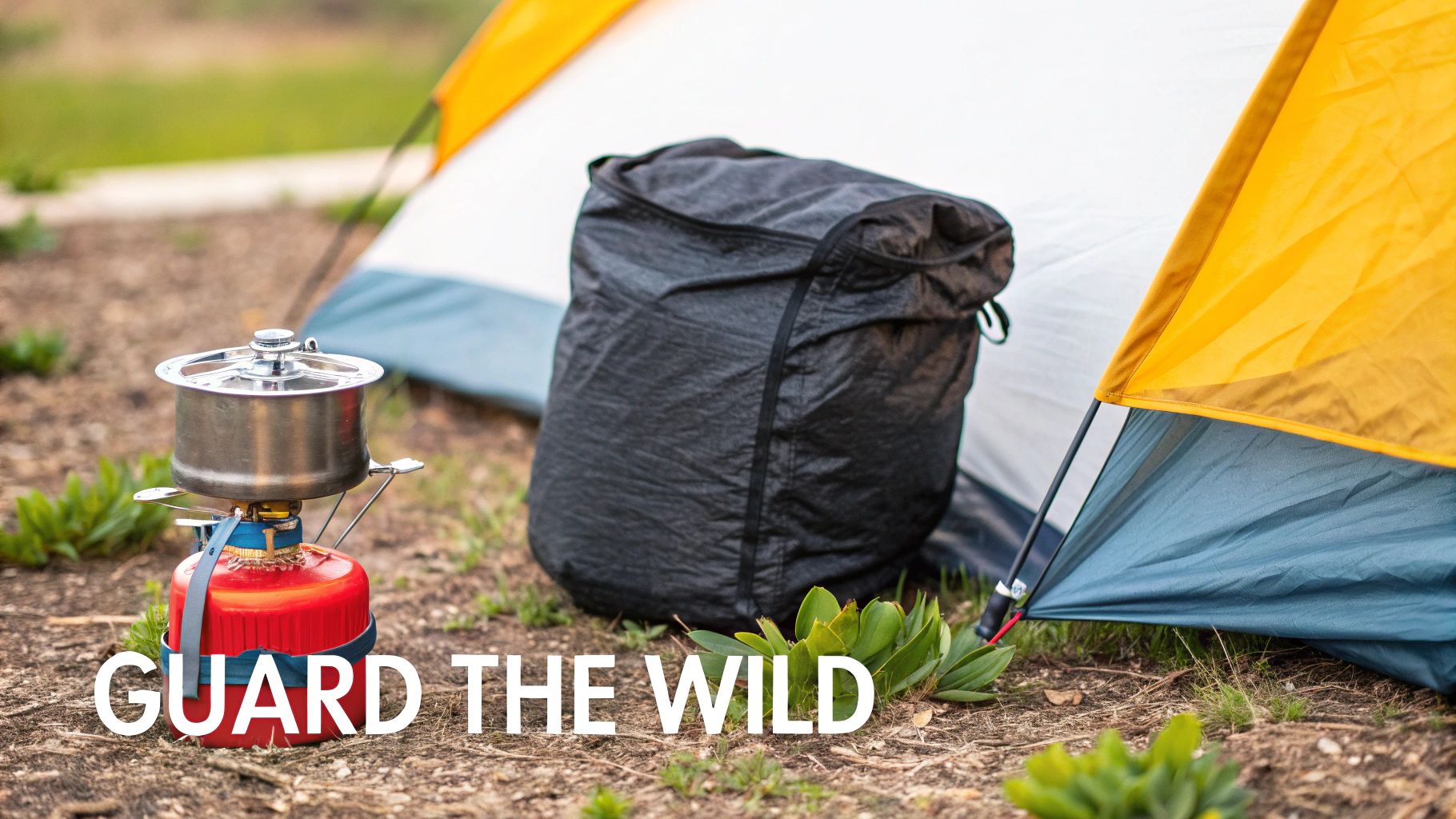
Knowing the rules is one thing, but living them is what really counts. This is where you go from being just another visitor to a true guardian of the wild places you love. It’s about more than just avoiding a mess; it's about actively leaving the landscape as beautiful—or even better—than you found it.
Think of yourself as a silent partner with the land. Your presence should be temporary and light, ensuring the untamed character of the Highlands remains for every bird, beast, and future adventurer who comes after you. This is your chance to step up and become a guardian of the wild.
The Campfire Question: To Light or Not to Light?
We’ve all seen the pictures—a crackling campfire under a blanket of stars. It's a romantic idea, but the reality in Scotland can be devastating. That's why the Scottish Outdoor Access Code strongly advises against them, and for good reason. The safest, smartest, and most eco-friendly choice will always be a camping stove.
Much of Scotland's ground is rich in peat. A fire that looks like it's out can actually smoulder underground for days, creeping through root systems before erupting into a destructive wildfire far from where it started. This isn't just a remote possibility; it's a very real risk that can scar fragile ecosystems for decades.
If you are absolutely certain a fire is safe and permitted:
- Keep it small and well-contained.
- Never light one on peaty ground or during dry spells.
- Douse it with plenty of water until every last ember is cold to the touch before you leave.
Dealing with Human Waste Properly
Let's be honest, it's not the most glamorous part of wild camping, but it's one of the most critical. When you're miles from the nearest loo, knowing how to manage human waste is essential for protecting water sources and the health of wildlife and other people.
The golden rule is to be at least 30 metres (about 100 feet) from any loch, river, or stream. Dig a hole about 15cm (6 inches) deep, do your business, and then fill it back in, placing the turf neatly on top. Here’s the crucial bit: you must pack out all toilet paper and wet wipes in a sealed bag. They don’t biodegrade quickly and are a blight on the landscape.
Respecting Scotland’s Wildlife
Remember, you are a guest in their home. Keep a respectful distance from any animals you see, and never, ever feed them. This is especially important during sensitive times, like the spring nesting season for birds (roughly April to July) or the autumn deer rut.
Your presence should be a whisper, not a shout. Observe from afar with binoculars, keep noise to a minimum, and ensure your dog is under close control at all times to avoid disturbing ground-nesting birds or livestock.
Since the 2003 Act, the official focus has been on encouraging good behaviour rather than simply restricting access. While the vast majority of visitors are responsible, a small minority cause real problems with litter, fires, and waste. This has led authorities to favour education and targeted ranger patrols over sweeping bans.
Beyond the legal side of things, responsible camping is also about self-reliance. Being prepared for the unexpected is key. Having a solid emergency kit with essential communication and survival gear for responsible outdoor adventures isn't just a good idea—it’s a necessity.
Remember: Your Vehicle Has No Rights
Here’s one final, vital point that many people forget: your right to roam does not extend to your vehicle. You can't just drive your car, van, or motorbike off-road to find the perfect camping spot.
All vehicles must be parked legally and considerately in proper parking areas. Never block gates or access tracks. This thoughtful approach is the hallmark of an experienced traveller, one who understands that incredible adventures come in many forms. To get inspired, you can explore the different travel styles available for exploring stunning landscapes and see how respect and preparation are universal themes.
Your Wild Camping Questions Answered
The spirit of wild camping in Scotland is woven from freedom and trust. But with that freedom comes a shared responsibility to care for the land. To help you step out into the wild with total confidence, we’ve put together answers to the most common questions about the laws and etiquette of camping in Scotland.
Think of this as the final check of your map before you shoulder your pack and head for the hills.
Can I Have a Campfire When Wild Camping in Scotland?
A crackling campfire can feel like the heart of an outdoor adventure, but the official advice from the Scottish Outdoor Access Code is simple: avoid them. The main reason is the very real and devastating risk of wildfire.
Much of Scotland's breathtaking landscape is peaty. A fire that looks like it’s out on the surface can actually smoulder underground for days, creeping through root systems before erupting far from where you camped. It’s a hidden danger with terrible consequences. That's why a camping stove is always the safest, most responsible choice for cooking. A good stove is efficient, leaves no scar on the ground, and completely removes the fire risk.
If you find yourself in a situation where a fire feels absolutely essential and you are certain it's safe to have one:
- Keep it small, controlled, and a good distance from trees, buildings, and any dry grass or heather.
- Never light a fire during long dry spells when the risk is at its absolute highest.
- You must be certain it is completely extinguished with water. Douse it, stir the ashes, and douse it again until it's cold to the touch.
Remember, in many areas like the Camping Management Zones, fires are banned outright. For the sake of the environment, a stove is your best companion.
How Long Can I Stay in One Spot When Wild Camping?
The whole idea is built on the principle of leaving no trace and being transient. While the Land Reform (Scotland) Act 2003 doesn't set a specific time limit, the accepted wisdom is to stay for two to three nights at most.
Staying any longer starts to look like a semi-permanent camp, which isn't covered by access rights and would need the landowner's permission. The ethos of wild camping is to move on, leaving the spot as pristine as you found it for the next person to enjoy. A great habit to get into is arriving late and leaving early, which minimises your presence and impact.
What Happens If I Accidentally Camp on Private Land?
It can happen, especially if you’re setting up in the dark. You might mistakenly pitch your tent where access rights don't apply—like a farmer’s field planted with crops, a private garden, or on business grounds.
The good news is that trespass in Scotland is a civil matter, not a criminal one. You won't be facing the "mountain police." In almost every case, if you’ve been respectful and haven't caused any damage, the landowner will simply ask you to pack up and move on.
The right way to handle it is to be polite, apologise for the mistake, and immediately start packing your things away without any fuss. This is exactly why it’s so important to be observant when you choose your spot, staying well clear of homes, farm buildings, and any enclosed fields.
Do I Need to Ask a Landowner for Permission to Wild Camp?
For the most part, no, you don't need permission. This is the incredible foundation of Scotland’s access culture. As long as you are on land where access rights apply and you are following the Scottish Outdoor Access Code to the letter, the law gives you the right to be there.
That said, a bit of courtesy and common sense goes a long way. If you’re ever unsure—maybe you're near a remote farm or cottage—it’s always a thoughtful gesture to ask if you can find the landowner. It helps build good relationships between campers and the people who live and work in the countryside.
And if you're with a larger group, you should definitely seek permission. Wild camping rights are really intended for small, low-impact groups. A bigger gathering falls outside that scope, so getting the landowner's okay is essential. Embracing this spirit of respect is what keeps Scotland’s wild places welcoming for everyone.
At BTOURS, we believe the best adventures are built on a foundation of respect for the places we explore. Our self-drive tours are designed to give you the freedom to discover Scotland's wild beauty at your own pace, with the confidence that comes from expert planning. Start creating your unforgettable journey today.
Learn more and book your Scottish adventure at https://www.btours.com.