Wales, a land of myth and mountainous beauty, is crowned by some of Europe's most formidable fortresses. The legacy of the Norman conquest is etched into the landscape, with stone sentinels rising from clifftops and guarding ancient riverways. These structures are far more than romantic ruins; they are powerful symbols of conflict, control, and a complex history that forever shaped the nation. For anyone fascinated by medieval life or seeking an epic road trip, exploring the great Norman castles in Wales is a truly essential journey.
This is not just another list; it's a curated road map to understanding the power, ambition, and architectural genius behind Wales' most significant Norman strongholds. We’ll guide you from the massive, innovative water defences of Caerphilly to the coastal birthplace of a Tudor king at Pembroke Castle, providing practical, actionable advice to transform your visit into an unforgettable self-drive expedition. Forget generic guides and surface-level summaries.
Here, you will find a comprehensive touring plan designed for the independent traveller. We provide expert advice on ideal visiting times to avoid crowds, specific photography tips to capture each castle's unique character, and logical self-drive route segments complete with suggested overnight stops. We'll delve into what makes each fortress notable, from Chepstow's towering Great Tower to Kidwelly's concentric perfection. Prepare to step directly into a world of knights, lords, and legends, equipped with all the details needed to create your own historic adventure.
1. Caerphilly Castle
Step into a world of medieval might at Caerphilly Castle, a true titan among the Norman castles in Wales. This isn't just a castle; it’s a revolutionary statement in military architecture. Built from 1268 by the powerful Anglo-Norman lord Gilbert de Clare, its groundbreaking concentric "walls within walls" design and vast, man-made water defences were so advanced they set a new standard for fortification across Europe.
Covering a staggering 30 acres, Caerphilly is the second-largest castle in Britain. Its scale is breathtaking, a clear signal of Norman dominance and ingenuity. The fortress was strategically designed to secure the region against the Welsh prince Llywelyn ap Gruffudd, and its formidable appearance alone was a powerful deterrent. Today, its iconic leaning south-east tower, which out-leans even the Tower of Pisa, serves as a dramatic reminder of its turbulent past.
Why It's a Must-See
Caerphilly Castle is the epitome of the concentric castle design, offering an unparalleled look into the pinnacle of medieval military engineering. Its extensive water defences are not just moats but a sophisticated system of lakes and platforms, making it a virtually impregnable fortress. Exploring its layers of gatehouses, towers, and walls feels like stepping directly into a history book, offering a tangible connection to the power struggles that shaped modern Wales.
Your Visit Planner
- Time on Site: Plan for at least 2.5 to 3 hours to fully appreciate its scale.
- Best Photography: Arrive for opening or stay until late afternoon. The golden hour light reflecting off the water creates truly magical shots of the ramparts.
- Top Tip: Combine your visit with Castell Coch, the nearby fairytale-like Victorian folly, for a fantastic full-day exploration of Welsh castle history.
- Crowd Control: The site is vast, but the inner wards can get busy. Visiting on a weekday or during the shoulder seasons (spring and autumn) offers a more peaceful experience.
- Good to Know: The castle is managed by Cadw. Ample parking is available nearby, and the visitor centre provides excellent interpretive guides to enhance your tour. Be sure to wear sturdy shoes and bring a waterproof jacket, as much of the site is exposed to the elements.
For those planning a comprehensive journey through the region, Caerphilly is a cornerstone of many South Wales itineraries. You can find more details on how to incorporate it into your trip by exploring these curated Welsh castle tours.
2. Chepstow Castle
Perched dramatically on limestone cliffs overlooking the River Wye, Chepstow Castle marks the very beginning of the Norman conquest in Wales. This magnificent fortress is one of the oldest surviving stone castles in Britain and a key landmark among the Norman castles in Wales. Founded in 1067 by William FitzOsbern, a close confidant of William the Conqueror, its construction began just one year after the Battle of Hastings, making it a powerful and immediate symbol of Norman authority.

Chepstow’s elongated design stretches along its clifftop perch, showcasing centuries of architectural evolution from its early Norman stone keep to later medieval gatehouses and towers. Its strategic riverside position was vital, controlling a key crossing point between England and Wales and serving as a crucial base for the Norman advance into the Welsh kingdom of Gwent. Walking through its gates, you can trace the history of British castle-building in its very stone and mortar.
Why It's a Must-See
Chepstow Castle offers a unique, linear journey through time. Unlike concentric castles, its layout tells a clear story of expansion over 600 years, with each section representing a new era of military design. The Great Tower, its Norman heart, is one of the earliest of its kind, and the 13th-century Marten's Tower contains beautifully preserved domestic chambers. Its stunning location offers breathtaking views across the Wye Valley, blending raw history with natural beauty.
Your Visit Planner
- Time on Site: Allow around 1.5 to 2 hours to explore the full length of the castle and its different baileys.
- Best Photography: The riverside path below the castle provides a fantastic and unique perspective, framing the fortress against the cliffs. Early morning light often catches the stone walls beautifully.
- Top Tip: Combine your visit with a walk along the Wye Valley Path to fully appreciate the castle's strategic setting. Remember to check local tide times if your walk involves the riverbank.
- Crowd Control: As a popular destination, arriving early in the day or during the week can help you avoid the largest crowds, especially in the narrower passageways of the keep.
- Good to Know: The castle is managed by Cadw. Parking is available in the town car park just a short, steep walk away. The castle's linear, multi-level layout includes many steps, so sturdy footwear is essential.
Chepstow is the perfect starting point for any tour exploring the Welsh-English border, and its inclusion in itineraries like the Taste of South England and Wales tour highlights its historical significance.
3. Pembroke Castle
Gaze upon the fortress that gave birth to a dynasty at Pembroke Castle, a majestic stronghold and one of the most historically significant Norman castles in Wales. Founded in 1093 by Arnulf de Montgomery, this imposing structure dominates the Pembrokeshire landscape from its strategic position on a rocky promontory, surrounded on three sides by water. Its story is inextricably linked with some of medieval Britain's most powerful figures, the Earls of Pembroke, and it famously became the birthplace of Henry Tudor, who would later be crowned King Henry VII.
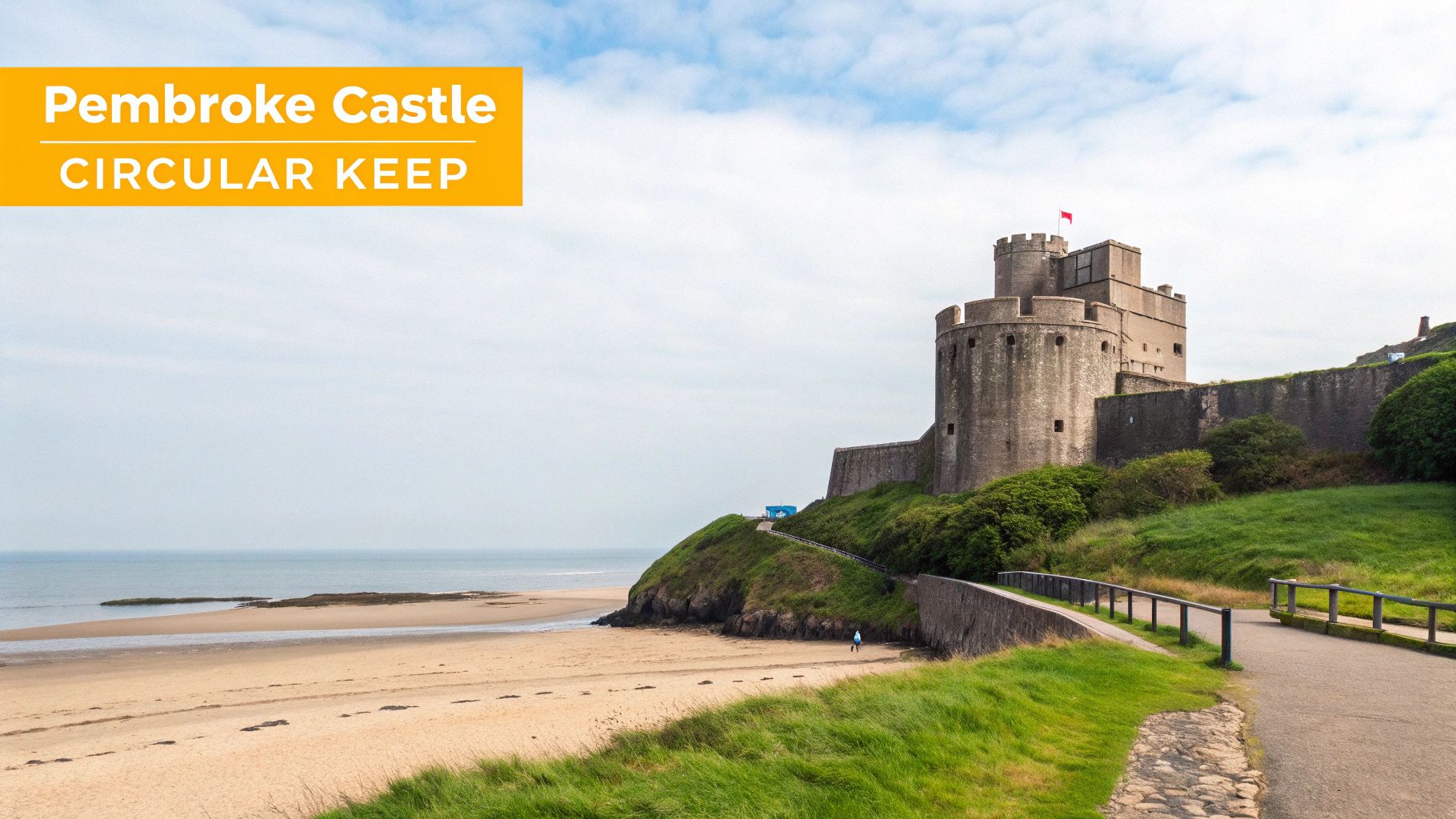
Pembroke’s most defining feature is its massive, circular Great Keep. Standing 23 metres high with walls up to six metres thick at its base, it is a masterpiece of Norman military engineering and remains remarkably intact. The castle's layout perfectly illustrates how Norman lords adapted their defences to the natural geography, creating a fortress that was both a formidable military base and a powerful symbol of their authority in West Wales.
Why It's a Must-See
Pembroke Castle offers a profound connection to the Tudor dynasty's origins. Standing in the room where Henry VII was born is a truly special experience. The castle is exceptionally well-preserved, allowing you to fully appreciate the scale and complexity of a major Norman fortress. From exploring the labyrinthine passageways to discovering Wogan's Cavern, a vast natural cave beneath the castle, Pembroke provides a rich and layered historical adventure.
Your Visit Planner
- Time on Site: Allow a good 2 to 2.5 hours to explore the entire site, including the keep, walls, and exhibition rooms.
- Best Photography: The views from the top of the Great Keep are unparalleled on a clear day, offering panoramic vistas of the town and estuary. For shots of the castle itself, the opposite bank of the Pembroke River provides a classic, stunning perspective.
- Top Tip: Book the audio guide upon entry. It provides fascinating narratives and deeper historical context that bring the castle's epic story and its famous inhabitants to life.
- Crowd Control: As a popular destination, Pembroke can get busy, especially during school holidays. Visiting on a weekday in the spring or autumn ensures a more relaxed experience and better light for photography.
- Good to Know: The castle is privately owned and managed. Paid parking is available a short walk from the entrance. The site hosts numerous events, so check their calendar before you go. Combine your visit with an exploration of Pembroke's medieval town walls and priory to complete your historical journey.
This Pembrokeshire gem is an essential stop, and its accessibility makes it a highlight for those exploring Britain by rail and local transport. For inspiration on planning your journey, you can explore UK-wide heritage itineraries.
4. Carew Castle
Discover the enchanting beauty of Carew Castle, a magnificent fortress that tells a story spanning over 2,000 years. Set in a breathtaking landscape beside a tidal mill pond, Carew stands as a powerful testament to the evolution of the great Norman castles in Wales. Established around 1110, it was transformed over the centuries from a Norman stronghold into a grand Elizabethan mansion, showcasing a unique blend of military might and domestic splendour.

This picturesque castle is more than just stone and mortar; it's a historic hub that includes a restored tidal mill, a medieval bridge, and a striking 11th-century Celtic cross. Its complex architectural story and stunning setting make it a favourite for photographers and heritage enthusiasts alike, perfectly illustrating the intersection of Norman power and deep-rooted Welsh culture.
Why It's a Must-See
Carew Castle offers a rare opportunity to witness architectural evolution in one location, from stark Norman defences to ornate Tudor windows. Its scenic location on the 23-acre mill pond provides some of the most beautiful castle reflections in Britain. The site’s historical layers, including the ancient high cross and the only restored tidal mill in Wales, create a rich and immersive experience that connects you to centuries of Pembrokeshire life.
Your Visit Planner
- Time on Site: Allow at least 2 hours to explore the castle ruins, the tidal mill, the bridge, and the Celtic cross.
- Best Photography: Visit during high tide when the mill pond is full to capture the iconic reflection of the castle on the water's surface.
- Top Tip: Pick up a landscape interpretation guide at the entrance. It provides fantastic context for understanding how the castle, mill, and surrounding environment are interconnected.
- Crowd Control: While popular, the site is large enough to absorb visitors. For a quieter visit, arrive early on a weekday morning.
- Good to Know: The castle is managed by the Pembrokeshire Coast National Park Authority. Combine your visit with the scenic waterside walk around the pond for the complete experience. The interpretive programme is most active in spring and summer.
Carew is a highlight of any Pembrokeshire road trip, often included in multi-castle day tours with Pembroke and Manorbier. You can easily build it into a larger journey by checking out these popular self-drive tours in Wales.
5. Cardigan Castle
Discover the story of conquest and cultural rebirth at Cardigan Castle, a key stronghold among the Norman castles in Wales. Founded around 1093 by the Norman lord Roger de Montgomery, this fortress occupies a commanding position overlooking the River Teifi estuary. While not a colossal stone giant like some of its contemporaries, Cardigan was a critical strategic base for controlling the rich river valley, a vital artery for inland trade and military campaigns.
The castle's history is a dramatic saga of capture and recapture between Norman lords and Welsh princes, most notably Lord Rhys, who famously held a grand cultural gathering here in 1176, often cited as the first ever Eisteddfod. Following centuries of decline, an award-winning restoration project has transformed the site into a vibrant heritage destination. It now offers a unique window into the complex and often turbulent relationship between the Welsh and their Norman conquerors.
Why It's a Must-See
Cardigan Castle offers a compelling narrative of resilience and cultural identity, moving beyond just military history. Its meticulously restored grounds and state-of-the-art interpretive centre bring the Norman-Welsh power struggles to life in an immersive way. The site beautifully blends ancient walls with contemporary gardens and facilities, making the story of this pivotal location accessible and engaging for all visitors. It’s a testament to how historic sites can be reborn for the modern age.
Your Visit Planner
- Time on Site: Allow around 1.5 to 2 hours to explore the castle grounds, museum, and restored Georgian house.
- Best Photography: Capture the castle’s profile from the opposite bank of the River Teifi or photograph the restored gardens from the top of the ramparts for a beautiful blend of history and nature.
- Top Tip: Fully engage with the interactive exhibits in the heritage centre before you explore the grounds. They provide essential context that enriches the entire experience.
- Crowd Control: As a popular West Wales attraction, it can be busy during summer holidays. A morning visit on a weekday often provides a more relaxed atmosphere.
- Good to Know: The castle is managed by a community-based non-profit trust. It features an excellent on-site restaurant and unique accommodation options within the castle walls. Combine your visit with a walk through the charming town of Cardigan and along the Teifi estuary to appreciate its strategic importance.
Cardigan Castle is an essential stop on any West Wales itinerary, perfectly paired with coastal explorations. Discover how it fits into a broader regional journey with these curated Welsh castle tours.
6. Kidwelly Castle
Discover the commanding presence of Kidwelly Castle, a magnificent semi-circular fortress that stands as one of the finest Norman castles in Wales. Overlooking the River Gwendraeth, its story begins around 1106 with Bishop Roger of Salisbury, but the formidable stone structure we see today was largely the creation of the powerful Chaworth family in the 13th century. It is a masterclass in adapting concentric castle design to the natural landscape.
Unlike the perfect symmetry of Caerphilly, Kidwelly’s "walls within walls" design is brilliantly moulded to its riverside bluff. This created a formidable semi-circular defence, with an immensely strong inner ward protected by a lower, but equally robust, outer circuit. The towering great gatehouse, a near-impregnable fortress in its own right, guards the entrance, showcasing the pinnacle of medieval military sophistication. The castle's substantial remains offer an incredible insight into the evolution of defensive strategy.
Why It's a Must-See
Kidwelly Castle provides a textbook example of concentric fortification ingeniously tailored to its environment. Its remarkably well-preserved state allows visitors to clearly trace the layers of its construction and understand the strategic thinking behind its design. The contrast between the powerful inner ward and the sweeping outer defences makes it a truly fascinating site to explore, offering a tangible connection to the centuries of conflict that defined this region of Wales.
Your Visit Planner
- Time on Site: Allow at least 2 to 2.5 hours to thoroughly explore the inner and outer wards, towers, and the impressive gatehouse.
- Best Photography: The view from across the River Gwendraeth is spectacular, especially in the late afternoon sun. The top of the great gatehouse offers panoramic views of the surrounding countryside.
- Top Tip: Combine your visit with a trip to the nearby picturesque village of Ferryside for stunning estuary views, completing a perfect day out in Carmarthenshire.
- Crowd Control: While popular, Kidwelly rarely feels overcrowded. A mid-week visit, especially during the spring or summer when interpretive programmes are often active, provides an enhanced experience.
- Good to Know: Managed by Cadw, the castle has good facilities and a small gift shop. Collect the interpretive materials on arrival to fully grasp the principles of its unique concentric design. Sturdy footwear is recommended for climbing the towers and walking the ramparts.
Kidwelly is a key stop on many historical itineraries, such as the South Wales industrial heritage tours that blend medieval fortresses with the region's rich metalworking history.
7. Tenby Castle
Discover a unique example of urban fortification at Tenby Castle, where medieval defences are seamlessly woven into the fabric of a stunning seaside town. Unlike the isolated rural strongholds often found among Norman castles in Wales, Tenby was established in the 13th century as an integrated part of a fortified coastal settlement. Its purpose was to control a strategic harbour and protect the Anglo-Norman colony within its walls.
Although today the castle itself consists of picturesque ruins crowning a headland, its true significance is revealed when viewed in context with the remarkably well-preserved medieval town walls. The castle and the town were a single defensive system, a testament to the Norman strategy of securing key economic and maritime hubs. The remaining gatehouse and fragments of the keep stand guard over the harbour, offering a glimpse into its past as a vital link in the Norman coastal network.
Why It's a Must-See
Tenby Castle offers a different perspective on Norman power, showcasing urban and commercial control rather than purely military dominance. The experience is about more than just the castle ruins; it’s about exploring an entire medieval fortified town. The panoramic views from Castle Hill, looking out over the colourful harbour and vast Carmarthen Bay, are simply breathtaking and provide a clear understanding of its strategic coastal position. It's the perfect blend of history, heritage, and classic British seaside charm.
Your Visit Planner
- Time on Site: Plan for 1 to 1.5 hours, which allows for exploring the castle ruins (30-45 mins) and a stroll along the adjacent town walls.
- Best Photography: Capture the castle ruins from the harbour below at high tide for a classic shot. For sweeping coastal views, climb to the top of Castle Hill just before sunset.
- Top Tip: Combine your castle visit with the Tenby Museum and Art Gallery, located on Castle Hill, to gain deeper insights into the town's rich maritime and social history.
- Crowd Control: Tenby is an extremely popular holiday destination. Visit on a weekday outside of the peak summer months (July-August) to enjoy the castle and town with far fewer crowds.
- Good to Know: The castle grounds are freely accessible. Be sure to pick up a town guide to follow the complete circuit of the medieval walls and understand the urban defensive system. Sturdy footwear is recommended for the uneven paths on Castle Hill.
Tenby is a highlight of any Pembrokeshire coastal itinerary and serves as an excellent base for exploring the region. You can integrate it into a multi-castle tour with Pembroke and Carew by checking out these curated Welsh castle tours.
8. Manorbier Castle
Discover one of the most picturesque and historically significant Norman castles in Wales at Manorbier, a beautifully preserved fortress nestled in a serene coastal valley. Founded in the early 12th century by the Anglo-Norman de Barri family, this castle is celebrated not just for its military architecture but for its profound literary connection as the birthplace of the renowned medieval scholar and historian, Gerald of Wales (Giraldus Cambrensis).
Manorbier's charm lies in its remarkable state of preservation and the sense of stepping back in time. Unlike many of its ruined contemporaries, the castle retains a feeling of habitation, with its chapel, gatehouse, and domestic ranges largely intact. Its idyllic setting, overlooking a secluded sandy cove, moved Gerald to describe it as "the pleasantest spot in Wales," a sentiment that still rings true for visitors today. It offers a unique blend of Norman fortitude and domestic medieval life.
Why It's a Must-See
Manorbier Castle provides a rare and intimate glimpse into the life of a Norman knightly family. Its manageable scale allows you to appreciate the details of its construction, from the defensive curtain walls to the private living quarters. The connection to Gerald of Wales makes it a pilgrimage site for literary and history enthusiasts, offering a tangible link to one of the most important chroniclers of the medieval world. The stunning coastal views and adjacent beach complete an unforgettable experience.
Your Visit Planner
- Time on Site: Plan for 1.5 to 2 hours to explore the castle, its grounds, and absorb the history.
- Best Photography: Capture the castle framed by the valley from the coastal path above, or head down to the beach at low tide for dramatic shots looking up at its battlements.
- Top Tip: Combine your visit with the nearby Manorbier village church, where Gerald's father and grandfather are buried, to deepen your connection to the de Barri family story.
- Crowd Control: The castle's more intimate setting is best enjoyed during the shoulder seasons (spring and autumn) or on a weekday morning to avoid the peak summer crowds.
- Good to Know: Manorbier is privately owned but open to the public. Parking is available in the village, a short walk away. The paths can be uneven, so sturdy footwear is recommended. Pick up the interpretation materials to learn more about the de Barri family history and Gerald’s writings.
Manorbier is a key stop on the 'Pembrokeshire Castle Trail' and features prominently in itineraries focusing on literary heritage. To weave it into a broader exploration, consider these curated Welsh castle tours.
8-Site Comparison: Norman Castles in Wales
| Castle | Site complexity (terrain & visit time) | Visitor resources (access & facilities) | Visitor experience (expected outcomes) | Ideal use cases | Key advantages |
|---|---|---|---|---|---|
| Caerphilly Castle | Large 30‑acre concentric site; uneven terrain; 2–3 hrs to explore | Good visitor centre, car park; 9 miles from Cardiff; limited dining | Well‑preserved dramatic ruins, strong photographic opportunities, interpretive displays | Multi‑day Welsh castle tours, photography, day trips from Cardiff | Concentric design, extensive water defences, iconic leaning tower |
| Chepstow Castle | Compact but steep clifftop site; 1–2 hrs | Small museum; limited town parking; riverside access | Early Norman stone keep, strong historical significance, scenic Wye Valley views | Border touring routes, riverside walks, short historical stops | One of Britain’s oldest stone keeps; dramatic clifftop position |
| Pembroke Castle | Compact peninsula fortress; climbable circular keep; 1.5–2.5 hrs | Museum and audio guides; family events; limited parking | Exceptional preservation, royal birthplace, panoramic coastal views | Family visits, coastal touring, panoramic keep climbs | Iconic circular keep; birthplace of Henry VII; very well preserved |
| Carew Castle | Multi‑period 30‑acre site with tidal features; ~2 hrs | Rural self‑drive access; limited on‑site facilities; strong interpretation | Layered architectural history, picturesque mill‑pond reflections | Quiet heritage landscape tours, photography, multi‑castle days | Multi‑period evolution, mill pond setting, peaceful less‑crowded site |
| Cardigan Castle | Restored interiors in riverside town; intimate spaces; ~1.5 hrs | Modern interpretation centre and interactive museum; limited catering | Immersive restored rooms, hands‑on exhibits, integrated town exploration | River valley touring, intimate museum visits, family exploration | Recent comprehensive restoration; strong interpretation and town integration |
| Kidwelly Castle | Large concentric site (~20 acres); open terrain; 2–2.5 hrs | Good interpretation panels; family facilities; accessible via main routes | Clear demonstration of medieval defensive systems, well‑preserved walls | Educational groups, defensive‑architecture study tours, photography | Excellent concentric design examples and impressive gatehouse |
| Tenby Castle | Fragmentary urban ruins; short visit (30–45 mins) within medieval town | Excellent surrounding town facilities (shops, restaurants); limited castle parking | Coastal views and town heritage combination; limited interior exploration | Beach + heritage day trips, short urban castle stops | Integrated urban fortification context and panoramic harbour views |
| Manorbier Castle | Small coastal‑valley site; inhabited ranges; 1.5–2 hrs | On‑site interpretation and museum; adjacent village facilities; seasonal access | Authentic inhabited interiors, literary/historical connections, intimate atmosphere | Literary/cultural tours, intimate heritage visits, photography | Well‑preserved inhabited rooms; birthplace of Gerald of Wales; picturesque valley setting |
Planning Your Epic Welsh Castle Itinerary
Your journey through the Norman castles in Wales is more than a simple sightseeing trip; it is a profound step back in time. From the formidable water defences of Caerphilly to the cliff-edge majesty of Chepstow, each fortress tells a story of ambition, conflict, and extraordinary engineering. The stones of Pembroke Castle whisper tales of the birth of a royal dynasty, while the romantic ruins of Manorbier, overlooking a secluded bay, offer a moment of quiet reflection on centuries of history.
This curated exploration has showcased not just architectural marvels but the very soul of medieval Wales. The Norman conquest was not a single event but a long, brutal, and transformative process. These castles are its physical legacy, iron-hard symbols of power that have since been softened by time, reclaimed by nature, and embraced by the Welsh nation as treasured monuments. They are the settings for legendary battles, political intrigue, and the daily lives of lords and soldiers who shaped the destiny of this land.
Weaving Your Own Welsh Saga
The true magic of exploring the Norman castles in Wales lies in the freedom of the open road. A self-drive tour allows you to connect these historical dots at your own pace, creating a narrative that is uniquely yours. You can linger an extra hour at Kidwelly to capture the perfect golden-hour photograph or take a spontaneous detour to a coastal path you spotted near Tenby.
To help you visualise your adventure, consider these focused itineraries:
- The Pembrokeshire Power Loop: Dedicate three to four days to immerse yourself in the coastal strongholds of Pembrokeshire. Start with the grandeur of Pembroke Castle, then explore the tidal beauty of Carew, the fortified town of Tenby, and the picturesque setting of Manorbier. This route is a masterclass in coastal defence and offers some of Wales’s most stunning scenery.
- The Marcher Lords’ Frontier: For those fascinated by the frontline of the conquest, a journey connecting Chepstow, Caerphilly, and Kidwelly is essential. This route traces the evolution of castle design from early Norman keeps to the most advanced concentric layouts, demonstrating how military architecture adapted to new threats and technologies.
- The Complete Conquest Trail: Ambitious travellers with a week or more can link all these sites, creating an unforgettable road trip. Start in the southeast at Chepstow, arc west through Caerphilly and Kidwelly, and then spend a few days exploring the Pembrokeshire coast before finishing at Cardigan. This epic journey provides a comprehensive overview of the Norman impact on Wales.
Practical Tips for a Flawless Journey
Crafting the perfect castle tour involves more than just a map. Remember to book tickets online in advance, especially during peak season, to save time and secure your entry. Utilise the Cadw Explorer Pass if you plan to visit multiple sites managed by the Welsh historic environment service, as it offers excellent value. For more general advice on itineraries and accommodation, you could also consult the FlipMyStay blog for travel tips, which offers a wealth of information for independent travellers.
The greatest takeaway from this guide is the realisation that these castles are not static relics. They are dynamic landscapes of discovery, offering new perspectives with every visit, in every season. They are gateways to understanding the complex, intertwined history of England and Wales and a testament to the enduring power of stone and story. Now, the open road awaits, and the ancient heart of Wales is ready to be explored.
Ready to turn your dream Welsh castle tour into a reality without the stress of planning? The experts at BTOURS specialise in crafting bespoke self-drive itineraries that include all these iconic Norman castles, hand-picked accommodations, and exclusive local experiences. Let BTOURS handle the details so you can focus on making memories among the timeless fortresses of Wales.