A good, detailed map of the Peloponnese isn't just a piece of paper or a screen; it's the very first step in crafting an adventure you'll never forget. It’s what takes your daydreams and turns them into a real, tangible journey, revealing the winding roads, ancient ruins, and breathtaking coastlines that make this Greek peninsula so legendary.
Why Your Peloponnese Adventure Starts with a Map
Imagine tracing the footsteps of Spartan warriors or ancient Olympians across a land so steeped in history that the myths feel alive. That incredible journey doesn’t start when your plane touches down. It begins the moment you unfold the right map.
A truly great map is your key to unlocking the very soul of the Peloponnese, transforming a standard holiday into a genuine expedition.
This guide is here to show you how to turn that simple chart into the blueprint for an unforgettable story. When you truly understand the lay of the land—from the jagged peaks of Arcadia to the sun-kissed shores of Messenia—your entire experience is elevated. Your map becomes more than just a navigator; it becomes a compass, pointing you towards hidden temples, tiny villages, and sweeping vistas that a digital screen can only ever hint at.
Setting the Stage for Your Journey
Think of planning your trip as building a personalised guidebook for your own epic quest. Getting the details right beforehand makes the experience seamless and powerful. In the same way a host might create a perfect welcome guide to anticipate a visitor's every need, your map helps you anticipate the journey ahead.
A well-chosen map empowers you to:
- Visualise your route: You can actually see the ribbon of road connecting ancient Olympia to the bustling port of Kalamata.
- Discover hidden gems: It’s how you’ll spot those small villages and secluded coves that GPS algorithms often ignore.
- Travel with confidence: You can navigate through areas with patchy mobile signal without a hint of stress.
A map is the greatest of all epic poems. Its lines and colours show the realisation of great dreams.
This guide will set the stage by introducing the different kinds of maps that can steer your adventure. Whether you're embarking on one of the incredible self-drive tours across Greece or blazing a trail all your own, we'll make sure you choose the perfect companion for the epic road that lies ahead.
Exploring the Seven Regions of the Peloponnese
The Peloponnese isn’t just one place; it’s a breathtaking mosaic of seven distinct regions, each with its own soul, scenery, and story. To truly get a feel for a map of the Peloponnese, you first have to appreciate this rich tapestry, where a short drive can take you from the grounds of an ancient battle to the shade of a serene olive grove.
Thinking of the peninsula as a single destination is like looking at a library and seeing only one book. It’s far better to imagine it as seven unique chapters, each waiting to be read. This simple shift in perspective will transform your travel planning, helping you group destinations logically and really immerse yourself in the unique character of each area.
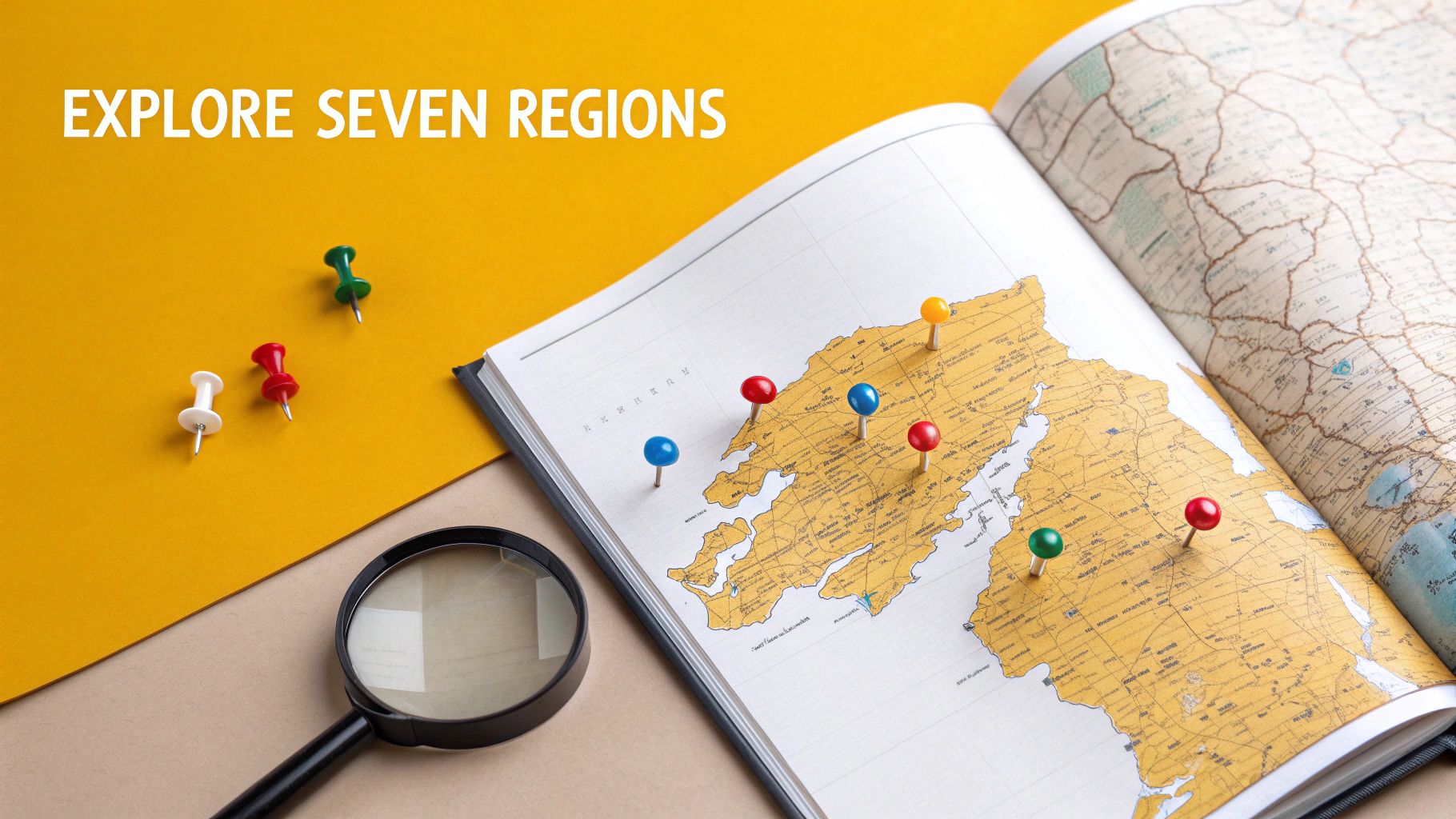
To help you get your bearings, here's a quick look at what makes each of the seven regions so special.
A Snapshot of the Peloponnese Regions
| Regional Unit | Main City / Hub | Key Attractions | Landscape Vibe |
|---|---|---|---|
| Achaea | Patras | Ancient Patras, Rio-Antirrio Bridge, Kalavryta | Coastal gateway, mountainous interior |
| Corinthia | Corinth | Ancient Corinth, Acrocorinth, Corinth Canal | Historic crossroads, vineyard hills |
| Argolis | Nafplio | Mycenae, Epidaurus, Tiryns, Nafplio Old Town | The heart of ancient Greek myths |
| Arcadia | Tripoli | Lousios Gorge, Stemnitsa & Dimitsana villages | Wild, untamed mountains and gorges |
| Laconia | Sparta | Mystras, Mani Peninsula, Monemvasia | Austere, dramatic, Spartan spirit |
| Messenia | Kalamata | Voidokilia Beach, Pylos, Methoni Castle | Fertile olive groves, golden coasts |
| Elis | Pyrgos | Ancient Olympia, Temple of Apollo Epicurius | Birthplace of legends, rolling hills |
This table is just a starting point, of course. Each region holds countless hidden gems just waiting for you to find them on your map.
A Journey Through Ancient Lands
Each of these regional units tells a vital part of Greece's epic story. As you travel from the northern shores down to the southern tips, the peninsula unfolds with an almost cinematic variety.
- Achaea & Corinthia: Think of these as the northern gateways, connecting the Peloponnese to the rest of mainland Greece. Achaea is home to the bustling port city of Patras, while Corinthia guards the world-famous canal and the mighty ruins of Ancient Corinth.
- Argolis: Often called the heart of Mycenaean Greece, this is where legends come alive. You'll find the lion-guarded fortress of Mycenae, the acoustically perfect theatre of Epidaurus, and the impossibly charming seaside town of Nafplio.
- Arcadia: This is the wild soul of the Peloponnese. The rugged, mountainous interior, with its stone villages tucked into deep gorges like the Lousios Gorge, offers a glimpse into a timeless, untamed Greece that feels worlds away from the coast.
From Spartan Plains to Olympic Fields
The southern and western regions complete the picture, each adding its own unforgettable flavour. Understanding how they connect geographically and historically makes planning a route so much more rewarding. For inspiration, our classic 8-day self-drive tour of Greece offers a fantastic blueprint for linking these iconic sites into one seamless adventure.
The Peloponnese isn’t just a place on a map; it is a living museum, where every hill and valley whispers tales of heroes, gods, and empires.
- Laconia: Welcome to the legendary homeland of the Spartans, a land dominated by the formidable Taygetos Mountains. Here you'll find the haunting ghost city of Mystras and the dramatic, tower-house-studded landscapes of the Mani Peninsula.
- Messenia: A land blessed with fertile olive groves and stunning golden beaches. Its coast is dotted with proud Venetian castles, and it boasts one of Greece's most beautiful and iconic bays at Voidokilia.
- Elis: This is where it all began—the birthplace of the Olympic Games. The sacred site of Ancient Olympia in the west remains one of the most powerful and evocative archaeological sites in the entire world.
Together, these seven regional units make up a landmass of over 15,503 km². Yet with a population density of just 34.80 people per km², you quickly realise how much vast, open landscape is out there, just waiting for you to explore. For those curious about the deeper story, you can learn more about the demographics and history of the Peloponnese.
Choosing the Right Map for Your Travel Style
What’s the perfect map of the Peloponnese? It’s the one that speaks your language of adventure. This isn’t about finding a single ‘best’ map, but about picking the right tool for the job—a choice that reflects the very spirit of your journey.
Are you dreaming of a sun-drenched road trip along the coast? A challenging trek across ancient mountain paths? Or perhaps a historical pilgrimage, tracing the footsteps of Spartan warriors? Your answer is the key to finding your ideal cartographic companion. Think of it as building a navigational toolkit, combining different map types so you’re ready for anything—from the charmingly narrow streets of Nafplio to a secluded beach that’s nowhere on the tourist radar.
Digital Convenience Meets Analogue Reliability
It’s tempting to just rely on Google Maps, and for good reason. In cities and on major motorways, digital apps are brilliant for real-time traffic and a dynamic view of the road ahead. But the Peloponnese is a land of wild, beautiful spaces where a mobile signal can be as elusive as an ancient myth.
Trusting only a digital map in the remote mountains of Arcadia or the rugged Mani Peninsula is a gamble. A physical map needs no signal, no battery, and will never lead you down an impassable farm track it mistakenly labels a 'shortcut'.
The smartest travellers use a hybrid approach. Lean on your phone for convenience when you have a signal, but always, always have a high-quality physical map tucked away as your steadfast, reliable backup.
Matching the Map to Your Mission
Different adventures demand different details. Knowing what you want to do is the first step in selecting a map that will truly enhance your experience. The various travel styles you might be drawn to will point you towards the perfect map for your Peloponnese journey.
Here’s a quick guide to choosing the right type:
- For the Road Tripper: A detailed road atlas is your best friend. Look for a scale around 1:200,000, which hits that sweet spot between showing the broader landscape and highlighting scenic routes, petrol stations, and tiny villages worth a detour.
- For the Intrepid Hiker: You absolutely need a topographic map. These specialised charts reveal the land's contours, showing you the steepness of trails, elevations, and crucial features like rivers and springs. Brands like Anavasi produce exceptional hiking maps for specific areas, like the famous Menalon Trail.
- For the History Buff: This is where a thematic map comes alive. These fascinating guides overlay historical information onto the modern landscape. Imagine having maps that detail ancient Mycenaean sites, Venetian fortresses, or even the old wine routes of Nemea. They add a rich, deep layer of context to everything you see.
Ultimately, your map is more than just a guide; it’s a promise of the discoveries that lie ahead. Choosing wisely ensures that promise is fulfilled, turning your trip into a seamless and deeply personal adventure.
How to Read Your Peloponnese Map Like a Pro
A good map isn’t just a tool; it's a language. And once you can speak it fluently, the whole of the Peloponnese opens up to you. With a physical map of the Peloponnese spread out before you, you can confidently wander into the wild, stunning corners of the peninsula, far beyond the reach of a fickle mobile signal. This is about more than just navigation—it’s about envisioning the adventure before you even turn the key.
The real magic happens when you look past the obvious symbols in the legend. The true story of the landscape is written in the subtle lines and numbers that define every hill, valley, and coastal road. Learning to interpret these turns a flat sheet of paper into a three-dimensional preview of the journey ahead.
From Kilometres to Real-World Timing
Don't be fooled by distance on the winding roads of the Peloponnese. A 50-kilometre stretch that seems like a quick jaunt on paper can easily stretch into an hour or more behind the wheel. This is where a proper map truly shines, revealing the tight switchbacks, steep gradients, and sleepy villages that a GPS often underestimates.
Here’s a simple rule of thumb I’ve learned over years of driving these roads: add 30% to any GPS-estimated driving time for routes that aren't on the main motorways. This builds in a realistic buffer, giving you the freedom to drive at a comfortable pace, pull over for that unexpected photo opportunity, and simply enjoy the ride without feeling rushed.
Take the drive from Sparta to Kalamata via the Langada Pass, for instance. It's an absolutely spectacular route, but it's demanding. Your map will show you the challenging terrain, helping you plan for a journey of genuine discovery, not just a way to get from A to B.
Decoding the Landscape for Hikers
If you're planning to swap the car for hiking boots, the most crucial element on your map becomes the contour lines. Think of these thin, wavy lines as your personal guide to the terrain’s steepness. They tell you everything you need to know about the effort required.
- Lines close together: Brace yourself! This signals a very steep incline or decline.
- Lines far apart: Easy does it. This means the ground is gentle, flat, or gradually sloping—perfect for a relaxed walk.
By tracing the contour lines on a topographic map with your finger, you can almost feel the trail’s difficulty before taking a single step. It’s like having an old-timer whispering in your ear, pointing out the lung-busting climbs and the welcome, gentle stretches.
To get started, this little chart breaks down the first big decision: picking the right map for what you actually plan to do.
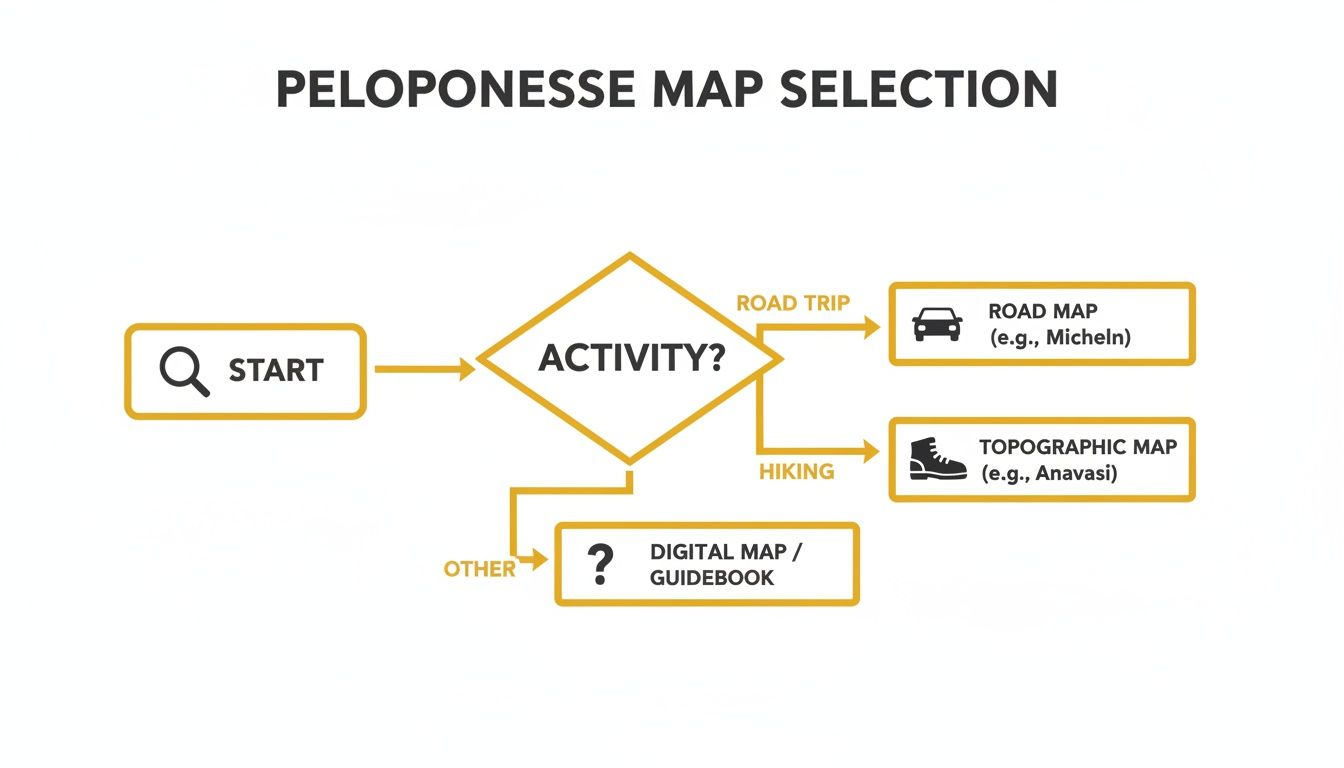
It all comes down to your adventure. This simple guide helps point road-trippers and mountain hikers toward the map that will serve them best.
Designing Your Ultimate Peloponnese Road Trip
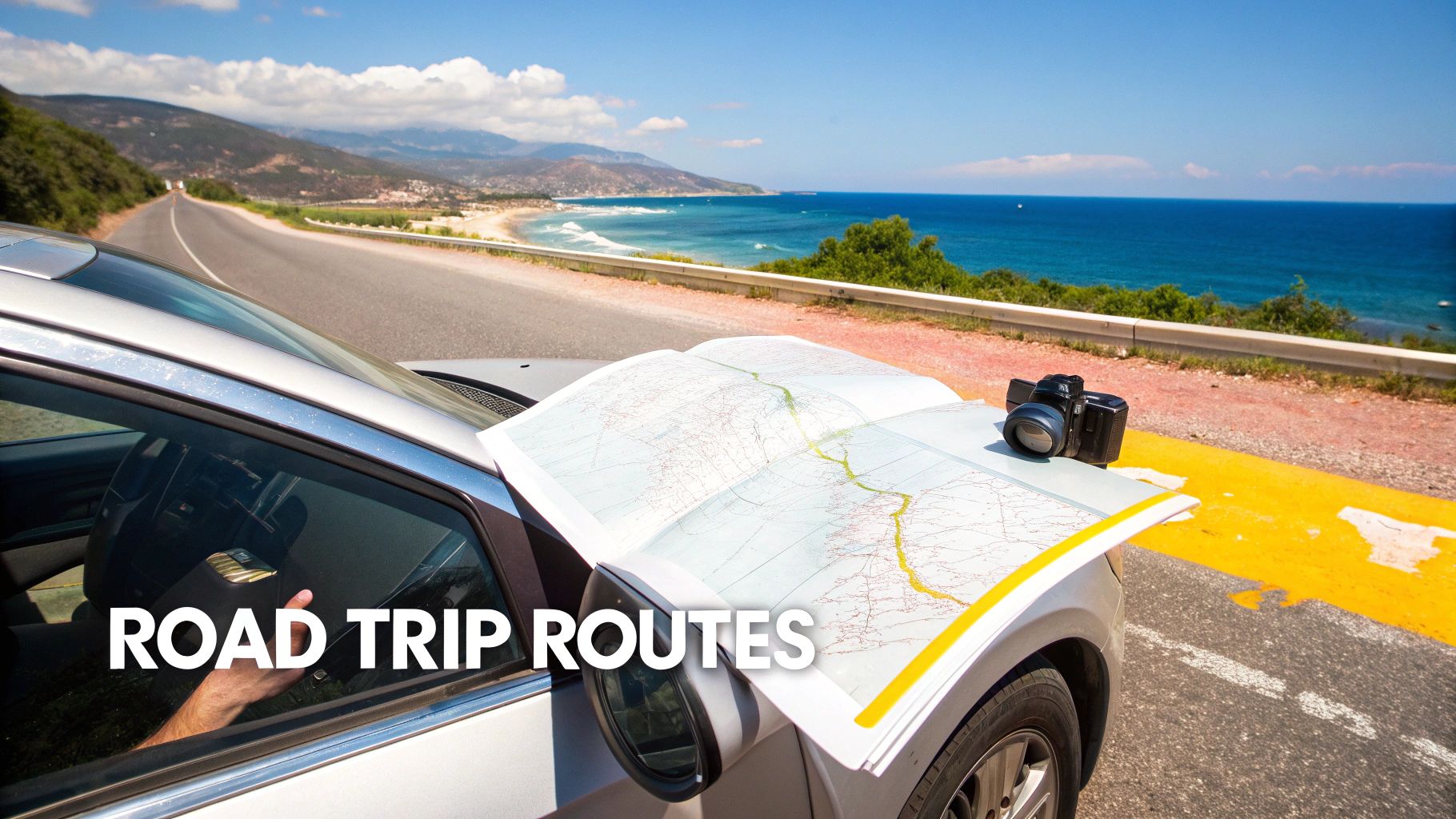
This is it. This is the moment where all the planning pays off and your adventure truly begins. With a map of the Peloponnese spread out before you, those abstract lines and names suddenly come alive, whispering promises of winding coastal roads, legendary ruins, and sleepy mountain villages. Your map isn't just a tool; it's the blueprint for the story you’re about to write on the open road.
To get your imagination fired up, we’ve put together three distinct, field-tested itineraries. Don’t think of them as rigid schedules. Think of them as epic starting points for your own journey. Each one is designed to show off a different side of this incredible peninsula, proving that no matter what kind of traveller you are, there’s a perfect Peloponnese road trip waiting for you.
The Classical Heartland: A Journey Through Myths
This route is a pure pilgrimage for the history lover, taking you straight through the heart of ancient Greek civilisation. It’s a journey that feels like stepping directly into the pages of a mythology book.
- Duration: 4-5 Days
- Focus: Archaeology, History, Culture
- Key Stops: Kick things off in Nafplio, the impossibly charming first capital of modern Greece. From there, you’ll head to the mighty citadel of Mycenae and the acoustically perfect theatre of Epidaurus. The path then leads west to the very birthplace of the Olympic Games, Ancient Olympia, before looping back through the rugged mountains of Arcadia.
This itinerary is a massive hit with UK travellers, and for good reason. In 2019 alone, around 392,000 UK visitors came to the Peloponnese, drawn by the undeniable pull of its history. With sites like Mycenae attracting 250,000 UK visitors and Olympia hosting 180,000 annually, you’ll be following a path celebrated by generations of explorers.
Coastal Castles and Hidden Coves
If your heart belongs to the sea, this is the adventure for you. This itinerary traces the dramatic shorelines of Messenia and Laconia, where Venetian fortresses stand guard over turquoise waters and the fiercely independent spirit of the Mani Peninsula endures.
- Duration: 5-7 Days
- Focus: Scenery, Relaxation, Coastal Exploration
- Key Stops: Start in Kalamata, a city famous for its olives. From there, drive south to the stunning castles of Methoni and Koroni, then venture into the wild, tower-house-studded landscape of the Mani. Your journey reaches its peak at the breathtaking rock fortress of Monemvasia, a living medieval town carved from stone.
This route is a true testament to the freedom of the open road. It’s all about discovering that perfect, unnamed cove for a swim and letting the rhythm of the waves set your pace.
Arcadia’s Mountain Soul: An Untamed Escape
For those who hear the call of the wild, this journey plunges deep into the rugged, untamed interior of the Peloponnese. This is a trip for the soul, leading you through deep gorges, ancient monasteries clinging to cliffs, and stone villages where time seems to have stood still.
Beyond just maps, getting advice from seasoned travellers can add so much to your planning. It’s well worth exploring some of the best travel blogs for a bit of extra inspiration.
- Duration: 3-4 Days
- Focus: Nature, Hiking, Authentic Village Life
- Key Stops: Base yourself in the gorgeous villages of Dimitsana or Stemnitsa. Hike a section of the Menalon Trail through the Lousios Gorge, visiting the historic Prodromos Monastery built into the cliffside. It's a chance to discover the quiet beauty of mountain life and breathe the crisp, clean air of Arcadia’s forests.
Of course, these routes are just the beginning. The real magic of a road trip is found in the detours, the spontaneous stops, and the personal discoveries you make along the way. For more ideas on how to craft your perfect journey, take a look at our curated self-drive tours, designed to give you the ultimate freedom to explore at your own pace.
Your Peloponnese Map Questions Answered
Exploring a new country always throws a few curveballs your way. Even with the perfect map of the Peloponnese tucked in your bag, you’re bound to have some practical questions pop up. So, let’s clear the air and tackle the most common queries we get from travellers.
Think of this as your pre-flight briefing. We'll make sure you have the real-world know-how to hit the road with complete confidence, ready to explore this stunningly diverse peninsula.
Can I Get By with Just Google Maps in the Peloponnese?
It’s tempting, isn’t it? But relying solely on your phone is a gamble I wouldn't take. While digital maps are brilliant for zipping around cities like Kalamata or cruising down major motorways, they can lead you astray in the wilder parts of the Peloponnese. Head into the mountains of Arcadia or the remote Mani Peninsula, and you’ll quickly find that mobile signal is a luxury, not a guarantee.
What’s more, I’ve seen GPS algorithms try to send people down some truly questionable dirt tracks masquerading as "shortcuts." These routes are often completely unsuitable for a standard rental car and can turn a scenic drive into a white-knuckle ordeal.
The best strategy? Go hybrid. Use Google Maps for its live traffic updates where there's signal, but always, always have a high-quality physical road map in the car as your foolproof backup. And before you even leave your hotel, download the entire region for offline use on your phone. It’s a non-negotiable for a stress-free journey.
What's the Best Physical Road Map to Buy?
When it comes to paper maps, my advice is simple: trust the locals. Greek publishers know this terrain like the back of their hand. The two names you need to know are Anavasi and Terrain Maps—they’re the gold standard, trusted by Greeks and seasoned travellers alike.
- Anavasi: These guys are artists. Their maps are renowned for their cartographic clarity, beautiful design, and a knack for highlighting scenic backroads you’d never find otherwise.
- Terrain Maps: Just as detailed, but often printed on durable, waterproof paper. They’re the perfect rugged companion for any adventure, ready for anything from a spilt coffee to a sudden downpour.
For general driving, look for a map with a scale between 1:150,000 and 1:250,000. This gives you that sweet spot of a broad regional overview combined with enough detail to navigate the charming little villages and country lanes. You can easily find them online before your trip or pick one up in a good bookshop in Athens.
How Accurate Are the GPS Driving Time Estimates?
Take any driving time you see on a screen with a healthy pinch of salt. Those estimates are often wildly optimistic. They’re usually spot-on for the modern motorways, but they just don’t grasp the reality of the Peloponnese’s regional road network. We're talking about narrow lanes that wind through countless villages with slow speed limits, and switchbacks that climb steep mountain passes.
Here’s a simple rule of thumb I live by: add at least 25-30% to any GPS-estimated travel time for journeys on smaller roads. This one little tweak will transform your schedule from a frantic race into a relaxed, enjoyable drive.
This buffer isn’t just about being realistic; it's about embracing the magic of the journey. It gives you the freedom to pull over for that jaw-dropping photo, explore a village that catches your eye, or just sit for a moment and soak in the incredible view.
Are There Special Maps for Hiking Trails?
Absolutely, and if you plan on doing any serious walking, they are essential. A road map just won't cut it. To navigate a trail safely, you need a proper topographic hiking map, and in Greece, Anavasi is the undisputed champion.
They produce incredibly detailed maps for specific trails and mountain regions, including a fantastic one for the famous Menalon Trail in Arcadia. These maps, usually at a super-detailed scale like 1:25,000 or 1:50,000, are packed with crucial information you won’t find anywhere else:
- Elevation Contours: So you know just how steep that climb ahead really is.
- Trail Markers: Helping you follow the route with confidence.
- Water Sources: Showing you where to find vital springs on a long, hot day.
- Terrain Features: Highlighting forests, rocky sections, and river crossings.
For the ultimate setup, pair a physical Anavasi map with a GPS app like AllTrails on your phone. This gives you the best of both worlds—the timeless reliability of paper and the real-time convenience of digital. You’ll be ready for whatever the trail throws at you.
Ready to stop dreaming and start driving? At BTOURS, we craft unforgettable self-drive adventures through the heart of Greece, giving you the freedom to explore at your own pace. Discover our curated itineraries and let us build the road trip of a lifetime for you. Learn more at https://www.btours.com.