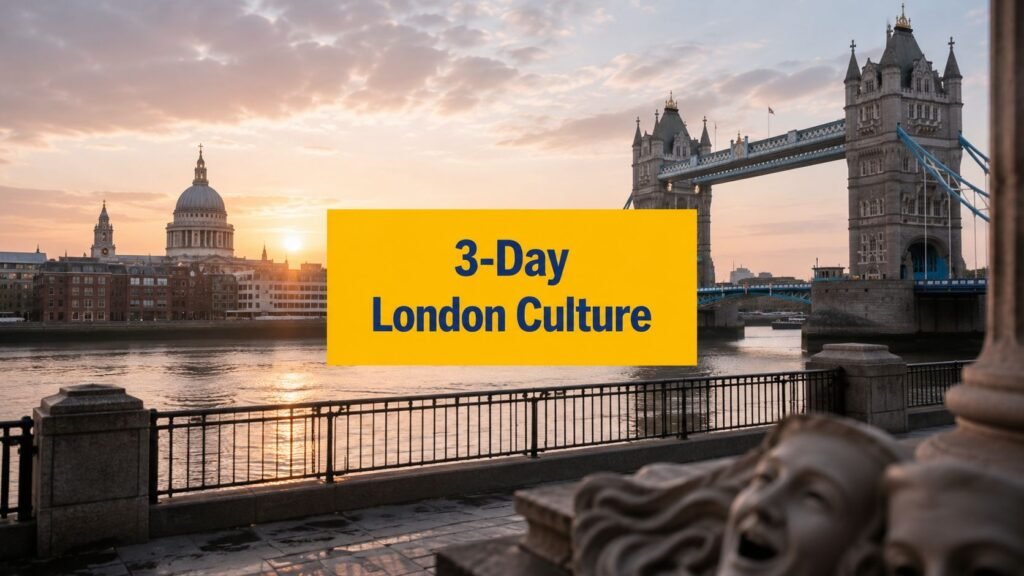
You've got three days in London, a saved folder full of places you “should” see, and the familiar worry that the trip could turn into a blur of queues, Tube changes, and rushed museum visits. That's usually what happens when people try to force the whole city into one rigid plan. London rewards focus far more than speed.
A good London 3 day itinerary cultural plan isn't about checking boxes. It's about building days that fit your interests and your energy. Some travellers want royal history and major landmarks. Others want galleries, theatre, old churches, market streets, or the creative edge of East London. The best short break usually combines a few of those, without making every day feel like a march.
That's why this guide doesn't lock you into one schedule. Instead, it gives you five themed cultural routes you can treat as building blocks. Pick three full days. Or combine one heritage-heavy morning with a literary evening and a slower neighbourhood-based afternoon. That mix-and-match approach works especially well in London, where a short distance on the map can still mean a slow journey in real life.
There's also a practical reason to plan this way. Research around London cultural trips shows that many visitors want heritage first, while others struggle more with logistics than with finding things to do. If you want to explore London's hidden gems, choosing themes rather than trying to “do London” all at once will give you a better trip.
Table of Contents
- 1. Royal London & Westminster Heritage
- 2. Museum Mile & Artistic London
- 3. Shakespeare, Theatre & Literary London
- 4. East London Street Art, Markets & Contemporary Culture
- 5. Roman London & Medieval Heritage Walking Trail
- London 3-Day Cultural Itinerary Comparison
- Bringing Your London Itinerary to Life
1. Royal London & Westminster Heritage

You step out near St James's on a London morning, hear the traffic soften as the park opens up, and suddenly the city starts making sense. Ceremonial London is not just a run of headline sights. It is the place where monarchy, religion, government, and public ritual still sit close enough to understand on foot.
For a three-day cultural trip, this works best as one of your anchor building blocks rather than a rigid full-day script. Some travellers want the classic first-visit route from Buckingham Palace to Westminster Abbey. Others care more about the Tower of London and the long story of power, imprisonment, and state symbolism. This theme lets you shape the day around those priorities without losing the thread.
Start with the landmarks that shape the city
Begin at Buckingham Palace, then walk through St James's Park towards Westminster. That short stretch does real work. It gives the morning some breathing room, helps you avoid a queue-to-queue experience, and makes the shift from royal ceremony to political London feel gradual instead of abrupt.
Westminster Abbey is the stop to protect time for. I usually advise travellers to treat it as the intellectual centre of this route, not a quick tick-off. Coronations, royal funerals, poets, scientists, military memorials, and centuries of national argument all meet in one building. If you rush it, you lose the point of being there.
A later afternoon visit often feels easier than the busiest midday window. Check official opening times before you commit, because services and special events can affect access at Westminster Abbey.
From Parliament Square, decide how much ground you want to cover. A strong version of this theme can stop around Westminster and St James's. A longer version continues east by boat or Underground to the Tower of London. Both work. The mistake is trying to force the whole ceremonial core, the Abbey, the Tower, and several extra museums into one long march.
How to make the day flow
The Tower of London earns its place if you want the harder edge of royal and state history. It is the counterweight to Westminster's pageantry. The palace-fortress was founded by William the Conqueror, and Historic Royal Palaces is the best starting point if you want current visitor details and context on the site's many roles, from royal residence to prison to treasury, at the Tower of London.
The practical choice is whether to pair Westminster with the Tower on the same day. I would only do that if you start early, pre-book timed entry, and keep lunch short. Otherwise, split this theme across two lighter sessions and use your remaining time for one of the other cultural routes in this guide. That approach usually gives independent travellers a better three-day mix.
A few choices improve this route straight away:
- Book timed entry in advance: Buckingham Palace interiors, Westminster Abbey, and the Tower all run better with a fixed slot.
- Use the river with purpose: A Thames boat between Westminster and Tower Bridge is not just transport. It resets your energy and gives the skyline some context.
- Wear proper shoes: Ceremonial London looks compact on a map, but the paving, queues, and museum floors add up.
- Keep one major interior as your priority: Trying to give equal time to every stop usually flattens the day.
If you want a model for stretching this kind of trip into a longer city break, this London 4-day city break itinerary shows how to spread major landmarks across several days without turning the experience into a checklist.
Accessibility planning matters here as well, especially in older buildings and crowded heritage sites. For a wider view of how cultural venues are improving visitor access, How museums can leverage Waymap is a useful read.
Where this theme works best
Choose this route if it is your first time in London, if you want the clearest introduction to the city's public identity, or if your trip needs one unmistakably classic day. It also suits couples and solo travellers who enjoy walking between major sights instead of spending the whole day indoors.
It pairs well with a calm evening. Dinner in St James's works. Afternoon tea can work too, especially if you want a more polished royal-themed finish. This guide to afternoon tea at Buckingham Palace is a useful planning reference.
What usually weakens this theme is overloading it. Trafalgar Square, Churchill War Rooms, Covent Garden, and the National Gallery are all nearby, but proximity is not the same as fit. Keep this building block focused, and it will give your three-day London cultural itinerary a much stronger backbone.
2. Museum Mile & Artistic London

A good London museum day often starts with one small mistake. You walk into a major collection at 10am, tell yourself you will “see the highlights,” and by 2pm you are tired, hungry, and barely taking anything in. This themed route works better as a focused cultural building block. Choose the kind of collection you care about, then let the rest of the day orbit around it.
South Kensington gives you one of the cleanest versions of that approach. The Victoria and Albert Museum is the obvious anchor if you want design, fashion, decorative arts, photography, and material culture in one place. The V&A itself explains the scale well in its museum overview. It is large enough that a strong visit needs a brief. Fashion and jewellery is one brief. Cast Courts and sculpture is another. The mistake is trying to cover both, then adding two more museums on top.
Build around one anchor museum
The most reliable pairing is the V&A with the Natural History Museum if you want a South Kensington day with very little friction between stops. The Natural History Museum visitor guide is useful for checking timed exhibitions, family traffic, and quieter entry windows. This pairing suits travellers who like variety, but it still asks for restraint. One museum gets your prime energy. The second gets a lighter pass, a specific gallery target, or a café break and one exhibition.
If your interest is painting rather than objects, shift the building block west. Start at the National Gallery, then decide whether the second stop should be the National Portrait Gallery, the Courtauld, or nothing at all. A shorter second stop usually gives the better day.
That trade-off matters.
Choose depth over coverage
Museum fatigue is real, especially on a three-day trip where every hour carries weight. I usually advise two main institutions at most. Three can work, but only if one is a deliberate walk-through rather than a full visit.
The British Museum is the clearest example. It can anchor a whole day by itself, particularly if your interest runs to ancient civilisations, empire, or contested collecting histories. The museum's own plan your visit page helps with entry planning, but the practical choice is simpler than that. Pick the departments or objects you care about before you arrive. Otherwise the scale takes over.
Accessibility and route planning matter more on museum days than many visitors expect. Large buildings, multiple levels, temporary closures, and sensory overload can slow the day down. For a wider view of how cultural venues are improving visitor access, How museums can leverage Waymap is a useful planning reference.
A museum day that actually feels good
The strongest version of this theme leaves breathing room. That might mean lunch in the V&A courtyard, a pause in South Kensington Gardens, or an early finish that leaves time for an evening gallery, concert, or good dinner. Short trips improve when you stop treating every free museum as an obligation.
If you want a broader framework that still leaves room to swap themed days in and out, this London in 3 days itinerary with optional add-ons is a useful planning companion.
A few practical rules usually keep this route strong:
- Start with your priority rooms. Do not save the galleries you care about for later.
- Pair by geography or by attention span. South Kensington works well because transit stays simple. The National Gallery pairs well with a smaller art stop because your eyes will already be working hard.
- Book special exhibitions early if they matter to you. Free permanent collections give flexibility. Temporary shows often do not.
- Protect one unscheduled hour. That is usually where the best part of the day happens.
This theme suits independent travellers who want to mix and match rather than follow a rigid timetable. Use it as one cultural block in your three-day plan, not as a test of endurance.
3. Shakespeare, Theatre & Literary London

You spend the afternoon on Bankside, hear the river traffic behind you, step into a play after dark, and suddenly London makes sense through its words. If your trip needs culture that carries into the evening, this theme earns a place in your three-day mix.
I plan this kind of day from the ticket backward. Start with the show you care about most, then build a tight orbit around it. That single decision usually improves the whole day. You eat at a decent hour, avoid cross-city zigzags, and arrive with enough energy to pay attention.
Build around the performance, not around a checklist
Pick one anchor. Shakespeare at the Globe, a West End production, a new play at the National Theatre, or a literary adaptation in a smaller venue all create different days.
The Globe works best with South Bank and Bankside. You can pair it with a riverside walk, a stop at nearby bookshops, and dinner without straying far. A West End evening suits Covent Garden, Soho, or Bloomsbury better, especially if you want a late finish without a complicated trip home.
Cultural visitors often put heritage high on the list, and theatre fits that pattern because London's stage culture is tied to place as much as performance. Westminster Abbey's Poet's Corner, the streets around Bloomsbury, and Bankside near the Globe all add context that a ticket alone cannot give.
Literary stops that earn their place
A strong literary day needs restraint. Two thoughtful stops are usually enough.
The Charles Dickens Museum is a good morning choice if you want to see a writer's working world up close. Dr Johnson's House offers a different mood. Smaller rooms, older City streets, and a sharper focus on language itself. The British Library can also fit this theme if manuscripts matter more to you than house museums, but it asks for more time and concentration.
I usually advise pairing one intimate literary site with one major performance venue. The contrast helps. A house museum gives you texture and scale. The theatre gives you energy, voice, and the public life of the city.
Ticket strategy matters here. If there is one production you would regret missing, book through the official box office and treat the price difference as part of the trip. Last-minute discounts can work well for flexible travellers, but they are a poor plan for a specific show, a Saturday night, or a short stay.
For travellers who want to combine themed days rather than follow a rigid schedule, this London in 3 days guide with optional add-ons works well as a planning framework.
Keep the route coherent
The weakness of literary London is not quality. It is sprawl. The sites connect intellectually, but they do not always connect neatly on foot.
So give the day a clear spine. Bloomsbury in the morning, South Bank in the afternoon, then a West End or National Theatre performance is one reliable version. Westminster Abbey and Poet's Corner followed by Covent Garden and an evening show is another. What usually falls apart is trying to force Dickens, the Globe, Westminster Abbey, the Barbican, and a long Soho dinner into the same day.
If you want this theme to feel rich rather than rushed, choose one literary cluster and one evening stage experience. That is the building-block approach at its best. You get a distinct side of London, then still have room to shape the rest of your three days around a different cultural mood.
4. East London Street Art, Markets & Contemporary Culture
East London suits travellers who want culture that still feels in motion. Over the course of a few streets, you can move from Huguenot and Jewish history to Bangladeshi food culture, warehouse-era reinvention, street art, independent fashion, and small contemporary galleries. For a three-day trip, that range matters. It gives you a very different cultural block from palaces, museums, or theatre without forcing a long checklist.
Here's a visual taste before you go further.
Modern London feels most alive in the East End
Independent travellers often struggle less with a lack of things to do than with stitching them together into a satisfying day. East London solves part of that problem because the experience is naturally clustered. You can stay within Spitalfields, Brick Lane, Shoreditch, and the streets that connect them, and still get a layered sense of the city.
That is the defining strength of this theme. It works as a flexible building block.
Brick Lane, Shoreditch, Spitalfields, and nearby side streets hold several Londons at once. Market lunch can sit next to a historic synagogue, a concept store, a Somali café, a design studio, or a wall that has changed since last month. If you try to treat the area like a set of headline attractions, you miss its character. The point is the overlap.
How to explore without reducing it to a checklist
East London rewards loose structure. It rarely rewards minute-by-minute planning.
Start with one anchor. Old Spitalfields Market works well if you want food and easier orientation. Brick Lane works well if street life matters more to you than order. Shoreditch High Street is useful if you want a contemporary angle first, then plan to drift outward.
A few habits improve the day:
- Go early if street art is a priority: Light is better, pavements are quieter, and the area is easier to read before brunch crowds arrive.
- Use the side streets as part of the route: Some of the strongest visual detail sits between the famous names, not on them.
- Pair a market stop with one quieter venue: A small gallery, bookstore, or museum stop gives the day shape.
- Expect change: Shops close, murals disappear, and pop-ups rotate. That instability is part of the appeal, but it also means rigid expectation is usually a mistake.
One route I recommend starts in Spitalfields, cuts through Brick Lane, then wanders into Shoreditch without trying to "finish" the neighbourhood. Travellers who like lived history as much as visual culture often do well adding the Museum of the Home. It gives social context to the area's reinvention and broadens the day beyond photogenic walls and food stops.
Best fit for your three-day mix
Choose this theme if another day on your trip already covers ceremonial or classical London. The contrast works well. East London brings in migration, reinvention, informal creativity, and the kind of culture that sits in daily use rather than formal display.
It also suits travellers who prefer to mix and match themed days instead of following a rigid schedule. A full East London day works well, but so does stealing half a day from this block and pairing it with another interest. That flexibility is one of the strongest planning advantages in a short London trip.
Go to East London for texture and change. The best hours here usually come from a good starting point, comfortable shoes, and enough spare time to follow your curiosity.
5. Roman London & Medieval Heritage Walking Trail

You turn a corner in the City, pass a line of glass office blocks, and suddenly meet a stretch of Roman wall or a medieval churchyard. That contrast is the appeal of this route. It rewards travellers who enjoy reading a city through surviving fragments, street patterns, and old foundations that still shape modern London.
For a three-day cultural trip, this theme works best as one of your mix-and-match building blocks rather than a fixed day that must run from morning to night. Some travellers use it as a full walking day. Others borrow the core City section, then pair it with another interest. That flexibility suits London well, especially if you want a trip that reflects your pace rather than a rigid schedule.
Read the City through what survived
Start around Tower Hill, the City, or Smithfield and keep your expectations focused. Roman and medieval London is rarely presented as one tidy, linear attraction. It appears in pieces. A wall section near a road junction, a church rebuilt after fire, a lane that still follows an older route, a gate site that explains how the city once defended itself.
That is why this route is better on foot than by Tube-hopping between landmarks. The walking itself does part of the interpretive work. You notice changes in street width, church density, and how the river once dictated trade, defence, and settlement.
The Tower of London can still fit this theme, but for different reasons than on a royal-focused day. Here, the interest lies in military position, control of access, and the relationship between fortress, city, and river. St Paul's Cathedral also earns its place for historical layering. The current cathedral dominates the skyline, but the site carries much older religious significance. If you want a quieter and more atmospheric stop, St Bartholomew-the-Great is often the point where travellers feel medieval London most clearly.
Build a route that stays tight
The best version of this walk is usually smaller than people first plan. The City looks compact on a map, but constant stopping slows the day, and that is a good thing.
A practical loop often includes some combination of London Wall remains, Tower Hill, Leadenhall area streets, St Paul's, Smithfield, and one or two churches you can enter. For visitors who want expert interpretation, the City of London Guides run themed walks led by qualified local guides. A guided walk is useful here because many of the most interesting details are easy to pass without context.
A few planning choices make a real difference:
- Keep the area focused: A compact City loop usually works better than trying to add too many outliers.
- Check church opening hours on the day: Many historic churches have limited access outside services or events.
- Use the Thames as your reference point: It helps explain trade, defence, and why settlement concentrated where it did.
- Allow time for pauses: Plaques, excavation displays, and surviving wall fragments are often the key to understanding the route.
Why this theme earns a place in a 3-day cultural trip
This route gives you historical continuity. You see how Roman Londinium became a medieval trading city, how later rebuilding changed it, and how much of old London still survives inside a working financial district.
It suits repeat visitors particularly well, but I also recommend it to first-time travellers who care more about historical texture than headline photos. The trade-off is straightforward. This is not the easiest cultural day in London. It asks for comfortable shoes, patience, and some curiosity about partial remains rather than grand set pieces.
That effort usually pays off. If you want one itinerary block that makes the rest of London feel more intelligible, this is often the one.
London 3-Day Cultural Itinerary Comparison
| Itinerary | Implementation Complexity | Resource Requirements | Expected Outcomes | Ideal Use Cases | Key Advantages |
|---|---|---|---|---|---|
| Royal London & Westminster Heritage | Moderate, requires timed entries and crowd management | Entrance fees for major sites (£25–35 each), 5–6 hours walking, optional riverboat/transport | Broad historical overview of monarchy and government; iconic landmarks and photo opportunities | First-time visitors, families, short city breaks seeking quintessential London | Concentrated landmark cluster, strong visitor infrastructure, clear historical narrative |
| Museum Mile & Artistic London | Low–Moderate, time management across large collections; timed slots for popular galleries | Significant time investment (3–4 hrs per major museum), paid special exhibitions, museum apps/maps | Deep artistic and intellectual enrichment across millennia; curated learning experiences | Art/history enthusiasts, academics, rainy-day itineraries, structured cultural immersion | Free permanent collections, weather-independent indoor venues, evening openings |
| Shakespeare, Theatre & Literary London | Moderate–High, advance theatre booking and evening logistics required | Theatre tickets (£15–100+), evening dining coordination, 1 full-day structure with transit | Live-performance experiences with literary context; memorable social and cultural engagement | Theatre lovers, literature scholars, couples, families with teens | Combines daytime museums with evening theatre, diverse venue choices, strong emotional impact |
| East London Street Art, Markets & Contemporary Culture | Low, largely self-guided and flexible but requires local navigation | 4–5 hours walking, optional local guides, low admission costs, outdoor exposure | Authentic contemporary culture, street art photography, diverse food and independent shopping experiences | Younger travelers, creatives, foodies, photographers, those seeking local authenticity | Affordable, highly photogenic, supports independent businesses, flexible non-linear exploration |
| Roman London & Medieval Heritage Walking Trail | Moderate, benefits from interpretive guides and attention to site hours | 5–6 hours walking, moderate fitness, museum access (variable), occasional interior fees | Archaeological depth and layered historical insight spanning Roman to medieval periods | History and archaeology enthusiasts, academic visitors, contemplative walkers | Tangible archaeological remains integrated in streetscape, walkable City core, quieter atmosphere |
Bringing Your London Itinerary to Life
Your best three days in London probably won't look exactly like anyone else's. That's a good thing. One traveller might combine Royal London with a museum day and a Shakespeare evening. Another might choose Roman London, East London, and an art-heavy South Kensington day. Both can work brilliantly if the pacing is right.
That's the advantage of using themed building blocks instead of a rigid minute-by-minute plan. You can shape the trip around how you travel. If you like early starts and landmark-heavy days, lean into Westminster and the Tower. If you prefer slower, richer wandering, pair museum time with literary London or spend a day in East London's markets and streets. A smart London 3 day itinerary cultural plan should give you structure without trapping you in it.
The biggest practical win is reducing friction. When each day has a clear cultural theme, your transport gets simpler, your energy goes further, and the city starts to feel more coherent. You remember the experience itself instead of the scramble between unrelated bookings. That matters even more on a short break, where one overpacked day can drag down the next.
There's also room to be honest about trade-offs. You won't see everything in three days, and you shouldn't try. London always leaves something for next time. The better goal is to leave feeling that you understood several real sides of the city. Royal ritual. World-class collections. Literary memory. Contemporary creativity. Ancient foundations. If you've touched three of those properly, your trip has already been a success.
At BTOURS, that flexible style of travel sits at the centre of how city breaks should work. Some travellers want complete independence with a strong framework. Others want the planning handled for them, while still keeping that sense of personal discovery. Both approaches are valid, and both can lead to a richer trip than a generic checklist itinerary.
That's why curated London breaks can be so useful. They remove the tiring parts, such as route logic, accommodation choices, and practical coordination, while still letting you experience London at your own pace. Done well, a curated trip doesn't make the city feel packaged. It makes it feel more accessible.
If you're ready to build your own version, start with the theme that matters most to you. Make that your anchor day. Then add one complementary classic day and one contrasting neighbourhood or evening-focused day. That combination usually creates the strongest balance of depth, variety, and ease.
If you'd like expert help turning these ideas into a well-organized short break, BTOURS can help you shape a London journey that fits your pace, interests, and style. From heritage-rich city stays to flexible cultural escapes with handpicked accommodation and practical support, BTOURS makes it easier to enjoy London fully instead of rushing through it.