There’s nothing quite like the freedom of driving in Ireland. It’s your ticket to exploring dramatic coastlines and ancient landscapes on your own schedule. This is how you discover those hidden villages, windswept peninsulas, and the authentic charm that lies far from the well-trodden tourist trails.
Let's turn any worries you might have—like driving on the left for the first time or navigating those famous narrow country roads—into pure, road-tripping confidence.
Your Ultimate Irish Road Trip Starts Here
Think of this guide not just as a list of rules, but as your personal roadmap to an unforgettable Irish experience, one hairpin turn and breathtaking vista at a time. Your journey to mastering Irish roads begins now, transforming your travel dreams into a brilliant reality. We’ll give you the practical know-how to feel less like a tourist and more like a local explorer uncovering the true heart of the Emerald Isle.
This guide is your co-pilot, designed to prepare you for everything from modern motorways to the most meandering country lanes. Soon you'll be navigating with ease, understanding local driving etiquette, and embracing the wonderful spontaneity that makes a road trip so special.
What to Expect on Your Journey
A road trip through Ireland is an adventure for all the senses. Before you even get behind the wheel, getting a handle on the basics will set you up for success. We’ve laid everything out to build your knowledge step-by-step, starting with the fundamentals.
Here's a glimpse of what we'll cover together:
- Mastering the Basics: Simple tricks for getting comfortable on the left and tackling roundabouts like a pro.
- Understanding the Roads: How to read Irish signs and keep an eye on speed limits (which are in kilometres per hour!).
- Rental Logistics: Choosing the right car, making sense of insurance, and managing things like fuel and tolls.
- Itinerary Planning: Ideas for crafting a realistic and inspiring route, featuring must-sees like the Wild Atlantic Way.
- Safety and Emergencies: Essential tips for parking, what to do if you break down, and staying safe on your travels.
The real magic of driving in Ireland isn't just getting from A to B. It’s about the unexpected discoveries you make along the way—a secluded beach, a friendly pub, or a castle ruin standing silently in a field.
To get you started right away, here’s a quick-glance table with the absolute essentials.
Ireland Driving Quick Start Guide
This little cheat sheet covers the most critical rules and tips for anyone driving in Ireland for the first time. Keep these points in mind, and you'll be off to a flying start.
| Essential Tip | Key Detail |
|---|---|
| Drive on the Left | Always keep your driver's shoulder aligned with the centre line of the road. |
| Speed is in Km/h | Speed limits are in kilometres per hour, not miles per hour. A crucial difference for many visitors. |
| Roundabout Rule | Yield to all traffic approaching from your right before entering a roundabout. |
| Road Types Vary | Be prepared for everything from modern motorways (M-roads) to very narrow, single-lane rural roads. |
| Fuel Pumps | In Ireland, petrol pump handles are typically green, while diesel handles are black—often the reverse of other countries. |
With these key pointers tucked away, you're already one step closer to hitting the open road with confidence. Now, let’s dive into the details.
Mastering Left-Side Driving and Roundabouts
Alright, let's talk about the two things that might have you feeling a bit hesitant about driving in Ireland: sitting on the ‘wrong’ side of the car and tackling your first roundabout. But think of these as part of the adventure, your first real steps towards driving like a true local. Honestly, with a simple mindset shift and a bit of know-how, that initial flutter of nerves will transform into pure, confident driving.
The switch to the left side of the road can feel a little strange for the first few minutes, but you'll be amazed at how quickly it becomes second nature. Before you hit a busy road, my best advice is to find a quiet car park or a deserted country lane. Just spend a few minutes there getting a feel for the car's size and position. That little practice session is worth its weight in gold for building muscle memory.
The Secret to Left-Side Driving
Want the single best trick I've ever learned for staying in your lane? It's this: always keep your driver's shoulder (that's your right shoulder) roughly aligned with the centre line of the road. This simple, constant point of reference is your anchor. It stops you from drifting too far over to the left, which is an easy mistake to make, especially on those charmingly narrow rural roads.
Your brain is already wired to position yourself in a lane from the driver's seat. By just focusing on keeping your body parallel to that middle line, you’ll naturally place the car exactly where it needs to be. It’s a tiny mental adjustment that makes a massive difference, turning something that feels awkward into something that feels completely intuitive. For an extra dose of confidence, especially for judging the left side of the car, a simple tool like these 360-degree adjustable blind spot mirrors can be a great help while you get used to the new perspectives.
This little graphic boils down the whole Irish road trip experience into three core ideas.
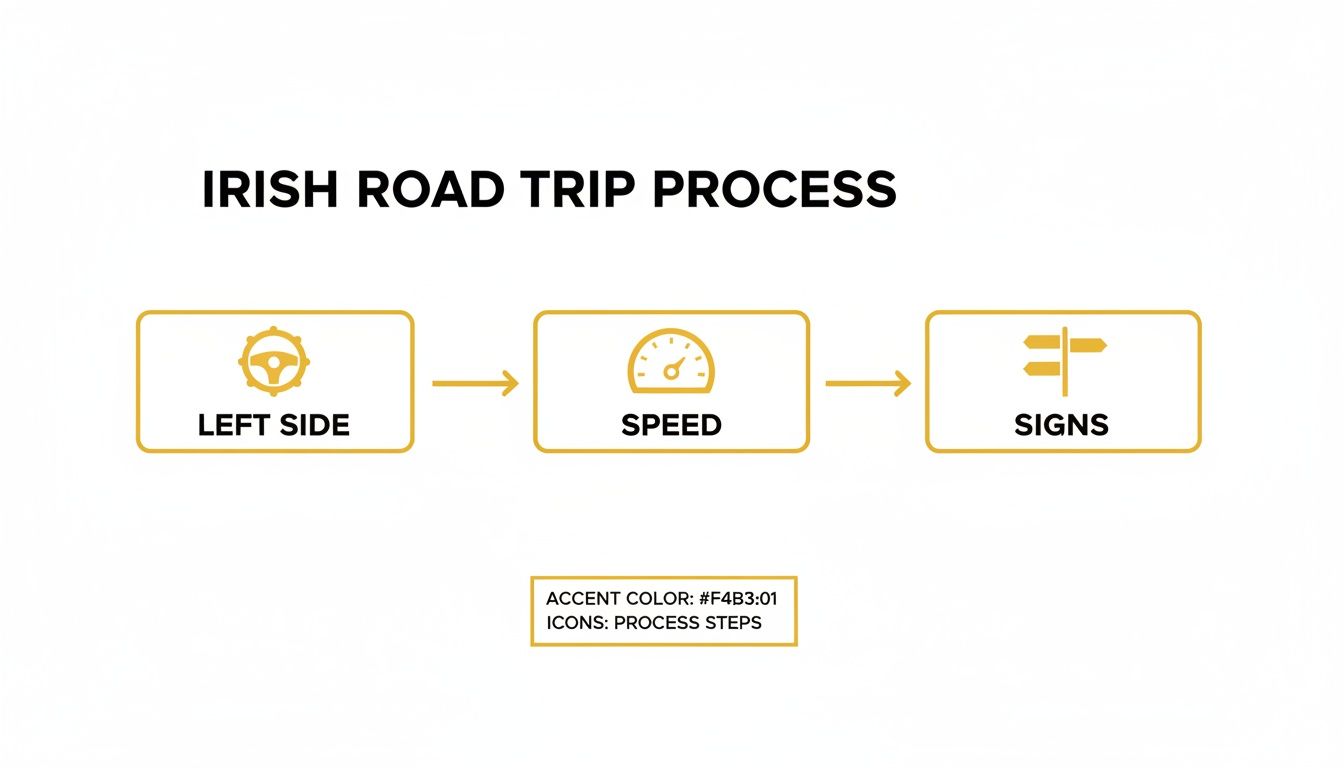
Get these three things down—staying on the left, knowing the speed limits, and understanding the signs—and you've cracked the code for a fantastic, stress-free journey.
Demystifying Irish Roundabouts
You’ll find roundabouts everywhere in Ireland; they’re designed to keep traffic moving safely and efficiently. The trick is not to see them as a chaotic free-for-all, but more like a flowing dance where everyone knows the steps. The golden rule is incredibly simple: you must give way to any and all traffic already on the roundabout, which will be coming from your right.
Once you’ve yielded and seen a safe gap, you pull onto the roundabout and travel clockwise. The real key, though, is knowing which exit you need before you even get to the roundabout. That's what tells you which lane to be in.
- Going left or straight ahead (1st or 2nd exit): Stick to the left-hand lane on your approach.
- Turning right (3rd exit or further): Get into the right-hand lane as you approach.
Using your indicators is how you communicate with other drivers. It’s absolutely crucial. Here’s how it works:
- On Approach: Signal left if you're taking the very first exit. Signal right if your exit is past the 12 o'clock position. No signal is needed if you're going straight on (usually the second exit).
- When Exiting: This is the most important part! As you pass the exit just before the one you want, signal left. This is the non-negotiable signal that tells everyone waiting that you’re about to leave the roundabout, giving them the space to enter.
A lovely bit of local driving culture is the 'thank you' wave. If another driver pulls in to let you pass on a narrow lane or gives you the right of way, a quick lift of the hand off the steering wheel is the universal, and much appreciated, sign of thanks. It’s a small thing, but it makes you feel part of the fabric of the place.
Follow these straightforward rules, and you'll be zipping through roundabouts like a seasoned pro before you know it. The system really is brilliant and, once you get the rhythm, much simpler than it might look at first glance. Just go with the flow, and you’ll find it’s one of the best things about driving in Ireland.
Reading the Roads: A Guide to Irish Signs and Speed Limits
So, you’ve mastered driving on the left. Fantastic! Now it's time for the next layer of your Irish road trip adventure: getting to grips with the language of the roads themselves. Think of Irish road signs as your constant co-pilot, guiding you through the landscape. They have their own unique personality, especially once you venture off the motorways and into the heart of the country. This isn't just about following rules; it’s about learning to read the land and move with its natural rhythm.
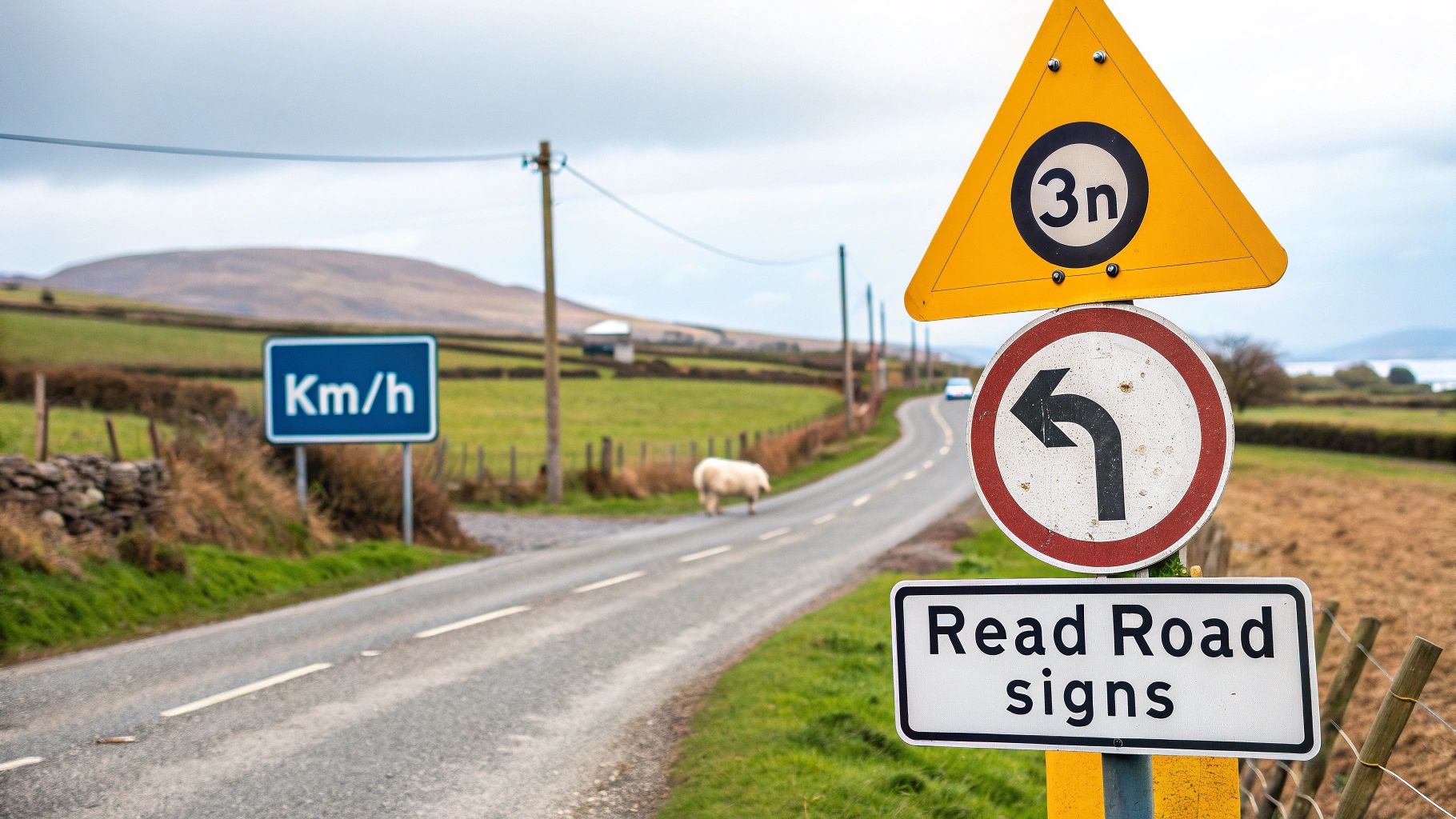
The first and most important thing to get your head around is that all speed limits in Ireland are in kilometres per hour (km/h), not miles per hour. This is a massive shift for visitors from the US or UK. Your rental car's speedometer will feature km/h, usually more prominently than mph, but you have to make that mental switch the second you get behind the wheel. As a quick rule of thumb, remember that 100 km/h is about 62 mph.
Cracking the Code of Bilingual Signs
As you journey west into the Gaeltacht (Irish-speaking) regions, you'll see the road signs transform. They become bilingual, displaying place names in both Irish (Gaelic) and English. Please don't let this throw you! It's a genuinely beautiful part of the country's cultural fabric.
You'll usually see the Irish name first, often in a lovely, traditional italic font, with the English name just below it in standard lettering. For instance, you might see An Daingean above Dingle. It's the same town, just with its two names proudly displayed. Getting used to this pattern will save you from any head-scratching moments and truly enrich your drive.
If you really want to feel like a pro before you go, getting familiar with something like this Highway Code and Traffic Signs book can give you a brilliant head start.
Embracing these bilingual signs is part of the magic. It’s a physical reminder that you are travelling through a land with a deep, living history and a language that has shaped its very identity.
While hard data on self-drive tourism can be tricky to pin down, my experience tells me that preparing for these unique regional quirks is what separates a good trip from a great one. It’s these small details that turn a simple drive into a genuine cultural immersion.
Navigating Speed Limits with Confidence
Irish speed limits are generally logical and based on the type of road you're on. While a posted sign always overrules the default, knowing the standard limits provides a great baseline for your journey. And a friendly word of warning: speed cameras are common, so sticking to the limits is as much about avoiding a hefty fine as it is about safety.
Here’s a simple table to help you get your bearings.
Irish Speed Limits at a Glance (in km/h)
| Road Type | Default Speed Limit (km/h) | Common Symbol/Sign |
|---|---|---|
| Motorways | 120 km/h | Blue sign with an 'M' (e.g., M7) |
| National Roads | 100 km/h | Green sign with an 'N' (e.g., N21) |
| Regional Roads | 80 km/h | White sign with an 'R' (e.g., R561) |
| Urban Areas | 50 km/h | Posted sign with '50' in a red circle |
The golden rule here is that these are limits, not targets. Just because the sign on a twisting, narrow 'R' road says 80 km/h, it doesn't mean you should be doing it. The conditions will often demand a much slower, more sensible pace.
The Charm and Challenge of Rural Roads
This brings us to the very soul of driving in Ireland: the narrow, winding country lanes. These are the roads where the real memories are made. We’re talking single-track roads, maybe with a strip of grass growing down the middle and ancient stone walls on either side. This is where you’ll run into the classic "Irish traffic jam"—a flock of sheep taking their sweet time to cross.
Here’s how you handle these incredible roads:
- Go Slow: Let your line of sight dictate your speed. If you can't see what's around that blind corner, assume another car (or a tractor!) is coming.
- Use Passing Places: Keep an eye out for small pull-in spots. The unwritten rule is that whoever is closer to a passing place should pull in (or reverse back) to let the other vehicle pass.
- Give a Little Wave: A friendly wave of acknowledgement is the local custom when someone makes way for you. It’s a simple gesture that makes you part of the local driving culture.
Driving these roads isn’t a race. It’s about patience, awareness, and soaking it all in. They are your personal invitation to slow down, breathe in the scenery, and discover the hidden corners of Ireland that the tour buses can never hope to reach.
Your Guide to Car Hire Insurance and Fuel
Now that the rules of the road are starting to feel a bit more familiar, let's get into the nitty-gritty. Nailing the practical side of things—choosing the right car, getting your head around insurance, and knowing the deal with fuel and tolls—is the final piece of the puzzle. Get this stuff right, and you’re free to just soak in the joy of the open road.
Think of your hire car as your trusty sidekick for this adventure. It might be tempting to go for a big, roomy model, but here’s my top tip for driving in Ireland: think smaller. Trust me on this. Many of the most magical roads are narrow, winding country lanes where a compact car is an absolute godsend. It just makes navigating those tight squeezes and finding a parking spot in a tiny village so much less stressful.
Making Sense of Car Hire Insurance
Car hire insurance can feel like trying to decipher a secret code, full of confusing jargon and acronyms. But honestly, it's simpler than it looks once you break it down.
The main thing you'll see is the Collision Damage Waiver (CDW). This isn't really insurance, but more of an agreement from the rental company that if the car gets damaged, they won't make you pay for the whole thing.
The catch? A CDW nearly always comes with a massive excess—that's the amount you still have to pay, and it can easily be thousands of euros. To get around this, rental companies offer extras like Super CDW or excess protection. It adds to the daily cost, but it can bring that scary excess right down to zero, giving you total peace of mind.
Here’s a pro tip: before you travel, check if your credit card includes car hire insurance. Some premium cards do, but you absolutely have to confirm it’s valid in Ireland and know exactly what it covers. You don't want any nasty surprises at the rental desk.
It’s easy to focus on the fun parts of planning, but getting the logistics like insurance sorted is what truly sets you up for a hassle-free trip. Knowing these details upfront helps you manage your budget and know what to expect.
Fuelling Your Irish Adventure
Right, let's talk about keeping your car going. At the petrol station, there's one crucial, colour-coded difference that catches out so many visitors. In Ireland, the pump handles are often the opposite of what you might be used to back home.
- Green Handle: This is for petrol (what you might call unleaded gasoline).
- Black Handle: This is for diesel.
Make a mental note or stick a post-it on the dashboard! Always, always double-check what fuel your hire car needs before you even drive away from the rental office. Putting the wrong fuel in can cause some serious, expensive engine damage. If the worst happens, this essential guide to handling misfuelling could be a lifesaver. It’s such a simple mistake to make, but a moment’s focus at the pump will save you a world of trouble.
And here’s a bit of local wisdom for you: if you're venturing out into a more remote area like the Dingle Peninsula or deep into the Wild Atlantic Way, fill your tank before you go. Petrol stations can be few and far between once you get off the beaten track.
A Quick Word on Road Tolls
The good news is that most roads in Ireland are completely free. You’ll only come across a few toll roads, mostly on the big motorways that connect the major cities. They’re really straightforward—you just pay with cash or a card at a toll booth.
The one big exception is Dublin's M50 motorway, the ring road around the city. It uses a barrier-free system called eFlow. Cameras just snap your registration number as you drive through, and it's up to you to pay the toll online or at a shop with a Payzone sign by 8 p.m. the following day.
But don't panic! Most car hire companies have this all sorted. Their cars are usually registered with the system, and they'll just charge the toll to the credit card you booked with, sometimes with a small admin fee. Just make sure to ask them how they handle the M50 toll when you pick up the car. With these details squared away, you're ready for anything Ireland throws at you.
Planning Your Perfect Irish Road Trip Itinerary
Alright, this is where the magic really begins. With the practicalities sorted, you can now start dreaming and sketching out the adventure of a lifetime. Crafting your Irish road trip isn't just about connecting dots on a map; it's about creating a rhythm for your journey, leaving room for spontaneity, and truly sinking into the soul of the island.
The biggest mistake first-timers make? Trying to cram everything in. Ireland might look small on paper, but it’s dense with story, scenery, and culture that deserves to be savoured, not just seen. The real secret to an unforgettable trip is pacing. Give yourself permission to slow down, and you’ll create space for those golden, unplanned moments—a long, chatty lunch in a country pub, a sudden detour down an inviting lane, or pulling over simply to watch a storm roll in over the Atlantic.
Iconic Routes to Ignite Your Imagination
To get the ideas flowing, let's look at two of Ireland’s most celebrated driving routes. They offer completely different flavours of the island, each one captivating in its own right.
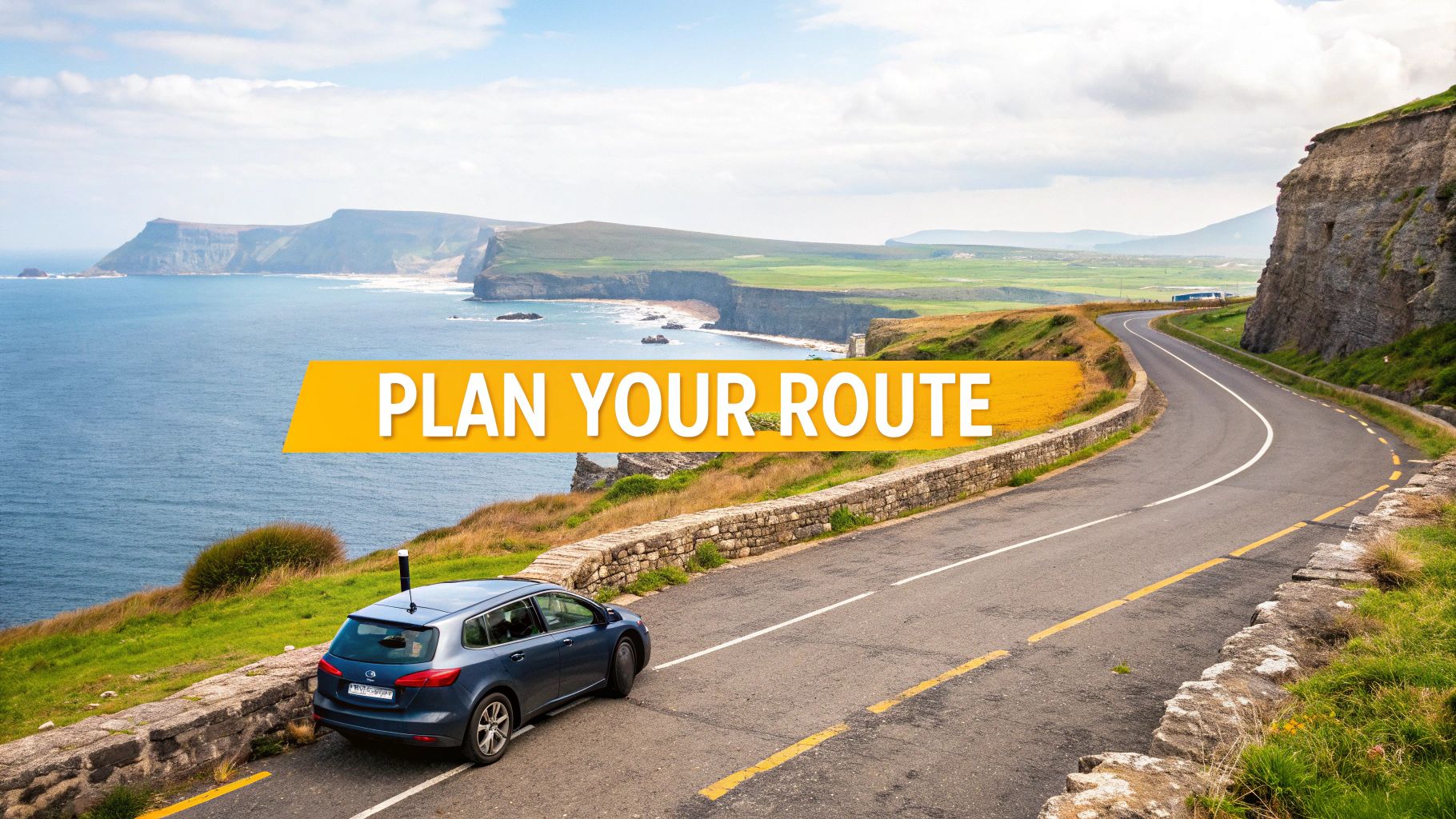
- The Wild Atlantic Way: This is the showstopper. A legendary 2,600 km coastal odyssey that hugs the western seaboard from County Donegal all the way down to Kinsale in County Cork. It’s a journey of raw, untamed power, where you'll find colossal sea cliffs, windswept beaches, and villages tucked into tiny, protected harbours. You don’t have to drive all of it—even a small section will give you a taste of its wild heart.
- Ireland's Ancient East: By contrast, this route takes you on a journey through time. It meanders through the lush, gentle landscapes of the east, uncovering millennia of history. This is where you’ll find tales of high kings and Viking invaders, ancient megalithic tombs that predate the pyramids, and grand country estates that whisper of a different era.
Think of your itinerary less as a rigid schedule and more as a personal story waiting to unfold. The greatest gift you can give yourself is time. A well-paced plan lets you breathe in the atmosphere, not just tick off a checklist.
Setting a Realistic Pace
On most of Ireland’s winding rural roads, aiming for 150-200 kilometres (that’s about 90-125 miles) per day is a brilliant goal. It might sound modest, but trust me, it’s the sweet spot. It leaves plenty of breathing room for exploration. Your sat-nav might predict a two-hour drive, but once you factor in stops for photos, castle ruins, and a proper cup of tea, it can easily, and joyfully, fill an entire afternoon.
While there isn't hard data on every self-drive tourist, visitor trends show a clear pattern: the happiest travellers are the ones who embrace the slower Irish pace. You can find more general insights into Irish tourism on the CSO website. And if you're packing for every possibility, a smart add-on like an aerodynamic roof box carrier can be a lifesaver for keeping your car clutter-free and comfortable.
Choosing the Best Season for Your Drive
Ireland’s character shifts beautifully with the seasons, each offering a unique mood for your drive. The best time to visit really comes down to the kind of experience you’re looking for.
| Season | Pros | Cons |
|---|---|---|
| Spring (Mar-May) | The country explodes in impossible shades of green, the roads are quieter, and the fields are full of newborn lambs. | The weather is a classic mixed bag—be ready for glorious sunshine and sudden showers in the same hour. |
| Summer (Jun-Aug) | You get wonderfully long days for exploring, the best chance of warm weather, and a fantastic, festive buzz in the air. | It’s peak season, which means higher prices, more cars on the road, and busier attractions. |
| Autumn (Sep-Nov) | See the landscape glow in stunning golds and reds. The weather is often mild and the summer crowds have vanished. | The days get noticeably shorter, and some tourist-focused spots may start to reduce their hours. |
| Winter (Dec-Feb) | Experience dramatic, moody skies, crisp air, the unique joy of a cosy pub with a roaring fire, and the lowest prices. | Days are short, it’s the coldest time of year, and some minor rural roads can be tricky in bad weather. |
Honestly, there’s no wrong time for driving in Ireland. With a bit of thoughtful planning and a true spirit of adventure, you’re guaranteed to create memories that will stay with you for a lifetime, no matter which month you choose.
Your Guide to Staying Safe on Irish Roads
Your safety and peace of mind are the most important things you’ll pack for this trip. When you’re properly prepared, you can handle any little bump in the road with total confidence, leaving you free to soak up the incredible adventure that is driving in Ireland. Think of this as your final pre-flight check before hitting the tarmac.
What to Do in a Breakdown
Even the most careful driver can get a flat tyre or have a car give up the ghost. It happens. The trick is not to panic. Just pull over somewhere safe, well away from traffic, pop on your hazard lights, and throw on a high-vis vest if there's one in the car.
Your first call should be to the car hire company – their contact details will be in the glove compartment. They'll sort everything out for you.
Emergency Contacts and Procedures
In the unlikely event you're in an accident, your priorities are simple: safety first, then communication. Check if anyone is hurt. If they are, or if the road is blocked, call the emergency services right away.
Here are the only numbers you really need to save in your phone:
- Emergency Services (Gardaí/Police, Fire, Ambulance): Dial 112 or 999. Both numbers work from any phone, and they’re always free to call.
- Automobile Association (AA) Ireland Breakdown: Many rental agencies use the AA for roadside assistance, so it’s handy to have their number as a backup.
A quick tip from experience: always get the details of any other drivers involved—name, address, and insurance info. If it’s safe, snap a few photos of the scene and any damage. This stuff is gold when you're filling out the report for the rental company.
The Art of Smart Parking
Sometimes, finding a parking spot in a bustling Irish town can feel harder than navigating a winding country lane. Most on-street parking is "Pay and Display." You'll need some coins for the meter, which will spit out a ticket to pop on your dashboard. More and more places are shifting to apps, which are a lifesaver if you have them set up.
For that extra bit of reassurance, especially if you're parking up overnight, you could look into advanced car security systems for an added layer of protection. It's also a brilliant idea to be self-sufficient for those smaller roadside hiccups. Why not pack a portable power source? An ultra-powerful portable car jump starter can give you complete independence, especially on those wild, remote roads.
With these preparations ticked off, you’re not just ready for the drive; you’re ready for a truly unforgettable journey.
A Few Final Questions About Driving in Ireland
Your Irish adventure is just around the corner! Before you hit the road, let's clear up a few common questions. Getting these details sorted will give you the peace of mind to truly soak it all in, making sure your journey is as smooth and delightful as a perfectly poured pint of Guinness.
Do I Need an International Driving Permit for Ireland?
For most visitors, the good news is you probably don't. If you're coming from the UK, anywhere in the EU, the US, Canada, or Australia, your standard, valid driving licence from back home is all you'll need. It's good for up to 12 months of driving here.
The main exception is if your licence isn't in English. In that case, grabbing an International Driving Permit (IDP) is a very smart move. It’s not a licence itself, but rather an official translation that accompanies your own. A quick call or email to your car hire company before you fly is always a good final check, just to be absolutely sure.
Are Automatic Cars Easy to Rent in Ireland?
You can definitely get an automatic car here, but it's important to know they aren't the norm. Manual cars (or 'stick-shift') are far more common, which means automatics usually come with a higher price tag.
If you’re not comfortable with a manual gearbox, my best advice is this: book your automatic hire car as far in advance as you possibly can. Especially during the busy summer months, they get snapped up fast. Booking early is the only way to avoid that sinking feeling of disappointment at the rental desk.
What Should I Know About Drink-Driving Laws?
Ireland takes drink-driving incredibly seriously. Our laws are among the strictest in Europe, and they're enforced rigorously. The penalties are steep, and frankly, it's just not worth the risk.
The legal limit for Blood Alcohol Concentration (BAC) is just 50mg for most drivers. For newer drivers, it’s even lower at 20mg. That’s a tiny amount, far less than what you might be used to. Police are often out conducting random breathalyser checks, particularly at night and on weekends.
The only rule to live by here is a simple one: if you're driving, don't drink any alcohol. It’s the clearest, safest path for you and everyone else sharing the road.
What Do I Do If There Are Sheep on the Road?
Sooner or later, it will happen, and it's one of the most wonderfully Irish moments you can have. You'll round a bend on a quiet country lane and find your path blocked by a woolly traffic jam. Don't think of it as a delay; think of it as a photo op!
When you see sheep or any other livestock ahead, just ease off the accelerator and be ready to stop. The most important thing to remember is not to use your horn. It can panic the animals, causing them to scatter in all directions. Just be patient, edge forward slowly as a path clears, and enjoy this quintessential piece of the Irish countryside. It's a perfect reminder to slow down and embrace the pace of life here.
Ready to write your own road trip story? At BTOURS, we live and breathe this stuff. We create self-drive tours that get you to the heart of what makes Ireland so special, all at your own pace. Explore our self-drive itineraries and let's start planning your adventure today.