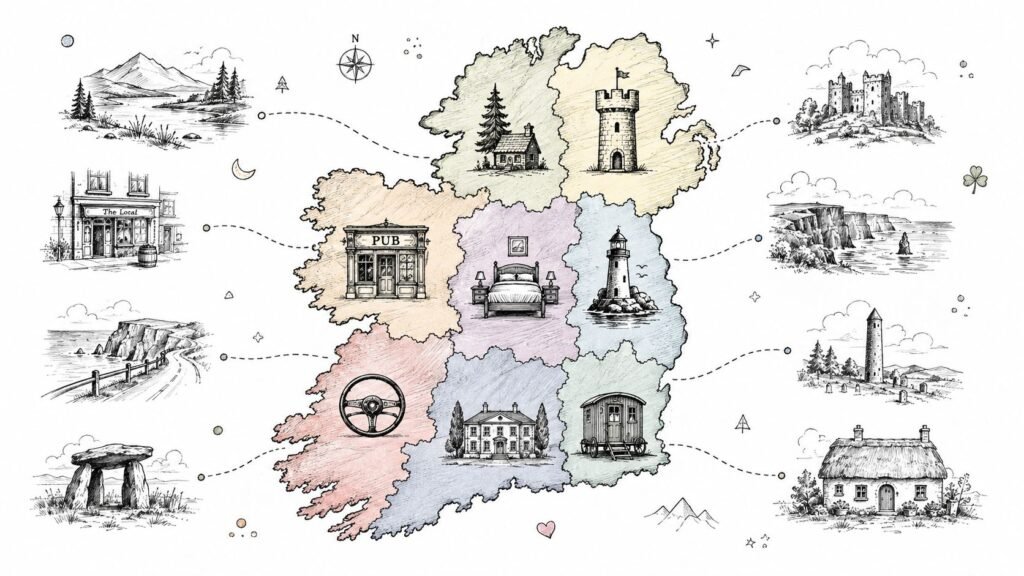
There isn't one universally best place to stay in Ireland. Dublin suits a first arrival and a culture-led break, Galway brings music and west-coast energy, Cork rewards food lovers, and Killarney makes a scenic circuit straightforward. Dingle and Beara are for travellers who want rugged Atlantic roads, while Waterford offers history and a quieter coastal rhythm. Even Galway and Clifden, often treated as interchangeable, work very differently once you consider driving time, road confidence and trip length.
Use the recommendations below as route decisions, not a generic town ranking. Each base includes its strongest travel purpose, its practical drawbacks and the length of stay it deserves. Ireland's official tourism guide divides the island into six marketed regions, including the Wild Atlantic Way, Ireland's Ancient East, Ireland's Hidden Heartlands, Dublin, Belfast and Northern Ireland, so choosing a region first gives your road trip a useful shape rather than leaving you to zigzag between famous names. Ireland's official destination guide provides the broader regional context.
For travellers who want the freedom of a self-drive holiday without building every overnight stop themselves, BTOURS offers carefully planned Ireland journeys with handpicked accommodation and flexible pacing. The right base is the one that lets you enjoy the scenery instead of rushing through it.
1. Dublin
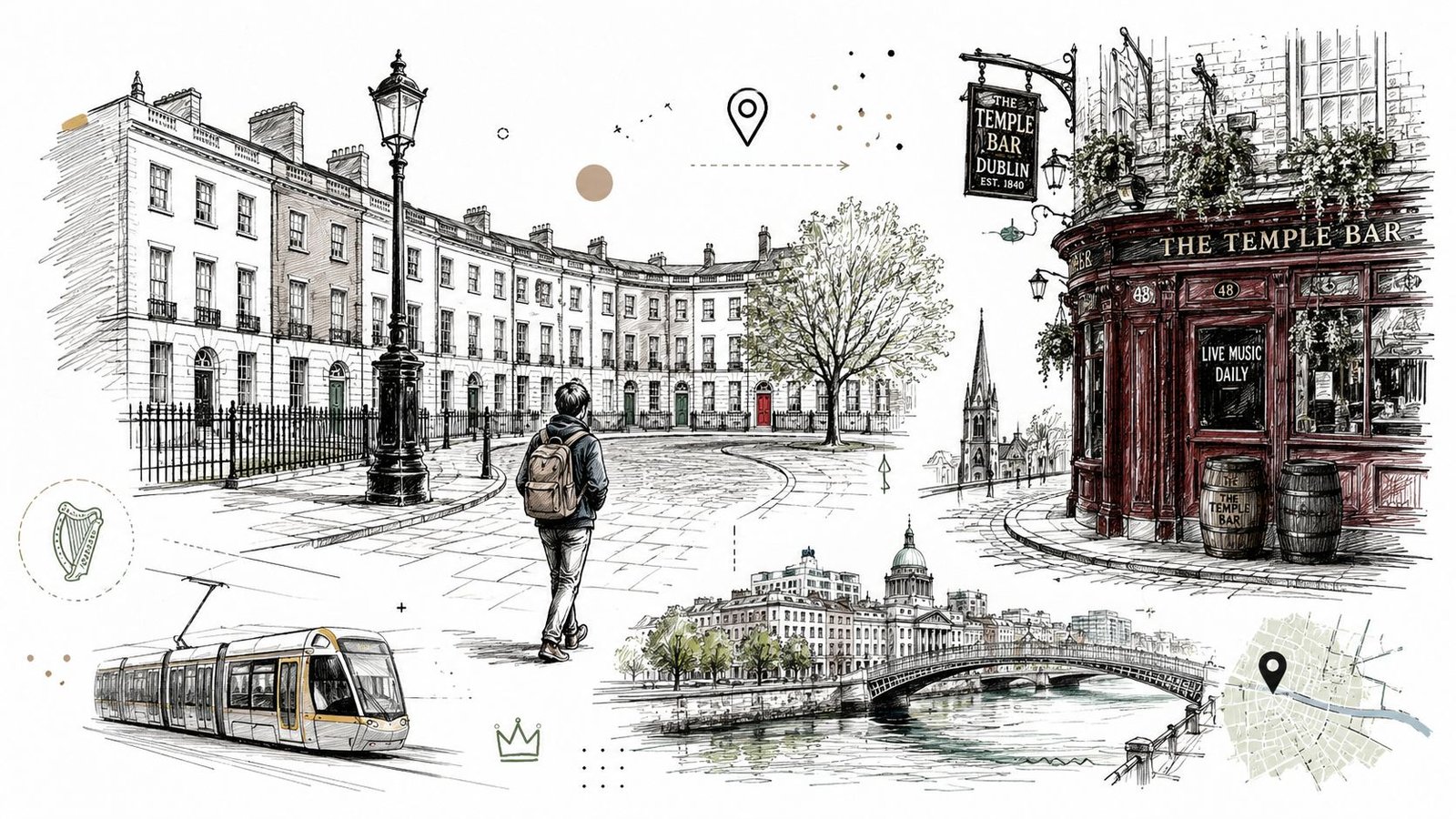
Dublin is the best place to stay in Ireland for a soft landing, especially if you want literary culture, Georgian architecture, museums and lively pubs before taking to the open road. The centre is compact enough for walking, yet the capital also works as a launch point for Wicklow, Glendalough and the east coast. It gives you a strong first impression of Ireland without requiring an immediate long drive after arriving.
Stay in Stoneybatter if you want a neighbourhood feel, independent cafés and traditional pubs beyond the most crowded visitor streets. Temple Bar is worth seeing, but it's a poor choice for every evening. Look for traditional music sessions in established local pubs where the atmosphere feels less staged and more connected to Dublin life.
Why Dublin works as a driving base
Collect your vehicle at Dublin Airport rather than handling city-centre collection. Spend your first day walking, then use the car for Wicklow and the surrounding countryside. Glendalough and the Wicklow Mountains make a rewarding escape, with wooded valleys, mountain scenery and historic sites close enough for a practical day trip.
Parking is the main compromise. Use secure Park Rite car parks while exploring on foot, and don't plan to drive between every central attraction. Visit Trinity College early in the morning, then walk towards the museums, Georgian squares and riverside streets.
Practical rule: Treat Dublin as a walking city first and a driving gateway second.
June, July and August bring strong demand, so reserve accommodation early. Inbound visitors stayed 51.1 million nights in Ireland in 2023, and hotels were the primary accommodation type for 42.4% of visitors, according to the CSO's inbound tourism findings. That makes Dublin a particularly sensible choice when you value hotel choice, transport connections and an easy first or final stop.
For a planned self-drive route, compare options for affordable Dublin car rental. Allow two or three nights for the capital, then continue towards Wicklow, Kilkenny or the west.
2. Galway and Connemara
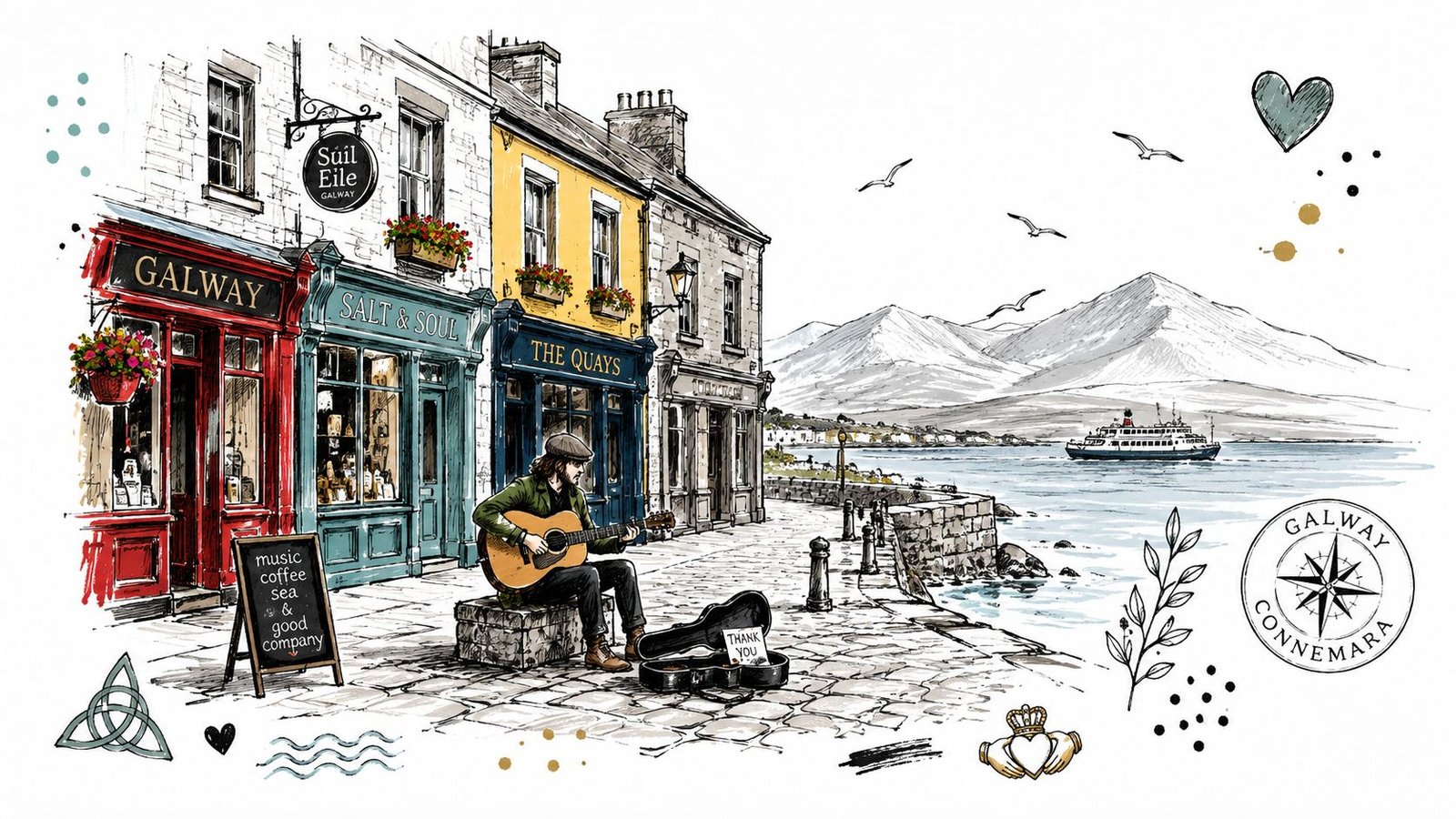
Choose Galway when you want west-coast atmosphere with a proper city base. Colourful streets, buskers, galleries, seafood and traditional music give Galway an energy that feels distinctly Irish without becoming too large to manage. It's the right choice for a trip that combines social evenings with day drives into Connemara.
Galway works best for a stay of several nights. From here, you can make a loop through Connemara, visit Kylemore Abbey, reach the coast around Clifden and arrange a ferry trip to Inishmore. You'll have more accommodation, restaurants and evening options than in a remote village, which matters after a full day on winding roads.
Galway or Clifden
Galway is better for shorter west-coast visits, evening life and first-time drivers. Clifden is better when the scenery itself is the priority and you want to wake close to Connemara's coastal roads. Don't confuse the two bases. Galway lets you return to a lively urban centre, while Clifden places you inside a quieter, more weather-exposed setting.
Family-run guesthouses suit Galway particularly well, giving you local conversation and a more personal welcome than a standard chain hotel. Book Aran Islands ferry tickets ahead during busy periods, and keep your itinerary flexible enough for weather changes. Coastal roads invite stops, and a route that looks short on a map can take much longer once you pull over for beaches, stone walls and mountain views.
Plan Connemara drives in daylight. The roads are winding, and the scenery can distract even confident drivers. Traditional sessions at Tí Neachtain or similar venues are a better evening choice than treating the city only as a daytime sightseeing stop.
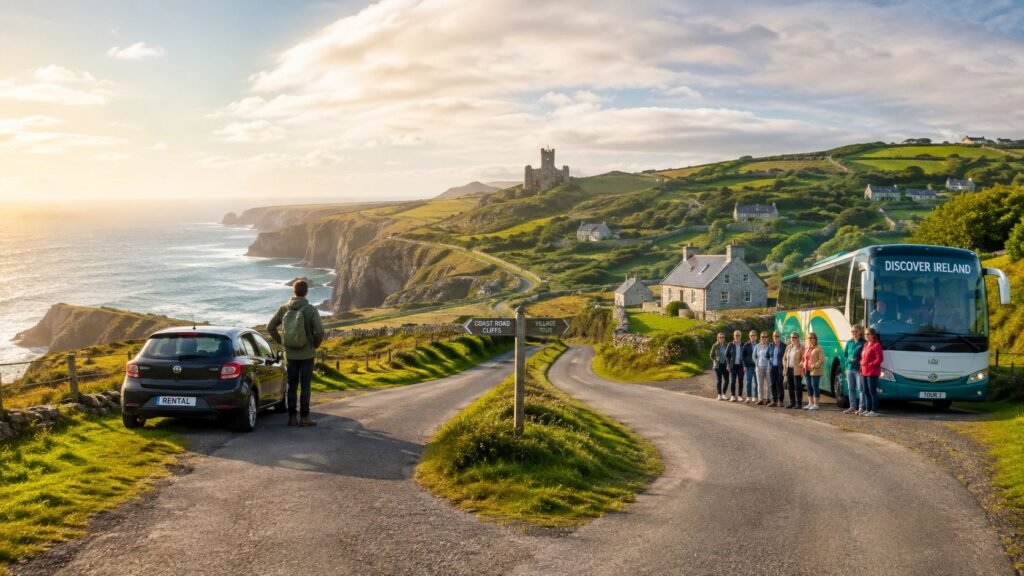
For a trip built around independent travel and scenic pacing, this visual guide to independent travel versus group tours in scenic Ireland reflects the kind of decision you'll make between a flexible road trip and a fixed programme.
Galway deserves three nights or more if you want both the city and Connemara. It's also a strong gateway into the Wild Atlantic Way, particularly for travellers who want comfort and choice before taking on more remote roads.
3. Cork City and South Coast
Cork is the best base for travellers who plan their days around food, harbour towns and southern coastal scenery. The city has an assured, independent character, while the surrounding roads lead quickly towards Kinsale, beaches and smaller communities. It's more than a convenient overnight stop. Cork gives you a city experience with a countryside and coast attached.
Start with the English Market, then explore Cork City Gaol for a historical perspective that adds depth to the region. A day drive to Kinsale combines colourful harbour views, galleries and excellent dining. Reserve dinner in advance if you're visiting at a busy time, especially if the meal is central to your itinerary.
Make Cork your food-led base
The Kinsale Harbour Loop is an ideal introduction to southern driving. It offers attractive coastal views without demanding the full commitment of a remote peninsula route. Continue towards Garretstown or Inchydoney Beach when you want a stronger Atlantic feel, and consider Clonakilty for a less obvious stop with a more local rhythm.
Cork works particularly well for travellers who want to alternate active driving days with easy urban evenings. You can spend the morning on the coast, return for a relaxed meal and still have access to cafés, cultural venues and accommodation with a broad range of styles.
Cork is the choice for people who want Ireland to taste as good as it looks.
The wider south is also supported by strong resident demand. In 2024, Irish residents took 36.7 million domestic overnight-trip nights, up 8.2% year on year, while the Southern region accounted for 43% of all overnight trips, according to the CSO Household Travel Survey. Cork belongs to the region that repeatedly attracts the largest share of domestic stays, though you should still expect popular coastal restaurants and guesthouses to fill quickly.
A Cork base suits two or three nights. Use it for a compact southern itinerary, or make it the urban beginning of a longer journey towards Kerry and the Atlantic coast. If you need airport comfort before or after the drive, consider booking Cork lounge access.
4. Dingle Peninsula
Dingle is for travellers who want the Atlantic at its most intimate and dramatic. The town gives you welcoming pubs, strong restaurants, craft shops and accommodation with local character, while the peninsula delivers archaeological sites, Irish-speaking communities and roads that constantly open onto the sea.
The defining drive is Slea Head. Begin early to reduce the chance of meeting large tour groups on the narrow route, and leave room for stops rather than treating the loop as a transfer. Ancient stone structures, small beaches and cliff-edge views make this a day for looking closely, not just collecting viewpoints.
Match Dingle to your confidence
Dingle is a better choice than Killarney when you want the road itself to feel like part of the experience. It demands more attention, particularly on narrow lanes and around the peninsula's bends. Rent a smaller vehicle if possible, and avoid packing each day with distant attractions.
Connor Pass adds mountain scenery and a different perspective on the peninsula, but weather can change quickly. Visit archaeological sites early when you want quiet reflection, then spend the afternoon exploring villages and local craft shops. The town is compact enough to enjoy on foot, so you won't need the car for every part of the stay.
Stay in Dingle for two or three nights. A single night can work in a tightly planned route, but it leaves little room for weather, slow driving or an unplanned conversation that turns into the best memory of the day. Rural accommodation is limited compared with Dublin or Cork, and peak-season rooms should be reserved well ahead.
Ireland's accommodation supply is substantial overall, with Fáilte Ireland estimating about 359,000 bed places by Q3 2025, but that national scale doesn't guarantee easy availability on a remote peninsula. The Business of Tourism report is useful context for understanding accommodation supply and demand across Ireland.
5. Killarney and Ring of Kerry
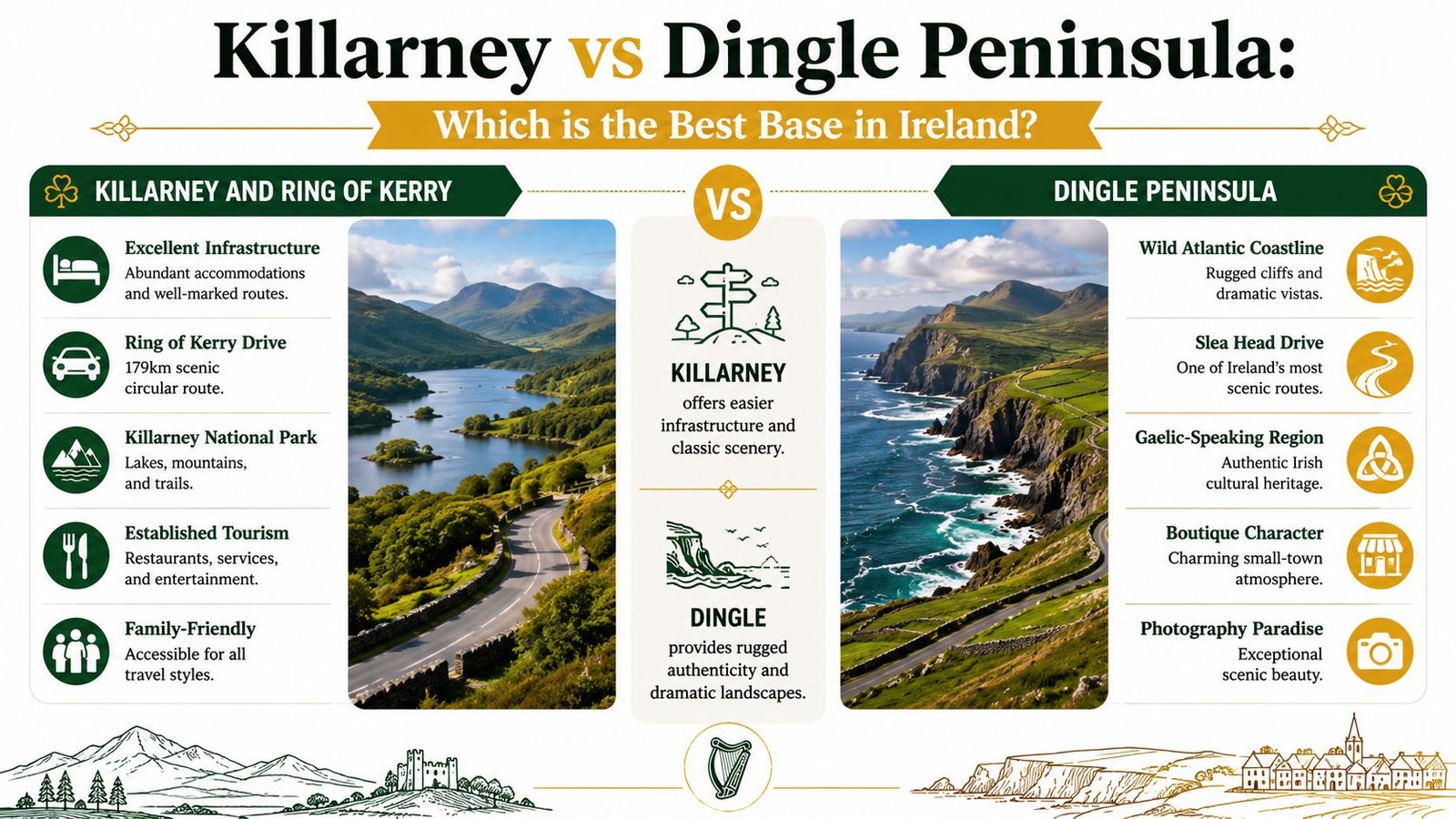
Killarney is the best place to stay in Ireland for an easy, classic scenic circuit. The town has a deep tourism infrastructure, plentiful places to eat and straightforward access to lakes, mountains and Killarney National Park. It's busier than Dingle or Beara, but that convenience is exactly why it suits first-time self-drivers and families.
The Ring of Kerry forms a 179km circular self-drive route, and it deserves a full day if you want to stop properly. Drive counter-clockwise to reduce the likelihood of being caught behind large tour buses, and leave early, ideally around 7 to 8am, for better light and a calmer start. These route details are practical recommendations, not reasons to rush. The best sections often come from pulling over at a viewpoint or taking a short walk.
What to do beyond the ring
Muckross House and Estate adds cultural context to the scenery, while Killarney National Park provides walking trails when you need a break from the car. The Gap of Dunloe offers mountain-pass views and lake vistas, although road conditions require patience.
Killarney also works as a launch point for day trips to Dingle or Beara, but don't attempt to treat every peninsula as a casual add-on. Their roads deserve time, and returning to Killarney after a long loop can turn a beautiful day into an exhausting one.
Book accommodation two to three months ahead for peak-season travel. Regional Ireland averaged 72% hotel occupancy in 2025, compared with 84% in Dublin, while regional ADR was €168 and RevPAR €121, according to the Irish Hotels Federation market update. These figures don't predict the price of a particular Killarney room, but they show why strong regional hubs can offer a useful balance of demand, choice and value.
Best fit: Choose Killarney when you want dramatic scenery with the least logistical friction.
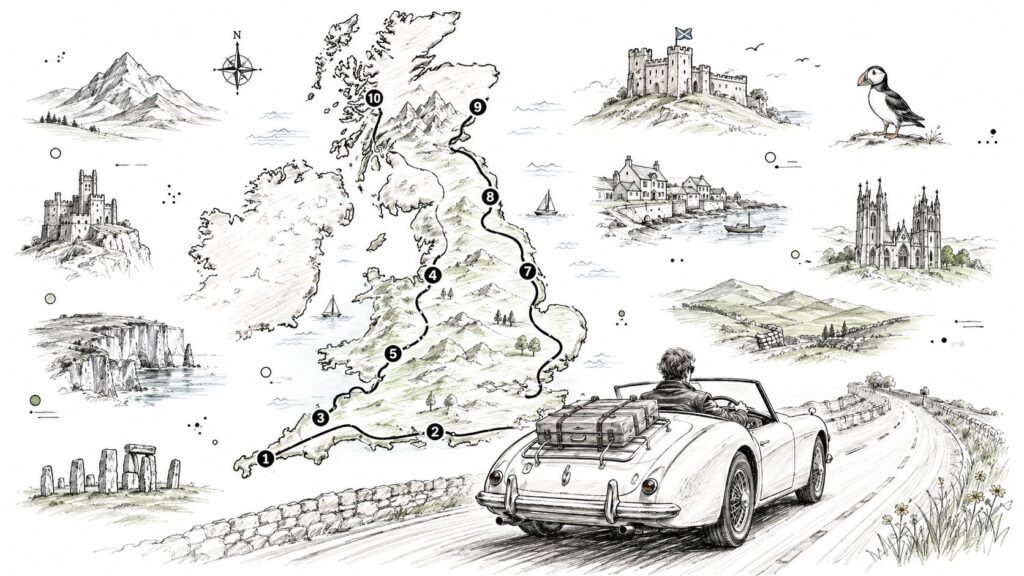
Give Killarney three nights for the Ring of Kerry, the national park and a second scenic day. This road-trip comparison resource is relevant if you're weighing a structured route against a more improvised drive.
6. Clifden and Connemara Coast
Clifden is the right base when you want to sleep inside the Connemara region, not just visit it from Galway. This coastal village gives you immediate access to mountain passes, Atlantic beaches, rural roads and the Sky Road. It's quieter, more exposed and more dependent on careful driving than Galway, which makes it a stronger choice for travellers with time and confidence.
The Sky Road is the signature outing. Drive it around golden hour for softer light and expansive coastal views, but check the weather before setting off. Atlantic conditions can change quickly, and a clear morning may become misty or wet by afternoon.
A remote base with real rewards
From Clifden, drive towards Letterfrack and Connemara National Park, then build in time for walks and visitor-centre context rather than trying to cover every road in one day. Single-track mountain roads slow the journey, and that's part of the appeal. You're travelling through an environment where the route matters as much as the destination.
Clifden's pubs are central to the experience. Choose a traditional venue for music and conversation, then keep the next morning unhurried. Guesthouses, small hotels and self-catering properties often feel more connected to the surrounding community than large city accommodation.
Choose Clifden for landscape immersion, not convenience.
The distinction matters for trip length. Galway can work as a compact west-coast stop, while Clifden deserves two or three nights if you want Connemara's coast, national park and mountain roads without constant packing. Reserve early for peak season because the accommodation pool is smaller than in Galway.
Pack waterproof layers and footwear suitable for changing conditions. Don't rely on a perfectly timed sunset, and don't plan a demanding drive after dark. Clifden is the better base for confident drivers who enjoy remote scenery and are happy to let weather shape the day.
7. Waterford and Southeast Coast
Waterford offers a quieter alternative for travellers who want medieval history, coastal villages and unhurried countryside driving. As Ireland's oldest city, it gives you a strong historical anchor, while the surrounding southeast opens into fishing harbours, clifftop roads and farmland. It's a particularly good choice when you want to get beyond the most heavily visited western routes.
Start in the Viking Triangle, ideally with a guided walking tour, then visit Waterford City Museum for additional historical context. The city is easy to combine with an afternoon meal and an evening without needing to move the car repeatedly.
Drive the Copper Coast slowly
The Copper Coast is the defining scenic route. Drive it during daylight, when the cliffs, coves and changing sea views are easiest to appreciate. Dunmore East makes a worthwhile coastal stop, especially early in the morning when the harbour is active and the fishing fleet is returning.
Inland, the Suir River valley offers a different Ireland, with rolling farmland and roads that feel less associated with headline attractions. Add time for these drives rather than filling every hour with named sights. Local restaurants with fresh seafood complete the southeast experience, particularly after a coastal day.
Waterford works for two nights, or longer if you're combining it with Wexford, Kilkenny or the wider Ireland's Ancient East. It's a practical base for travellers who prefer a calmer pace and want a regional city rather than a resort town.
The accommodation choice also depends on stay type. CSO data for March 2025 recorded hotels as the main accommodation for 43.0% of overseas visitors, while 40.3% stayed in their own property or with family and friends, and 4.8% used rented or self-catering accommodation as their main type. The CSO inbound tourism release shows why a city base such as Waterford can suit travellers who want reliable hotel access, while a longer rural route may justify looking for a more independent property.
Choose Waterford when history matters as much as scenery and you'd rather discover the coast without following Ireland's busiest touring pattern.
8. Beara Peninsula
Beara is the best base for rugged Atlantic immersion and genuine road-trip solitude. The peninsula sits between Cork and Kerry, with mountain passes, fishing villages, hidden beaches and roads that demand concentration. It rewards travellers who want scenery that feels remote and who don't mind trading convenience for atmosphere.
Castletownbere is a strong anchor for exploring the peninsula, while a circular drive reveals the changing relationship between mountains and sea. The route is not about reaching a single famous attraction. It's about stopping at villages, viewpoints and beaches that invite you to slow down.
Beara needs patience
Rent a small, manoeuvrable vehicle. Narrow mountain roads leave little room for hesitation, and daylight driving is the sensible choice, particularly in winter. Research road conditions before setting out, check the forecast and keep your schedule loose enough to turn around when conditions deteriorate.
Accommodation is limited, so reserve four to five months ahead for peak-season travel. A full peninsula loop can take four to five hours for 45km with stops, according to the practical route guidance for this journey. That isn't a timetable to race against. It's a reminder that distance means little on Beara's roads.
Beara suits the driver who sees a slow road as the point of the holiday.
Stay for two or three nights if you want to explore properly. A single night gives you a glimpse, but it forces you to compress the very qualities that make Beara special. Pack weather-appropriate clothing, leave room for spontaneous stops and expect Atlantic exposure rather than dependable sunshine.
Beara also provides a useful contrast with Cork. Cork gives you restaurants, urban culture and easier road access. Beara gives you silence, distance and a stronger sense of remoteness. Choose between them according to your confidence behind the wheel and your tolerance for limited accommodation, not just according to which scenery looks more dramatic in photographs.
Top 8 Places to Stay in Ireland, Comparison
| Destination | Accessibility & transport | Resource requirements | Expected experience | Ideal use cases | Key advantages |
|---|---|---|---|---|---|
| Dublin | Very easy, major airport, frequent public transport, car rental available | Low–Moderate, wide accommodation range; book in summer | Urban culture, Georgian architecture, lively pubs, easy short drives | 2–3 day city base; start point for self-drive routes | Extensive services, flight connections, cultural landmarks |
| Galway and Connemara | Moderate, good road links and ferry access to Aran Islands | Moderate, car recommended; guesthouses common; book seasonally | Bohemian city vibe plus rugged Connemara coastline and mountains | Multi-day self-drive of Connemara; music and seafood-focused stays | Authentic culture, gateway to Connemara and islands |
| Cork City and South Coast | Moderate, regional airport, good road access; car useful for coast | Moderate, strong restaurant scene; book Kinsale dining in advance | Sophisticated urban charm, culinary highlights, nearby coastal drives | Food-centric trips; short coastal drives to Kinsale and beaches | Renowned culinary scene and relaxed regional character |
| Dingle Peninsula | Challenging, narrow, winding coastal roads; remote sections | High, small/maniouvrable vehicle advised; accommodation books early | Dramatic Atlantic coastline, archaeology, Gaelic-speaking communities | Scenic drives (Slea Head), photography, authentic cultural immersion | Rugged landscapes, minimal traffic, strong local character |
| Killarney & Ring of Kerry | Moderate, excellent tourist infrastructure; well-marked routes | Moderate, abundant accommodation but busy in peak season | Iconic mountain and lake scenery, established circular drive (Ring of Kerry) | Family-friendly self-drive, classic scenic loop, hiking in national park | Well-developed services, easy navigation, varied scenic stops |
| Clifden & Connemara Coast | Challenging, remote coastal and single-track roads | Moderate–High, limited options; book ahead for peak months | Pristine Atlantic beaches, Sky Road panoramas, quiet village life | Photography, off-the-beaten-path self-drives, Connemara exploration | Undiscovered coastal scenery and panoramic drives |
| Waterford & Southeast Coast | Moderate, smaller city hub; car recommended; nearest major airport Cork | Low–Moderate, reasonable prices and service levels | Medieval history, Waterford Crystal, scenic southeast coastal routes | Historical city breaks plus quieter coastal drives | Rich heritage, less crowded coastal experiences |
| Beara Peninsula | Challenging, very remote, narrow mountain and coastal roads | High, very limited services; early booking and small vehicle needed | Exceptionally dramatic, rugged coastal and mountain scenery | Adventurous self-drivers, nature photography, secluded stays | Highly photogenic, authentic and uncrowded landscapes |
Build the Ireland Stay That Fits Your Journey
The best Irish base depends on the kind of days you want to remember. Choose Dublin for culture, literary heritage, a gentle arrival and a final night with straightforward airport access. It's the most comfortable starting point if you're adjusting to left-side driving, and it gives you excellent walking before you collect the car or head towards the countryside.
Choose Galway when you want music, restaurants and west-coast character with practical access to Connemara. It's the better choice for a shorter visit or for travellers who want a lively evening base. Choose Clifden when the coast, mountains and rural roads matter more than city life. Clifden needs more driving confidence and rewards a slower itinerary.
For food and the South Coast, choose Cork. The city supports memorable meals, while Kinsale, Inchydoney, Garretstown and the smaller villages create a varied self-drive route. Cork is a stronger fit than Beara when you want comfortable logistics, more dining choice and a balance between urban and coastal experiences.
Choose Killarney for the easiest introduction to Ireland's famous scenic circuits. It has established tourism infrastructure, access to the national park and a clear base for the Ring of Kerry. You'll encounter more visitors, but you'll also find the planning simpler. If you want a more intimate and demanding Atlantic experience, choose Dingle. If you want the most remote feeling and are comfortable with narrow roads, choose Beara.
Waterford is the choice for history and quieter coastal discovery. The Viking Triangle, Copper Coast and Dunmore East create a strong southeast route without requiring you to follow the most familiar western itinerary.
Build around driving confidence and available days
A short trip should favour connected bases with plenty of accommodation and evening choice. Longer trips can justify Clifden, Dingle or Beara, where the reward comes from staying close to the natural scenery rather than spending every day transferring between regions. The CSO recorded 2.3 million domestic overnight trips in the Southern region in Q3 2025, when that region represented 49% of all domestic overnight trips, reinforcing the south and southwest as particularly established areas for Irish stays. The CSO travel survey provides that regional demand context.
Reserve scarce rural accommodation early, especially for Dingle, Clifden and Beara. City hotels and larger regional centres give you more flexibility, but popular coastal bases can narrow quickly during summer. Revenue confirms that guest and holiday accommodation uses the reduced VAT rate irrespective of the duration of the stay, a pricing rule explained in its accommodation VAT guidance. Hosts should also understand Revenue's €40,000 per annum threshold for the supply of services from 01 January 2024, as outlined in its technical tax guidance.
Your route should have a rhythm, not just a collection of pins. Pair a city with a peninsula, give scenic loops a full day and avoid changing accommodation every night. BTOURS can turn these regional choices into a flexible Ireland self-drive itinerary with handpicked hotels, B&Bs and guesthouses, planned pacing and support from the first route decision to your time on the road. For broader thinking about how destinations communicate their character, these Samba destination marketing insights offer useful context.
Choose the base that matches your priorities, then let the route grow from it. Ireland is at its best when you leave enough time for weather, conversation, music, food and the unexpected turn that makes a carefully planned journey feel personal.
BTOURS creates Ireland self-drive journeys with personalised routes, flexible pacing and carefully selected hotels, B&Bs and guesthouses matched to your travel style. Visit BTOURS to start shaping an Ireland itinerary around the bases and regions you most want to experience.