TRAVEL STORIES & GUIDES
Road Trip Northern Ireland: A Realistic Route Plan
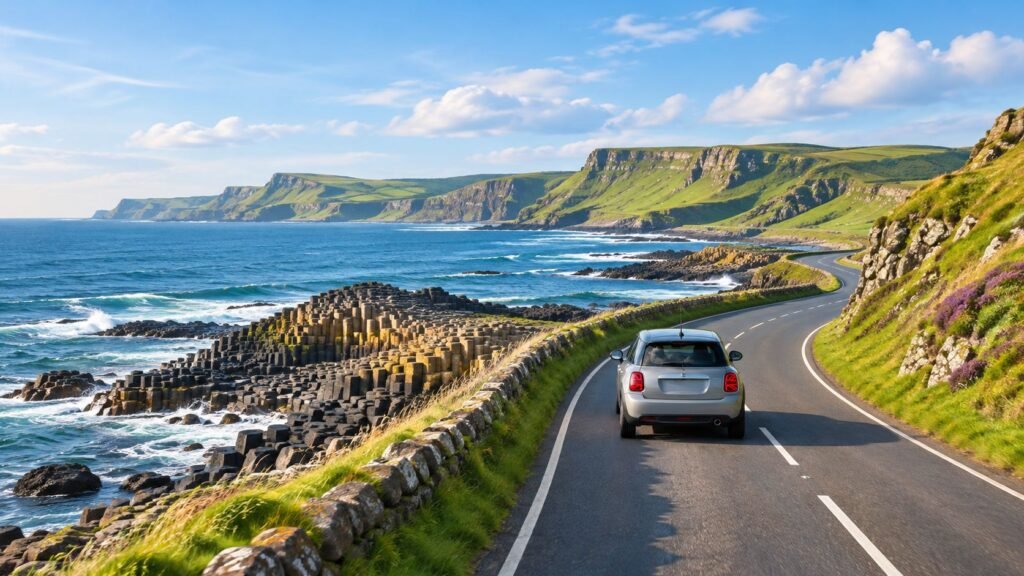
The usual advice for a Northern Ireland road trip starts with a list of attractions. That's the wrong starting point. Belfast, the Causeway Coast and the Fermanagh lakes can all belong on the same journey, but only when the overnight stops and arrival arrangements leave enough time to enjoy them.
The route shape comes first, the sightseeing second. A satisfying trip connects places without turning every afternoon into a race towards the next hotel. That means treating the ferry arrival as a travel day, choosing bases beyond the coast and leaving something off the list.
Pick a Route Shape That Fits Your Days
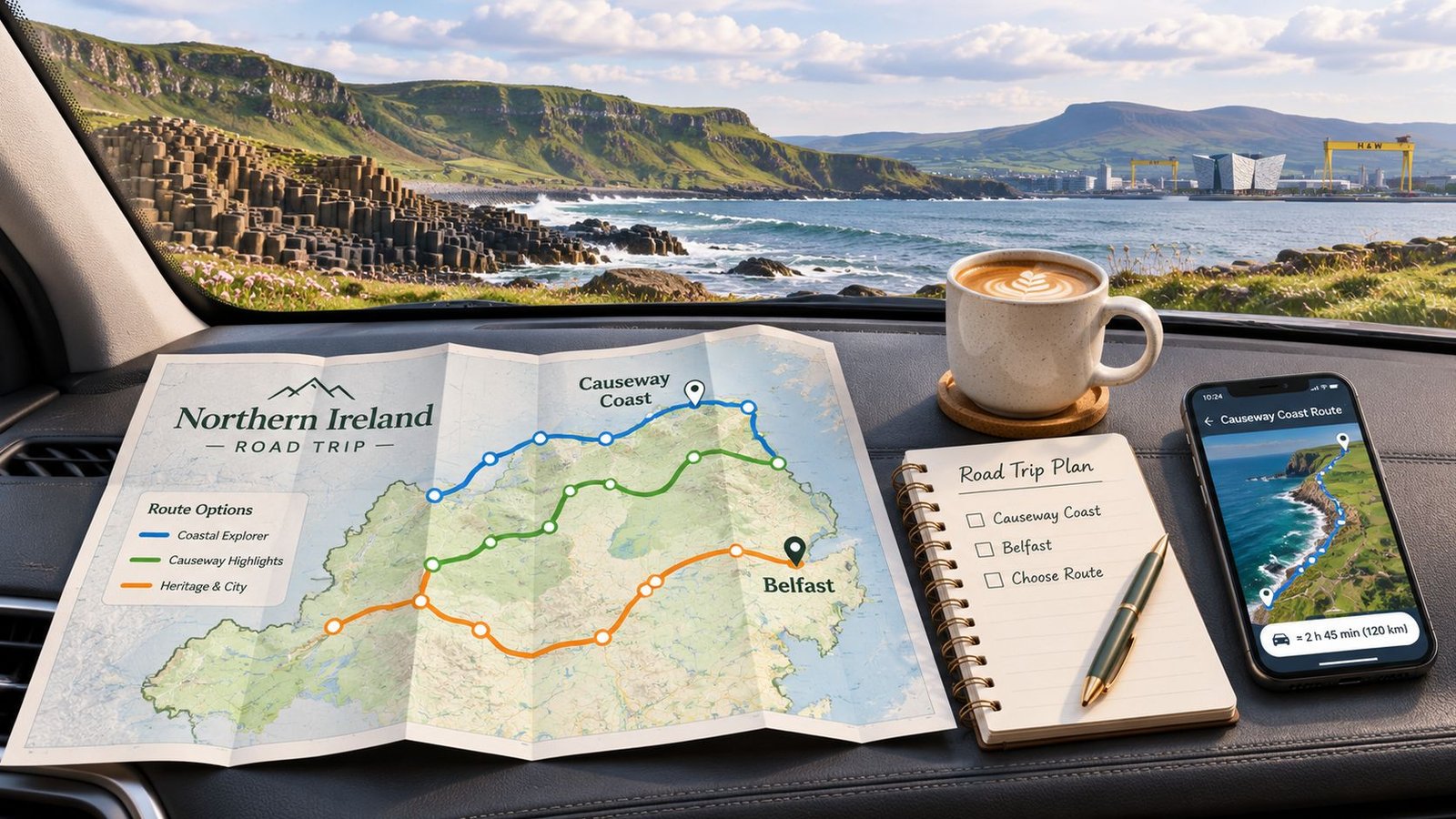
The most useful starting choices are a north-coast loop, a coast-and-lakes circuit, or a broader loop through County Down. The following are suggested planning templates, not timed itineraries. Driving bands are allowances to aim for when selecting accommodation, rather than promises about particular roads.
Route shapes, overnight bases and daily driving by trip length
| Trip length | Route loop | Overnight bases | Typical daily driving |
|---|---|---|---|
| 3 days | Belfast and the Causeway Coast | Belfast, Portrush or Portstewart | Aim for roughly 1.5 to 2 hours, with longer coastal days |
| 5 days | Adds Derry~Londonderry and the Fermanagh lakes | Belfast, Portrush, Derry~Londonderry, Enniskillen | About 2 hours with one longer transfer |
| 7 days | Five-day loop plus the Mournes and the Ards Peninsula | Belfast, Portrush, Derry~Londonderry, Enniskillen, Newcastle | Aim for roughly 1.5 to 2 hours on local days, with longer connecting transfers |
The bases listed are options along each loop, not a requirement to sleep in every town. On the shorter circuits, changing accommodation every night can consume the time supposedly saved by driving closer to the next attraction.
Match the loop to usable days
The north-coast option works best when Belfast sightseeing sits outside the main driving days. With an arrival afternoon and an early departure inside the same short break, a coastal base and a selective route are more realistic than a complete circuit.
Adding Derry~Londonderry and Enniskillen creates a different journey, not just a longer coastal drive. It introduces a westward transfer and makes the final return important. Including Newcastle, the Mournes and the Ards Peninsula requires similar discipline: extra days shouldn't automatically become extra stops.
Map-app estimates can mislead on the Causeway road because uninterrupted driving isn't the experience most visitors want. Bends, villages, parking searches and the decision to stop for a view all extend the day.
Planning test: For these sample itineraries, a day approaching three hours behind the wheel is a reason to move an overnight stop or remove an attraction.
Luggage also affects the ease of changing bases. A small overnight bag avoids unpacking the entire boot at each hotel; Urban Totes' weekender bag packing tips offer useful ways to separate frequently needed items from the main luggage.
Choose Stops That Fit the Route Shape
A good sightseeing day has an anchor stop and a droppable option. Booking several timed visits along the same scenic road removes the freedom that makes a self-drive journey worthwhile.
For the north-coast loop, leave Belfast along the coast through Carrickfergus and Glenarm, with Glenariff Forest Park as the main walking stop. These places form a route, not an obligation to park at every turn. Belfast deserves its own allocation of time, and the Belfast must-see guide can help separate city sightseeing from the coastal departure.
Match the stops to the available space
- North-coast day: Make the Giant's Causeway the anchor, checking visitor-centre booking arrangements before committing. Add Dunluce Castle if time allows; the Dark Hedges, inland from the coast, is the optional detour rather than another fixed appointment.
- Westward extension: Continue past Mussenden Temple above Downhill Strand towards the walls of Derry~Londonderry. On a short trip, combining both with the inland return to Belfast creates a substantial final day, so Derry is the first major addition to reconsider.
- Fermanagh extension: From Enniskillen, choose between a Marble Arch Caves visit and a longer outdoor commitment such as the Cuilcagh boardwalk. Castle Coole provides another possibility, subject to current access and opening arrangements.
- County Down extension: Pair Mount Stewart with Strangford Lough, then use Newcastle for time beneath the Mournes. An inland journey around the lough avoids making a boat crossing essential to the schedule.
A Sperrins crossing towards Cookstown can suit the longer itinerary, but it's a deliberate scenic diversion, not the automatic route between Derry and Enniskillen.
For exposed outings such as Carrick-a-Rede, boat crossings or Cuilcagh, confirm operating conditions before setting out. High winds can disrupt access. The alternative should already have a name: a Bushmills stop instead of the rope bridge, Enniskillen instead of the boardwalk, or the inland Belfast route instead of another coastal detour.
Choose Overnight Bases Beyond the Causeway Coast
An attractive hotel isn't necessarily a useful road-trip base. The better choice is the place that makes the following morning easy and the previous evening restful.
According to Tourism NI's 2025 local-area summary, 70% of Northern Ireland's overnight trips took place outside Belfast, while Causeway Coast and Glens accounted for about 23% of overnight trips. That shows the coast's importance, but it doesn't establish where accommodation will be hardest to book on particular dates.
For the longer sample circuits, spreading nights across at least three bases can reduce backtracking. It isn't automatically worthwhile on the shortest trip, where another check-in may cost more time than it saves.
Judge the base, not just the bedroom
- Morning access: Check the actual road to the first planned stop. A property that looks close across a lough or mountain ridge may require a much longer drive.
- Walkable dinner: Confirm that somewhere suitable will serve food after arrival. A rural stay loses some appeal if the driver must head back out after checking in.
- Overnight parking: Ask whether parking is on-site, allocated or on the street, and whether luggage can be unloaded near the entrance.
Portrush or Portstewart works for a concentrated coastal stay. Enniskillen shifts the emphasis towards Fermanagh's lakes, while Newcastle supports a Mournes-focused finish. Cookstown, Omagh, and towns around Ards and North Down deserve consideration when their location suits the chosen route, rather than because they're less familiar.
The guide to choosing a place to stay in Ireland offers a broader basis for comparing town stays with rural accommodation.
Design for a disrupted afternoon
Northern Ireland's official severe-weather guidance warns that strong winds and heavy rain can cause flooding, fallen trees, debris and road or bridge closures; exposed roads and high-sided vehicles are particularly vulnerable to crosswinds.
Weather resilience belongs in the accommodation plan. Keep the longest rural transfer away from forecast warning periods where possible, preserve daylight for unfamiliar roads, and postpone travel when authorities advise it. A flexible half-day is more useful than a viewpoint that must be reached before the next check-in.
Before booking each base, record the nearest supermarket, the check-in deadline and an indoor option for a wet afternoon. Those details often matter more than another photograph of the room.
Plan Arrival Day Around the Ferry and First Night
The first decision after choosing a sailing is whether the driver should continue towards the coast or stop near the arrival port. The answer depends on alertness and arrival time, not enthusiasm.
Tourism NI's ferry passenger update recorded a 4% increase in passengers travelling to and from Northern Ireland in January to June 2025, compared with the same period in 2024. Sea arrival deserves a proper place in the itinerary, especially for travellers bringing their own car.
From disembarkation to dinner
Consider a couple arriving after an early start and a ferry crossing. They've booked a coastal cottage because the map suggests an achievable onward drive, but the sailing is delayed and the accommodation's kitchen arrangements are unclear. The problem isn't the distance alone: it's fatigue, darkness and the lack of an easy stopping point.
A short onward hop towards Belfast may be reasonable when the driver is rested. A late arrival followed by unfamiliar rural roads argues for a nearby first night instead.
For a hypothetical arrival after 18:00, keeping onward driving below about two hours is a planning ceiling, not a recommendation to drive while tired. A fatigued driver should stop sooner.
Check whether the sailing arrives at Belfast or Larne before selecting accommodation. Drive on the left, review the sat-nav route before leaving the terminal, and reject unnecessary minor-road shortcuts rather than following them automatically.
Confirm the latest check-in time and whether food will be available. A hotel accepting late arrivals doesn't necessarily mean its kitchen serves late.
Ferry travel can make luggage easier than flying, particularly with an owned vehicle, but that convenience doesn't remove the fatigue cost. With separately arranged car hire, collection arrangements need their own allowance.
If the sailing is delayed, contact the accommodation and any affected booking before cancelling anything; don't assume a cancelled reservation can be reinstated. Keep the Causeway visit for the following day.
Arrival-day plan: disembark, assess the driver's alertness, reach an easy first-night base, eat and rest.
Speed Limits and Rules to Know Before You Drive
A continuous road journey across the Irish border doesn't mean a continuous system of speed signs. Northern Ireland uses miles per hour, while the Republic of Ireland uses kilometres per hour, as explained in nidirect's speed-limit guidance.
Speed limits for cars and towing vehicles in Northern Ireland
| Road type | Ordinary car (mph) | Towing caravan or trailer (mph) |
|---|---|---|
| Built-up areas | 30 | 30 |
| Single-carriageway roads | 60 | 50 |
| Dual carriageways and motorways | 70 | 60 |
The ordinary-car figures above are the standard maximums in the linked speed-limit guidance; the towing limits are set out in nidirect's road-safety guidance for visitors, which also prohibits towing vehicles from the outside lane of motorways with three or more lanes.
Read the road as well as the sign
A legal maximum isn't a target speed. Wet bends, low sun, tractors, walkers and restricted visibility can all require a much slower pace. A rural road may carry a national limit without offering anything like a comfortable drive at that speed.
Street lighting generally signals a built-up-area limit unless signs indicate otherwise, and some towns have lower signed limits. Drivers should look for changes rather than infer the permitted speed from how wide or quiet the road appears.
Towing also changes the practical itinerary. More space is needed for turning and parking, and a scenic stop that works for a car may offer no sensible place to manoeuvre a caravan. Accommodation access should be checked before payment, not discovered at the entrance.
A clear road ahead doesn't make an unsuitable speed safe, particularly where the next bend conceals a walker or farm vehicle.
Northern Ireland has its own road-safety legislation and Highway Code, as explained in the official introduction to the Northern Ireland Highway Code. Anyone continuing into Donegal or elsewhere in the Republic should also read its Rules of the Road.
The guide to driving in the UK provides broader preparation for visitors unfamiliar with left-side driving. The visitor guidance cited above also sets the minimum car-driving age at 17 and requires occupants to wear fitted seatbelts in both front and rear seats; car-hire eligibility remains a separate matter.
Check Roads and Weather Before Each Driving Day
A road-trip plan needs a repeatable morning check, not just a route saved before leaving home. The checks should cover the whole driving day, including the exposed stretch scheduled for late afternoon.
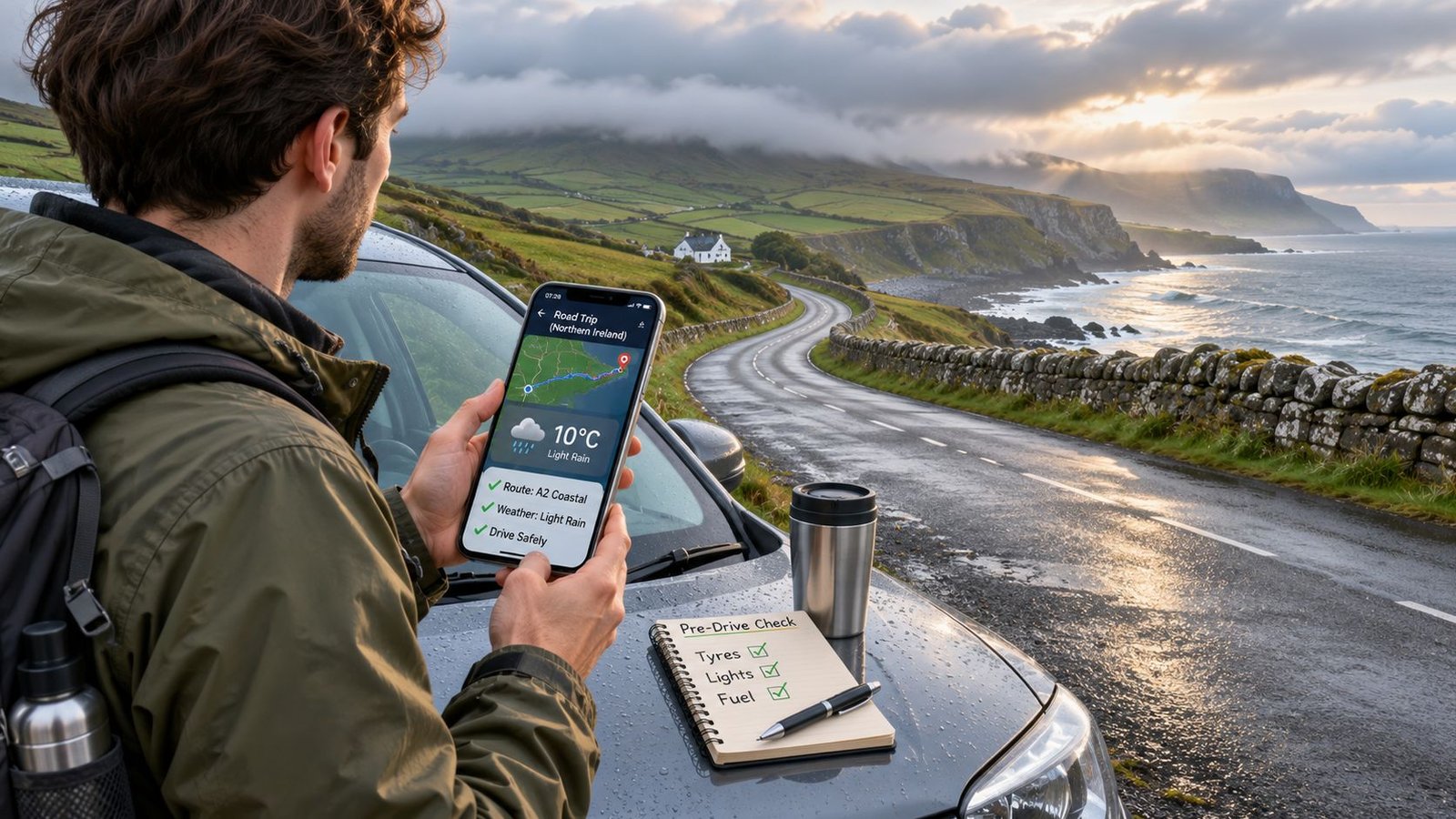
The official Northern Ireland travel and roads guidance directs travellers to TrafficwatchNI for current traffic information and cameras. The Department for Infrastructure can impose planned and emergency closures, including for road subsidence and dangerous structures, so yesterday's clear route isn't a guarantee.
A departure procedure that works on rural roads
Map the whole day. Mark coastal stretches, bridges, rural single-carriageway sections and planned works. Identify an inland alternative before leaving, using Ordnance Survey NI maps where the arrangement of smaller roads isn't clear.
Check TrafficwatchNI immediately before departure. Read the traffic bulletins and closure notices, then inspect relevant cameras. A camera helps assess what's visible at that location; it doesn't prove the entire route is clear.
Read the Met Office forecast for the places being visited. Check wind and rain along the coast rather than relying only on the forecast for the overnight town. Pay attention to warning periods that overlap the intended journey.
Reassess before the remote segment. A lunch stop or fuel stop is a useful decision point. If access has changed, switch to the prepared alternative while a straightforward junction is still available, rather than continuing towards a closure.
Follow temporary signs on the road. Navigation software may suggest a smaller lane when the main route closes. Official diversion signs take priority over an automatic recalculation, especially where vehicle width or local access could become a problem.
As a worked planning allowance, adding at least 20 minutes to each leg creates some breathing room for an unexpected delay. It's not a forecast of traffic conditions, and longer disruption may still require dropping the optional stop.
When the coast closes at lunchtime
Suppose the morning's coastal outing finishes normally, but a closure appears before the onward drive. Stop somewhere safe, check the current notice and use the inland alternative written into the plan.
That might mean abandoning a final viewpoint and heading towards the overnight base. If no safe alternative remains, contact the accommodation and wait for official advice rather than treating an unclassified lane as an improvised escape route.
Book Your Bases and Confirm the Route
Book the journey's fixed points before filling the gaps. The arrival-night bed and departure-night location determine whether the route works; the remaining accommodation should connect them without creating an avoidable rush.
Start with the chosen trip length and pencil in the overnight towns. Check the actual arrival and departure times against that outline before paying for attractions. A late ferry arrival and an early flight home leave less touring time than the calendar suggests.
Settle the beds, then the vehicle
- Arrival night first: For a ferry journey, secure a manageable first stop with compatible check-in arrangements. Assess cancellation terms alongside location.
- Middle nights next: Choose accommodation that supports the intended morning activity, rather than an appealing room on the wrong side of the route.
- Departure night deliberately: Stay within a comfortable journey of the relevant port or airport, allowing for check-in requirements and possible disruption.
- Car arrangements explicitly: Establish whether the vehicle is owned, hired separately or provided through a package. Check insurance, excess, named drivers and any cross-border permissions before the balance falls due.
A BTOURS self-drive tour follows an arranged route with planned overnight stops, while the traveller controls the daily pace between them. Vehicle hire may be included, optional or not included, depending on the tour. The specific listing in the current tour collection should determine expectations, not assumptions about self-drive packages.
Flights, hotels and car hire arranged separately remain separate bookings unless the selected package explicitly includes them. The BTOURS Travel Hub gathers third-party options for those arrangements.
Before paying, put the sailing or flight times, overnight addresses, parking instructions and vehicle details together in a single accessible document. For a question about a BTOURS journey, send the tour name or link, preferred dates and number of travellers to info@btours.com, so the enquiry concerns a specific, workable trip.
Links disclosure: This article may contain external links, including affiliate links. If you book or buy through an affiliate link, BTOURS may earn a commission.