
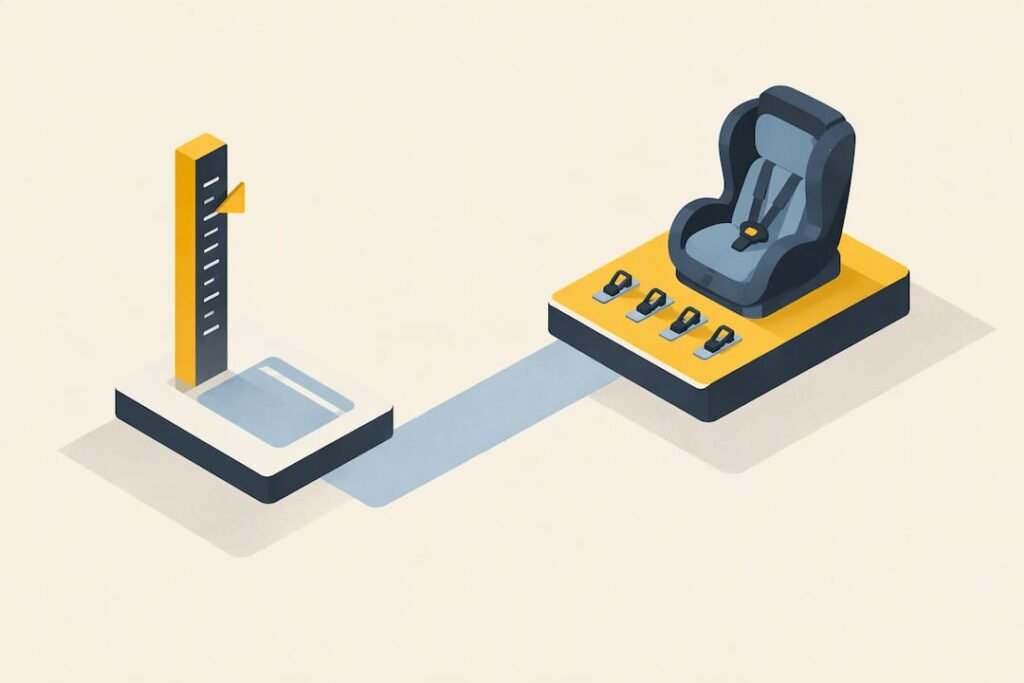
Every child in the UK must travel in an appropriate child car seat until they turn 12 years old or reach 135 centimetres in height, whichever happens first, under rules set out by Gov. Once a child passes that threshold, a standard adult seat belt becomes the legal requirement. The rest of this guide covers which seat type fits your child, how to fit it correctly, and what the law says about taxis, hire cars and medical exemptions.
What the law requires: age, height and seat use rules
The rule is simpler than it sounds. A child must use a suitable child car seat until they reach 135 centimetres in height or their 12th birthday, whichever comes first, according to GOV.UK’s statutory guidance. Most children hit 135 centimetres somewhere between the ages of 10 and 12, so height, not birthday, usually decides the switch to a seat belt for the tallest children in a class.
To measure accurately, stand your child against a wall with their shoes off and their back straight, then mark the height with a book held flat against their head. Do this every few months rather than guessing, since growth spurts can happen quickly.
Once a child is taller than 135 centimetres or turns 12, whichever comes first, they can legally use an adult seat belt instead of a child seat. GOV.UK remains the definitive source for this rule, and it is worth checking the page periodically since guidance can be updated.
In practice, enforcement usually happens during routine traffic stops or after a collision, when officers check restraint use as a matter of course. Key points to remember:
- The 135 cm or 12-year rule applies regardless of whether the child is small or tall for their age.
- Seat belts alone are not considered adequate for children below the height threshold.
- Parents, not just drivers who are strangers to the child, are responsible for ensuring compliance.
Choosing between height-based i-Size and weight-based R44 seats
Two approval systems exist side by side in the UK, and it helps to know which one you are buying into. Height-based seats, known as i-Size or R129, group children by height rather than weight and are becoming the standard choice for newer seats. Weight-based seats under the older R44 standard still appear widely and remain legal, grouped instead by the child’s weight in kilograms.
i-Size (R129) seats require children to travel rear-facing until they are over 15 months old, a guideline built into the standard itself. These seats tend to rely on ISOFIX fittings rather than a seat belt, and R129 testing includes side-impact assessment that older R44 seats were not required to pass.
R44 seats are split into groups from 0 (birth) through to Group 3 (around 22 to 36 kilograms), and parents move a child up a group as they outgrow the current one, usually shown by the child’s shoulders reaching the top harness slots or their head nearing the seat’s edge.
- Move from a harnessed seat to a booster only once the child has outgrown the harness weight or height limit stated by the manufacturer.
- Choose a high-back booster over a backless one for younger or smaller children, since it offers head and side protection a backless booster cannot.
- A backless booster is generally only suitable for taller, older children who already fit the vehicle’s seat belt geometry well.
Fitting your child seat correctly and avoiding common mistakes
Correct fitting matters as much as buying the right seat. Research into restraint effectiveness shows that properly fitted seats substantially cut injury risk in collisions, and that fit and correct usage often matter more than the seat’s age or price, according to a peer-reviewed study on child restraint effectiveness.
- Check that ISOFIX connectors click firmly into the car’s anchor points and that the seat cannot move more than 2 centimetres at the belt path once installed.
- For belt-fitted seats, confirm the belt runs through the correct guides, sits flat with no twists, and pulls fully tight.
- On forward-facing seats, attach the top tether to its designated anchor point and remove any slack.
- Check harness tightness by attempting to pinch the webbing at the shoulder: if you can pinch a fold of fabric, tighten further.
- Inspect straps for twists before every journey, since a twisted strap concentrates force on a smaller area of the body in a crash.
Pro Tip: Remove your child’s coat before buckling the harness, then lay the coat over the fastened straps like a blanket if they need warmth.
Bulky winter coats compress under crash force, leaving the harness effectively too loose to protect the child properly.
Taxis, hire cars and what to do when travelling
Taxis and minicabs are treated differently under UK law. Children can travel without a child seat in a licensed taxi or private hire vehicle if one is not available, though this exemption does not extend to a family’s own car. Hire cars follow the same rules as any private vehicle, so a suitable seat is still required.
- Book ahead with taxi firms that stock child seats, or bring a portable, approved seat of your own for reliability.
- When hiring a car, request an ISOFIX-equipped model and confirm the child seat booking directly with the rental company rather than assuming one will be provided.
- For airport transfers and organised tours, check in advance whether the operator supplies seats or expects you to bring your own, since policies vary by provider.
Parents hiring larger vehicles such as limousines for events face similar questions, and this guidance on car seats in hired vehicles covers the practical steps worth taking before booking. For UK self-drive trips specifically, our guide to driving in the UK covers other vehicle rules worth knowing before you set off.
Children with medical conditions or disabilities
A standard child seat is not always suitable for every child, particularly those with certain physical disabilities or medical equipment needs. In these cases, parents should seek written guidance from a paediatrician or specialist occupational therapist, who can recommend an appropriate restraint or confirm whether a specific exemption applies.
Specialist restraint suppliers produce adapted seats designed for children with additional needs, and a clinician’s letter can support both the choice of equipment and any conversations with insurers or transport providers. This is not an area to guess at: professional advice should guide the decision rather than general product reviews.
Reading the approval label on a child seat
Every legal child seat carries an approval label, usually printed on a sticker attached to the seat’s frame. Look for a circled “E” followed by a number, alongside either “R129” for i-Size seats or “R44/04” for the older weight-based standard. These codes confirm the seat has passed the relevant European testing regime, including crash and, for R129 seats, side-impact testing.
Buying a seat without a visible, legible approval label means you cannot confirm it meets any recognised safety standard, which matters both for your child’s protection and for staying within the law.
Penalties and what to expect if stopped
Driving without a properly restrained child can result in a fine and penalty points on the driver’s licence, since responsibility falls on whoever is driving at the time. If stopped, officers may ask to see the seat’s fitting and check the child’s height or age against the rule.
Keeping the seat’s original instructions and proof of purchase in the glovebox makes it easier to demonstrate the seat is approved and correctly matched to your child, should the question ever come up.
Buying advice: used seats, replacement age and winter safety
A seat’s history matters as much as its label. Safety guidance consistently warns against buying a second-hand child seat from an unknown source, since crash damage can weaken the structure invisibly. If you do accept a used seat from someone you trust, confirm its full history and check it falls within the manufacturer’s stated replacement age.
Any seat that has been in a moderate-or-greater crash should be treated as unusable, since crash forces can create structural damage that is not visible from the outside.
Manufacturers commonly recommend replacing a child seat after a period generally around five to ten years, depending on the model, so check the date moulded into the plastic shell and the guidance in the manual rather than relying on how the seat looks.
Winter clothing deserves particular care. Bulky coats compress under harness pressure in a crash, leaving far more slack than appears when the child is dressed, and research on winter clothing and harness fit recommends removing thick coats before fastening the harness and adding a blanket over the top once the straps are secure.
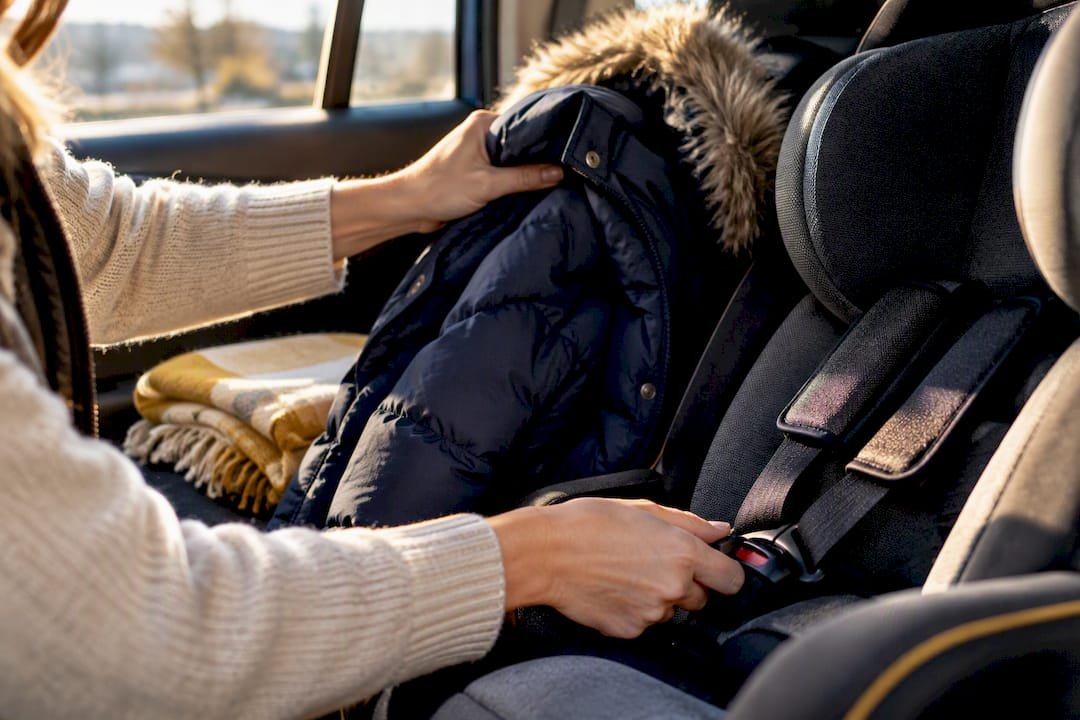
Pro Tip: Fasten the chest clip at armpit level and tighten the harness until you cannot pinch a fold of webbing between your fingers, every single journey.
If you are ever unsure whether a seat is fitted correctly, certified fitting technicians and clinics run by bodies such as RoSPA offer hands-on checks, which are worth using at least once when a new seat goes into the car.
The gap between knowing the law and getting it right
The legal threshold gets most of the attention, but it is the least useful number in this whole topic. Plenty of parents can quote “12 or 135 centimetres” without ever checking whether their child’s current seat is fitted tightly enough, or whether last year’s seat has been sitting in direct sunlight degrading its plastic shell.
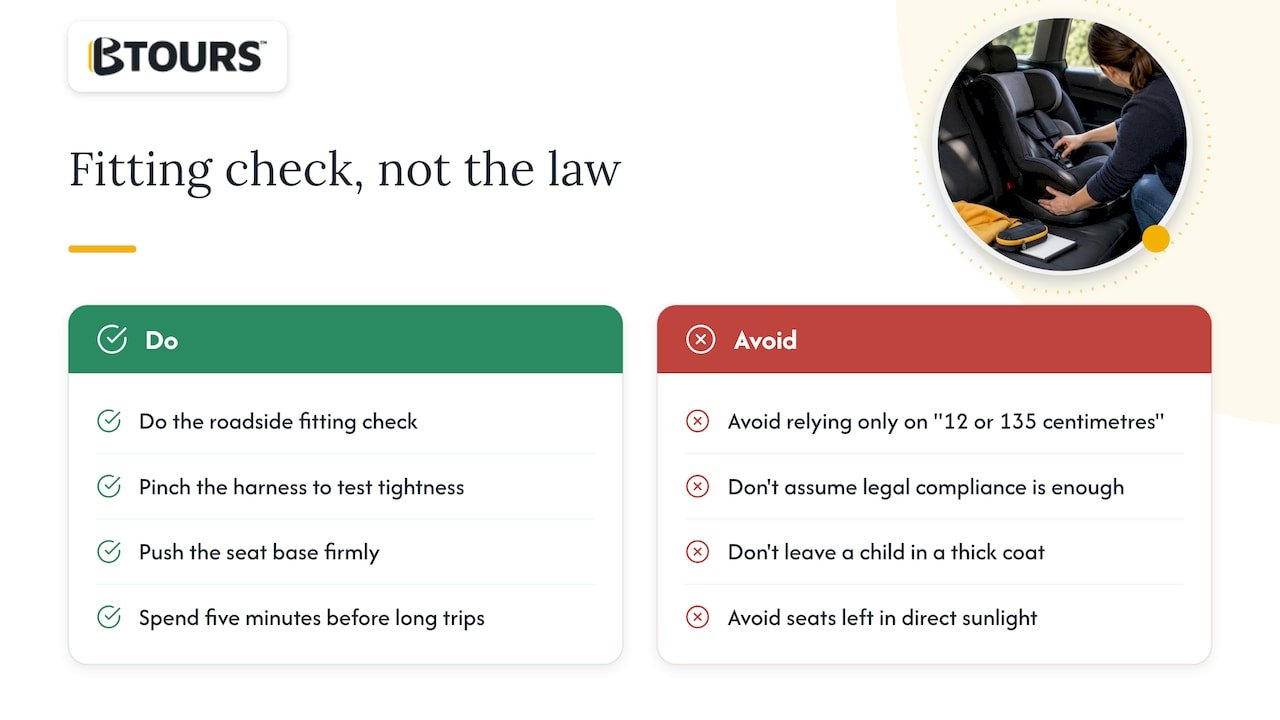
Compliance is a floor, not a safety plan. A seat that technically satisfies the law but sits loose at the belt path, or holds a child in a coat thick enough to leave two fingers of slack, offers a false sense of security that is arguably worse than no seat at all, because it looks correct while failing at the one moment it matters.
If you take one thing from this guide, make it the fitting check, not the age rule. Spend five minutes at the roadside pinching the harness and pushing the seat base before every long trip. It costs nothing and it is the single habit most likely to matter in a crash.
— Theo
This article is general information, not a substitute for advice from a qualified lawyer. Consult a qualified legal professional about your own circumstances before acting on anything here.
Sources
- PubMed study on child restraint effectiveness
- Used child safety seats checklist (New York State traffic safety)
- Kids’ car seats: bulky coats don’t mix — here’s why (UK HealthCare)
FAQ
Does a 7 year old need a car seat in the UK?
Yes, a child must use an appropriate child car seat unless they have already reached 135 centimetres in height, since the legal rule is based on height or age 12, whichever comes first. Most children under 12 fall short of that height, so a booster or harnessed seat is still required.
Can I use a US car seat in the UK?
A seat approved to US standards is not automatically legal in the UK, since UK law requires seats approved to the European R129 (i-Size) or R44 standard, shown by a circled “E” mark on the label. Bringing a US-approved seat without this marking means it cannot be confirmed as meeting UK requirements.
Does a 2 year old need a car seat in a taxi in the UK?
In a licensed taxi or private hire vehicle, a child can travel without a car seat if one is not available, though the child should use the rear seat and, where possible, an adult seat belt or lap belt. This exemption does not apply to a parent’s own car, where a suitable seat is always required.
Can a 4 year old use a backless booster seat in the UK?
A backless booster is generally intended for older, taller children rather than a typical 4 year old, since younger children benefit from the head and side protection a high-back booster or harnessed seat provides. Manufacturer weight and height limits, printed on the seat’s approval label, determine the exact point at which a backless booster becomes suitable.