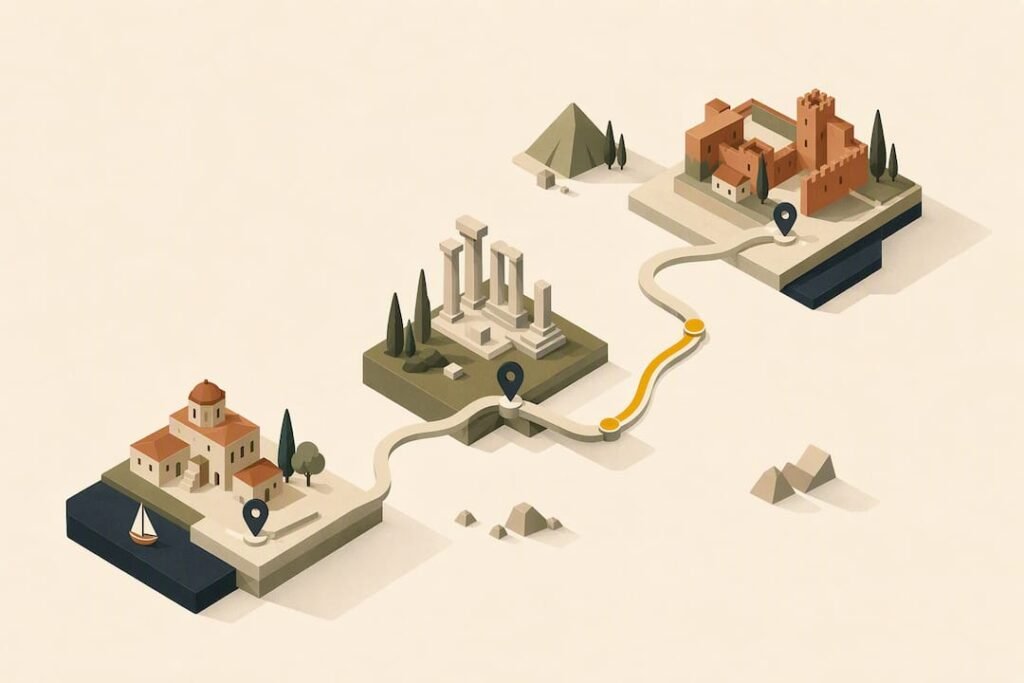
For most travellers, a 7 to 10 day self-drive from Athens around the Peloponnese strikes the right balance between ancient ruins, coastline and rural villages. A workable starter route runs Athens, Ancient Corinth, Mycenae, Nafplio, Olympia, Kalamata or the Mani peninsula, then back towards Athens. Self-driving beats a tour bus here because the region rewards detours: a quiet cove or a mountain village rarely sits on a fixed coach schedule.
At-a-glance itinerary options and who each suits
The Peloponnese works at almost any pace, but the length of your trip should match what you actually want to see rather than what looks impressive on paper. A tight loop covering three or four highlights beats a rushed circuit that tries to fit in everything.
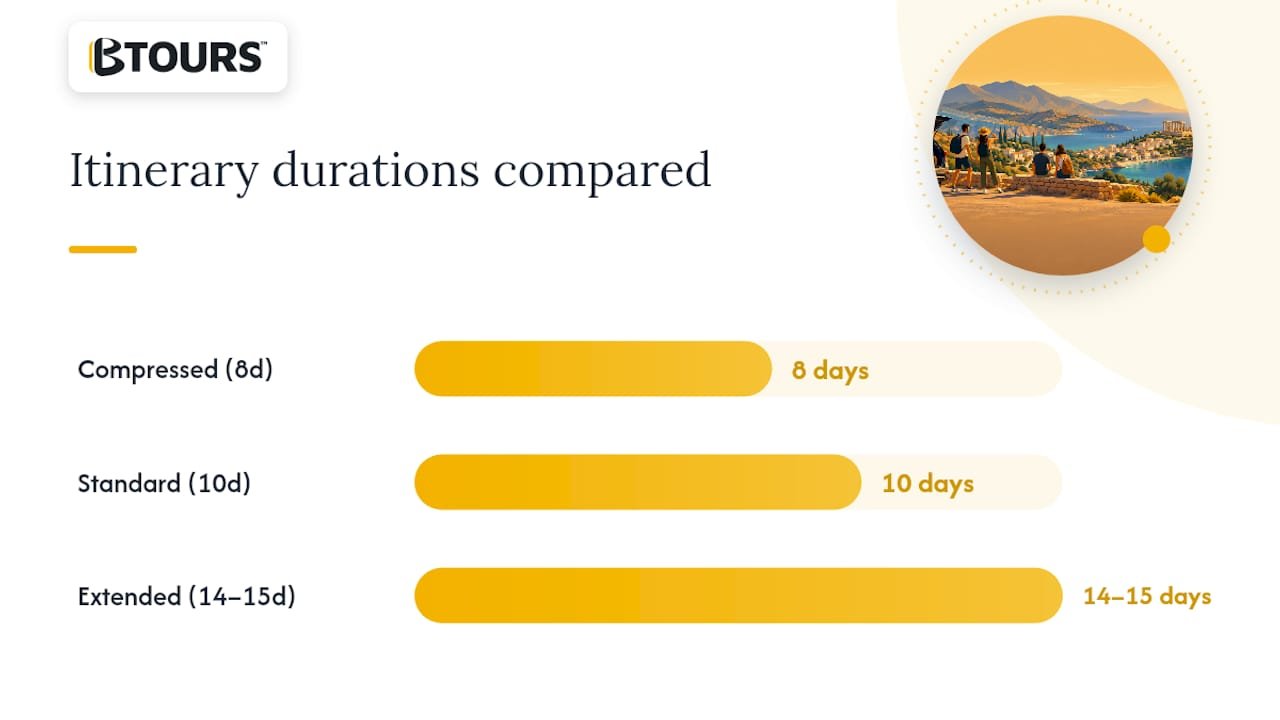
- 4 nights (mini loop): best for a first taste or an add-on to an Athens city break, covering Corinth, Mycenae and Nafplio with light driving, around 2 to 3 hours behind the wheel most days.
- 7 days: best for travellers who want ruins, coast and one proper rural detour, typically 2.5 to 4 hours of driving on travel days and closer to an hour on sightseeing days.
- 10 days: best for a fuller regional picture, adding Olympia, Messinia and the Mani peninsula, with daily driving averaging 2 to 3.5 hours.
- 14 to 15 days: best for slow travellers or those combining the Peloponnese with Delphi and central Greece, with several no-driving rest days built in.
The 4-night route is a simple triangle: Athens to Corinth and Mycenae, overnight in Nafplio, then back to Athens. The 7-day version extends that triangle west to Olympia before looping back through Arcadia. The 10-day plan pushes further south into Messinia and the Mani before returning north, while the 14 to 15 day version adds Delphi and the Menalon Trail as a loop within the loop.
None of these routes need a car for more than about 4 hours on any single day if you overnight strategically. The Peloponnese is roughly the size of a small US state, but the roads are slower than motorway distances suggest, particularly once you leave the main highways for coastal or mountain villages.
Four ready-to-use sample day-by-day itineraries
These plans assume a rental pickup in Athens and a return there, though Kalamata airport is a useful alternative for one-way trips through Messinia.
4-night mini loop (Corinth, Mycenae, Nafplio)
- Day 1: Athens to Ancient Corinth (about 1.5 hours, 85 kilometres), then on to Mycenae, overnighting in Nafplio.
- Day 2: Morning at Mycenae’s citadel and tombs, afternoon exploring Nafplio’s old town and Venetian fortress on foot.
- Day 3: Day trip to Epidaurus’s ancient theatre (45 minutes each way) or a slow morning by the coast, second night in Nafplio.
- Day 4: Return to Athens (about 2 hours, 145 kilometres), with a coffee stop in Corinth if time allows.
7-day loop (adds Olympia and Arcadia)
- Day 1: Athens to Ancient Corinth and Mycenae, overnight Nafplio.
- Day 2: Nafplio town, optional Epidaurus detour.
- Day 3: Nafplio to Olympia (about 3 hours, 210 kilometres) via the Arcadian mountains.
- Day 4: Morning at Ancient Olympia, afternoon free or a short drive into Arcadian hill villages.
- Day 5: Olympia to Kalamata or Messinia coast (about 2 hours, 110 kilometres), afternoon on the beach.
- Day 6: Explore Messinia’s coastline or the Mani’s edge as a day trip, second night in the same base.
- Day 7: Return to Athens (about 3.5 hours, 260 kilometres) or fly out from Kalamata.
10-day loop (adds Mani and a rest day)
Follow the 7-day plan through day 5, then:
6. Day 6: Kalamata to the Mani peninsula (about 1 hour, 45 kilometres), overnight in a tower-house village.
7. Day 7: Full day exploring Mani’s coastal hamlets and churches, no long drives.
8. Day 8: Mani to Sparta and Mystras (about 1.5 hours, 65 kilometres), afternoon at the Byzantine ruins.
9. Day 9: Sparta back towards Nafplio or direct to Athens depending on flight timing.
10. Day 10: Final Athens sightseeing or departure.
14 to 15 day loop (adds Delphi and the Menalon Trail)
Follow the 10-day plan, inserting two extra stops: a night in the Arcadian villages around the Menalon Trail between Olympia and Messinia for a half-day walk, and a two-night extension north to Delphi before returning to Athens, adding roughly 3 hours of driving each way.
For slower pacing, drop one overnight stop entirely and add a rest day in Nafplio or the Mani rather than trying to squeeze in another site. Faster travellers can compress the 10-day route into 8 by combining Olympia and Messinia into consecutive travel days, though this leaves little time to simply sit somewhere.
Driving and logistics: car hire, licences, roads, tolls and parking
Renting a car and navigating Greek roads is straightforward once you know a few local quirks. Rental firms typically expect a valid driving licence alongside an International Driving Permit for visitors, so arrange the IDP through your national motoring association before you fly.
- Book insurance that includes collision damage waiver with a low excess, since minor scrapes on narrow village roads are common.
- Choose a smaller or mid-sized car, both for fuel economy and for manoeuvring tight streets in hill towns and old quarters.
- Stick to 5 to 6 hours of driving as a sensible daily maximum, even on days without a scheduled overnight change.
- Expect secondary roads to be slower than motorways but essential for reaching most archaeological sites and coastal villages.
Greece’s motorways, such as the route linking Athens, Corinth and Patras, are fast and well-surfaced, and worth using for the longest transfers. Once you turn onto regional roads towards Mycenae, Olympia or the Mani, expect winding, narrower routes where overtaking is rare and patience matters more than speed.
Tolls apply on the main motorways and are paid in cash or by card at booths, so keep some coins handy. Fuel stations are frequent along major routes but sparser in remote mountain areas, so refuel before heading into the Mani or Arcadia rather than after. Parking at major archaeological sites like Olympia and Corinth is usually free and well signed, while town centres such as Nafplio can require a short walk from an outer car park during peak season.

Pro Tip: Download offline maps before you leave Wi-Fi range, since mobile signal drops in mountain passes and rural Mani.
Region-by-region must-see highlights and what each offers
Each region of the Peloponnese has a distinct character, so it helps to know what you are choosing between rather than trying to see everything.
- Corinthia: Ancient Corinth sits just off the National Highway and is easy to combine with a short stop at the Corinth Canal; the Ministry of Culture lists a full ticket at €15 and a reduced rate of €8, with combined ticket packages available.
- Argolis: Nafplio makes the best overnight base for Mycenae, with its walkable old town and Venetian fortress rewarding an evening stroll after a day of ruins.
- Arcadia: The Menalon Trail links mountain villages on foot, offering a walking alternative to driving for readers who want to slow down mid-trip.
- Messinia: Costa Navarino and the Palace of Nestor offer quieter beaches and archaeology than the Athens-adjacent sites, and the region is drawing fresh attention thanks to new trails and high-profile filming, according to Independent travel coverage, which also notes Kalamata airport sits around a 40-minute drive from the area.
- Mani peninsula: Distinctive stone tower-houses and a rugged coastline set Mani apart, and BBC Travel describes how this defensive architecture reflects the region’s separate cultural history.
- Olympia: The archaeological site and museum share one ticket, and the Ministry of Culture lists a full price of €20 and reduced rate of €10, with opening times shifting by season.
A quieter alternative near Athens is emerging fast: Messinia’s visibility is rising thanks to new walking trails and international filming interest, which gives travellers a genuine reason to push further south than the standard Corinth-Mycenae loop.
For readers building their own version of this route, our detailed Peloponnese planning guide covers overnight bases and scenic stops in more depth.
Where to stay and how to pace your days
Choosing a handful of bases rather than a new hotel every night saves time and driving fatigue. Nafplio works well for Corinth, Mycenae and Epidaurus; Kalamata or a Messinia coastal town suits Olympia’s western approach and Mani day trips; Sparta or Monemvasia anchors the southern leg for those adding Mystras.
- Basing yourself for two or three nights cuts unpacking time and lets you leave the car behind for a day of walking.
- Changing hotels nightly suits faster 4-night loops but adds packing overhead on longer trips.
- Nightly budgets vary widely by season and property type, so check current rates directly with accommodation providers rather than relying on general estimates.
- Book accommodation for July and August several months ahead, since coastal towns fill quickly in peak summer.
Our round-up of key Peloponnese stops covers accommodation suggestions alongside each highlight if you want a fuller picture before booking.
Food, seasons and activities: what to try and when to go
Regional food is one of the quiet highlights of a Peloponnese road trip. Look out for Kalamata olives and olive oil at source, wild greens dishes in Arcadian villages, and fresh seafood along the Messinian coast, often served at small tavernas rather than tourist-facing restaurants.

Spring and autumn are the most comfortable seasons for driving and sightseeing, avoiding the summer heat that makes midday visits to Olympia or Corinth uncomfortable and the winter closures that affect some rural sites and seasonal tavernas. Our guide to travelling in Greece in May covers what to pack and expect during one of the best shoulder-season windows.
Book ahead where possible for a guided walk on the Menalon Trail, an olive-oil tasting in Messinia, or a local cooking class, since these small-scale experiences often have limited daily capacity.
Planning checklist and packing: documents, apps, money and safety
Sort your paperwork and downloads before departure day rather than at the airport.
- Confirm your driving licence, arrange an International Driving Permit, and check your hire car booking and insurance excess.
- Pre-book tickets for Olympia, Corinth or Delphi where the Ministry of Culture site allows it, especially in peak season.
- Download offline maps, a currency converter and the contact number for your car hire company’s roadside assistance.
- Carry a mix of cash and card, since smaller villages and toll booths sometimes prefer cash.
Pack comfortable walking shoes for uneven ruins, a hat and sun protection for exposed sites like Olympia, and swimwear for the Messinian and Mani coastlines. Keep a paper copy of key documents alongside digital ones, and let someone know your rough daily route when heading into remote mountain roads.
Why choose a personalised self-drive itinerary
BTOURS specialises in personalised self-drive itineraries across multiple countries, including a dedicated Peloponnese road trip planning resource built around flexible routing and realistic daily pacing rather than a fixed coach schedule. Beyond the route itself, BTOURS curates accommodation and offers on-trip support, detailed further in this round-up of Peloponnese stops, so travellers are not left guessing about where to stay each night.
This combination matters most on a region like the Peloponnese, where the difference between a rushed circuit and a memorable trip often comes down to who planned the pacing and who picked the places to sleep.
Balancing ruins, coast and slow discovery
The temptation on a first Peloponnese trip is to schedule every site the guidebooks mention. The better instinct is to linger: an extra hour at Mycenae’s Lion Gate or an unplanned swim near the Mani coast often outlasts the memory of a fourth ruin seen at speed.
If your BLUF route feels tight, cut a site rather than a rest. The region rewards travellers who leave room to wander a village square with no destination in mind.
— Theo
How BTOURS can turn these plans into a booked trip
Turning a paper itinerary into a booked trip means someone else handling the routing, the bookings and the on-the-ground questions while you keep the freedom of driving yourself. BTOURS builds Peloponnese self-drive trips around exactly that split.
- Personalised routing based on how much driving and how many rest days you actually want.
- Curated accommodation booked in advance, so you are not searching for rooms mid-trip.
- On-trip support if plans change or a question comes up along the way.
Enquiring typically starts with a short conversation about your interests and travel dates, followed by a sample itinerary and pricing band before anything is booked. The Classic Greece self-drive tour, which runs Athens, Nafplio, Olympia, Meteora, Litohoro and Thessaloniki over 8 days, is a useful starting point if you want a version of this route already built and ready to adjust.

Get in touch through the Greece self-drive tours page to start shaping your own Peloponnese route.
Sources
- Ministry of Culture and Sports | Ancient Corinth
- Why The Odyssey film will make Messinia a holiday hotspot | The Independent
- The people who say they’re descended from Spartans | BBC Travel
FAQ
How many days do you need in Peloponnese?
Most travellers do well with 7 to 10 days, enough time to cover Corinth, Mycenae, Nafplio, Olympia and one southern region like Messinia or the Mani without rushing. A shorter 4-night loop works for a first taste, while 14 to 15 days suits those adding Delphi or the Menalon Trail.
What is the most beautiful part of Peloponnese?
Opinions vary, but the Mani peninsula stands out for its distinctive stone tower-houses and rugged coastline, described by BBC Travel as culturally and visually separate from the rest of the region. The Messinian coast around Costa Navarino offers a quieter, beach-focused alternative.
Which town in the Peloponnese is the best to stay in?
Nafplio is the most practical base for Corinth, Mycenae and Epidaurus, with a walkable old town and Venetian fortress. For a southern leg, Kalamata or a Messinia coastal town works well as a base for Olympia and Mani day trips.
Is it difficult for Americans to drive in Greece?
Driving in Greece is manageable with an International Driving Permit alongside a valid home licence, though roads narrow considerably in villages and mountain areas. Sticking to well-marked motorways for long transfers and taking secondary roads slowly makes the adjustment straightforward.