Give the Cotswolds two to three days and you’ll cover the highlights properly; give it five and you’ll actually relax. For a first visit, the classic north loop out of Cheltenham or Moreton-in-Marsh is the better starting point, with the quieter south loop as your second act. Driving yourself beats any tour bus here, because the best of this landscape hides down lanes no coach can reach.
At-a-glance itineraries: which cotswolds road trip suits you?
The right length depends less on how much time you have and more on what you actually want from the trip. A photographer chasing golden-hour shots of honey-coloured stone needs a different pace than a family trying to keep two kids entertained between castles.
Here’s how the main options stack up:
- 1 day (approx. 50 to 60 miles): Cheltenham, Bourton-on-the-Water, the Slaughters, Stow-on-the-Wold. Suits time-pressed visitors doing a day trip from Bath, Oxford or London who want a taster rather than the full picture.
- 2 to 3 days (approx. 100 to 140 miles): North loop plus one detour day, covering Broadway, Chipping Campden, Bibury and Blenheim Palace. This is the itinerary Cotswolds Tourism recommends as the sweet spot for exploring properly, and it suits most first-time visitors, couples and photographers who want variety without exhaustion.
- 5+ days: Both loops at a walking pace, with time for Westonbirt Arboretum, Sudeley Castle and at least one long countryside ramble. Best for retirees, nature lovers and anyone who has done the Cotswolds once already and wants the version without a schedule.
Daily time budgets matter more than mileage here. A day covering three villages typically breaks down as two to three hours of actual driving and four to five hours on foot or in attractions, because the distances are short but the stone bridges, tearooms and photo stops eat the clock. Popular northern circuits run around 60 miles, which sounds trivial until you factor in single-track lanes capped at 30mph and a queue of cars behind a tractor outside Stow-on-the-Wold.
Families with young children generally do better on the 1 or 2-day plan, since car time between villages stacks up faster than adult attention spans handle well. Walkers and cyclists lean toward the 5-day version, using Cirencester or Chipping Campden as a base to fit in a half-day trail without sacrificing a village stop. Photographers should build every itinerary around dawn and dusk, arriving at Arlington Row or Broadway Tower well before the day-trip coaches do.
North loop: practical route, timings and parking tips
The official Cotswolds Romantic Road splits into two circular loops, both starting from Cheltenham, and each one takes a full day at a comfortable pace with stops. The northern circuit is the one most first-timers should drive first: Cheltenham, Broadway, Chipping Campden, Stow-on-the-Wold, Bourton-on-the-Water, and back through Moreton-in-Marsh.
If you’re arriving by train, start from Moreton-in-Marsh instead of Cheltenham. It shaves 20 minutes off the loop and puts you closer to Stow and the Slaughters first thing, when parking is easiest.
- Cheltenham to Broadway (about 35 minutes). Park near the High Street and walk up to Broadway Tower for the view before the coach parties arrive.
- Broadway to Chipping Campden (about 15 minutes). Allow 45 minutes to walk the High Street and the Market Hall.
- Chipping Campden to Stow-on-the-Wold (about 25 minutes). Good lunch stop; the market square has metered parking that fills by midday.
- Stow-on-the-Wold to Bourton-on-the-Water (about 15 minutes). This is the busiest village on the loop, so timing your arrival matters more here than anywhere else on the route.
- Bourton-on-the-Water to Moreton-in-Marsh (about 20 minutes). A relaxed final stretch, ideal for an early dinner if you’re staying overnight.
Total driving time on this loop runs under two hours; the rest of your day belongs to villages, cream teas, and standing in the road trying to get a photo of a stone bridge without a bin lorry in it.
Crowd timing is the single biggest variable on this route. Bibury and Bourton fill quickly through mid-morning to early afternoon in peak season, so arriving before 9:30am or after 5pm buys you empty streets and free parking that simply doesn’t exist at noon in August.
Pro Tip: Book your Broadway Tower slot for first light if you’re travelling in summer. The car park is small, the light is better, and you’ll have the view to yourself for a good 30 minutes before the next car pulls in.
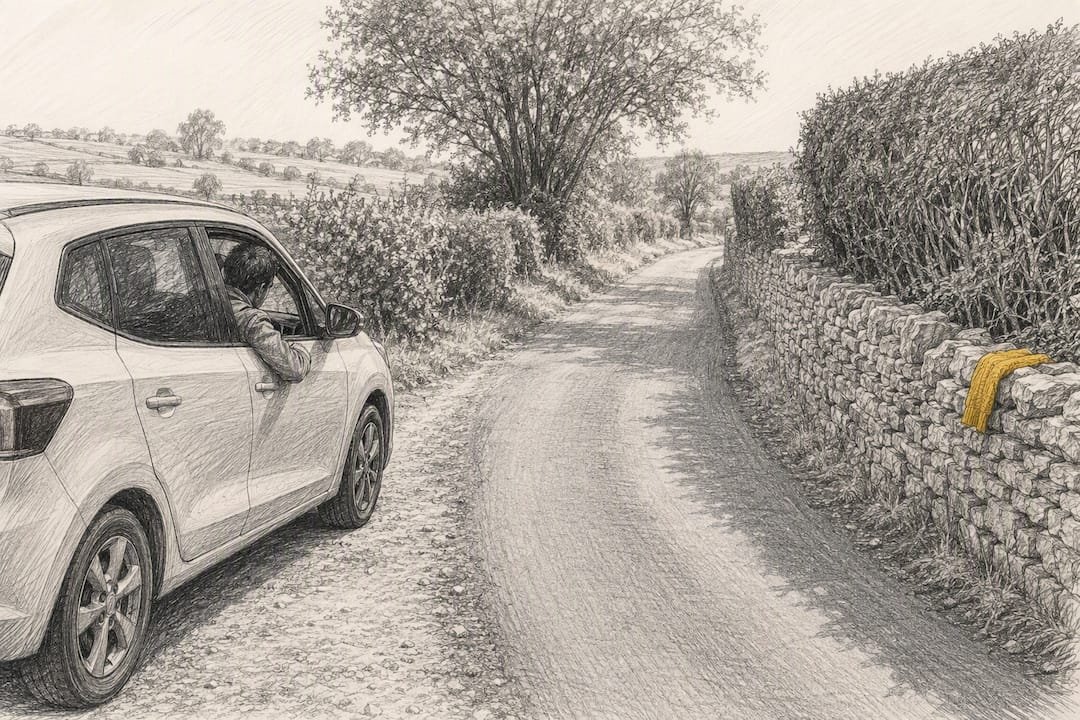
Single-track lanes connect several of these villages, and reversing etiquette isn’t optional once you’re on one. Whichever driver is nearer a passing place reverses into it, not the other way round, and if you’re not confident reversing a hire car, practise in an empty car park before you hit the narrow stretches between Stow and Bourton.
South loop: Cirencester, Bibury and quieter valleys
The southern circuit of the Romantic Road runs through Cirencester, Bibury, Painswick and Tetbury, and it’s the loop most seasoned Cotswolds visitors prefer once they’ve done the north one. Fewer coaches, more genuine village life, and the kind of valley scenery that doesn’t photograph as well on Instagram but feels better to actually drive through.
- Cheltenham to Cirencester (about 30 minutes). The old Roman town anchors this loop and has plenty of all-day parking, unlike most Cotswolds villages.
- Cirencester to Bibury (about 20 minutes). This is your Arlington Row stop, and it deserves the most careful timing of the entire trip.
- Bibury to Painswick (about 40 minutes). A quieter, hillier village with a churchyard famous for its clipped yew trees.
- Painswick to Tetbury (about 30 minutes). Good antiques shopping and a relaxed final stop before heading back.
Arlington Row in Bibury is the most photographed row of cottages in England, and it’s also the tightest pinch point on the whole trip. There’s no dedicated car park directly outside the row, so use the pay-and-display near Bibury Trout Farm and walk the final few minutes. Arrive before 9am if you want the classic shot without twenty other phones in it, or come back after 5pm when the light turns golden and the day-trippers have gone.
You can stretch this loop into a longer day, or a second full day, by adding Blenheim Palace, Westonbirt Arboretum or Castle Combe, but not all three in one go. Blenheim sits about 25 minutes north of Cirencester and genuinely needs two to three hours to do justice, given the scale of the grounds and the state rooms inside. Westonbirt Arboretum is a similar distance south and works best as a half-day add-on, particularly if you’re travelling in October when the tree colour turns spectacular. Castle Combe lies further west, closer to Bath than to Cirencester, so it fits more naturally onto a day that’s already heading that direction rather than bolted onto this loop.

Try to add all three and you’ll spend more time driving than looking at anything, which defeats the point of a scenic driving itinerary in the first place.
Copyable day plans for 3 and 5 days
A written itinerary only earns its keep if you can lift it straight into your notes app and drive it. Here’s how both the 3-day and 5-day versions break down, hour by hour.
3-day itinerary:
- Day 1, morning: Depart Cheltenham by 9am, drive to Broadway (35 min), walk up to Broadway Tower.
- Day 1, afternoon: Chipping Campden and Stow-on-the-Wold, lunch in Stow.
- Day 1, evening: Base yourself in Moreton-in-Marsh or Stow for the night.
- Day 2, morning: Bourton-on-the-Water by 9am, then the short drive to Upper and Lower Slaughter for the riverside walk between the two, roughly 25 minutes on foot.
- Day 2, afternoon: Drive to Bibury (about 45 minutes), aiming to arrive by early afternoon before the after-lunch crowd peaks.
- Day 2, evening: Cirencester for dinner and an overnight stay.
- Day 3, morning: Blenheim Palace, arriving at opening time to beat the coach parties.
- Day 3, afternoon: Return loop through Tetbury or Painswick, depending on which way you’re heading home.
5-day itinerary repeats the above across the first three days at half the pace, then adds:
- Day 4: Westonbirt Arboretum in the morning, Castle Combe in the afternoon, staying near Cirencester or heading toward Bath overnight.
- Day 5: Sudeley Castle near Winchcombe in the morning, then a slow drive back through Broadway with time for a proper walk rather than a photo stop.
If you’re travelling from London or already near Wiltshire, Day 5 swaps neatly for a Bath or Stonehenge detour instead of Sudeley, since both sit within roughly an hour of the southern loop. Building in one flexible day like this is the easiest way to stretch a 3-day plan into 5 without repeating the same villages twice.
Where to base yourself for the least driving
Your choice of base changes the whole rhythm of the trip, because every extra mile back to your hotel at night is a mile you’re not spending in a village.
- Moreton-in-Marsh: Sits almost centrally on the north loop and has its own railway station, making it the best base for anyone arriving car-free and picking up a hire car locally.
- Stow-on-the-Wold: Highest elevation in the Cotswolds, with more pubs and evening atmosphere per square metre than almost anywhere else on the north loop.
- Cirencester: The obvious base for the south loop, with proper all-day parking and enough restaurants that you won’t eat at the same place twice.
- Broadway: Prettier to stay in than to base a whole trip from, since it sits at the northern edge and adds driving time to south loop days.
- Chipping Campden or Bourton: Quieter alternatives if Stow feels too busy at night, though both have fewer dinner options.
Midweek bookings run noticeably cheaper and give you first pick of parking and tearoom tables; weekends from Friday through Sunday see the whole region fill up, particularly around Bourton and Bibury, so book accommodation at least a few weeks ahead for a summer weekend.
Driving and logistics: what you actually need to know
A car is close to essential here, because many of the Cotswolds’ best villages and viewpoints simply aren’t served by regular public transport, and the region spans almost 800 square miles across five counties.
- Car size: Book the smallest hire car that fits your luggage. Local advice is explicit that oversized vehicles struggle on lanes hemmed in by stone walls, and a compact car turns a stressful single-track stretch into a non-event.
- Automatic vs manual: Automatics cost more to hire in the UK but remove one thing to think about if you’re not used to driving on the left.
- Driving side and roundabouts: The UK drives on the left; at roundabouts, traffic already on the roundabout has priority, and you give way to your right. The Highway Code’s rules on roundabouts and overtaking are worth a five-minute read before you set off.
- Passing places: On single-track lanes, whichever driver is closest to a passing place reverses into it.
- Parking: Most villages use pay-and-display machines; carry coins as a backup, since card readers occasionally fail in rural spots.
- Fuel and EV charging: Fuel stations thin out between villages, so don’t run below a quarter tank; EV charging points exist in larger towns like Cheltenham and Cirencester but are sparser in the smaller villages.
- Offline maps: Mobile signal is patchy across the region, so download offline maps in Google Maps or Ordnance Survey before you leave your hotel each morning.
For a broader look at UK road rules before you land, BTOURS has a detailed driving guide covering exactly this kind of first-time-on-the-left situation.
What makes each Cotswolds village worth the stop
- Arlington Row, Bibury: A row of 17th-century weavers’ cottages and the most photographed street in the Cotswolds. Fifteen minutes is enough for the photo; go before 9am or after 5pm for the crowd-free version.
- Bourton-on-the-Water: Known for the low bridges crossing the River Windrush through the village centre. Allow an hour, and expect it to be the busiest stop on your north loop.
- The Slaughters (Upper and Lower): No shops, no coaches, just a quiet river walk connecting the two villages in about 25 minutes on foot. The calmest stop on the whole itinerary.
- Broadway Tower: An 18th-century folly with sweeping views over several counties. Arrive at opening or just before sunset for the best light.
- Castle Combe: Frequently cited as one of England’s prettiest villages, with a single main street that takes 20 minutes to walk end to end.
- Blenheim Palace: A UNESCO World Heritage site and the birthplace of Winston Churchill. Budget two to three hours minimum for the grounds and state rooms.
- Westonbirt Arboretum: Over 15,000 trees across several hundred acres, at its best in autumn. A half-day is realistic if you want to walk more than one trail.
- Cirencester: The Roman-founded “Capital of the Cotswolds,” with a genuine working town centre rather than a village frozen for tourists.
Getting to the Cotswolds: airports, trains and car hire
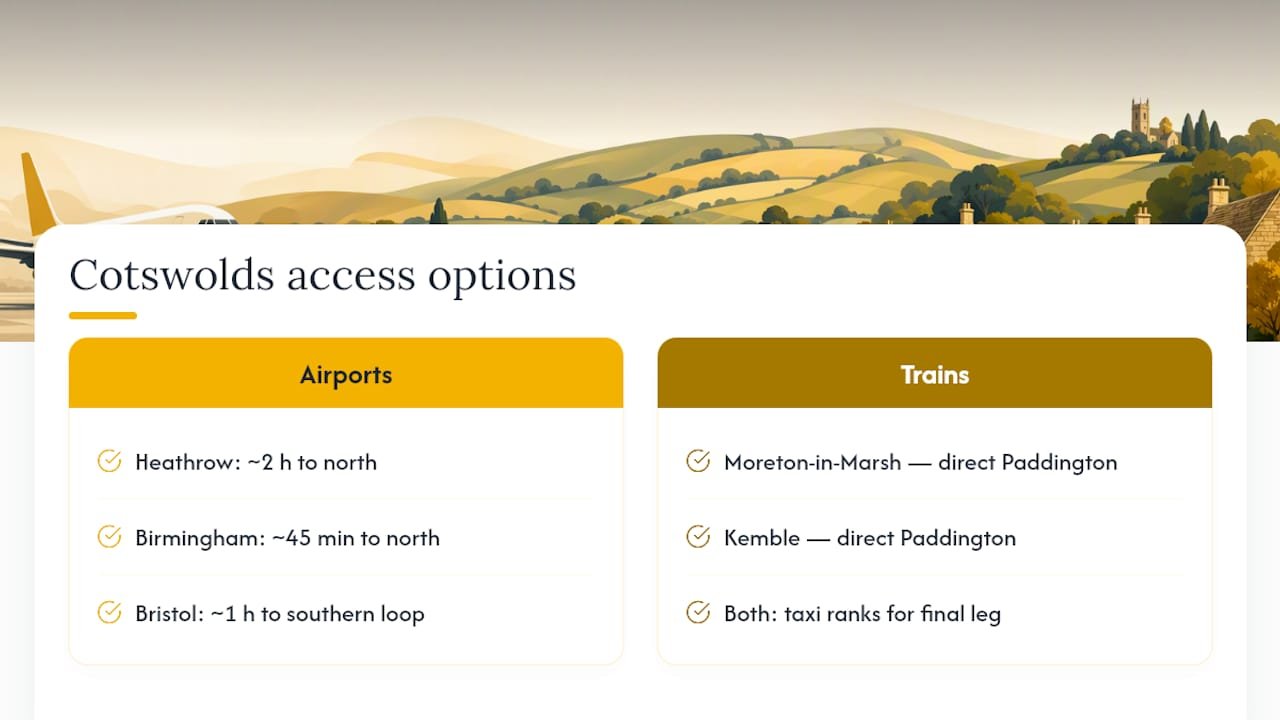
Heathrow sits around two hours’ drive from the northern Cotswolds, Birmingham Airport about 45 minutes, and Bristol Airport roughly an hour from the southern loop, making Birmingham the quickest option if flight availability allows it. By train, Moreton-in-Marsh and Kemble both connect directly to London Paddington and have taxi ranks for the final leg to your accommodation.
When collecting a hire car, check the excess insurance terms carefully and add a second driver if you’re planning to split long stretches. Automatic cars book out fast in summer, so reserve one early if you’d rather not manage a manual gearbox and left-hand roundabouts on the same trip.
Why a personalised self-drive plan beats a DIY printout
A DIY itinerary works well if you enjoy the planning as much as the trip. Where it falls apart is the detail: which car park actually has space at 9am in July, which villages to swap when it rains, which back road avoids the tourist traffic on a bank holiday. That’s where a planned self-drive itinerary earns its cost, particularly for travellers with limited time or a specific interest like history or gardens they want the route built around.
Some itinerary providers build these routes using local knowledge, pairing custom routes with accommodation and support if plans change mid-trip. DIY suits confident planners with time to spare; a planner suits anyone who’d rather spend their evenings deciding on dinner, not re-routing tomorrow’s drive.
The editorial verdict on planning a Cotswolds road trip
Most Cotswolds advice online is written by people who visited once, in good weather, with no traffic. It reads well, but it underestimates two things: how badly a single tour bus can wreck a “quick 20-minute stop,” and how much a compact car matters on a lane built for horse-drawn traffic two centuries ago.
The itineraries here are built around realistic driving times and arrival windows, not the fantasy version where every village is empty and every car park has space. That’s the gap in most generic Cotswolds content: it lists villages beautifully but never tells you what happens when three coaches arrive in Bibury at the same time as you.
If there’s one piece of conventional wisdom worth ignoring, it’s the idea that more stops equals a better day. Locals drive this region slowly, on purpose, because the lanes punish anyone in a rush. Cut one village from your list before you cut ten minutes from your visit to the one you kept. Prioritise timing over ticking boxes, and the trip will feel like a holiday rather than a checklist.
— Theo
Book the expert route or build your own
A specialised self-drive itinerary service offers an alternative to spending your evenings buried in tab after tab of village guides and parking forums. Where a DIY plan leaves you guessing which car park has space and which back road dodges the coach traffic, a prepared self-drive itinerary arrives already built, with handpicked accommodation and support if your plans shift mid-trip.

The Taste of England eight-day self-drive tour covers exactly this kind of England-wide route planning, built around personalised pacing rather than a fixed coach schedule. If London bookends make sense for your trip, the England landing page has shorter city-break options to combine either side of your Cotswolds days. And if a longer countryside drive across England, Scotland or Wales appeals beyond just the Cotswolds, the main self-drive tours page is the place to start comparing full itineraries. Whichever way you go, decide now: build it yourself with this guide, or get in touch with BTOURS and have the route, the rooms and the backup plan sorted before you land.
Sources
For live opening times, driving rules and official route maps, go straight to the primary sources: Cotswolds Tourism’s road trip hub for scenic routes, the Highway Code for UK driving law, and Cotswolds Tourism’s itinerary guide for the official Romantic Road loops. If you’re keen to combine a countryside day with a round of golf, Marbella Golf Times’ UK pitch and putt guide is worth a look too.
- Cotswolds Road Trip: Best Scenic Driving Itineraries – Cotswolds Tourism
- Getcarhire
- Cotswolds travel tips – Cotswolds Tourism
FAQ
How long does it take to drive around the Cotswolds?
The northern loop of the Romantic Road takes a full day at a comfortable pace and covers around 60 miles, while a comprehensive exploration of both loops can run over 200 miles across several days. Actual driving time on any single day is usually under two hours, with the rest spent walking villages and stopping at viewpoints.
How many days do you need to see the Cotswolds?
Most first-time visitors need 2 to 3 days to see the main villages properly without rushing between them. Five days allows a genuinely relaxed pace, quieter village visits and time for detours to places like Westonbirt Arboretum or Sudeley Castle.
What is the best road trip to take through the Cotswolds?
The northern loop, running Cheltenham, Broadway, Chipping Campden, Stow-on-the-Wold, Bourton-on-the-Water and Moreton-in-Marsh, is the best starting route for first-time visitors, since it forms one of the two official Romantic Road circuits. The southern loop through Cirencester, Bibury, Painswick and Tetbury makes a strong second day or return trip for a quieter alternative. Travellers who’d rather have both routes pre-planned with accommodation sorted can look at BTOURS’ England self-drive itineraries instead of piecing the route together themselves.
What does Rick Steves say about the Cotswolds?
Rick Steves is widely known for recommending the Cotswolds as one of England’s best regions for slow, village-hopping travel by car rather than coach tour, favouring smaller, less crowded villages over the busiest honeypots. That advice lines up with the timing strategy in this guide: arriving before 9:30am or after 5pm at popular stops like Bibury and Bourton-on-the-Water avoids the worst of the day-tripper crowds.
Is it better to drive yourself or join a tour bus?
Self-driving wins for most travellers because many of the region’s best villages and viewpoints aren’t served by public transport, and a tour bus can’t stop at every quiet lane or small church you want to see. A compact hire car handles the narrow lanes far better than a coach, and it gives you control over exactly when you arrive at each village.