That’s the whole method. What follows breaks each step down with templates, tool recommendations and a sample seven-day itinerary you can copy, plus the point at which it’s worth handing the job to an expert planner like Btours instead of doing it yourself.
TL;DR:
- Planning the route on a desktop map tool before booking accommodations or tickets helps avoid miscalculations and ensures route flexibility.
- Limiting daily driving to three to six hours and using the 70/30 or 3-2-1 rules helps prevent travel fatigue and allows for enjoyable scenic detours.
- Lock in anchor nights and high-demand activities early to secure availability, but leave some nights unbooked to allow for spontaneous exploration.
- Prepare a detailed itinerary with printable day sheets, offline maps, and shared copies to prevent confusion and accommodate signal issues.
- Consider hiring an expert or tour operator for complex trips involving multiple countries, fixed date commitments, or group needs to save time and reduce planning stress.
Table of Contents
- Self drive itinerary planning: a quick checklist to start now
- Which planning tools do you actually need?
- How do you structure daily driving legs without burning out?
- Booking strategy and budget: what to lock in and what to leave loose
- Vehicle, kit and safety checks before you set off
- How do you organise and share the itinerary so nobody’s confused?
- Sample 7-day self drive itinerary template
- When does an expert-planned itinerary make more sense?
- Want the same result without the planning hours?
- A closing thought on planning versus wandering
- Sources
Self drive itinerary planning: a quick checklist to start now
Before touching a single map app, decide what the trip is actually for. Travel advisor Sandra Zo Awodele’s advice to Forbes Advisor is to nail down your “non-negotiables” before anything else: the two or three experiences you’d be gutted to miss. Everything else in the route bends around those anchors.
Once you know your anchors, the rest of the workflow follows a fairly predictable order:
- Write down your non-negotiables. Two or three places, events or experiences that define the trip. If it’s not on this list, it’s optional.
- Fix your trip length and daily driving ceiling. Four days, ten days, three weeks. Decide upfront how many hours behind the wheel feels sustainable, not aspirational.
- Plot the anchors on a desktop map tool and sketch the legs. Drag the route between each anchor and see what the drive actually looks like before you commit.
- Book the anchor nights and any tickets with limited availability. Everything else can wait.
- Sort the vehicle, build a shareable trip file, and save offline map copies. Do this a few days before departure, not the night before.
This sequence works whether you’re planning a long weekend in the Cotswolds or a fortnight through the Scottish Highlands. The order matters more than the detail. Nail the anchors and the daily driving limit early, and every other decision, accommodation, activities, packing, gets much easier to make.
Which planning tools do you actually need?
Self-guided travel planning tends to fail for one of two reasons: people plan entirely on their phone, or they use a navigation app for a job it was never built to do. Sort those two problems and the rest of the process gets a lot smoother.
Planning complex, multi-stop routes is genuinely easier on a desktop screen. HowToGeek’s comparison of phone versus desktop planning found the bigger map view makes it far quicker to drag routes, drop waypoints and spot the scenic diversions worth adding, the kind of detail you’d miss squinting at a five-inch screen while planning on desktop.
Three tool categories cover almost everything a self-drive traveller needs:
- Trip planners and map editors (for the design phase): these let you organise stops, reorder days, attach notes and save booking confirmations against each location. Dedicated road trip planners exist precisely to separate this creative, iterative work from live driving.
- Navigation apps (for the driving phase): built for real-time traffic, rerouting around closures, and turn-by-turn guidance. They’re not designed to hold your whole itinerary, and treating them as your planning source of truth means losing notes, bookings and context the moment you close the app.
- Booking and reservation platforms: for campsites, ferry crossings, and any timed or dated ticket where availability genuinely runs out.
The practical workflow is simple: design the whole trip on a desktop trip planner, export or share it once it’s finalised, then switch to your navigation app purely for the drive itself.
Pro Tip: Keep your trip planner open in a browser tab even after you’ve exported to your navigation app. If a detour looks good on day four, you can update the master plan on the spot instead of losing the idea by evening.
How do you structure daily driving legs without burning out?
Most itineraries collapse not because the route was wrong, but because the days were too long. The fix is a rule most experienced road-trippers already use without naming it: the anchor and support method. Anchors are your non-negotiable stops, the reason for the trip. Support stops fill the gaps: a coffee break, a viewpoint, a quick photo stop that adds texture without adding pressure.
Guides commonly suggest capping actual driving at roughly three to six hours per day, with extra time layered on top for fuel, food and photo stops. A three-hour driving day can easily eat six hours of your daylight once you add stops, and that’s fine, provided you’ve planned for it rather than discovered it at 4pm with two hours left to your accommodation.
Two pacing frameworks are worth stealing:
- The 70/30 rule: plan 70% of your time and leave 30% genuinely open, for weather, mood, or the unplanned village that turns out to be the best bit of the trip.
- The 3-2-1 rule: no more than three hours of driving, two major stops, and one anchor experience per day, a rough ceiling rather than a target to always hit.
Route-scouting advice from Road & Track recommends literally dragging your route line on the map to hunt for scenic detours, then checking street view for road surface and access before committing, a habit borrowed from event organisers who reality-check group logistics before anyone sets off.
One practical snag: most consumer map tools cap the number of waypoints you can add to a single route. If your scenic loop has more stops than the tool allows, split the trip into separate day-by-day maps rather than cramming everything into one overloaded route. It’s more files to manage, but each one stays usable, and you avoid the frustration of a planner that silently drops your tenth stop.
Booking strategy and budget: what to lock in and what to leave loose
Not every night deserves a reservation, but some absolutely do. Anchor nights, the ones tied to your non-negotiables, along with any high-demand activity (a popular ferry crossing, a timed castle entry, a festival weekend) should go in the diary early. General planning guidance suggests booking these weeks to months ahead in peak season, while everything else can stay open.
Deliberately leaving some nights unbooked isn’t sloppiness, it’s how you build in room to linger somewhere unexpected or change direction if the weather turns.
For budgeting, break costs into distinct buckets rather than one vague total:
- Fuel: estimate using your route distance and current prices, then add a margin for detours.
- Accommodation: your biggest variable cost, and the one most affected by how far in advance you book.
- Food and activities: easy to underestimate on longer trips.
- Tolls and parking: often forgotten entirely until the first toll booth.
- Contingency: a buffer of 10 to 15% on top of everything else, for the breakdown, the extra night, or the meal that runs over.
Mixing accommodation types, a couple of characterful stays at anchor points, simpler options in between, keeps costs down without sacrificing the experiences that matter. And before booking anything, check the cancellation policy. A cheap non-refundable rate looks less appealing once you factor in the flexibility you’re giving up for it.
Vehicle, kit and safety checks before you set off
A breakdown two hours from the nearest garage turns a good trip into a bad story fast. Pre-trip vehicle checks are unglamorous but they’re the difference between a minor inconvenience and a ruined week.
Before departure, check:
- Tyre tread and pressure, including the spare.
- Oil, coolant and windscreen wash levels.
- Lights, indicators and brake function.
- Battery health, particularly if the car’s been sitting idle.
Carry a basic emergency kit: a torch, a warning triangle, a first aid kit, jump leads, and enough water and snacks to cope with an unplanned delay. If you’re driving somewhere remote, top up fuel more often than habit dictates. In parts of Scotland and rural Ireland, the next filling station might be further than you’d guess from the map. Electric vehicle drivers should map charging points along the route in advance rather than assuming coverage matches urban expectations.
Check that your insurance and breakdown cover actually apply to the country and terrain you’re driving through, some policies exclude certain roads or require advance notice for cross-border trips.
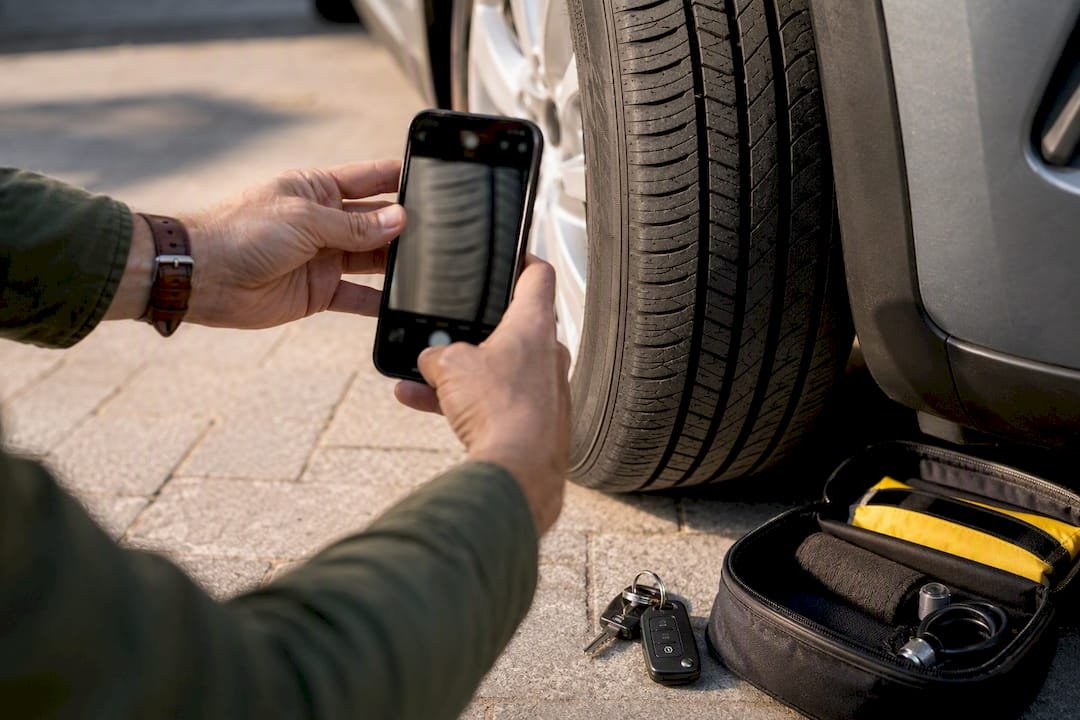
Pro Tip: Photograph your tyres, dashboard mileage and any existing scratches before you leave, especially with a hire car. It takes thirty seconds and saves an argument later.
How do you organise and share the itinerary so nobody’s confused?
A brilliant itinerary that only exists in your head, or worse, only on your phone with no signal, isn’t much use to anyone. Build a trip pack that survives a dead battery and works for everyone travelling with you.
- Export printable day sheets. One page per day: route, driving time, anchor stop, accommodation, check-in details.
- Add calendar invites for time-sensitive bookings. Ferry crossings, timed tickets and check-in windows belong in a calendar, not just a spreadsheet.
- Attach practical notes to each stop. Parking instructions, check-in codes, and a reminder to arrive before dark at rural accommodation with poor lighting or tricky access.
- Keep one master version and share a read-only copy. Confusion multiplies fast when three people are editing the same document from different phones.
- Download offline map areas and screenshot key confirmations. Rural stretches of Wales, the west of Ireland and much of the Greek mainland have patchy signal. Trip planners that let you attach confirmations and notes directly to each stop remove a lot of this friction before you even leave home.
Sample 7-day self drive itinerary template
A template only earns its place if you can actually copy it. Here’s a generic seven-day scenic loop structure, built around three anchors with support stops filling the gaps.
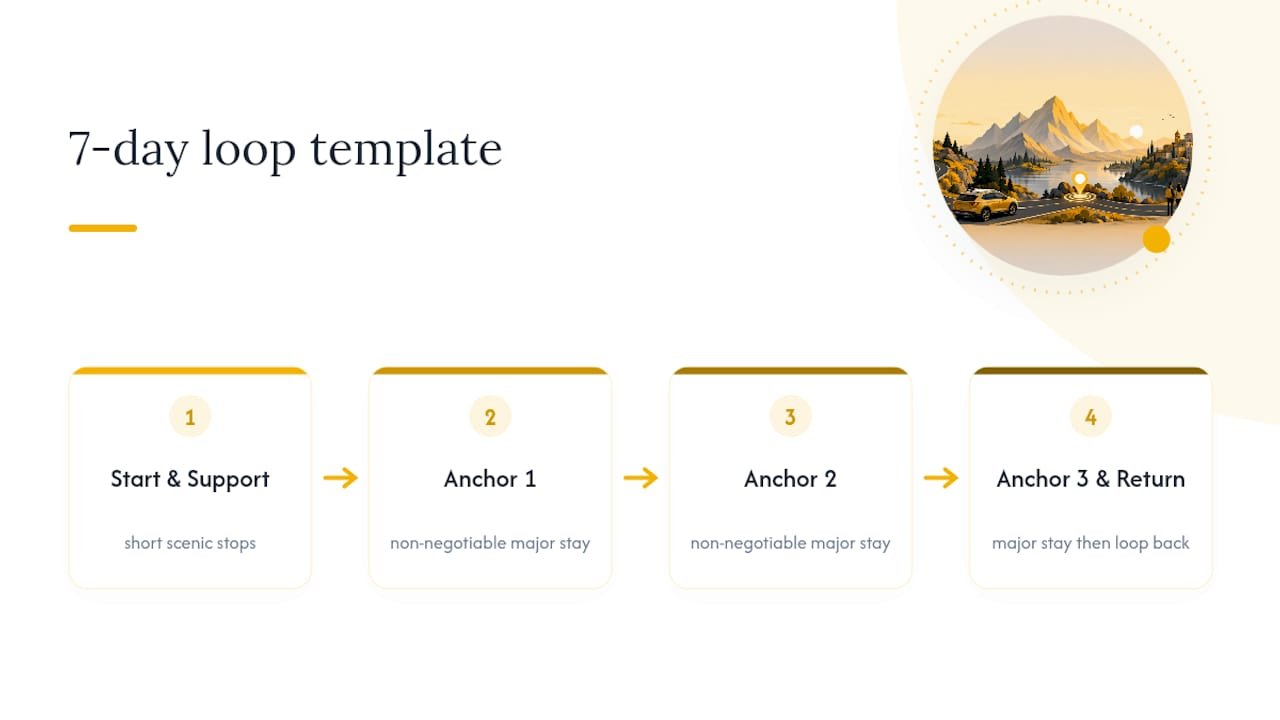
For a shorter trip, drop to one anchor with two or three support stops. For longer trips, add a second loop rather than stretching daily driving times. Solo travellers can push pacing slightly harder; groups should build in buffer, since group logistics (parking several cars, coordinating meal stops, differing energy levels) slow everything down more than solo drivers expect.
When does an expert-planned itinerary make more sense?
DIY planning works brilliantly for straightforward trips. It gets harder once you’re juggling fixed-date commitments, a complex multi-country route, or a group with different mobility needs and interests. That’s the point where the hours spent researching accommodation and cross-checking road conditions start outweighing the savings of doing it yourself.
An expert-planned self-drive itinerary typically includes:
- Route-testing, so recommended roads and stops are checked, not just guessed at from a map.
- Handpicked accommodation chosen for character and location rather than whatever ranks highest on a booking site.
- Local contacts and on-trip support, so a problem on day four doesn’t mean starting from scratch with no local knowledge.
Btours builds exactly this kind of itinerary across England, Scotland, Wales, Ireland and Greece, and is a member of the Adventure Travel Trade Association, which reflects a commitment to consistent planning and service standards for independent travellers. For readers who want the freedom of self-drive without the research overhead, that’s the trade-off worth weighing against a DIY plan.
Want the same result without the planning hours?
If everything above sounds achievable but the reality is you’d rather spend those hours actually looking forward to the trip, this is exactly the gap Btours fills. Instead of building your own route from scratch, comparing accommodation across five different booking sites, and hoping the pacing holds up in practice, you get a self-drive itinerary that’s already been route-tested and paced by people who’ve driven it.
Some tour operators create personalised, multi-day self-drive routes across multiple countries, with accommodation chosen for character, and provide support if plans need to shift mid-trip. It’s the same freedom of driving your own route on your own schedule, minus the hours spent second-guessing whether day four’s driving time is realistic. If you’ve read this far and the DIY version still feels like a lot of admin for a holiday, see what to look for in a self-drive tour package before you book, and get a sense of how a hand-built itinerary compares to building your own from scratch.
A closing thought on planning versus wandering
The best itineraries I’ve seen aren’t the most detailed ones, they’re the ones with just enough structure to remove decision fatigue and just enough space left to wander off script. Plan your anchors properly, be honest about your daily driving limit, and resist the urge to fill every gap. The templates here will get you most of the way. If the planning itself feels like the part you’d rather skip, that’s precisely the gap Btours exists to close.
— Theo
Sources
For more detail on the ideas covered here, Forbes Advisor’s guide to planning a road trip covers the non-negotiables approach in full, while Road & Track’s route-scouting piece is worth reading for anyone tackling a genuinely scenic, detour-heavy route.
On the Btours site, expert pacing tips for scenic self-drive tours expands on daily leg structuring, and the smart packing and route planning guide covers vehicle prep in more depth than fits here.
- How To Plan A Road Trip – Forbes Advisor
- I stopped planning trips on my phone and started using Google Maps on desktop — HowToGeek
- Free Road Trip Planner: Scenic Routes, Best Stops | Pilot
- How to plan the ultimate road trip | Road & Track
- How to plan a road trip – Turo / Wayfaring
Recommended
- How to Plan a Multi‑Day Self‑Drive Holiday Without the Stress
- The Stress‑Free Guide to Planning a Multi‑Day Self‑Drive Holiday (No Route Research Required)
- How to Choose a Multi‑Day Itinerary That Feels Adventurous, Comfortable and Easy to Follow
- Freedom to Roam: The Power of Flexible Self‑Drive Itineraries (With Expert Support)