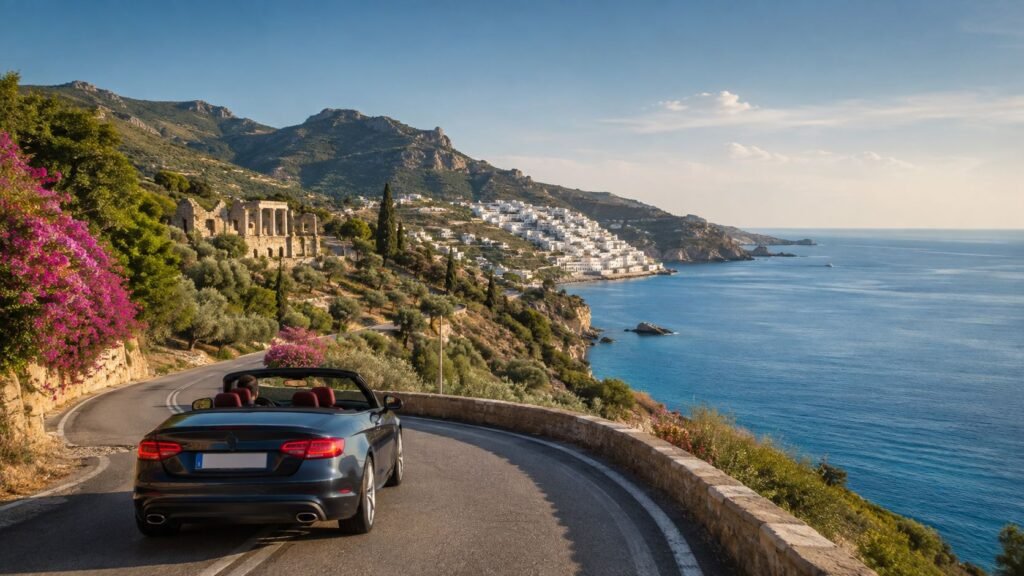
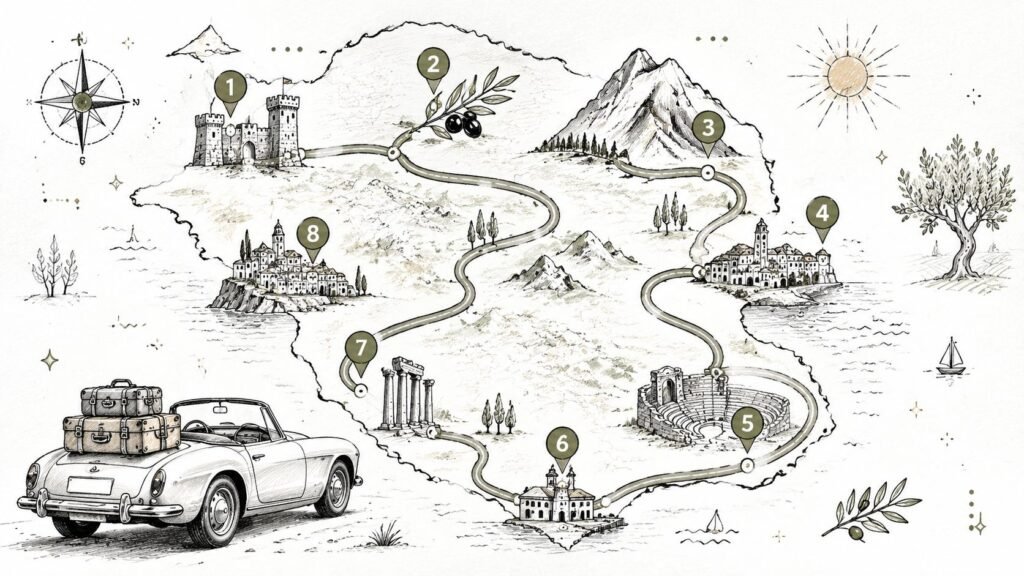
You've left Athens behind, the Acropolis is shrinking in the rear-view mirror, and the road ahead is already changing character. Classical landmarks give way to engineering marvels, Venetian harbour towns, mountain roads, stone villages and the southern coastlines of the Mani Peninsula. This is the appeal of a Peloponnese road trip, a journey that feels like a natural progression rather than a checklist of disconnected sights.
The route below is designed for independent travellers, but you can shorten it, add overnight stays or remove stops depending on your time and priorities. You'll find practical guidance on drive connections, heat management, parking, accommodation style and the best season for each place. The Peloponnese is an established tourism region, with 732,000 visits and 5.54 million overnight stays recorded in the official 2023 regional analysis (official Peloponnese tourism analysis), so you can build a well-supported route around recognised tourism corridors.
Collect the car after exploring central Athens, keep the itinerary flexible on winding southern roads and let each stop set the pace. If you want planning support without surrendering independence, BTOURS offers carefully designed self-drive itineraries with handpicked accommodation and assistance throughout the journey. Before you go, Adventure Medical Kits help you pack a practical travel first-aid kit.
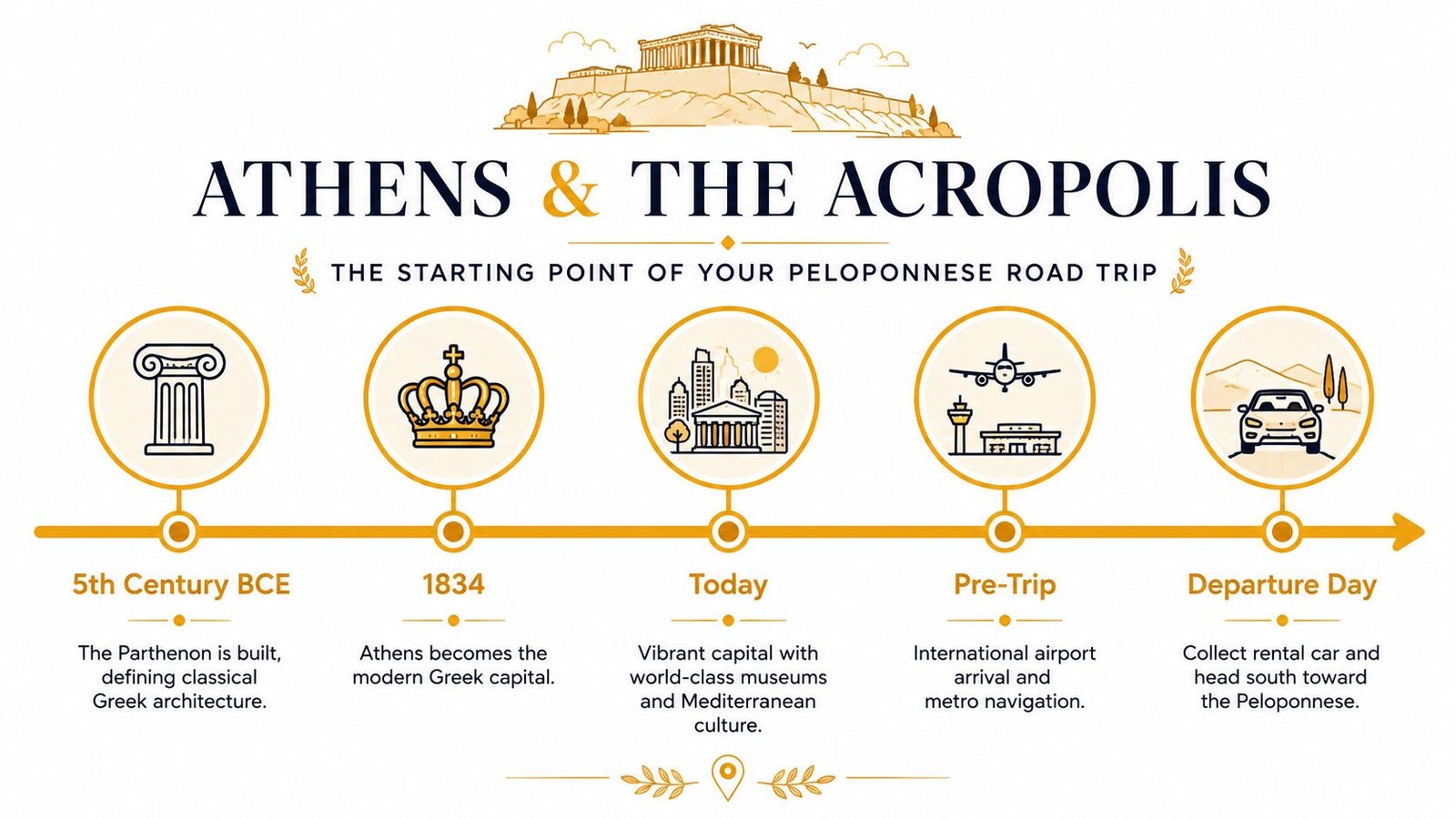
1. Athens and the Acropolis
Athens belongs at the beginning of your route, even though the city sits outside the Peloponnese. It gives you the cultural context for everything that follows, from classical temples to the mythology woven through Mycenae, Epidaurus and Sparta. The Acropolis remains the defining sight, with the Parthenon rising above the city as one of the most recognisable achievements of classical Greek architecture.
Stay in Plaka if you want to walk to the Acropolis, the Ancient Agora, Roman monuments and lively tavernas without moving the car through central traffic. Use the metro and walk during your city stay. Athens is easier and less stressful without luggage, navigation decisions and narrow streets competing for your attention.
Start early, collect the car later
Visit the Acropolis early in the morning or late in the afternoon. You'll find cooler conditions and a more manageable experience than during the hottest, busiest part of the day. A combined ticket covering several archaeological sites can help you organise your sightseeing efficiently, but check current availability and admission conditions before travelling.
Pick up your rental car after your main Athens sightseeing, ideally for an afternoon departure or the following morning. You won't gain much from having a car while exploring Plaka, Monastiraki or the Acropolis, and avoiding city parking makes the opening days more enjoyable.
Practical rule: Treat Athens as a walking and public-transport destination first, then make the car the tool for the Peloponnese.
The city also rewards a slower evening. Have dinner in Plaka, visit a museum, or climb Lycabettus Hill for broad views across the urban basin. Families should keep the Acropolis visit focused and build in shade breaks. Couples may prefer an early archaeological visit followed by a long lunch and an evening neighbourhood walk.
For a broader perspective on choosing between independent travel and organised support, see this guide to independent travel and group tours.
2. Corinth and the Ancient Canal
Corinth is your natural gateway into the Peloponnese. The drive from Athens is straightforward, and the stop combines two very different experiences: the remains of a powerful ancient city and the sharply cut modern canal that separates the peninsula from mainland Greece.
Begin at the archaeological site while the air is still cooler. The Temple of Apollo provides the visual centre, while the surrounding remains help you read Corinth as a strategic city rather than just another collection of stones. Wear a hat, apply sun protection and carry more water than you think you'll need. Exposed ruins offer little shelter when the heat rises.
Make the canal a proper stop
The Corinth Canal deserves more than a quick photograph through the car window. Stop at a viewpoint, watch the narrow waterway below and then continue across the bridge so the geography of your route becomes clear. This is the moment when the journey changes from leaving Athens to entering the Peloponnese.
If you have energy, continue to Acrocorinth, the hilltop fortress above the ancient city. The climb and uneven ground demand time, especially in warm weather, but the views explain why Corinth held such strategic importance. Don't squeeze the fortress into an already overloaded morning. It works best when you accept that the first day is about orientation rather than distance.
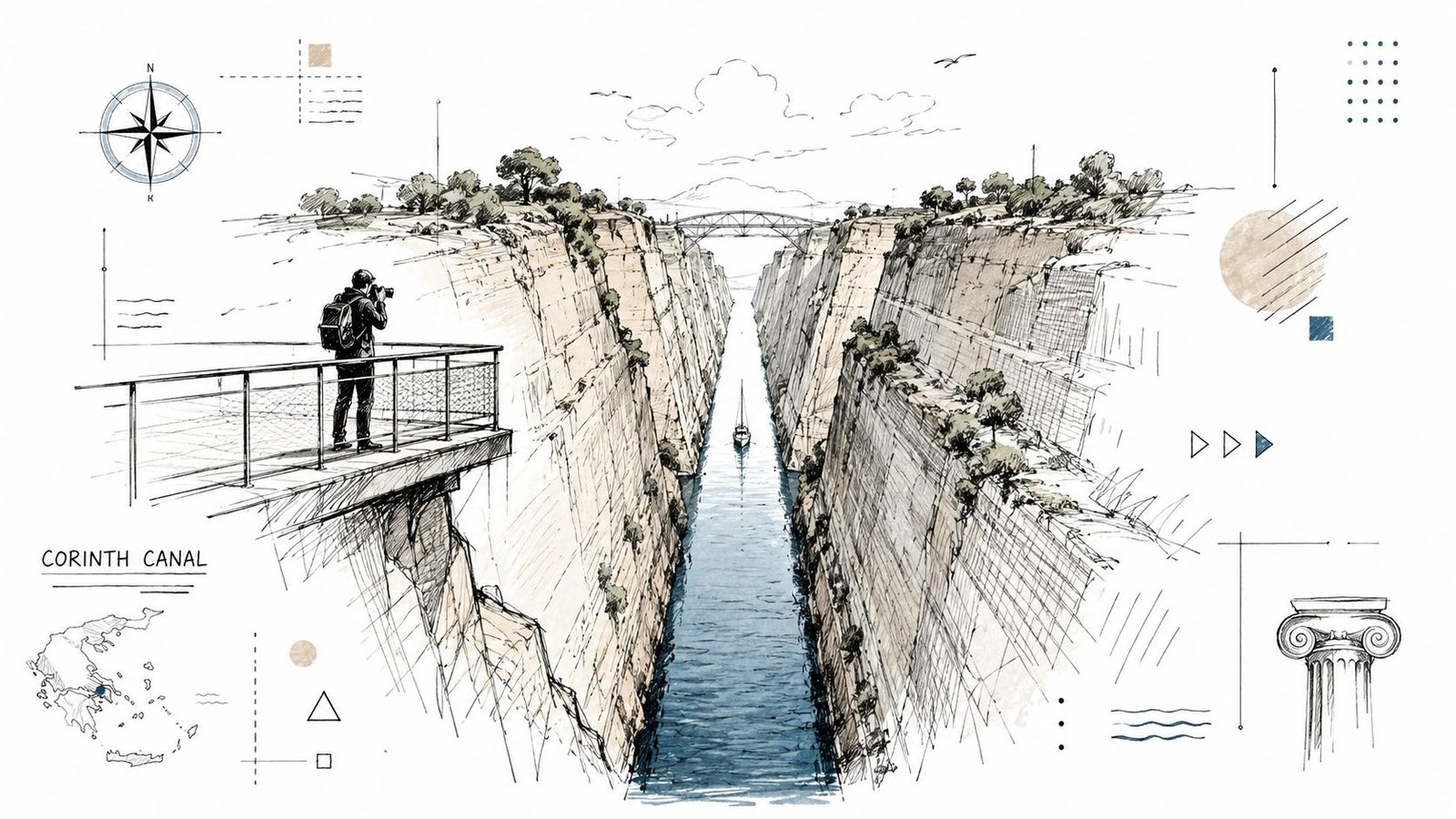
Corinth works as a purposeful gateway. Give it enough time to connect the ancient city, the fortress and the canal, rather than treating it as a rushed roadside photo stop.
Loutraki makes a useful lunch or recovery stop after the ruins. Its waterfront restaurants and thermal facilities offer a change of pace, particularly for families who need a break from archaeological walking. Sleep near Corinth if you want an easy start to the Argolid, or continue towards Nafplio if you've started early and prefer to settle beside the sea.
3. Nafplio and Palamidi Fortress
Nafplio gives this route its strongest coastal stop. Venetian and Ottoman traces, neoclassical buildings, a harbour and narrow lanes make the town easy to explore on foot. Use it as a base for Epidaurus and Mycenae, so you can visit both without changing accommodation each night.
Leave the rental car in a designated area outside the Old Town. Narrow lanes become stressful when pedestrians, scooters and delivery vehicles compete for space, and searching for a closer spot wastes time. Park once, then walk the harbour, explore the side streets and choose a waterfront taverna for seafood.
Time the climb for softer light and fewer visitors
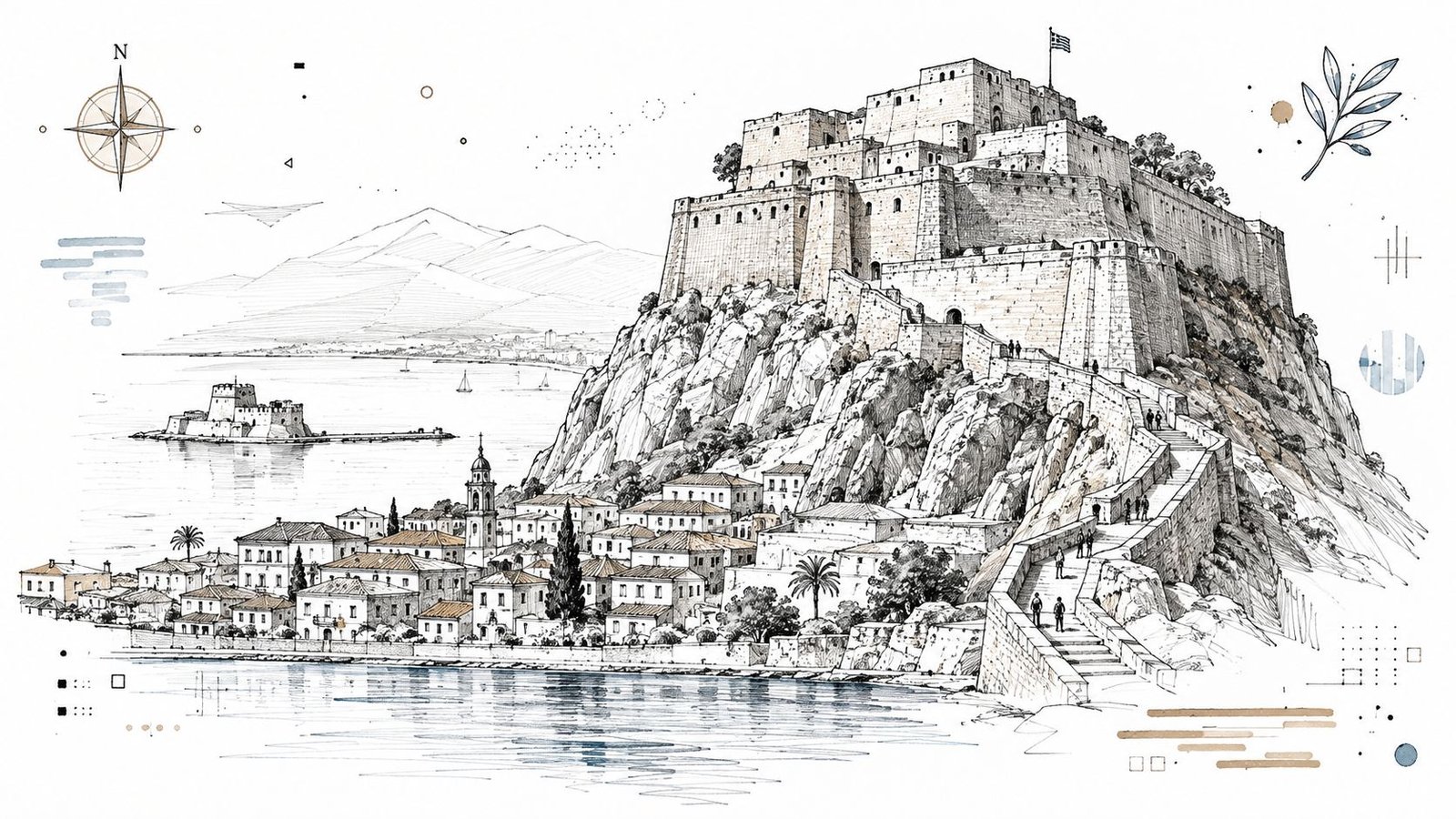
Palamidi rises above Nafplio on the mountainside. Climb early in the morning or late in the day, when the stone steps feel more manageable and the Argolic Gulf catches gentler light. Carry water, even if the streets below feel cool. In summer, heat and exposed steps can slow the ascent, so build the visit around the weather rather than squeezing it between other stops.
Set aside several hours for the fortress and Old Town. A practical sequence is Palamidi first, a long lunch afterwards, then an unhurried walk through the lower town. From the harbour, you can also take a boat to Bourtzi, the small castle in the water. Check departure times locally because services change with weather and season.
The best Nafplio plan is deliberately simple: park once, walk widely, climb Palamidi at a cooler hour and reserve dinner if you're visiting during the busiest summer period.
Nafplio works for couples seeking atmospheric evenings and families needing restaurants, promenades and nearby services. Choose a restored guesthouse in or near the Old Town for atmosphere. Stay outside the centre for easier parking and quieter nights.
4. Mycenae and Ancient Palace Ruins
Mycenae changes the historical tone of the route. Instead of the open civic spaces associated with classical Athens, you'll encounter a fortified Bronze Age citadel surrounded by massive walls, tombs and a terrain that still feels defensible. The Lion Gate provides the memorable arrival point, but the whole site deserves attention beyond the first photograph.
Walk through the gate, follow the remains of the acropolis and look closely at the construction of the Cyclopean walls. The scale of the stones gave rise to later legends that only giants could have built them. The beehive tombs add another layer, showing how power and burial were expressed long before the classical city-states became dominant.
Use Nafplio as your base
Mycenae works particularly well as a half-day excursion from Nafplio. The connection is manageable, and returning to the town for lunch or an evening by the harbour keeps the day from becoming a sequence of long drives and exposed ruins. Allow at least several hours if you want to include the museum rather than rushing from the Lion Gate to the car park.
A local guide can transform the visit. Without context, the site can feel sparse, especially for younger travellers. With an explanation of palace organisation, mythology, burial customs and the relationship between the citadel and the surrounding terrain, the stones become part of a coherent story.
Visit in April, May, September or October for more comfortable archaeological touring. Summer remains possible, but arrive early, wear a hat and carry water. The site has limited shade, and the open setting intensifies the heat.
- Combine the history: Add nearby Tiryns if you want a fuller Bronze Age day.
- Protect your pace: Don't pair Mycenae, Epidaurus and a long onward transfer unless you're comfortable sacrificing time at each.
- Choose a guide thoughtfully: A concise, site-focused guide is more useful than a rushed lecture filled with dates.
Mycenae isn't a decorative stop. It supplies the deeper historical layer that makes the later classical sites feel like part of a much longer Peloponnesian story.
5. Epidaurus and the Ancient Theatre
Plan Epidaurus as a half-day visit, then decide whether the theatre or the wider sanctuary deserves your best walking time. The theatre sits within the sanctuary of Asclepius, the ancient healing god, and its geometry remains striking before you test the famous acoustics. Stand near the centre of the orchestra while someone speaks from the stage, then climb into the seating to hear how clearly sound carries.
The theatre is only the headline. Explore the temples, stadium and structures linked to healing and medical practice, because these remains explain why people travelled here. Together, the sanctuary and theatre show how religious life, treatment, civic gathering and performance occupied the same place.
Check the performance calendar before booking
The theatre hosts productions of ancient Greek drama during the summer period, including works by Sophocles, Euripides and Aristophanes. If a performance is a priority, check the programme before reserving accommodation and secure tickets well ahead of a summer visit. An evening under the open sky offers a stronger sense of the venue than a morning inspection, but you must arrange transport and plan the return journey.
For a quieter, more comfortable visit, arrive in the morning or late afternoon. These hours reduce exposure to the strongest heat and can ease pressure from tour groups. Nafplio is the most practical base for combining Epidaurus with other Argolid sights. Return there for dinner rather than adding another long drive after walking the sanctuary.
The theatre draws attention, but the sanctuary explains the site. Make time for both.
Families can turn the acoustic demonstration into a shared experiment instead of expecting children to absorb every ruin. Couples can follow the visit with a slow dinner in Nafplio. Independent travellers attending an evening performance should confirm closing times, parking and transport before committing, particularly when staying outside town. In summer, book the performance first and build the road trip around it. In spring or autumn, keep the schedule looser and spend longer examining the sanctuary.
6. Sparta and the Ancient Laconian Region
Sparta asks you to adjust your expectations. The modern city and archaeological remains don't deliver the monumental drama of Mycenae or the polished setting of Epidaurus. Their value lies in what they reveal about a society organised around military discipline, communal life and a political culture that shaped classical Greek history.
Start at the Archaeological Museum. It gives the scattered remains a framework, helping you understand the objects and local history before you walk through the ancient site. The visit can feel underwhelming if you arrive expecting a complete ancient city, but it becomes more rewarding when you approach Sparta as a place of historical interpretation rather than visual spectacle.
Build a Laconian base
Sparta works as a base for Mystras, the Taygetus region and the Laconian countryside. Mystras adds Byzantine architecture, fortified slopes and expansive views, creating a strong contrast with Sparta's classical associations. Nearby villages provide a more grounded experience of contemporary rural Greece, with local cafés, family-run restaurants and slower evenings.
Use the city for a museum and site visit, then decide whether you want to stay overnight or continue towards Monemvasia. If you're travelling in hot weather, make the archaeological visit early and reserve the middle of the day for lunch, driving or an indoor museum.
- For history-led travellers: Spend time with the museum before judging the ruins.
- For scenery-focused travellers: Treat Sparta as the launch point for Taygetus and the wider Laconian countryside.
- For a balanced route: Pair Sparta with Mystras rather than giving the entire day to the ancient remains.
The surrounding roads require attention. Greece drives on the right, and published road guidance gives typical limits of 50 km/h in towns, 90 km/h on rural roads and 130 km/h on motorways (Greece road-trip guidance). These are reference limits, not targets. On mountain roads, bends, surfaces and visibility should determine your speed.
7. Monemvasia and the Medieval Fortress Town
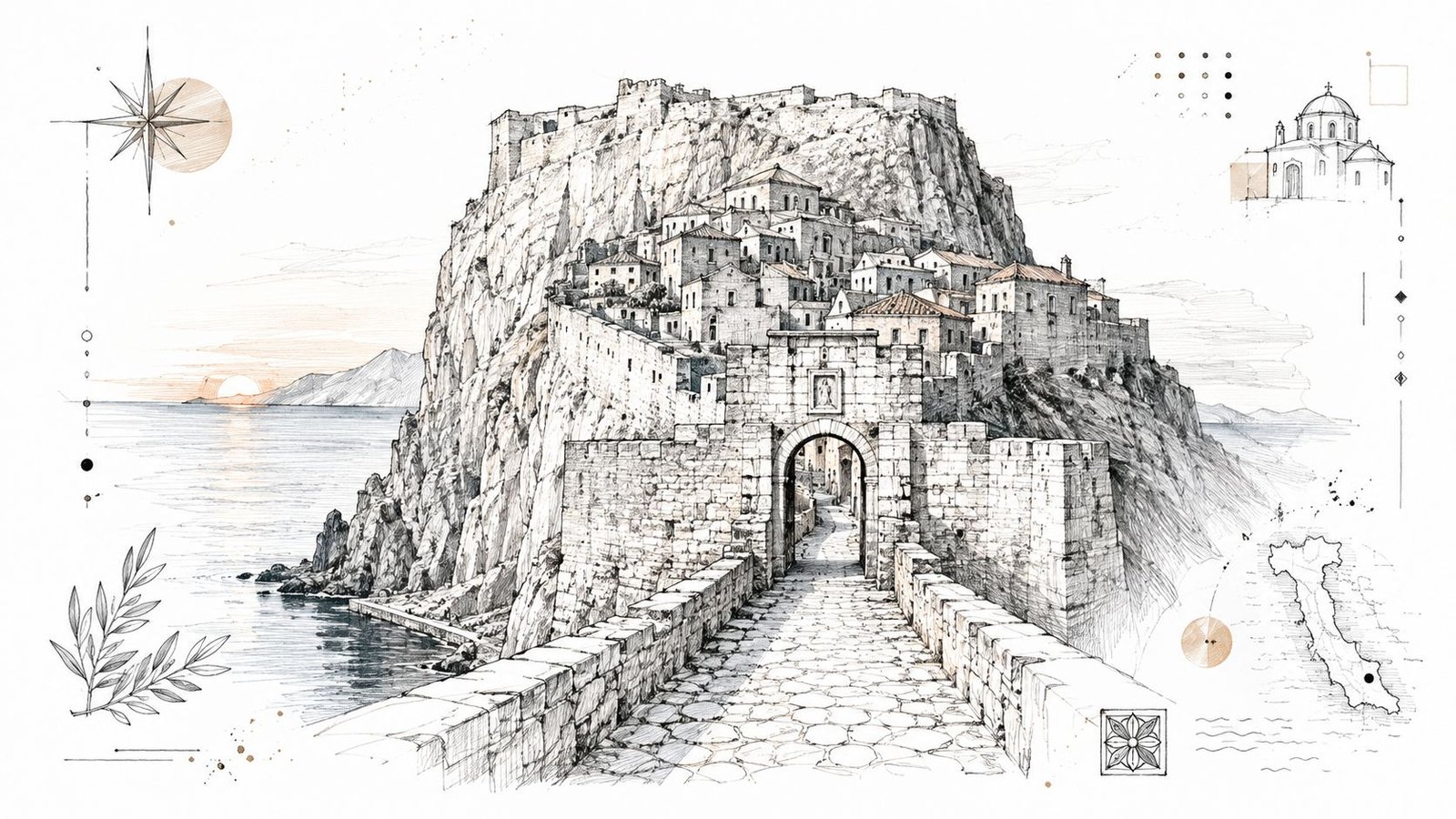
Monemvasia changes the route's mood completely. The medieval settlement occupies a rocky peninsula linked to the mainland by a causeway, with stone lanes, sea-facing buildings and a fortress setting separated from the modern road network. Plan to arrive in the late afternoon. Softer light, cooler air and fewer day visitors make the approach far more enjoyable.
Park outside the old town and continue on foot. The lanes are narrow and uneven, so the settlement suits pedestrians, not vehicles. If you are staying inside the walls, take only what you need for the evening. Wheeled luggage is difficult over the cobbles.
Stay for the evening
An overnight stay makes Monemvasia far more rewarding than a quick stop. Choose a restored stone guesthouse inside the old town for atmosphere, or stay near the causeway for simpler parking and access. Waterfront restaurants suit sunset, but reserve during the busiest summer months.
Explore the lower town in the evening, then climb to the upper town early the following morning. The ruins are exposed, uneven and tiring in hot weather. An early start protects your energy and leaves time for the coast or an unhurried meal later.
Check your hire contract before arranging any ferry connection with the rental car. UK travellers should carry a valid UK driving licence, and some agreements require written permission before the vehicle travels by ferry (guidance on driving in Greece, tolls and ferry use). Vehicle spaces may sell out before passenger tickets, so confirm the arrangements early.
This coastal-drive planning guide for Greece reflects the slower route design Monemvasia deserves. Treat the town as a medieval coastal stay, not another archaeological tick. Arrive late, walk the lower town after the day visitors leave, and reserve the upper fortress for the cooler morning.
8. Githio and the Mani Peninsula
Githio is the practical gateway to the Mani Peninsula and a fitting final major stop. Its harbour, seafood restaurants and relaxed waterfront make it an easy place to slow down after the historical concentration of the northern and central route. From here, the scenery turns rugged, with mountains meeting the sea and villages marked by defensive stone tower houses.
Base yourself in Githio or Kardamyli, depending on whether you want a harbour town or a smaller coastal village. Traditional stone accommodation suits the region, but prioritise parking, access and realistic driving times over appearance alone. A beautiful remote property isn't useful if every meal requires a difficult night drive along unfamiliar roads.
Drive south without rushing
The coastal road through the Mani is a destination in itself. Drive slowly, stop in villages and allow time for viewpoints, short walks and unplanned tavernas. Roads away from the main routes can become narrow, with blind bends, potholes and changing surface width, so progress is slower than a map may suggest (traveller guidance on driving in the Peloponnese).
Visit Vathia early in the morning, when the tower village is quieter and the heat is less severe. The Mani isn't a place to cram into a single transfer. Allow two to three days for the peninsula if you want to combine the villages, coast, food and architecture without turning every day into a driving exercise.
- For scenery: Follow the coastal road and stop often.
- For food: Choose waterfront tavernas and ask what arrived that day.
- For architecture: Look beyond restored façades to understand how tower houses defended local communities.
- For a slower finish: Stay in a stone house and schedule an unplanned afternoon by the sea.
Southern-road rule: Never build a rigid itinerary around a long mountain transfer. Keep an alternative overnight stop available and avoid rural night driving.
The UK Foreign Office highlights a high summer wildfire risk in Greece from April to October, so check local conditions before each driving day and keep routes adaptable (official Greece inbound tourism bulletin). This Greece coastal-road itinerary inspiration fits the Mani's combination of sea views, villages and flexible pacing.
Peloponnese Road Trip: 8-Stop Comparison
| Destination | Accessibility / Travel effort | Resources & facilities | Highlights / Expected experience | Ideal for | Key advantages |
|---|---|---|---|---|---|
| Athens & the Acropolis | Major international airport; excellent public transport; urban traffic and congestion | Wide range of hotels, car rental, museums, restaurants, strong logistics | Acropolis / Parthenon, Acropolis Museum, Plaka, city views | First-time visitors; start of Peloponnese road trip; cultural immersion | Logistics hub with rich museums and vibrant contemporary culture |
| Corinth & the Ancient Canal | ~1 hour drive from Athens via highway; short stop en route | Basic visitor facilities, small museum, canal viewing platforms, limited dining | Ancient Corinth (Temple of Apollo), Acrocorinth, dramatic canal views | Quick en route stop; photographers; archaeology interests | Minimal detour with striking canal photo opportunities |
| Nafplio & Palamidi Fortress | ~2 hours from Athens; parking can be difficult in summer | Good hotels and restaurants, waterfront promenade, local museums | Palamidi Fortress, romantic Old Town, Bourtzi castle | Couples; cultural strolls; coastal dining and photography | Highly photogenic, walkable Old Town, central base for the region |
| Mycenae & Ancient Palace Ruins | ~30 minutes from Nafplio; compact archaeological site | On-site museum, basic visitor services, limited shade and dining | Lion Gate, Cyclopean walls, tholos tombs, Bronze Age artifacts | History and archaeology enthusiasts; focused short visits | Exceptional historical significance and well-preserved Bronze Age remains |
| Epidaurus & Ancient Theatre | ~1 hour from Mycenae; more remote location | Archaeological museum, few dining options, seasonal performance infrastructure | World-class acoustics, Sanctuary of Asclepius, summer theatre performances | Classical theatre fans; performance attendees; peaceful visits | Outstanding acoustics and very well-preserved theatre complex |
| Sparta & Ancient Laconian Region | Remote inland; longer drives from coastal sites | Regional archaeological museum, modest tourism infrastructure, access to Taygetus | Sparse ruins, museum context, rural Laconian landscapes and villages | Travelers seeking authentic rural Greece and interior exploration | Less crowded, authentic cultural experience and inland gateway |
| Monemvasia & Medieval Fortress Town | ~1.5 hours from Sparta; limited parking outside pedestrian centre | Boutique hotels in restored houses, waterfront restaurants, pedestrian-only old town | Intact medieval walls, Byzantine/Ottoman architecture, dramatic sea views | Romantic getaways; photographers; medieval history lovers | Exceptionally picturesque, preserved medieval atmosphere, quality accommodations |
| Githio & The Mani Peninsula | ~1.5 hours from Monemvasia; winding coastal and mountain roads | Harbour town services, fresh seafood tavernas, basic village amenities, hiking trails | Tower-house villages, rugged coastal scenery, traditional Mani culture | Photographers, hikers, off-the-beaten-path travelers | Rugged natural beauty, authentic local culture, excellent value |
Turn the Route into Your Own Greek Odyssey
This route works because its geography creates a clear rhythm. Athens supplies the cultural opening, Corinth marks the crossing into the peninsula, Nafplio provides a comfortable Argolid base, and Mycenae and Epidaurus add two different forms of ancient Greek history. From there, Sparta and Mystras shift the focus inland before Monemvasia and the Mani deliver the most atmospheric coastal finish.
Don't try to give every stop equal weight. Nafplio deserves extra time if you want a relaxed base for Mycenae and Epidaurus, evening meals by the harbour and a proper visit to Palamidi. Monemvasia merits an overnight stay because its character appears after the day trippers depart and its upper town is best explored early. The Mani needs the most flexible pacing, particularly if you want to drive beyond Githio, visit Vathia and stop in smaller villages.
Corinth should be purposeful rather than rushed. Use it to understand the transition into the Peloponnese, visit the ancient site, see the canal and decide whether Acrocorinth fits your energy and weather. If you only stop for a photograph, you'll miss the relationship between the ancient city's strategic position and the modern engineering cut beside it.
Choose the right season and driving rhythm
The shoulder seasons, especially April to June and September to October, offer a strong balance for archaeological sightseeing, coastal walks and mountain driving (Peloponnese holiday guidance from TUI). Summer delivers long days and lively waterfronts, but it also demands early starts, shade planning, advance reservations and greater patience at parking areas.
Collect the car after Athens rather than at the start of your city stay. Drive archaeological sites early or late, carry water and sun protection, and avoid stacking several major ruins into one punishing day. On southern roads, allow more time than the route planner suggests. Narrow mountain stretches, blind bends and changing surfaces reward calm driving, not ambitious schedules.
For UK travellers, Greece already has strong mainstream appeal. ABTA-reported figures place Greece among the UK's top five holiday destinations, while over 80% of British holidaymakers travelled in 2024 and the average British traveller took 3.94 holiday trips (UK travel demand reporting). A Peloponnese road trip gives that familiar Greek holiday a more flexible shape, with history, coast and countryside linked by your own decisions.
Build the journey around what you want to remember. Choose the historical highlights if Mycenae, Epidaurus and Corinth matter most. Choose the coastal route if Nafplio, Monemvasia and Githio are your priority. Choose the rural version if the Mani, Taygetus and village food appeal more than another museum. Then create a flexible self-drive itinerary with accommodation, ferry conditions, route alternatives and realistic driving days. BTOURS can help with route design, handpicked accommodation and support from planning through the journey while leaving you free to explore at your own pace.
BTOURS offers self-drive multi-day itineraries in Greece, with route planning, selected accommodation and journey support for travellers exploring places such as Nafplio and the wider Peloponnese. Visit BTOURS to shape a road trip around your preferred balance of archaeological sites, coastal scenery and Mani Peninsula driving.