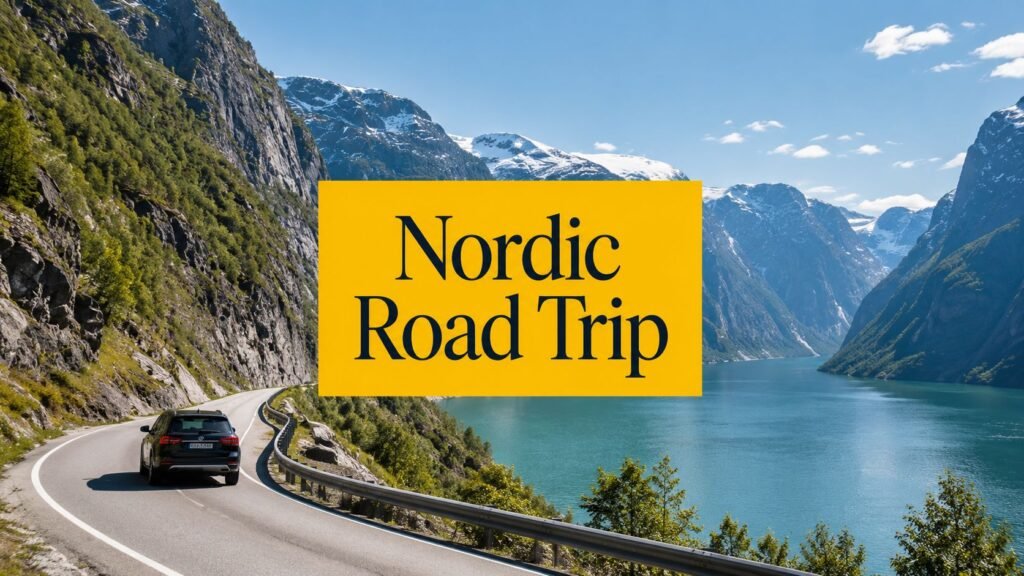
You are in Dover with the car packed, the playlist sorted, and a much better trip ahead than the average fly-in city break. The mistake UK drivers make is treating Scandinavia like a loose collection of capitals and viewpoints. It works far better as one connected road trip, planned around ferries, border crossings, fuel costs, and the long driving days that make this part of Europe so rewarding.
A good Scandinavia multi day trip starts before you leave the UK. Choose the wrong entry point, book ferries in the wrong order, or ignore where fuel prices spike, and you burn time and money fast. Choose well, and the whole journey clicks into place. You get the fjord roads, coastal cities, forest stretches, and late-summer light people talk about for years.
Demand is rising across the region, and Scandinavia is no longer a niche add-on for a wider Europe holiday. In 2025, Norway was projected to reach 40.6 million guest nights, with foreign demand continuing to grow, as reported by Statistics Norway and cited earlier in the article. That matters for one reason. UK drivers need to book the right crossings and overnight stops early if they want the best routes instead of the leftovers.
The planning gap is still obvious. General Scandinavia guides focus on rail passes, short flights, or one-country loops. UK motorists need different advice. You need to know whether to arrive via Denmark or northern Germany, where a ferry saves an ugly motorway slog, how tolls and bridges affect your route, and why fuel strategy matters more in Norway than it does in southern Sweden.
That is the difference between a trip that feels expensive and awkward, and one that feels brilliantly put together. At BTOURS, we plan Scandinavian self-drive holidays by joining the route, the crossings, the stopovers, and the driving rhythm into one clear plan. That is how you turn a big idea into a trip you can enjoy.
Table of Contents
- Why Your Scandinavian Road Trip Dream Is Closer Than You Think
- Designing Your Dream Scandinavian Itinerary
- Essential Logistics for UK Drivers
- Sample Multi-Day Road Trip Itineraries
- Accommodation and Booking Your Scandinavian Trip
- Conclusion Your Scandinavian Adventure Awaits
- Frequently Asked Questions About Your Scandinavia Road Trip
Why Your Scandinavian Road Trip Dream Is Closer Than You Think
The best Scandinavian trips don't feel rushed. You leave a city after breakfast, stop for coffee in a harbour town that wasn't even on your original list, then reach your hotel with enough daylight left for a waterside walk. That's the version worth planning for. Not the frantic one where every day is a transport connection.

The trip already fits the way people travel now
Scandinavia suits travellers who want space, design, scenery and structure without chaos. Roads are generally well organised, towns are clean and easy to get around, and the region rewards people who like independent travel instead of rigid group touring.
That's one reason the dream is closer than it used to be. The old idea was that Scandinavia was difficult, expensive, distant and best tackled by specialists only. I don't buy that. It's one of the strongest regions in Europe for a self-drive holiday because every move you make adds value. A detour often becomes the highlight.
Practical rule: If you like Britain's coastal drives, but want bigger landscapes and cleaner logistics once you're on the ground, Scandinavia is the natural upgrade.
Why driving beats patchwork transport
The main frustration for UK drivers isn't a lack of interest. It's the lack of joined-up advice. Most online guides tell you where to go, but not how to make the road trip function when you're crossing between Nordic countries with your own vehicle or a hire car.
That matters because a self-drive trip is only as good as its weakest practical decision. The wrong crossing, the wrong overnight stop, or the wrong fuel plan can distort the whole holiday. Good planning fixes that early.
Here's what driving gives you that rail-heavy planning usually can't:
- Control over pace: You can stay longer in places that deserve it and cut weaker stops without rebooking half the trip.
- Access to authentic views: Fjord viewpoints, lakeside cabins, village bakeries and coastal lay-bys rarely sit beside major transport hubs.
- A better emotional arc: Grand vistas land harder when you earn them by road.
- More useful packing: Boots, layers, picnic gear and proper luggage stop being a problem when your car travels with you.
A Scandinavia multi day trip works best when you stop thinking like a city-break traveller and start thinking like a route planner. The reward is simple. More freedom, fewer compromises, and a holiday that feels shaped by your choices rather than by timetables.
Designing Your Dream Scandinavian Itinerary
Travelers often start with a map. I think that's backwards. Start with the kind of trip you want, then choose the geography that supports it. Scandinavia is too broad for random pin-dropping, and the strongest itineraries have a clear personality.

Choose the trip by mood, not by map
Booking data supports what good planners already see. SAS aviation data for 2026 shows a significant rise in two-person leisure bookings, pointing to more couple-focused Nordic breaks, while the same reporting highlights the destination dupe trend, where travellers choose lesser-known Nordic cities instead of crowded headline spots for similar atmosphere and better value. You can read that shift in this SAS demand trend report on travellers pivoting to Scandinavia.
That should change how you build your route. Don't chase every famous stop. Pick the version of Scandinavia that matches how you like to travel.
Four travel styles that actually work
Adventure seeker
Norway is the obvious anchor. Think mountain roads, fjord ferries, waterfall stops and long scenic drives where the journey is the point. This style suits travellers who don't mind moving often as long as every driving day earns its keep.
Culture enthusiast
Denmark and southern Sweden make more sense. You get design-led cities, royal history, waterfront districts, museums, castles and polished food scenes without huge driving pressure. This is the best fit if you want a multi-day road trip that still feels urban and elegant.
Nature lover
Mix western Norway with quieter stretches of Sweden. Lakes, forests, national park access and cabin stays work better here than a capitals-only route. You're not trying to tick off landmarks. You're trying to spend time in natural surroundings that slow you down.
Urban explorer
Choose a tight loop around Copenhagen, Malmö and Stockholm, then add one or two smaller places that act as your “destination dupe” swaps. That's where the smart value sits. A smaller Nordic city can deliver harbour walks, excellent dining and strong design credentials without the pressure of a flagship capital.
For travellers who want route ideas built around that kind of flexibility, self-drive tours from BTOURS are a useful reference point for how themed road journeys can be structured around pace rather than just mileage.
The smartest mistake to avoid
The common planning error is mixing incompatible trip types. People try to combine deep fjord driving, three capitals, island hopping and Arctic scenery in one holiday. It looks ambitious on paper and exhausting in reality.
Use this quick filter instead:
| If you want… | Prioritise… | Skip… |
|---|---|---|
| Dramatic scenery | Norway-heavy routing | Too many city overnights |
| Romantic pace | Fewer bases, better hotels | Daily hotel changes |
| Design and food | Denmark and Sweden | Long mountain detours |
| Epic driving | Multi-country loop with ferries | Backtracking |
The best itinerary isn't the one with the most stops. It's the one where the route feels inevitable.
If you're planning a Scandinavia multi day trip for the first time, choose one dominant theme and one supporting theme. For example, fjords plus city culture. Or capitals plus coastal villages. That's enough to make the trip feel rich without making it clumsy.
Essential Logistics for UK Drivers
The journey itself often determines whether travellers gain or lose confidence. The route itself is the fun part. The logistics decide whether the fun arrives smoothly or with a headache.

Pick your entry strategy early
Your first major decision is how you want to get off Britain and onto the continental road network. Don't leave that until the rest of the trip is built. Your crossing shapes the whole rhythm of the journey.
Some drivers prefer the quickest push into mainland Europe and then drive north through Denmark. Others like a ferry segment because it breaks the journey and lowers fatigue. Neither is automatically right. The right one is the one that supports your route, your timing and your tolerance for long first-day mileage.
If you still like navigating on paper as a backup to apps, Barrons' 2026 UK large scale atlas review is worth a look before departure. Digital navigation is excellent, but a physical overview helps when you're visualising the opening leg out of the UK.
Cross-border rules you need to sort before departure
A Scandinavia road trip doesn't require panic. It does require discipline.
Before you leave, make sure you've checked:
- Vehicle ownership papers: Carry the documents that prove the vehicle is yours or that you're authorised to use it.
- Insurance scope: Confirm your cover applies across every country on your route.
- Registration markers: Make sure your car displays the correct UK identification requirements for international driving.
- Tyre and seasonal readiness: If you're travelling outside the mild-season window, check country-specific winter requirements before you go.
- Bridge and ferry planning: Know whether your route depends on a fixed crossing or a sailing, because that affects timing and overnight placement.
The specific anxiety is real. Many drivers feel fine about the scenery and nervous about the regulations. That's normal. The solution isn't more browsing. It's a pre-departure checklist that treats each border crossing as an admin task, not a mystery.
Fuel strategy and budgeting
Generic advice often loses its utility. If you use a standard UK road-trip fuel model in Norway, you can misprice your journey badly.
Due to the UK's non-EU status, UK drivers face a 10% higher VAT on fuel in Norway, and the most efficient strategy is to pre-fuel in Sweden, where fuel is cheaper. Over a long route, that can reduce per-kilometre expenditure by 18% to 22%, according to this Nordic fuel and routing guidance for UK travellers.
That changes how you should think about route design. Fuel is not a background cost. It's a routing lever.
A practical approach looks like this:
- Enter Norway with a full tank when possible
- Use Swedish segments deliberately rather than incidentally
- Avoid casual top-ups in expensive areas
- Budget by country, not by total distance
Local planner's view: The cheapest litre is the one you bought before Norway, not the one you hunt for once you're already deep into fjord country.
If your route touches Sweden before or after a long Norwegian segment, use that to your advantage. It's one of the cleanest ways to protect the budget without compromising the trip.
Driving rhythm beats speed
Many UK drivers focus too much on distance and not enough on fatigue. That's a mistake in Scandinavia. Road quality can be excellent and still slow you down because the scenery, ferries, tunnels, weather and stopping opportunities all affect momentum.
Here's the rhythm I recommend:
- Short urban days at the beginning or end
- Long scenic days only when the overnight stop is worth the effort
- No stacking of demanding drives on consecutive days
- One proper pause day in any trip over a week
A smart road trip feels spacious even when it's full. That comes from sequencing, not from bravado. Your goal isn't to prove how much you can drive. It's to arrive alert enough to enjoy where you've reached.
Sample Multi-Day Road Trip Itineraries
The best template depends on what kind of traveller you are. Some people want the concentrated hit of Norway's western drama. Others want a broader loop with capitals, bridges and sea crossings. A few want the full northern sprawl and are happy to let the road become the story.
Start with the version that fits your appetite, not your ego.

The 10-day Fjord Explorer
This route is for travellers who want maximum impact with minimal dilution. Keep the focus on Norway and let the scenery carry the trip.
A strong version starts in Oslo. Spend your first night there, adjust to the road setup, and don't rush out immediately. Then head west in stages rather than in one punishing push. Bergen earns at least a proper evening and morning. Its harbour energy, hillside viewpoints and compact centre make it one of the easiest cities in the region to enjoy without overplanning.
After Bergen, the trip sharpens. You're moving into fjord country properly. Use overnight bases that give you evening atmosphere, not just parking. Smaller waterside settlements often outperform larger functional towns because your off-road hours matter too.
A good flow looks like this:
- Oslo
- Bergen
- fjord-side stop
- mountain or valley overnight
- Geiranger area
- Ålesund or another strong finishing town
What makes this trip work is restraint. Don't stuff it with extra countries. Don't treat every viewpoint as mandatory. Give yourself time to stop for ferries, bakeries, photo lay-bys and short walks without turning each day into a race.
The 14-day Scandinavian Capitals Loop
This is the polished option. It suits couples, first-time visitors and anyone who wants variety without going fully remote.
The route works well when it balances city sophistication with road-trip breathing room. Copenhagen, Malmö, Stockholm and Oslo all justify inclusion, but the secret is in the transitions. You need smaller stops between bigger urban chapters so the trip keeps its shape.
One useful comparison point for scenic long-route planning is how travellers approach major coastal drives elsewhere, such as the Wild Atlantic Way in Ireland. The principle is the same. Signature highlights matter, but the route becomes memorable because of the places in between.
For this capitals loop, think like a curator:
| Segment | Best use of time | What makes it work |
|---|---|---|
| Copenhagen to southern Sweden | Gentle start | Easy adaptation to Nordic driving |
| Sweden interior or coast | Scenic breathing room | Smaller towns add texture |
| Stockholm | Urban peak | Architecture, islands, food |
| Westward transfer | Strategic overnight | Avoid city-to-city grind |
| Oslo finish | Relaxed close | Compact, stylish and easy |
This is also the itinerary where “destination dupe” thinking pays off most. A smaller Nordic city or island town can deliver the romance and atmosphere people chase in larger capitals, often with less crowd pressure and a better sense of calm.
You don't need every major stop. You need the right combination of major and minor ones.
A short visual can help settle the mood before you finalise your route:
The 21-day Grand Northern Tour
This is the route for travellers who don't want a sampler. They want scale. More road, more contrast, more silence, more weather.
The mistake here is assuming longer means you should just add more driving. It doesn't. Longer means you can use the region's transport geometry properly. That includes ferries.
Integrating the Hurtigruten coastal ferry can reduce total driving time by 45% on a 14-day Scandinavia road trip compared with staying on a continuous E6 route, and the overnight journey from Oslo to Copenhagen removes 1,200km of driving, according to this Scandinavian itinerary analysis with ferry time savings. That's not a gimmick. It's one of the smartest fatigue-management tools available to road-trippers.
A ferry isn't lost time. On the right route, it's recovery time that also moves you forward.
A grand tour can work like this:
Southern entry and settling phase
Start with Denmark or southern Sweden. Easy roads. Clean adjustment. Strong first nights.Central Scandinavian stretch
Build toward Oslo and western Norway. Fjords, mountain roads and classic photo moments are found.Coastal transfer or ferry integration
Use overnight sea travel or strategic ferry segments to cut dead mileage.Northern focus
Push into the more dramatic, sparser terrain only if you've protected enough days for them to breathe.A soft finish
End in a city or a smoother southern corridor. Don't make the final days the hardest.
This itinerary rewards travellers who understand that pace creates luxury. Not thread count. Not hotel category. Pace. If you're covering serious ground, every cut in fatigue improves the entire holiday.
Accommodation and Booking Your Scandinavian Trip
You finish a long day in western Norway, roll into a hotel car park 25 minutes outside town, then realise dinner means getting back in the car. That is bad booking. On a Scandinavia multi day trip, where you sleep affects your fuel use, evening options, parking stress, and how fresh you feel the next morning.
What to book and what to avoid
Book for route efficiency first, character second, price third. That order works.
In cities, stay central and pay for the right location. You want one parking session, then an evening on foot. In rural Norway, Sweden, and Finland, do the opposite. Pick places that belong to the setting, cabins by a lake, small harbour hotels, guesthouses near a fjord road, or well-run inns in towns you would otherwise drive straight through.
Avoid building the trip around bland roadside chains unless the stop is purely functional. They look practical on a map, but they often create extra driving for food, views, and basic atmosphere. For UK drivers covering long distances across borders, that wasted mileage adds up fast.
Demand rises quickly in the best summer corridors, especially around fjord gateways, ferry-linked towns, and capital city weekends. As noted earlier, Scandinavia has seen strong tourism growth. The good rooms disappear first, not the expensive ones.
Why character matters more than stars
A well-run 3-star hotel in the right spot beats a forgettable 4-star on a ring road. Every time.
You are not choosing one base for a beach holiday. You are building a chain of overnight stops that either support the drive or weaken it. Good accommodation should shorten the walk to dinner, reduce backtracking, give you a calm place to recover, and make the stop feel tied to the region rather than copied from anywhere in Europe.
That is especially important on a self-drive route with ferries and border crossings. If your next morning includes an early departure to a port or a long push into another country, the wrong hotel can cost you time, fuel, and patience before breakfast.
If you want your stays to match the pace and personality of the route, BTOURS' travel styles collection is a useful way to compare different trip rhythms before you book.
If you're curious how availability shifts across booking systems, Samba's guide to seamless tour booking with Samba explains why good rooms can vanish quickly across multiple sales channels.
When to lock it in
Do not wait until every stop is polished. Book the pressure points first.
Start with arrival and departure nights, then reserve the places that are hardest to replace. In Scandinavia, that usually means Copenhagen or Oslo on a weekend, fjord-area bases with limited stock, and overnight stops tied to a ferry departure or a long cross-border driving day. Those are the bookings that protect the whole trip.
Use this order:
- First: arrival and departure nights with reliable parking
- Second: scenic bases where location saves driving time the next day
- Third: ferry-linked or cross-border transition stops
- Last: flexible inland nights where supply is broader
My advice is simple. Fix the nights that control the route, then leave a little freedom around them. That is how experienced road-trippers book Scandinavia properly.
Conclusion Your Scandinavian Adventure Awaits
A Scandinavia multi day trip isn't difficult because the region is inaccessible. It feels difficult because most advice is built for train travellers, city-break planners or people willing to improvise every detail on the move.
Drivers need a different approach. Pick the right travel style first. Build a route that matches it. Treat fuel, crossings and ferries as strategic decisions, not last-minute admin. Then choose accommodation that improves the journey instead of merely housing it.
That's how the trip changes from vague ambition into something real. You stop wondering whether Scandinavia is too big, too complex or too expensive to tackle by road. You start seeing the actual shape of the holiday. One well-planned crossing. One strong route. One sequence of stays that turns long distances into a coherent adventure.
The appeal is obvious once you do that. You get elegant cities, quiet roads, dramatic coastlines, mountain scenery, harbour towns and the freedom to follow your own tempo. Few European trips give you that combination so cleanly.
If you've been circling the idea for months, stop circling it. Choose the version of Scandinavia you want and start building it properly. The road does the rest.
Frequently Asked Questions About Your Scandinavia Road Trip
What documents should I carry for a UK-registered car
Carry your driving licence, vehicle registration document, insurance details and any authorisation paperwork if the car isn't registered in your name. Check current requirements for UK identification markers on the vehicle before departure. If you're using a hire car, confirm in writing that cross-border driving is allowed for every country on your route.
Do I need cash in Denmark, Norway and Sweden
Card payments are widely used across Scandinavia, and many travellers rely on them for almost everything. Still, it's sensible to carry a small amount of local currency if you prefer a backup. Denmark, Norway and Sweden each use their own currency, so don't assume one cash stash will cover the whole trip.
Is an EV practical for a Scandinavia road trip
Yes, but only if you plan it as an EV trip from the start. Don't retrofit charging logic onto a route built for petrol timings. In cities and on major corridors, charging is generally far easier to work into the day than many first-time visitors expect. In more remote areas, your accommodation choice becomes more important because overnight charging or nearby charging access can decide whether the next day feels easy or awkward.
Can I wild camp anywhere under Right to Roam rules
No. Right to Roam concepts in parts of Scandinavia apply to responsible access to nature, not blanket permission to park or vehicle-camp anywhere you like. A tent and a car are not treated the same way. If you're sleeping in or beside a vehicle, check local restrictions carefully and don't assume public access rights override land use, parking rules or local prohibitions.
For a road trip this ambitious, the smartest move is to stop piecing it together from scattered tabs and start with a route built by specialists. Explore BTOURS if you want a self-drive Scandinavia holiday that's mapped with real care, practical pacing and the kind of accommodation that makes the whole journey feel considered.