Imagine the sheer freedom of it all: discovering Ireland entirely on your own terms. Picture a dramatic coastline unfurling before your eyes, ancient castles emerging from the morning mist, and a patchwork of vibrant green fields stretching as far as you can see. This isn't just another trip; it's your story, waiting for you to write it. A self-drive tour is the absolute best way to unlock the true, untamed soul of the Emerald Isle.
Your Epic Irish Road Trip Starts Here
Consider this guide your trusted co-pilot, designed to turn any nerves about driving in Eire into pure, unadulterated excitement. We're here to demystify the rules of the road, share a bit of local wisdom for navigating with confidence, and give you all the tools you need to explore Ireland’s legendary beauty.
Let’s be honest, the thought of driving on the left, tackling roundabouts, and squeezing down narrow country lanes can feel a little intimidating at first. But with a bit of prep, those challenges become part of the adventure. Think of it as learning the unique rhythm of the country—a skill that brings you that much closer to an authentic Irish experience.
From the historic cobblestones of Dublin to the wild, salt-sprayed shores of the Wild Atlantic Way, your journey begins right now. Let's get you ready for an unforgettable adventure, one filled with spontaneous discoveries and the singular magic of Ireland.
What to Expect From This Guide
This is much more than just a list of rules; think of it as a complete toolkit for your road trip. We’ve laid everything out to build your confidence step-by-step, making sure you feel ready for every twist and turn the road throws at you.
Here’s a sneak peek at what we'll cover to get you ready for driving in Eire:
- Essential Rules and Licences: We’ll cover the absolute non-negotiables, from the legal documents you'll need to the golden rule of always keeping left.
- Navigating Like a Local: You'll get a practical breakdown of Irish road signs and a simple, step-by-step method for mastering roundabouts.
- Rural Road Wisdom: We’ve got tips for safely enjoying those narrow, scenic lanes where Ireland’s best-hidden gems are found.
- Car Hire and Itineraries: You'll find solid advice on choosing the right vehicle and two incredible self-drive routes to spark your imagination.
Embracing the drive is embracing the destination itself. The freedom of the open road in Ireland allows you to follow your curiosity, stop for that unplanned photo, and discover a side of the country that tour buses can never reach.
To make your journey even smoother, being well-prepared is essential. As you embark on your epic Irish road trip, gaining broader travel insights can be beneficial, such as those often shared on Blulinc's travel blog. Furthermore, packing light is always a smart strategy for a road trip; you might be interested in a compact carry-on like this Ryanair-approved underseat backpack to maximise space in your hire car.
Getting Your Ducks in a Row Before You Fly
The secret to an incredible Irish road trip isn’t just what you do when you get here; it's the prep work you do before you even leave home. Getting the essentials sorted beforehand is the difference between a trip filled with hassle and one where you can just relax and soak in the scenery. Think of it as laying the groundwork for a truly seamless adventure.
First things first: your documents. This is the non-negotiable part. Having your paperwork in order is your legal green light to explore Ireland’s winding roads. I’ve found that keeping everything in one place saves a lot of fumbling around at the rental desk; something like a good leather passport holder is perfect for keeping your licence and other vital bits safe and handy.
Is Your Licence Good to Go?
Thankfully, for most travellers, this part is pretty simple. If you have a valid driving licence from the UK, any EU or EEA country, the USA, Canada, Australia, or New Zealand, you're all set.
But what if your licence is from somewhere else? Or if it isn’t in English? That's when you'll need an International Driving Permit (IDP). Don't think of it as a replacement licence; it's simply an official translation that you must carry with your original one. It’s a small bit of paperwork that makes a world of difference.
A Quick Pro-Tip: Don't just assume everything is fine. Always check the specific policy of your car hire company before you click "book." A quick email or phone call can save you from a major headache when you arrive to pick up your car.
The Nitty-Gritty of Age and Rentals
While you can legally drive in Ireland at 17, the world of car hire operates on its own set of rules. You’ll generally need to be at least 21 years old to even be considered, and if you’re under 25, be prepared for a hefty ‘young driver surcharge’.
Here’s how it usually breaks down:
- Ages 21-24: Expect to pay more per day. Your choice of cars will also likely be limited to the smaller, less-powerful models.
- Ages 25-75: This is the sweet spot. You'll have access to the full range of vehicles without any extra age-related fees.
- Over 75: You might hit a few extra hurdles. Some rental agencies ask for a recent letter from your doctor stating you're fit to drive, or even proof of a clean driving record for the past five years.
The Big One: Keep Left!
Alright, this is the single most important adjustment you'll make. In Ireland, we drive on the left-hand side of the road. It feels completely backwards if you're used to driving on the right, but trust me, you’ll get the hang of it faster than you think.
I tell everyone the same thing. Burn this mantra into your brain: "Stay left, look right."
Every time you pull out, approach a junction, or enter a roundabout, your brain will want to look left. You have to consciously override that instinct and look right for oncoming traffic. The driver's seat is also on the right side of the car, which puts the gearstick on your left. It’s a lot to process, which is why I always, always recommend visitors hire an automatic. It takes one major challenge out of the equation, freeing you up to focus on the road and, more importantly, the stunning views.
How to Navigate Irish Roads with Confidence
Getting to grips with Irish roads is where the real adventure begins. It’s about more than just getting from one beautiful spot to another; it's about learning the unique rhythm of the landscape. From road signs and roundabouts to the flow of the motorways, understanding the local way of doing things will transform you from a tourist into a truly confident explorer.
One of the first things you’ll notice, particularly out west, are the bilingual road signs. In the Gaeltacht (Irish-speaking) regions, you'll see place names in both Irish Gaelic and English. Don't worry when a sign points you toward An Daingean—you're still on the right road for Dingle! Think of it as a beautiful little piece of the cultural tapestry, not a navigational test.
The basics are simple, but they are the absolute foundation for a great trip.
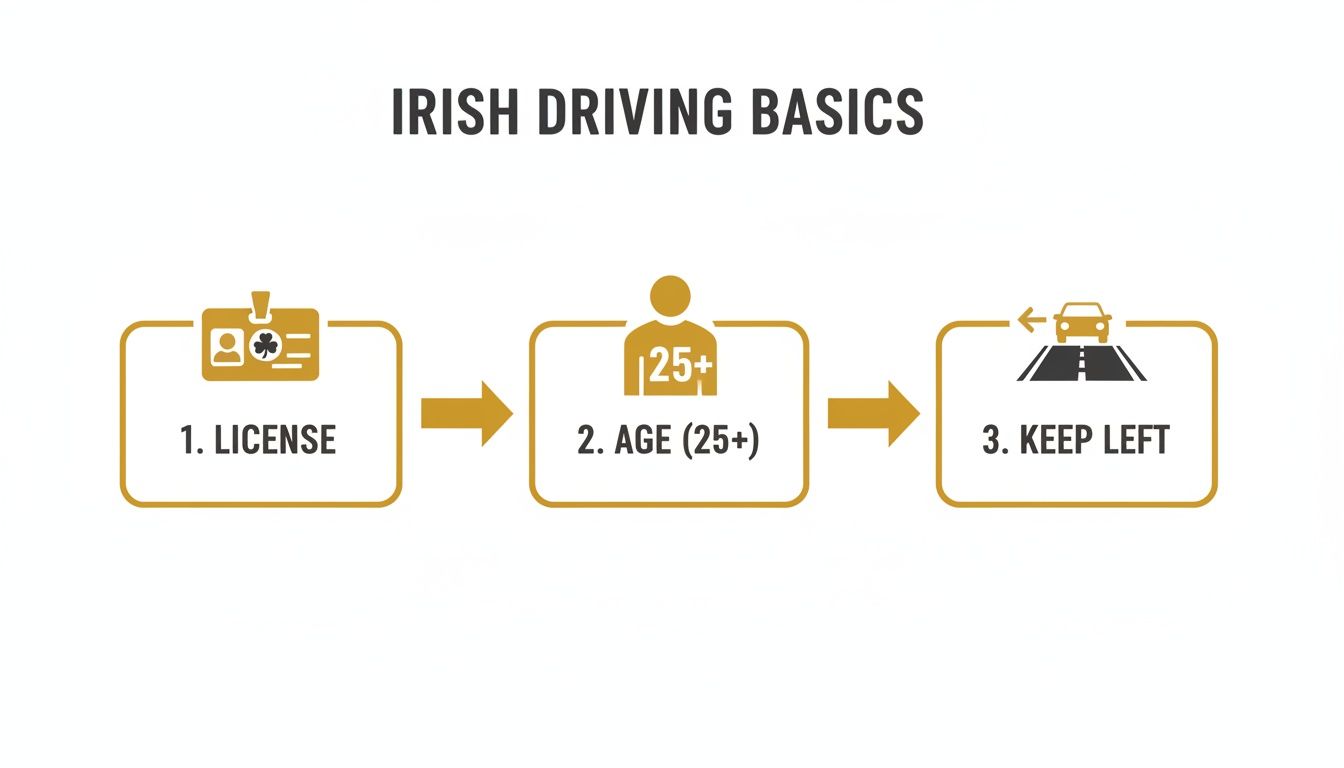
As long as you have the right licence, meet the age requirements, and make 'keep left' your mantra, you have everything you need for an unforgettable road trip.
Mastering the Art of the Roundabout
If Irish roads have a heartbeat, it's the roundabout. You'll find them everywhere, and once you get the hang of them, you'll see how much more efficient they are than traffic lights. For many visitors, they’re the biggest source of anxiety, but there’s a simple way to think about them that makes it all click.
Imagine each roundabout is a clock face, and you are always approaching from the 6 o'clock position. Where you plan to exit dictates how you approach and signal.
- Going left (1st exit at 9 o'clock): Stay in the left-hand lane and signal left as you enter. Easy.
- Going straight on (2nd exit at 12 o'clock): Approach in the left-hand lane. Don't signal until you've passed the first exit, then pop on your left indicator to show you're leaving.
- Going right (3rd exit at 3 o'clock): This is the one to practice. Approach in the right-hand lane, signalling right as you enter. Keep that right signal on until you pass the 12 o'clock exit, then switch to your left signal to exit smoothly.
The golden rule that never changes is this: always give way to traffic already on the roundabout, which will be coming from your right. Once you master that simple flow, you’ll be navigating them like a local. For extra peace of mind, a good navigation tool can be a game-changer; many drivers find a wireless CarPlay screen helps keep directions crystal clear without taking their eyes off the road.
Cruising on Motorways and Handling Tolls
For those longer journeys between cities, you'll find yourself on Ireland’s excellent motorways, marked with an 'M' (like the M8). They’re the fastest and most direct routes you can take. Just like everywhere else, the fundamental rule is to keep left unless you are overtaking. The right-hand lane is purely for passing slower traffic.
Most motorways have traditional toll plazas where you can pay with cash or card. But there's one big exception that every visitor needs to know about.
The M50 motorway, which circles Dublin, has a barrier-free tolling system called eFlow. There are no booths; overhead cameras simply snap a picture of your registration plate. It's then your responsibility to pay the toll online or at a Payzone shop by 8 p.m. the next day to avoid a fine.
This is a crucial point to discuss with your car hire company. Many have an arrangement where they manage the toll and charge it to your account, but you absolutely must clarify this before you drive off the lot. Get these key navigational elements down, and you’ll feel ready and empowered to handle any road Ireland throws your way.
Staying Safe on Rural Roads and Understanding Speed Limits
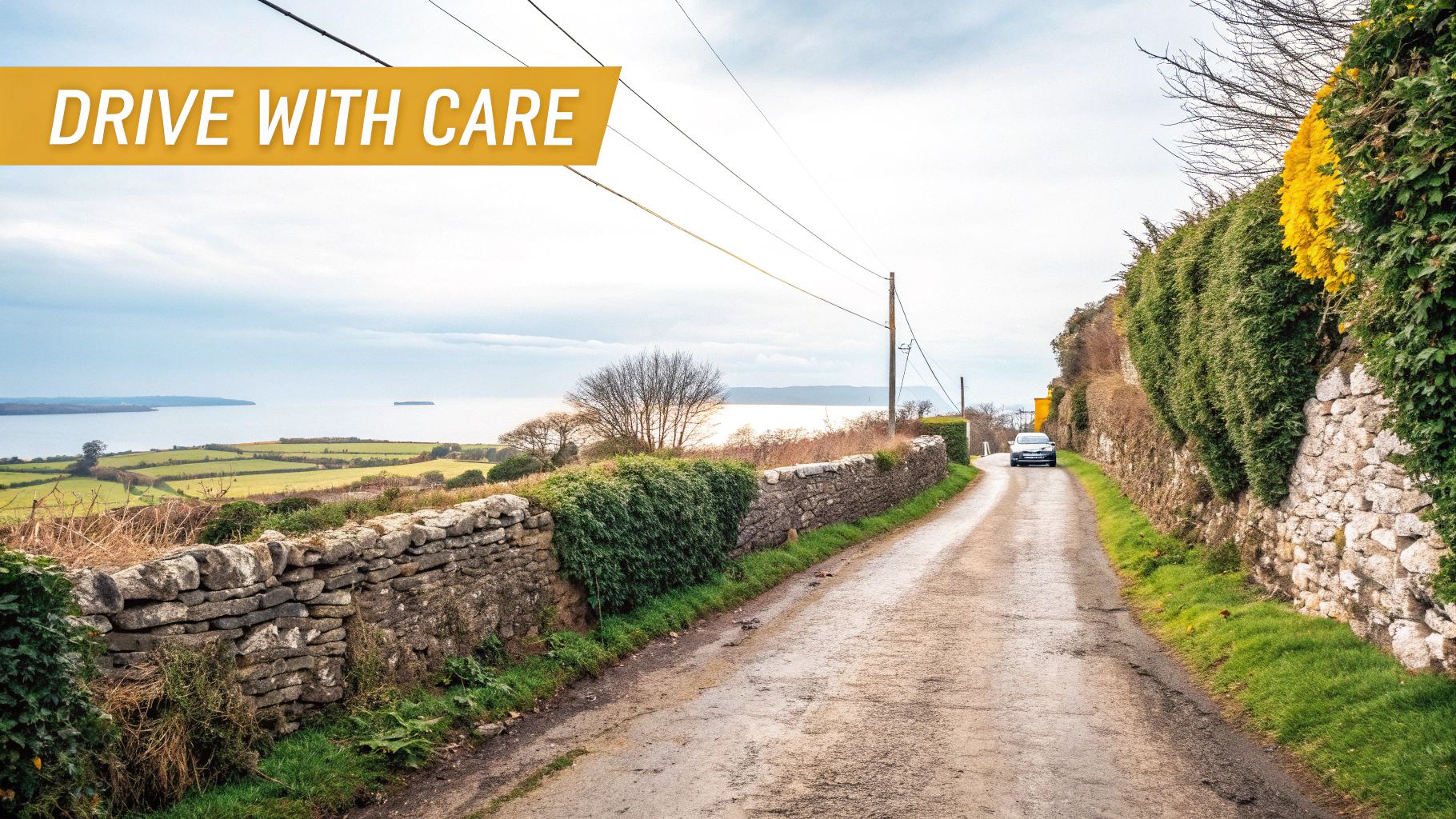
Sure, motorways will get you between the big cities, but the real magic of Ireland unfolds on its rural roads. These are the little arteries that snake their way to hidden coves, forgotten castles, and quiet villages. Getting comfortable on these lanes—and getting a feel for the local speed limits—is your ticket to a truly unforgettable journey.
First things first: every speed limit sign you see is in kilometres per hour (km/h), not miles. Your hire car will have a speedometer that shows km/h, but it’s a mental shift you need to make right away. It’ll stop you from accidentally creeping over the limit or, just as frustrating for locals, driving far too slowly.
Decoding Irish Speed Limits
The national speed limits are your baseline. Think of them as the absolute ceiling, only to be reached in perfect conditions—sunshine, dry roads, and not another soul in sight.
Here’s a quick rundown of what to expect:
- Motorways (M roads): 120 km/h (about 75 mph)
- National Roads (N roads): 100 km/h (about 62 mph)
- Regional Roads (R roads): 80 km/h (about 50 mph)
- Built-Up Urban Areas: 50 km/h (about 31 mph)
Of course, you’ll spot special limits of 30 km/h or 60 km/h as you pass through small villages or near schools. Pay close attention to these signs. They’re strictly enforced, not just for safety, but to help keep these communities peaceful.
The Art of Navigating Country Lanes
Now for the real adventure: those winding, narrow country roads. Many are barely wide enough for one car, hemmed in by ancient stone walls and overgrown hedgerows. You might see a sign indicating the speed limit is 80 km/h, but I can promise you, trying to hit that speed would be both terrifying and incredibly foolish.
This is the golden rule of driving in rural Ireland: the speed limit is a maximum, not a target. Your real speed should be guided by the conditions, how far you can see ahead, and what feels safe.
Driving these lanes is like learning a new dance, one that’s all about courtesy and caution. You’ll find blind corners, sudden dips, and maybe even a tractor or a flock of sheep ambling across your path. Slow right down for bends and always be ready to stop. For a bit of extra security on your trip, it’s never a bad idea to have some basics on hand. You might even consider packing a set of heavy-duty jump leads, just in case.
Along these routes, you'll notice small pull-in areas. These aren’t for a picnic; they’re passing places, and there’s an unwritten etiquette to using them:
- Be ready to reverse. If you meet another car and the nearest pull-in is behind you, it’s good form to be the one to back up.
- Give a thank-you wave. When another driver pulls in to let you pass, a quick lift of the hand is the universal way to say thanks.
- Mind the four-legged locals. It’s not a stereotype! Sheep and cows on the road are a regular part of the experience. Slow down, give them space, and enjoy the moment.
Think of this slower pace not as a limitation, but as an invitation. It’s your chance to really soak in the landscape, to spot that crumbling ruin on a hillside, and to connect with the wild, authentic heart of the Irish countryside.
Choosing the Right Car Hire and Insurance
Getting your car and insurance sorted properly is one of those things that can make or break a road trip. Get it right, and your journey will be all about the freedom of the open road; get it wrong, and you could be facing a lot of stress. Let's make sure you start your Irish adventure with complete peace of mind.
Think of it as the first, most important decision of your trip. The right car will feel like your trusty steed, carrying you effortlessly towards ancient castles and cliffside vistas.
Select the Right Vehicle for Your Trip
Here’s the single best piece of advice anyone can give you about renting a car in Ireland: go smaller than you think you need. I know that big, roomy SUV looks tempting, but trust me, you’ll regret it the first time you find yourself on a classic Irish boreen—a narrow country lane with stone walls on one side and a flock of sheep on the other.
A compact car is your golden ticket. It’s nimble, easy to park in a crowded coastal village, and it gives you that little bit of extra breathing room on those winding roads. Plus, you’ll save a nice bit of cash on fuel, which is better spent on a hearty pub lunch.
Another pro tip? Consider hiring an automatic. Even if you drive a manual at home, everything is flipped here. You’ll be sitting on the right and shifting gears with your left hand, all while navigating unfamiliar roads. Taking the gearbox out of the equation frees up so much mental energy, letting you focus on the drive and, more importantly, the incredible scenery.
Decoding Car Hire Insurance
Right, let’s talk insurance. This is the bit that often causes confusion, but it doesn't have to be complicated. Think of it as your financial safety net, protecting you from unexpected bumps in the road—both literally and figuratively.
The quote you get online will almost always include basic insurance, but the catch is the sky-high excess. This is the amount you have to pay out of pocket if there’s any damage. Reducing that excess is the key to a worry-free trip.
Here’s what you’ll be looking at:
- Collision Damage Waiver (CDW): This isn't really "insurance" in the traditional sense. It's the rental company agreeing not to charge you for the entire value of the car if it gets damaged. The catch? You’re still on the hook for a hefty excess, which can easily be €1,500 to €3,000.
- Super CDW (or Excess Insurance): This is the magic add-on you'll almost certainly want. For an extra daily fee, it slashes your excess right down, often to zero. It’s the difference between a minor scrape being a small inconvenience or a holiday-ruining expense.
Before you commit to a rental, it's worth getting your head around what different policies involve. A bit of time spent understanding what liability insurance covers will help you choose the right cover for your journey with confidence.
Final Checks Before You Drive Away
Don't be in a rush to leave the rental car park. A few minutes of checks here can save you a world of trouble later. It's a simple pre-flight checklist for your road trip.
- Document Everything: Do a slow walk-around of the car. Use your phone to take photos and a quick video of every single scratch, scuff, or dent you can find, no matter how tiny. Point them out to the rental agent and make sure they’re noted on the rental agreement before you sign anything.
- Know Your Fuel: Pop open the fuel cap and double-check if your car takes petrol or diesel. In Ireland, the pump nozzles are the opposite of what you might be used to: green for petrol and black for diesel. Putting the wrong fuel in is a nightmare scenario that insurance won’t cover.
- Find the Breakdown Number: Locate the rental company’s 24/7 breakdown assistance number. It might be on a sticker inside the windscreen or with the car's documents. Save it to your phone right away. Just knowing it’s there if you get a flat tyre is hugely reassuring.
Two Unforgettable Irish Self-Drive Itineraries
Alright, you’ve got the rules of the road down. Now for the fun part—dreaming up the incredible adventure that awaits. The real magic of having your own car in Ireland is the freedom it gives you to chase your curiosity, to pull over whenever a view steals your breath, and to craft a story that's entirely your own.
To get your imagination fired up, I’ve laid out two of my favourite self-drive itineraries. Each one has a completely different feel, a unique soul.
One journey takes you deep into Ireland’s mythic past, a path that winds through 5,000 years of history and whispers tales of high kings, saints, and medieval knights. The other is a wild, elemental dance with the Atlantic Ocean, a route defined by dramatic cliffs and untamed landscapes that demand your full attention.
Think of these less as strict plans and more as invitations—invitations to explore, to get wonderfully lost, and to find the heart of Ireland at your own pace. Let’s see which one calls to you.
A Journey Through Ireland's Ancient East
This 5-day itinerary is a time-traveller’s dream. It’s a route that traces a path through the lush, rolling landscapes that cradle some of Ireland's most profound historical treasures. Expect crumbling monastic ruins, powerful ancient sites, and stories etched in stone.
-
Day 1: The Serenity of Glendalough (Approx. 1.5 hours from Dublin)
Your adventure begins as you drive south into the magnificent Wicklow Mountains National Park. Your destination is Glendalough, a 6th-century monastic city tucked away in a deep glacial valley. Spend the afternoon wandering among its iconic round tower and stone churches, feeling the profound sense of peace that still clings to this sacred place. -
Day 2: Medieval Marvels in Kilkenny (Approx. 1.5 hours drive)
Head southwest to the vibrant city of Kilkenny. It’s a place that wears its history with pride. You can explore the magnificent Kilkenny Castle before losing yourself in the narrow cobbled lanes of the 'Medieval Mile'. It’s an incredibly photogenic city with a fantastic pub scene for the evening. -
Day 3 & 4: The Neolithic Heartland (Approx. 2 hours drive)
Now you travel north into the Boyne Valley, the very cradle of Irish civilisation. I’d recommend basing yourself here for two nights to really soak it all in. You absolutely must pre-book your visit to the UNESCO World Heritage Site of Brú na Bóinne to witness the awe-inspiring passage tombs of Newgrange and Knowth—incredible structures older than the pyramids. -
Day 5: The Hill of Tara and Return (Approx. 1 hour to Dublin)
Before heading back, make one last, poignant stop at the Hill of Tara. This windswept, ancient ceremonial site was once the seat of the High Kings of Ireland. Standing on that hill, looking out across the plains of Meath, you can almost feel the echoes of history on the wind.
This itinerary is for the storyteller, the history lover, and anyone who feels a pull towards the distant past. It’s a gentler pace, designed for deep immersion in Ireland's incredible heritage.
A Taste of the Wild Atlantic Way
If it’s raw, dramatic beauty you’re after, this 7-day adventure is for you. It captures the true spirit of the world's longest defined coastal touring route. Get ready for salt spray on your windscreen and views that will genuinely leave you breathless.
-
Day 1 & 2: Galway's Vibrant Heart (Approx. 2.5 hours from Dublin)
Your first move is to cross the country to Galway, the perfect gateway to the west. Spend your first day getting lost in this bohemian city, with its colourful shopfronts, brilliant street performers, and some of the best seafood you'll ever taste. It's the ideal place to soak up the atmosphere before you head into the wild. -
Day 3: The Burren and Cliffs of Moher (Approx. 1.5 hours drive)
Drive south into the otherworldly landscape of County Clare. Your first stop is the Burren, a unique and starkly beautiful region of cracked limestone pavement. Then, prepare yourself for the main event: the majestic Cliffs of Moher, rising an astonishing 214 metres from the churning Atlantic below. Take your time, walk the coastal path, and just let the sheer scale of it all sink in. -
Day 4 & 5: Connemara's Rugged Soul (Drive times vary)
Head northwest into the heart of Connemara, a landscape of breathtaking contrasts. Think dark loughs, sweeping mountainsides, and vast peat boglands stretching to the sea. For some of the best views, take the Sky Road loop from Clifden, and don't miss Kylemore Abbey—a gothic fairytale castle perfectly reflected in the lake at its feet. -
Day 6: The Quiet Beauty of Mayo (Approx. 2 hours drive)
Continue your journey north into County Mayo. It's an often-overlooked corner of the coast, but it’s every bit as stunning. Discover the wild, untamed beauty of Achill Island, or find a peaceful harbour around the lovely town of Westport. This is your chance to find a quiet piece of the Wild Atlantic Way all to yourself. -
Day 7: The Journey Back East (Approx. 3.5 hours to Dublin)
Enjoy one last, hearty Irish breakfast before beginning the drive back across the country. Your head will be full of memories of that wild, untamed coastline. This route gives you a true sense of the immense power and majesty of Ireland's western edge.
Answering Those Last-Minute Questions
Even the most well-prepared traveller has a few niggling questions that pop up right before grabbing the car keys. Let's get those sorted so you can hit the road with complete confidence. Think of this as a final chat over a cup of tea before your grand Irish adventure begins.
These are the little bits of know-how that can turn a moment of "what do I do now?" into a seamless, stress-free part of the journey.
What Happens If I Break Down?
First off, take a deep breath. It happens. The most important thing to know is that your car hire company is your first port of call. Before you even pull out of their car park, find their 24/7 breakdown assistance number. It’s usually on a sticker on the windscreen or tucked in with the vehicle’s documents.
Pop that number straight into your phone. If you hit a snag:
- Find a safe spot to pull over, as far off the road as you can manage.
- Switch on your hazard lights to make sure other drivers can see you clearly.
- Call the breakdown number and give them as precise a location as you can.
Nearly all rental agreements come with basic breakdown cover, so whether it's a flat tyre or something more serious, they'll know exactly what to do.
Can I Use My Phone for Navigation?
Yes, and you'll be glad you did! Apps like Google Maps or Waze are lifesavers, whether you're navigating the one-way streets of Galway or trying to find a hidden gem of a B&B down a winding country lane. The trick is to use it legally and safely.
It is illegal to hold and use a mobile phone while driving in Ireland. You must have it secured in a hands-free cradle or mount.
Make sure your hire car comes with a phone mount or, better yet, bring your own. Also, a quick word to the wise: rural Ireland’s charm often includes patchy mobile signal. Before you set off each morning, download the day's route for offline use. That way, your sat-nav will keep working its magic even when you're deep in the beautiful back-of-beyond.
How Should I Handle Parking?
Parking is a bit of a mixed bag, changing from city to village. In larger centres like Dublin and Cork, you'll mainly find multi-storey car parks or on-street "pay and display" bays. For these, you simply buy a ticket from a machine and pop it on your dashboard. Always double-check the signs for how long you're allowed to stay.
In smaller towns, you might find free parking, but often with a time limit. Keep an eye out for "disc parking" zones. This system requires you to grab a paper disc from a local shop, set your arrival time, and display it in your car. Parking wardens are a common sight, so it's always worth being careful. And remember, for many visitors, parallel parking on the left will feel completely backwards—take it slow, and don't be shy about finding an easier, drive-in spot!
At BTOURS, we believe the freedom of a self-drive holiday is the only way to truly unlock the magic of Ireland. Our tours are crafted to give you all the tools and inspiration you need to explore this incredible island at your own pace.
Ready to find your perfect Irish road trip? Come and see what's waiting for you at https://www.btours.com.