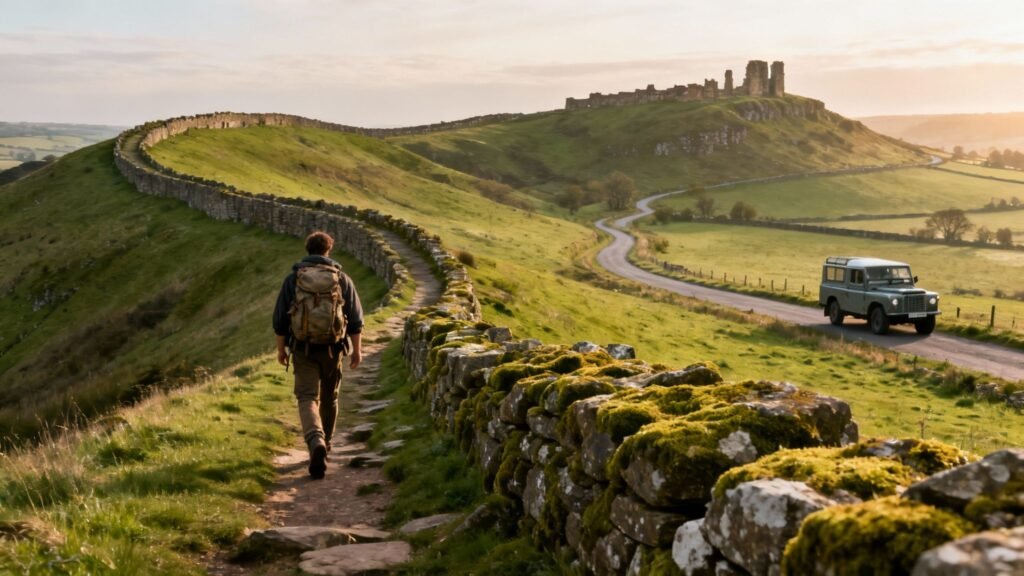
Stretching 84 miles (135km) from coast to coast, the Hadrian's Wall Path isn't just a walk; it's a journey back in time. This iconic National Trail traces the footsteps of Roman legionaries across the wild, beautiful landscapes of northern England, following a frontier that stood for nearly 2,000 years.
Walk the Edge of an Empire

Walking Hadrian's Wall is like stepping into a living museum, where the rugged English countryside is your guide. It’s an experience that captures the imagination, blending incredible Roman history with scenery that will stop you in your tracks.
And you don't need to be a hardcore hiker to take it on. The path is well-marked and the challenge is more about stamina than technical skill, making it a brilliant adventure for anyone with a decent level of fitness. As you make your way from the urban bustle of Wallsend to the peaceful salt marshes of Bowness-on-Solway, you’re literally walking through history.
A Frontier Forged by 15,000 Soldiers
It all started back in AD 122. Emperor Hadrian gave the order, and a colossal undertaking began. For nearly 300 years, this wall marked the north-west frontier of the Roman Empire, a powerful statement of their control. Imagine the sheer effort: it took around 15,000 soldiers from three legions to build it.
It's no surprise that the wall was named a UNESCO World Heritage Site in 1987. Its historical significance is immense, and every stone tells a story.
So, What's the Big Deal?
The magic of the Hadrian's Wall Path is its incredible variety. One moment you're clambering over a dramatic crag with views for miles, the next you're exploring the ghostly ruins of a Roman fort. It never gets boring.
- History You Can Touch: You'll pass ancient milecastles, crumbling turrets, and astonishingly well-preserved forts like Housesteads and Vindolanda.
- Jaw-Dropping Scenery: The trail slices through some of northern England's most breathtaking landscapes, from rolling farmland to windswept, wide-open moorland.
- A Proper Challenge (That You Can Actually Do): It’s a genuine long-distance walk that will test you, but it's not a gruelling mountaineering expedition. For many, it's the perfect first multi-day trek.
- A Taste of the North: The path links lovely villages and historic market towns, giving you a real feel for the warm hospitality and unique culture of the north.
This guide is here to give you everything you need to plan your own adventure along this incredible slice of England. Let’s get you from daydreaming about it to actually doing it.
How to Plan Your Hadrian's Wall Walk
A great walk starts long before your boots hit the trail. Getting the planning right is the secret sauce to a smooth, enjoyable, and genuinely unforgettable trek along Hadrian's Wall. Think of this as your logistics hub, where we'll sort everything from the best time of year to walk to where you'll lay your head at night.
Good preparation means you can lose yourself in the staggering views and ancient history, not stress about where you’re sleeping or whether you've taken a wrong turn. Let's get into the key bits and pieces you need to decide.
Choosing the Best Time to Go
Timing is everything, and the season you choose will completely change the character of your walk. While you can technically walk the path any time of year, the sweet spot is between May and October.
- Spring (May to June): This is when the landscape bursts into life. Wildflowers are out, lambs are bouncing around the fields, and the days are getting wonderfully long. The weather is often lovely, and you’ll get ahead of the main summer rush.
- Summer (July to August): You'll get the longest daylight hours, which means more time to explore. This is peak season, so it’s busier and warmer. It's also when the ground is at its driest, which is a huge help in protecting the fragile archaeology from erosion.
- Autumn (September to October): My personal favourite. The crowds start to thin, and the countryside is painted in gorgeous golden colours. The air is often crisp and cool – just perfect for walking, though you’ll need to keep an eye on the earlier sunset.
It's best to avoid the main path in the depths of winter (November to April). The ground gets seriously waterlogged and delicate, and many pubs, B&Bs, and cafes shut up shop for the season. Walking in the summer really does help preserve this UNESCO World Heritage site for everyone.
Navigation and Finding Your Way
As a well-kept National Trail, the Hadrian's Wall Path is clearly marked with its signature acorn symbol. It’s pretty hard to get properly lost, but it’s not impossible – especially if the Northumberland weather decides to throw some fog your way.
Your best bet is a mix of old-school and new-tech. A proper Ordnance Survey (OS) map is fantastic for getting the big picture of the landscape. For the day-to-day navigation, a GPS app like AllTrails or the OS Maps app on your phone is a lifesaver. Just make sure you download the maps for offline use before you set off, as phone signal can be very patchy in the remote middle sections.
Transport To, From, and Along the Wall
Getting to either end of the walk is refreshingly simple. The eastern start at Wallsend is a quick trip on the Newcastle Metro. From the western end at Bowness-on-Solway, a bus service (less frequent, so check times!) connects you to Carlisle, which is a major hub on the national rail network.
Now, for the secret weapon for anyone wanting a bit more flexibility. The AD122 Hadrian's Wall Bus is brilliant. This seasonal bus shadows the most dramatic central parts of the wall. It lets you walk a section, hop on the bus back to your base, or skip a bit if your legs are feeling it. It’s a real game-changer. If you’re thinking about weaving this walk into a grander tour, check out our guide on seeing the Best of Britain by Train.
Accommodation: Book Well in Advance!
You’ll find a great mix of places to stay along the route, from cosy B&Bs and historic pubs to walker-friendly hostels and campsites. But here’s the crucial bit: in the beautifully remote central section, the options are few and far between, and they get booked up ridiculously fast.
I can’t stress this enough: book your accommodation months in advance. This is especially true if you’re walking during the peak months of June to September. Don't leave it to chance. Nailing down your overnight stops early is the single most important thing you can do to guarantee a stress-free adventure. While you're at it, have a look at this ultimate guide to packing light for travel – your back will thank you for it
Walking the Route Stage by Stage
Right, this is where the adventure really begins to take shape. Thinking about the entire 84-mile journey can feel a bit daunting, so let's break it down into manageable daily chunks. This way, you can properly picture the walk ahead, from the bustling city start to the wild, windswept heart of Roman Britain.
The best way to approach the walk is not as one massive undertaking, but as a series of six unique and brilliant day hikes. Each day has its own distinct personality, with the scenery and history changing constantly as you make your way from one coast to the other.
Stage 1: Wallsend to Heddon-on-the-Wall (15 miles / 24 km)
Your epic journey kicks off at Segedunum Roman Fort in Wallsend. The first day is less about ancient ruins and more about modern history, as you trace the path of the River Tyne right through the heart of Newcastle. It's a fascinating start, showing off the city’s iconic bridges and regenerated docklands.
The path here is mostly flat and paved, which makes for a fairly gentle, if long, warm-up for your legs. As you finally leave the city behind, the landscape softens into pleasant parkland. A final climb up to the village of Heddon-on-the-Wall rewards you with your first proper, impressive glimpse of Hadrian's Wall.
Stage 2: Heddon-on-the-Wall to Chollerford (15.5 miles / 25 km)
Leaving Heddon, you’re plunged straight into classic, rolling English countryside. This stage largely follows the route of the old Military Road, which was built using stone nicked from the Wall itself – a bit of historical irony for you to ponder as you walk. It’s a lovely stretch, mostly on grassy tracks through farmland, with long, straight sections where you can really find your rhythm.
You'll be walking beside the Vallum—that enormous defensive ditch that ran south of the Wall—and its sheer scale becomes more obvious with every step. The big historical payoff for the day is arriving at Chesters Roman Fort near Chollerford. It's one of the best-preserved cavalry forts along the entire frontier and an absolute must-see.

This simple visual breaks down the key to a stress-free trip. It all boils down to getting your season, accommodation, and route sorted well in advance.
Stage 3: Chollerford to Steel Rigg (12 miles / 19 km)
Get ready, because this is the most dramatic and iconic section of the entire walk. Today, you leave the gentle fields behind and climb into the rugged beauty of Northumberland National Park. This is the Hadrian's Wall you've seen in pictures, a stone serpent winding its way over the dramatic basalt cliffs of the Whin Sill.
The path becomes a series of short, sharp climbs and descents. It’s definitely challenging, but the breathtaking views are more than worth the effort. The highlights come thick and fast:
- Housesteads Roman Fort: Perched high on a ridge, it offers unbelievable panoramic views and gives you a real feel for what life was like for the soldiers stationed here.
- Sycamore Gap: The famous lone tree nestled in a dramatic dip. It's a truly special place.
- Milecastle 39: One of the best-preserved milecastles, it gives you a perfect idea of how these small, fortified gateways functioned.
Hadrian's Wall Walk Typical 6-Day Itinerary
To help you visualise the whole journey, here’s a quick overview of a classic six-day itinerary. It breaks down the walk into daily sections, highlighting the distances and the unmissable sights you'll encounter along the way.
| Day | Route Section | Distance (Miles/Km) | Key Highlights |
|---|---|---|---|
| 1 | Wallsend to Heddon-on-the-Wall | 15 miles / 24 km | Segedunum Roman Fort, Newcastle Quayside, first stretch of Wall |
| 2 | Heddon-on-the-Wall to Chollerford | 15.5 miles / 25 km | Walking alongside the Vallum, Chesters Roman Fort |
| 3 | Chollerford to Steel Rigg | 12 miles / 19 km | Housesteads Roman Fort, Sycamore Gap, Milecastle 39, dramatic Whin Sill crags |
| 4 | Steel Rigg to Walton | 16 miles / 26 km | Walltown Crags, Birdoswald Roman Fort, transition to gentler Cumbrian scenery |
| 5 | Walton to Carlisle | 11 miles / 18 km | Peaceful riverside walking along the River Eden, Rickerby Park |
| 6 | Carlisle to Bowness-on-Solway | 14.5 miles / 23 km | Solway Firth estuary, coastal views of Scotland, official end pavilion |
This structure provides a fantastic balance of challenging days and more relaxed walking, ensuring you get to experience the full diversity of the trail without burning out.
Stage 4: Steel Rigg to Walton (16 miles / 26 km)
The spectacular scenery doesn't stop when you leave Steel Rigg. Your morning is filled with more exhilarating walks along the crags, taking you past the highest point of the entire path at Windshields Crags. You'll also get to explore the impressive ruins at Walltown Crags and the remains of a Roman bridge at Willowford.
After passing the brilliant fort at Birdoswald, you'll feel the landscape begin to change. The dramatic cliffs give way to a much softer, pastoral setting as you make your way down towards the village of Walton. It’s a long day, but it perfectly blends the last of the rugged terrain with a peaceful walk into the calmer lands of Cumbria.
Stage 5: Walton to Carlisle (11 miles / 18 km)
This stage is a much gentler and flatter affair, which your legs will definitely thank you for! The walk guides you through pleasant farmland and along quiet country lanes, eventually meeting the River Eden for the final approach into Carlisle. It's a peaceful day that offers a different kind of beauty after the wildness of the central sections.
Walking through the beautiful Rickerby Park provides a lovely, green welcome to the historic city of Carlisle. With its magnificent castle, cathedral, and museum, Carlisle is a brilliant place to rest, explore, and gear up for your final push to the coast.
Stage 6: Carlisle to Bowness-on-Solway (14.5 miles / 23 km)
The final leg of your journey is a world away from where you started. Leaving Carlisle, the trail follows the River Eden out towards the Solway Firth, an internationally important estuary absolutely teeming with birdlife. The scenery is flat, open, and exposed, with huge skies and that unmistakable salty smell in the air.
Those last few miles are a serene stroll along the salt marshes, with the coast of Scotland visible across the water on a clear day. Finally arriving in the quiet village of Bowness-on-Solway and seeing the official finish pavilion is a wonderful, if slightly bittersweet, moment. You’ve done it. You’ve walked across a country, tracing the edge of an ancient empire. For those looking to continue their journey north, our guide to Edinburgh the Athens of the North is the perfect next stop.
Choosing an Itinerary That Fits Your Style
One of the best things about the Hadrian's Wall walk is that there’s no single right way to tackle it. The perfect adventure is the one that fits you—your timeframe, your fitness, and what you’re hoping to get out of the journey. Whether you're a hardcore hiker aiming to conquer all 84 miles or a history lover keen to see the most spectacular ruins, there's a plan that'll work for you.
Think of it like planning any holiday. Some of us want that full, immersive, two-week escape, while others are all about a long weekend packed with just the absolute highlights. Both are brilliant ways to travel, and the Hadrian's Wall Path is just as flexible.
The Classic End-to-End Trek
For many walkers, this is the ultimate goal: the full coast-to-coast pilgrimage from Wallsend in the east to Bowness-on-Solway in the west. It's the classic way to do it, and for good reason. You get to see the entire character of the Wall unfold before your eyes.
Most people take six or seven days to complete the whole route, which gives you a real sense of accomplishment. You'll watch the landscape morph from the regenerated urban buzz of Newcastle, through the wild, rugged heart of Northumberland National Park, and finally to the quiet, beautiful salt marshes of the Solway Firth. It's a true immersion into the story of Northern England.
This option is perfect for:
- The Purists: Anyone who wants the satisfaction of ticking off an entire National Trail.
- Challenge Seekers: It’s a proper trek that requires commitment and stamina.
- Those with a Week to Spare: It slots perfectly into a standard holiday break.
The 3-Day 'Best Of' Highlights Route
Only have a long weekend? No problem at all. You can still experience the most dramatic, historically rich, and frankly jaw-dropping sections of the Wall with a shorter three-day plan. The trick is to focus on the central section, where the Wall is at its absolute best.
This "greatest hits" tour zooms in on the incredible stretch between Chollerford and Walton. This is where the Wall rides the crest of the dramatic Whin Sill, giving you those iconic, windswept views you’ve seen in pictures. You'll pass all the big-name Roman sites like Housesteads, Vindolanda, and the famous Sycamore Gap. It’s all killer, no filler.
This itinerary is ideal for a long weekend. It packs in the most stunning scenery and richest history without needing a full week, making for an efficient but totally unforgettable adventure.
The Self-Drive and Walk Strategy
Now for a game-changer that offers incredible flexibility and comfort, particularly if you fancy exploring the wider region. Instead of packing up and moving to a new B&B every day, you pick a central base—a lovely town like Hexham or Haltwhistle—and use your car to hop between different starting points along the trail.
This approach completely sidesteps the daily chore of packing and arranging luggage transfers. After a brilliant day on the path, you just head back to your comfortable base. You can use your car or the fantastic AD122 bus service to create your own "hop-on, hop-off" walking schedule, tackling whichever sections you fancy, in any order you like.
This freedom also means you can easily detour to other nearby attractions, you have a much wider choice of pubs and restaurants for the evening, and you can set your own pace without the pressure of having to reach a certain village by nightfall. It's an incredibly versatile way to experience the Wall, and it's the kind of freedom that defines so many UK road trips. You can get more ideas by exploring our dedicated page for self-drive tours.
Comparing Walking Itinerary Styles
So, which approach is right for you? The classic trek offers a profound sense of journey, while the self-drive option provides unparalleled flexibility and comfort. Here's a quick comparison to help you decide.
| Feature | End-to-End Walk | Self-Drive & Walk |
|---|---|---|
| Pace & Pressure | Fixed daily mileage; need to reach the next stop. | Completely flexible; walk as much or as little as you want. |
| Accommodation | New B&B or hotel each night. | Stay in one central, comfortable base. |
| Luggage | Carry your own or use a daily luggage transfer service. | Leave everything in your car or at your accommodation. |
| Dining Options | Limited to what's available in your overnight village. | Access to a wide range of restaurants and pubs in your base town. |
| Flexibility | Stick to the linear path. | Easily visit nearby attractions and other trail sections. |
| Best For | Purists, challenge-seekers, and immersive travellers. | Independent travellers, families, and those wanting comfort. |
Ultimately, whether you're a long-distance purist or a flexible explorer, Hadrian's Wall offers an unforgettable experience. The best way to walk it is simply the way that excites you most.
Your Essential Hadrian's Wall Packing List
Packing smart is the real secret to a happy trek along Hadrian's Wall, and it all comes down to one simple, brilliant idea: layers. The weather up here is famously fickle, capable of flipping from glorious sunshine to a proper downpour in what feels like minutes. If you’re prepared for anything, you can just relax and enjoy the journey.
Let's start from the ground up, because this is where a walk can be made or broken. Your most important bit of kit, without a doubt, is a pair of broken-in, waterproof hiking boots. This is absolutely not the time to be testing out new footwear. Team them up with some good quality, moisture-wicking socks (think wool or a decent synthetic) to keep your feet dry and ward off the dreaded blisters that can stop a walker in their tracks.
The Art of Layering for British Weather
The best way to dress for a day on the Wall is to think of your clothes as a three-part system. It’s an approach that lets you adapt on the fly, peeling off or adding layers as the weather shifts without having to stop for a full wardrobe change.
- Base Layer: This is what’s right next to your skin. Its main job is to pull sweat away from your body, so you want materials like merino wool or modern synthetics. Steer clear of cotton, whatever you do – it just soaks up moisture and leaves you feeling damp and chilly.
- Mid-Layer: This is your insulation. A lightweight fleece or a thin down jacket is perfect for trapping body heat. It needs to be breathable, though, so it can let the moisture passed on from your base layer escape.
- Outer Layer (Shell): Think of this as your personal shield. A properly waterproof and windproof jacket and a pair of over-trousers are non-negotiable. Look for gear with taped seams, as that's the real mark of something that will keep the rain out.
What to Carry in Your Daypack
Aside from what you're wearing, a few essentials in your daypack will make all the difference. A comfy, well-fitting pack of around 25-35 litres is the sweet spot—big enough for the day's necessities but not so big that it weighs you down.
Inside, you'll always want a water bladder or a couple of bottles; staying hydrated is key. A small first-aid kit is another must-have, and I'd suggest adding extra blister plasters and antiseptic wipes. And don't be fooled by a cloudy sky! Sun cream, a hat, and sunglasses are vital.
Here's a pro tip to keep your pack light: use a luggage transfer service. These fantastic companies pick up your main suitcase each morning and drop it off at your next B&B or hotel. It means you can walk with just a light daypack, carrying only what you need for that day's stretch.
And as you walk, it’s worth remembering you’re treading over a landscape bursting with undiscovered history. It's estimated that less than 5% of Hadrian’s Wall has ever been properly excavated, which just shows how many secrets are still buried right beneath your feet. This makes it even more important to tread lightly and pack out everything you pack in, helping to preserve this incredible place for everyone. You can learn more about the ongoing work from the archaeology of Hadrian's Wall.
Bringing Roman History to Life on the Trail
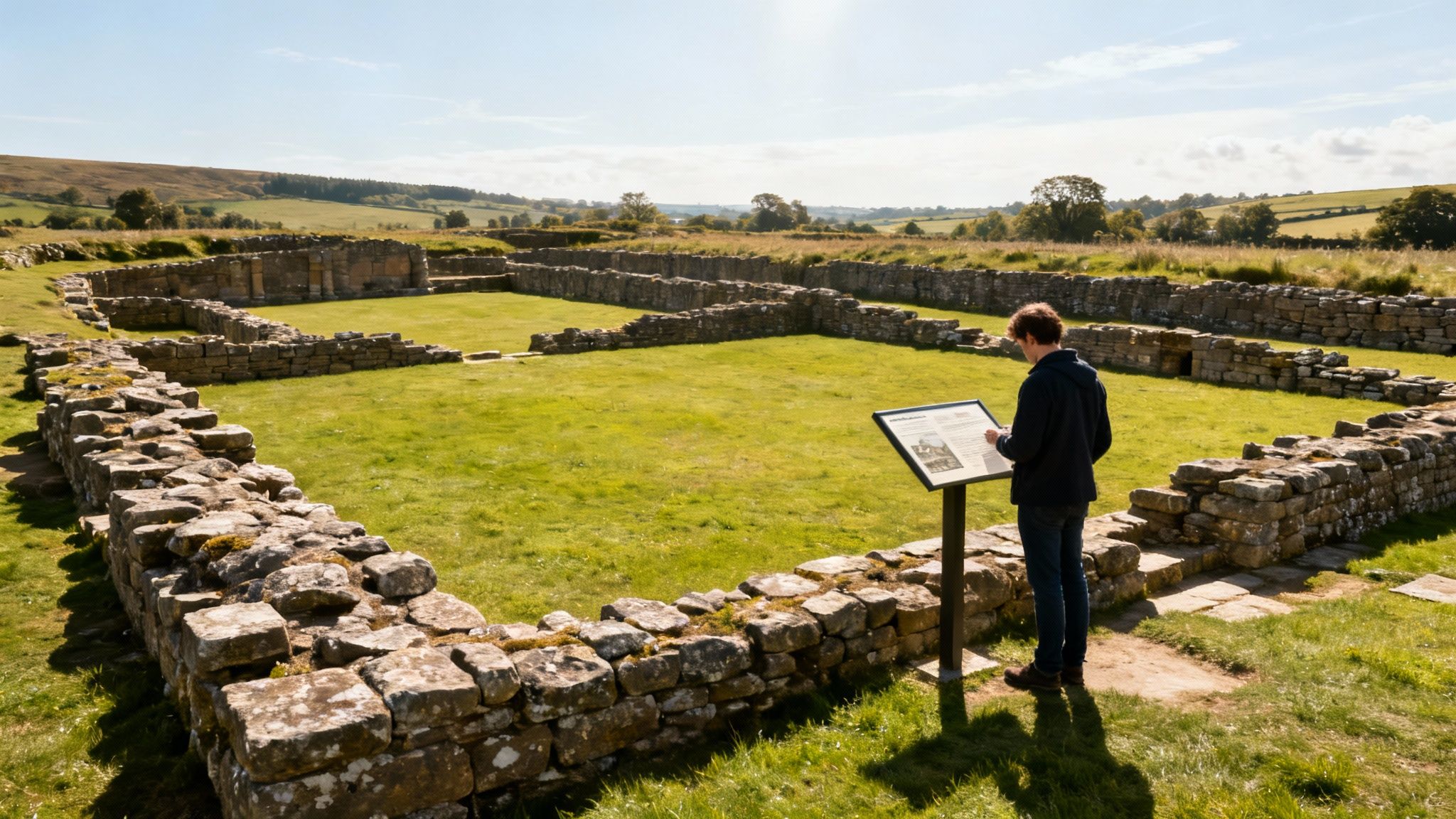
Walking Hadrian's Wall is a brilliant achievement, no doubt about it. But the real magic isn't just in the miles you cover; it's in the journey back through time. You're not simply hiking across stunning countryside. You're exploring a massive open-air museum where every ditch, mound, and stone tells a story. To really get it, you have to look past the ruins and picture the vibrant, bustling life that once hummed along this northern frontier.
This was never just a simple stone barrier. It was a buzzing, multicultural spine running across the country, home to soldiers, merchants, families, and artisans from every corner of the Roman Empire. Try to imagine the forts as more than military bases. They were miniature towns, complete with bathhouses, temples, workshops, and pubs. For the Romans, this was the edge of the known world—a place of constant motion and incredible cultural fusion.
Stepping into a Roman Soldier's Boots
To really elevate this walk from a long hike into a genuine historical pilgrimage, you need to stop at the key sites that breathe life into the past. These places are the anchors of your journey, giving you the context that transforms a pile of old stones into a gripping human drama.
For anyone walking the Wall, two places are an absolute must-see:
-
Vindolanda: If you only visit one place, make it this one. Vindolanda was a fort and settlement that was here even before the Wall, and the excavations have unearthed an absolute treasure trove. The most famous discovery is the Vindolanda Tablets—wafer-thin wooden postcards that give us an unbelievably personal peek into daily life. We're talking letters asking for more beer, birthday party invitations, and complaints about the British weather. They make the Roman experience feel incredibly real and human.
-
The Roman Army Museum: Found near the dramatic Walltown Crags, this museum is the perfect primer on what it was really like to be a soldier on this wild frontier. Through brilliant interactive displays and a fantastic 3D film, you get a real sense of the training, the gear, and the sheer daily grind of army life. It's the ideal place to grasp the bigger picture of the military machine that built and manned this incredible structure.
Uncovering Life Beyond the Forts
But the story of the Wall is about more than just soldiers. A whole civilian world sprang up around the forts, creating settlements called vici. These were thriving communities where soldiers’ unofficial families lived side-by-side with local Britons, trading with people from as far away as Syria and North Africa.
And we're still learning more. Recent digs in Carlisle, for instance, have revealed a massive Roman bathhouse, perhaps even linked to the Emperor Septimius Severus. The discovery of over 70 beautifully carved gemstones for signet rings and a rare scrap of Tyrian purple dye paints a picture of a sophisticated, elite society living right on the edge of the empire. This wasn't just a muddy outpost. Find out more about these incredible Roman-era findings to see how the story is still unfolding.
When you visit these sites, you arm yourself with stories. The crumbling foundations you pass on the trail are no longer just ruins. They become the barracks where soldiers slept, the bathhouse where they gossiped, and the gateways where traders haggled. Suddenly, your walk becomes a journey not just across a landscape, but through the very lives of the people who shaped it.
Got Questions About the Hadrian's Wall Walk? We’ve Got Answers.
Tackling a long-distance trail like Hadrian's Wall always sparks a few questions. It’s completely normal to wonder about everything from how tough the hills really are to whether you can pitch a tent along the way. Getting these details sorted is the key to a stress-free adventure.
Think of this as your practical FAQ. We're here to clear up the common queries so you can stop worrying about the logistics and start dreaming about those epic Roman views.
How Tough Is the Hadrian's Wall Path, Really?
Officially, the walk is graded as moderate. You won't be scrambling up any mountains, that's for sure. The real challenge is one of endurance – just putting one foot in front of the other, day after day.
The toughest part, without a doubt, is the central section running through Northumberland National Park. Here, the path follows the dramatic crags of the Whin Sill, serving up a relentless series of short, sharp, steep climbs and descents. They'll definitely get your legs and lungs working! The beginning and end of the trail, however, are much flatter and gentler. The path itself is well looked after and signposted, so as long as you have a decent level of fitness, you'll be absolutely fine.
Which Way Should I Walk It: East to West or West to East?
This is a classic debate, but the overwhelming majority of walkers travel from east to west. That means starting at Wallsend in the east and finishing up in Bowness-on-Solway on the west coast. There are a couple of very good, very British reasons for this.
- The Wind at Your Back: The prevailing winds in the UK blow from the west. Walking east to west means you'll have a helpful breeze pushing you along, not a face-full of wind for 84 miles. Trust us, it makes a difference.
- The Big Reveal: This direction saves the absolute best bits for the middle. You build up to the most spectacular, well-preserved sections of the Wall, creating a real sense of drama before the landscape softens again towards the Cumbrian coast.
Do I Need to Hire a Guide?
Honestly? No, a guide is not necessary. The route is a designated National Trail, which means it’s brilliantly signposted with the familiar acorn symbol from start to finish. A good map or a GPS app is all you really need to find your way.
That said, guided tours are a fantastic option if you want someone else to handle all the logistics. They’ll book your accommodation, arrange luggage transfers, and provide fascinating historical context that really brings the ruins to life.
It all boils down to personal preference. If you love the freedom of going at your own pace and figuring things out as you go, a self-guided trip is perfect. If you’d rather just relax and soak it all in, a guided tour is the way to go.
Can I Camp Along Hadrian's Wall?
Yes, absolutely! Camping is a brilliant, budget-friendly way to do the walk, and there are plenty of campsites dotted along the route, especially in the popular central section.
The one golden rule you must follow, however, is that wild camping is illegal in England. It's strictly forbidden along the entire length of the Wall to protect the incredibly fragile archaeology of this UNESCO World Heritage Site. Make sure you book your campsite pitches well ahead of time, especially if you're walking in the summer, as they get snapped up fast.
Ready to walk the edge of an empire without the planning stress? At BTOURS, we specialise in creating unforgettable self-drive holidays that give you the freedom to explore at your own pace. Discover our curated UK itineraries and start planning your perfect adventure today at https://www.btours.com.