There's simply no better way to get to the heart of Ireland than on a self-drive tour. It’s the freedom to chase the sunset along a dramatic coastline, to get lost (in a good way) down a winding country lane, and to linger over a pint in a pub buzzing with trad music. You set the pace.
Your Adventure on the Emerald Isle Awaits
Picture this: the open road stretching ahead, a map full of intriguing possibilities, and the famous green hills of Ireland rolling out on either side of you. That’s the real magic of a self-drive holiday—it’s not just a trip, it's your adventure. You’re in charge. You decide if today’s plan is to explore that crumbling castle ruin on the hill or to spend another hour soaking in the local atmosphere.
Think of this guide as your friendly co-pilot. We’ve done the heavy lifting and distilled years of experience into a straightforward roadmap, making the planning process just as much fun as the trip itself. Forget the stress of sifting through endless information; we've got you covered with practical, real-world advice to help you craft an unforgettable Irish journey.
To give you a quick overview, here's a snapshot of what goes into planning a brilliant Irish road trip.
Ireland Self-Drive Tour At a Glance
This table breaks down the key elements you'll need to consider for your trip.
| Planning Aspect | Key Consideration | Recommended Duration |
|---|---|---|
| Route Choice | Scenery vs. History? Coastal vs. Inland? | 7-14 days for a focused region |
| Pacing | Avoid over-scheduling; allow for spontaneous stops. | Aim for 2-4 hours of driving per day |
| Accommodation | B&Bs, hotels, or castles? Book in advance for peak season. | Pre-book 2-3 months ahead |
| Car Rental | Choose a smaller vehicle for narrow roads. | Manual is common; book automatic early. |
| Best Season | May-September for better weather and longer days. | April/October for fewer crowds. |
From choosing the perfect route to navigating those charmingly narrow roads, our tips will help you feel like a local behind the wheel.
What to Expect in This Guide
We’ll walk you through everything, step-by-step, so you feel confident and excited for the road ahead.
- Iconic Itineraries: We’ll dive into legendary routes like the sprawling Wild Atlantic Way, the classic Ring of Kerry, and Northern Ireland’s breathtaking Causeway Coastal Route.
- Driving & Logistics: Get the lowdown on driving on the left, understanding Irish roads (from motorways to boreens!), and handling your car rental with ease.
- Seasonal & Accommodation Advice: We'll help you figure out the best time of year for your trip and share our top tips for finding the perfect places to stay, from cosy B&Bs to magnificent castle hotels.
- Cultural Highlights: Discover those authentic, off-the-beaten-path experiences that connect you with Ireland's rich history and incredibly vibrant culture.
"You'll often hear the Irish greeting, Céad Míle Fáilte. It means ‘a hundred thousand welcomes,’ and honestly, it couldn't be more fitting. You feel it from the moment you arrive."
Ready to get this show on the road? For expertly crafted itineraries and friendly planning support, take a look at our full range of self-drive tours of Ireland. Let's start building your adventure.
Choosing Your Perfect Ireland Road Trip Itinerary
This is where the fun really starts—turning that daydream of an Irish road trip into a solid plan. The best way to think about Ireland is not as a single place, but as a collection of incredible stories, each with its own unique landscape and feel. Your perfect tour of Ireland is all about deciding which of those stories you want to step into.
Are you picturing the wild, untamed drama of the Atlantic coast, with its crashing waves and cliffs that plunge into the sea? Or is it the classic, postcard-perfect Ireland you're after, full of rolling green hills and unbelievably charming villages? Maybe you're a history buff, keen to peel back the layers of ancient myths, crumbling castles, and even modern-day film locations.
Let's dive into three of Ireland's most beloved road trips to help you find the one that's calling your name.
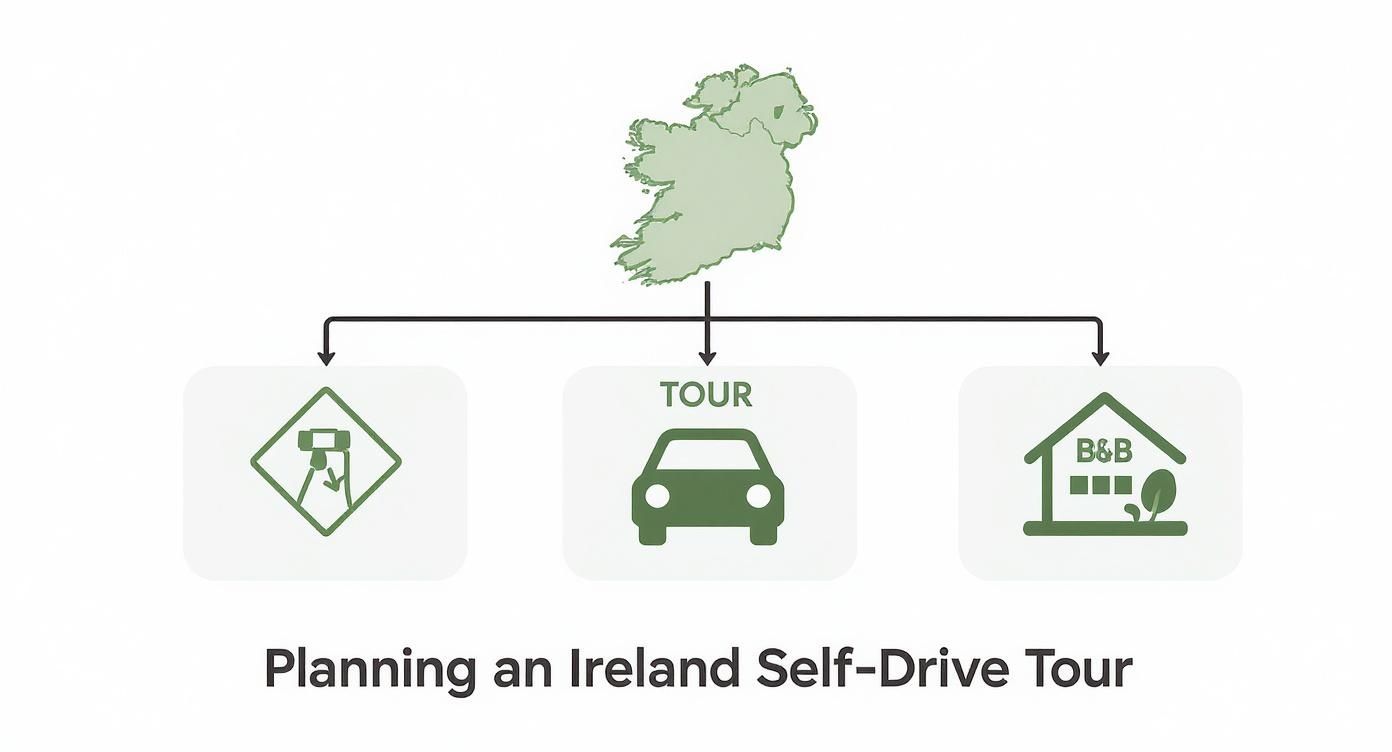
As you can see, figuring out your route is the first big piece of the puzzle. It directly shapes what kind of car you'll need and where you'll want to stay, setting the foundation for your entire adventure.
The Wild Atlantic Way: For the Coastal Adventurer
Stretching for a jaw-dropping 2,500 km (1,553 miles) along Ireland’s entire west coast, the Wild Atlantic Way is more than just a road—it's an epic journey. This isn't a route you rush; it's an experience you soak in. It’s for anyone who finds beauty in raw, powerful nature.
Picture yourself winding along roads that cling to the very edge of Europe, where every single bend in the road reveals another view that will stop you in your tracks. From the rugged peninsulas of County Cork in the south to the dramatic sea stacks of Donegal in the north, this is Ireland at its most untamed.
The Wild Atlantic Way is less of a route and more of a feeling. It’s about pulling the car over for no reason other than the view, stumbling upon a hidden beach all to yourself, and just feeling the immense power of the ocean.
A 5-Day Taster (The Central Section)
This snippet gives you a taste of the wildly popular stretch through Counties Clare and Galway.
- Day 1: Kick things off at the legendary Cliffs of Moher. Take a walk along the coastal path for those world-famous views, then head for the colourful village of Doolin, the heart of traditional Irish music.
- Day 2: Immerse yourself in the strange, lunar-like landscape of The Burren National Park. You’ll find ancient tombs and rare alpine flowers pushing up through the cracks in the limestone.
- Day 3: Make your way to the vibrant, bustling city of Galway. Get lost in the cobbled streets of the Latin Quarter and soak up the lively pub scene.
- Day 4: Hop on a ferry for a day trip to the Aran Islands. Renting a bike on Inis Mór is the best way to explore ancient forts like Dún Aonghasa, perched precariously on a clifftop.
- Day 5: It’s time to head into the wilds of Connemara. Don’t miss the Sky Road from Clifden for sweeping panoramic views, and be sure to visit the stunningly beautiful Kylemore Abbey.
Want to tackle more of this epic route? Take a look at our complete guide to exploring the magnificent Wild Atlantic Way in Ireland.
The Ring of Kerry: For Lovers of Classic Scenery
If your vision of Ireland is all about lush green fields, sparkling lakes, and villages so quaint they look like they’ve been painted, then the Ring of Kerry is the drive for you. This 179 km (111-mile) circular route in County Kerry packs an incredible amount of classic Irish beauty into one very manageable trip.
It’s a gentler, more polished experience than the Wild Atlantic Way, but it's every bit as breathtaking. You’ll meander through Killarney National Park, passing grand Victorian manors and ancient stone forts, all with spectacular views over the Iveragh Peninsula.
A Perfect 3-Day Itinerary
- Day 1: Start in the lively town of Killarney. Spend the day exploring Killarney National Park, visiting Ross Castle and Muckross House before taking in the incredible panorama from Ladies View.
- Day 2: Drive the Ring clockwise, making plenty of stops in charming towns like Kenmare and Sneem. For an extra dose of drama, take the Skellig Ring detour for even wilder coastal views and a visit to the Kerry Cliffs.
- Day 3: Finish the loop by stopping at Inch Beach for a windswept walk on the sand. A small detour to the buzzing town of Dingle is always a good idea before you head back to Killarney.
The Causeway Coastal Route: For History Buffs & Fantasy Fans
For a journey steeped in myth, geology, and TV fame, head north. The Causeway Coastal Route in Northern Ireland runs for 193 km (120 miles) from Belfast to Derry~Londonderry and is packed with some of the most recognisable landmarks on the entire island.
This drive is an absolute must for history lovers and Game of Thrones fans, as it’s home to countless filming locations. But the appeal is universal, with its dramatic castles, a world-famous rope bridge, and the mind-boggling Giant's Causeway. The tourism here is booming; with an estimated 4.7 million overnight trips generating around £1.1 billion, it's clear this corner of the island has captured the world's imagination.
A Cracking 3-Day Itinerary
- Day 1: Begin in Belfast with a visit to the incredible Titanic Belfast museum. From there, drive north along the coast to the dramatic, cliff-top ruins of Dunluce Castle.
- Day 2: Test your nerve walking across the Carrick-a-Rede Rope Bridge! Then, spend a good few hours marvelling at the Giant's Causeway, a UNESCO World Heritage Site made of over 40,000 interlocking basalt columns. It has to be seen to be believed.
- Day 3: Visit The Dark Hedges, the iconic avenue of beech trees that has become a world-famous photo spot. Continue on to the historic walled city of Derry~Londonderry to walk the 17th-century walls and learn about its fascinating, complex past.
How to Confidently Drive in Ireland

The idea of driving in Ireland can feel a little nerve-wracking, especially if you're not used to driving on the left or squeezing through narrow country lanes. But I always tell people to think of it less as a hurdle and more as part of the authentic Irish adventure.
With just a little bit of prep, you’ll be handling the roads like a local, giving you the freedom that only a proper tour of Ireland by car can offer. We'll go through everything you need to know, from tackling roundabouts to figuring out the quirky local roads. The goal is simple: to make sure you feel confident enough to enjoy the journey, not just the destination.
Mastering the Basics: Driving on the Left
For most visitors, the biggest mental block is simply driving on the left-hand side of the road. If you're coming over from the UK, you’re already a pro! For everyone else, the key is to take it slow at first and keep one simple mantra in mind: the driver should always be toward the centre of the road.
When you first hop in your rental, don't just zoom out of the car park. Take a few minutes to get your bearings. Practise shifting gears with your left hand and get your mirrors adjusted just right. It’ll feel a bit odd for the first hour or so, but you’d be amazed how quickly your brain clicks into gear.
A fantastic little trick for your first few junctions is to say your actions out loud. "Okay, turning left… staying left." It sounds silly, but it really helps reinforce the muscle memory until it feels completely natural.
Understanding Irish Roads
Not all roads in Ireland are created equal, and knowing what the signs mean will make your drive infinitely more relaxing. It helps to think of Irish roads as a bit of a hierarchy, from the big motorways down to the tiny, charming back lanes.
- Motorways (M-roads): These are your main arteries, like the M50 circling Dublin or the M8 connecting to Cork. They're multi-lane highways with speed limits usually at 120 km/h (75 mph). They’re the quickest way to get between the big cities.
- National Roads (N-roads): The next step down. These can be modern dual carriageways or simple single-lane roads that link major towns. The speed limit here is typically 100 km/h (62 mph).
- Regional Roads (R-roads): Now we're getting into the good stuff. These smaller roads wind you through villages and deep into the countryside. They’re often narrower and twistier, so your speed will naturally drop, but the views really open up.
- Local Roads (L-roads & Boreens): This is where the real adventure is! These are the smallest, often single-track lanes, affectionately known as "boreens." You'll find yourself pulling into passing places to let others by, so take it easy, wave, and enjoy the slow pace.
Getting around these roads is all part of the fun, and a good GPS or map app on your phone is an absolute must. My best advice is to plan routes that mix the efficiency of motorways with the scenic beauty of the regional roads.
Navigating Roundabouts and Junctions
Roundabouts are everywhere in Ireland and are designed to keep traffic flowing. Honestly, they’re brilliant once you get the hang of them. The golden rule is simple: always give way to traffic already on the roundabout, which will be coming from your right.
As you approach one, try to get into the correct lane early. If you're taking the first or second exit (turning left or going straight on), you'll want the left-hand lane. If you're heading for an exit past the 12 o'clock position (essentially turning right), you’ll usually need the right-hand lane. And don't forget to signal when you're about to exit!
Out in the countryside, junctions can sometimes be poorly marked or have sightlines obscured by high hedges. The best policy is to always approach with caution and be ready to stop.
Car Hire and Insurance Essentials
When you rent your car, I strongly suggest getting an automatic. It’s one less thing to worry about if you’re not used to shifting gears with your left hand. Just be sure to book well in advance, as automatics are less common and get snapped up quickly. It's also wise to choose a smaller car—it makes navigating tight village streets and those narrow boreens so much easier.
Make sure you understand the insurance. Most rentals include a basic Collision Damage Waiver (CDW), but this usually comes with a hefty excess (the amount you’d have to pay if there's any damage). For true peace of mind, I’d recommend adding Super CDW or a separate excess protection policy.
If sorting through rental companies and insurance jargon sounds like a headache, our professionally organised self-drive tours handle all those logistics for you. It’s a great way to take the stress out of the planning.
Finding the Best Times and Places to Stay
Timing your trip to Ireland is a big decision, and so is figuring out where to rest your head each night. Honestly, these two choices will do more to shape your adventure than almost anything else.
Every season paints the Emerald Isle in a completely different light, offering a totally unique vibe. In the same way, choosing between a cosy B&B and a grand castle hotel will fundamentally change the feel of your journey. Let’s break down the options so you can perfectly match the season and your stay to the trip you’ve been dreaming of.
Choosing the Best Season for Your Trip
Ah, Irish weather. It’s famously unpredictable, but that’s part of the charm! The truth is, there’s no "bad" time to visit—just different experiences waiting for you.
Spring (March to May): This is when Ireland truly wakes up. Think impossibly green fields dotted with newborn lambs and wildflowers bursting into colour. The days start getting longer, the summer crowds haven't arrived yet, and there's a real sense of freshness in the air. You’ll definitely still need a rain jacket, but you'll be rewarded with a quieter, more vibrant Ireland.
Summer (June to August): This is prime time for a reason. You get the longest days of the year, with daylight sometimes stretching past 10 pm. It's perfect for squeezing every last drop of sightseeing out of your day. It’s certainly the busiest season, especially with visitors from nearby, which creates a fantastic, lively atmosphere in the towns and pubs.
Autumn (September to October): My personal favourite. The crowds start to thin out, and the landscape puts on a spectacular show of gold, red, and rustic brown. The weather is often crisp and clear, making it a wonderful time for hiking. It’s a photographer’s dream and a much more peaceful time to travel.
Winter (November to February): Don’t write off a winter trip! Sure, the days are shorter and it’s chilly, but this is the season for roaring fires in cosy pubs, warming bowls of stew, and a truly authentic local experience. While some attractions might have shorter hours, you’ll have the main sights almost to yourself.
Finding Your Perfect Home Away from Home
Once you've picked a season, the fun part begins: choosing where you'll stay. The accommodation in Ireland is as varied and full of character as the landscape itself.
Your accommodation is more than just a place to sleep; it’s an integral part of your cultural experience. A friendly chat with your B&B host over a full Irish breakfast can often be as memorable as visiting a famous landmark.
A Look at Your Main Options:
Bed & Breakfasts (B&Bs): This is the classic Irish experience, and for good reason. B&Bs are usually family-run and offer incredible hospitality, priceless local tips, and a breakfast that will fuel your entire day. You just can’t beat that personal touch.
Hotels: From handy city-centre spots to luxurious country manors, hotels offer consistency and a wider range of amenities. They’re a great choice if you want facilities like an on-site restaurant or a spa, especially in bigger cities like Dublin. For a taste of city life, have a look at our guide to a five-day Dublin experience.
Castle Hotels & Manor Houses: Looking for a once-in-a-lifetime splurge? Why not sleep like royalty? Ireland is dotted with historic castles and grand houses that have been beautifully converted into hotels, offering an amazing mix of history, luxury, and atmosphere.
Travel between the UK and Ireland is incredibly popular—it’s one of the most consistent travel flows in the region. The UK, for instance, welcomed nearly 3 million visits from the Republic of Ireland, which just goes to show how intertwined these neighbouring travel cultures are. Given this popularity, booking your accommodation well in advance is always a smart move, especially if you have your heart set on a unique spot or are travelling in the summer.
Unforgettable Experiences Beyond the Main Roads
The best road trips are measured in moments, not miles. A truly great tour of Ireland comes alive in those spontaneous discoveries you make between the big destinations. It’s about pulling over to capture a rainbow stretching over a patchwork of green fields, or following a tiny, hand-painted sign down a laneway that leads to a deserted beach.
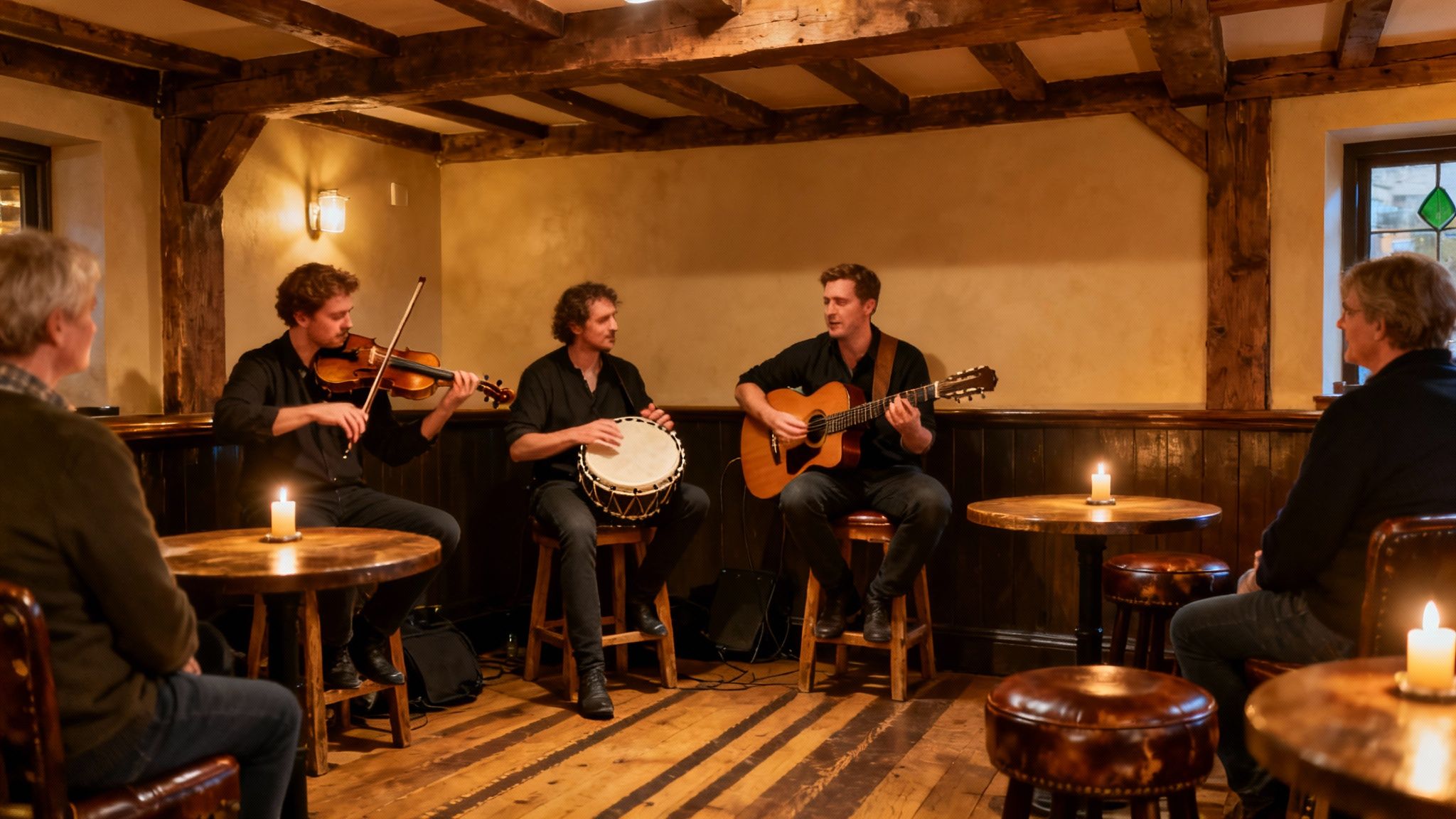
These are the detours that make the best stories. Imagine the feeling of stepping into a pub in Doolin that’s been around for centuries, where the air is buzzing with the sound of a live traditional music session. This isn’t a show put on for visitors; it’s the real deal, a gathering of the community, and you're immediately welcomed in.
Immersing Yourself in Irish Culture
Authentic experiences are hiding in plain sight, just waiting to give you a genuine feel for Ireland's incredible heritage. It’s about more than just looking at things; it’s about doing, tasting, and listening.
Catch a Trad Music Session: Find a pub in a town like Doolin or Galway. Your best bet is to look for the smaller, cosy spots where locals are gathered with their fiddles, flutes, and bodhráns (a traditional Irish drum) for an unforgettable evening of music.
Explore Ancient History: Feel the weight of history as you stand before the majestic Rock of Cashel, a breathtaking collection of medieval buildings rising from a limestone hill. Or, step even further back in time and wander through the Neolithic passage tombs at Brú na Bóinne, structures that are older than Egypt’s pyramids.
Taste the Spirit of Ireland: Skip the big commercial distilleries and seek out a smaller, independent whiskey or gin maker. Hearing about the craft directly from the people who live and breathe it gives you a much richer, more personal appreciation for what’s in your glass.
If you’re spending time in the capital, you’ll want to explore Dublin's unique experiences, which can take you far beyond the usual tourist trail.
Getting Active in the Great Outdoors
Ireland's landscapes aren't just pretty pictures to be viewed from a car window; they're an invitation to get out and explore. Honestly, one of the best ways to connect with the island’s raw beauty is to stretch your legs and breathe in that fresh Atlantic air.
"The true essence of Ireland is found not on the motorway, but on the footpath. A hike through its national parks or a cycle along its coastlines connects you to the land in a way a car window never can."
Hop on a ferry to the windswept Aran Islands and rent a bicycle to discover ancient stone forts like Dún Aonghasa, perched dramatically on a sheer clifftop. If you prefer a different kind of green, Ireland is a world-class golfing destination. The sport is bigger than ever; the 151st Open at Royal Liverpool drew a massive 261,180 spectators, which was a 30% jump from 2014. Even the AIG Women’s Open saw its attendance shoot up by 53%.
Why not break up your driving days with one of these active adventures?
- Hike in Killarney National Park: Follow the beautiful trails winding around serene lakes and through ancient woodlands to the stunning Torc Waterfall.
- Walk the Cliffs of Moher Coastal Trail: For a far more dramatic and less crowded view, try walking a section of the path from Doolin or Hag's Head.
- Kayak in a Sea Lough: Get a completely different perspective of the coastline by exploring the sheltered waters of Carlingford Lough or Strangford Lough.
These are the kinds of experiences that turn a simple drive into the adventure of a lifetime, making your tour of Ireland something you’ll never forget.
Your Essential Ireland Packing and Prep Checklist
With your route planned and excitement levels high, it's time to tackle the final piece of the puzzle: what to pack. Getting this right is the secret to a truly seamless tour of Ireland. It means you can soak up the views and enjoy the craic without sweating the small stuff. Consider this your definitive guide to a stress-free trip.
Packing for Ireland is all about preparing for four seasons in a single day. Seriously. The weather is famously unpredictable, so layering is the name of the game. A sudden shower or a brisk Atlantic breeze can pop up even on the sunniest summer afternoon. Your absolute, must-have, don't-leave-home-without-it item? A lightweight waterproof jacket.
Underneath, think in layers you can easily shed or add. Thermal tops, a cosy fleece, and comfortable walking trousers are your best friends. And please, don't skimp on footwear. A pair of sturdy, waterproof walking shoes or boots that you've already broken in will be your saviour when you're rambling through ancient abbey ruins or trekking along a cliffside path.
Documents and Digital Helpers
Before a single sock goes into your suitcase, get your documents sorted. You will absolutely need a valid driving licence, your passport, and the credit card you used to book the car hire. Having a printout or a screenshot of your rental confirmation is also a smart move.
Your phone is going to be your most trusted co-pilot. I always recommend downloading your maps for offline use in an app like Google Maps. It’s a complete game-changer when you’re out in the countryside and the phone signal inevitably disappears.
A quick tip on staying connected: Before you go, it's worth figuring out how to make cheap international calls. It’s a simple bit of prep that makes keeping in touch with everyone back home much easier and cheaper.
Handling Your Money
Here's a quick but crucial heads-up on currency. The Republic of Ireland uses the Euro (€), but just across the border, Northern Ireland uses the Pound Sterling (£). If your journey takes you north, it's wise to have a little of both currencies for smaller purchases like a coffee or a postcard, although credit and debit cards are accepted almost everywhere.
Your Quick-Reference Checklist:
- Essential Documents: Driving licence, passport, credit card, and rental confirmations.
- Core Clothing: Waterproof jacket, a couple of fleeces or jumpers, and comfy walking trousers.
- Footwear: Broken-in, waterproof walking shoes are non-negotiable.
- Accessories: A warm hat, scarf, and gloves are a good idea, even outside the dead of winter.
- Tech: A portable power bank for your phone and a universal travel adaptor.
Once you’ve got this list ticked off, you're officially ready. All that's left is to jump in the car, turn up the radio, and let your incredible Irish road trip begin.
Answering Your Final Questions About a Tour of Ireland
As your trip gets closer, you're bound to have a few last-minute questions bubbling up. Think of this as a final chat over a cup of tea to smooth out any lingering worries, so you can head off on your tour of Ireland feeling completely prepared and excited.
Let's start with the most common question we get: how much time do you actually need? While you could easily spend a lifetime uncovering every nook and cranny of the island, a week is a great start. A seven-day trip gives you a brilliant, focused taste of a specific region, like the glorious southwest or the dramatic Causeway Coast, without ever feeling like you're just ticking boxes.
Got ten days to play with? Now you're talking! That’s enough time to comfortably blend two distinct areas. You could easily pair the classic Ring of Kerry sights with the wild, music-filled landscapes of County Clare and Galway. And with a full two weeks, you can really sink into the rhythm of a proper grand tour, covering some serious ground and getting a much deeper feel for the culture.
So, How Tricky Is Driving in Ireland?
It's totally normal to feel a bit nervous about driving on the left, especially when you picture those famously narrow, winding country roads. The honest truth? It’s a bit weird for the first hour or two, but you'll be surprised how quickly it starts to feel natural. The real secret is to just take it easy, especially on your first day.
Remember, you're on holiday, not commuting. Slowing down isn't just safer; it lets you actually see the incredible scenery you came for and gives you plenty of time to navigate roundabouts or the inevitable flock of sheep blocking the road.
The main motorways connecting the cities are modern and a breeze to drive on. It’s the smaller rural roads, the 'boreens', where you’ll need to pay more attention, often tucking into a lay-by to let an oncoming car squeeze past. Trust us on this: opting for a smaller rental car will be the best decision you make, especially when navigating the tight streets of a charming old village.
What’s the Best Month for a Road Trip?
This really comes down to what you’re looking for in a holiday, as each season in Ireland has its own unique charm.
- For the Best Weather: June, July, and August give you the longest, brightest days and the warmest temperatures. It’s ideal for packing as much as possible into your days, but it's also peak season, which means more people and higher prices.
- For Fewer Crowds: The sweet spots are May and September. The weather is often absolutely lovely, the summer crowds have either not yet arrived or have started to fade, and you get the bonus of seeing the countryside burst into life in spring or turn golden in the autumn.
- For the Best Value: If you don't mind packing an extra jumper, consider April or October. You’ll find the roads are much quieter, accommodation is cheaper, and you can often have popular spots almost to yourself.
Honestly, there’s no bad time to visit. It’s all about choosing the season that feels right for the kind of adventure you have in mind.
Ready to swap the planning for the open road? The team at BTOURS has already done the hard work, creating a range of self-drive itineraries that handle all the logistics. All that's left for you to do is enjoy the journey. Find your perfect Irish adventure at https://www.btours.com.