
Welcome, curious traveller, to a London you have never seen. Beyond the iconic silhouettes of Tower Bridge and the Houses of Parliament lies a city brimming with secrets, oddities, and quiet wonders just waiting to be discovered. This is not just another travel guide; it is an invitation to explore the capital's hidden veins, where history whispers from forgotten tunnels and artistry thrives in unexpected corners. Forget the queues and the well-trodden tourist trails. It is time to step away from the predictable and into the extraordinary.
This curated collection will guide you through ten of the most remarkable and unusual places to visit in London, each offering a unique story and an escape from the crowds. From a subterranean postal railway and a magnificent Arab Hall hidden inside a Victorian artist's home, to a gothic industrial wilderness reclaimed by nature, these destinations promise an authentic experience. Whether you are a seasoned Londoner looking for a new perspective or a first-time visitor eager to find something truly different, this list is your key. Prepare to delve into overgrown Victorian cemeteries, Jacobean time capsules, and architectural marvels that even most locals do not know exist. Your authentic London adventure starts here.
1. The Leighton House Museum
Tucked away on a quiet street in Holland Park, Leighton House Museum is a breathtaking palace of art that feels worlds away from the city's hustle. It was the former home and studio of the Victorian artist Frederic, Lord Leighton, and stands as a testament to his unique aesthetic vision. This is not just a gallery; it’s an immersive artwork in itself, making it one of the most enchanting unusual places to visit in London.
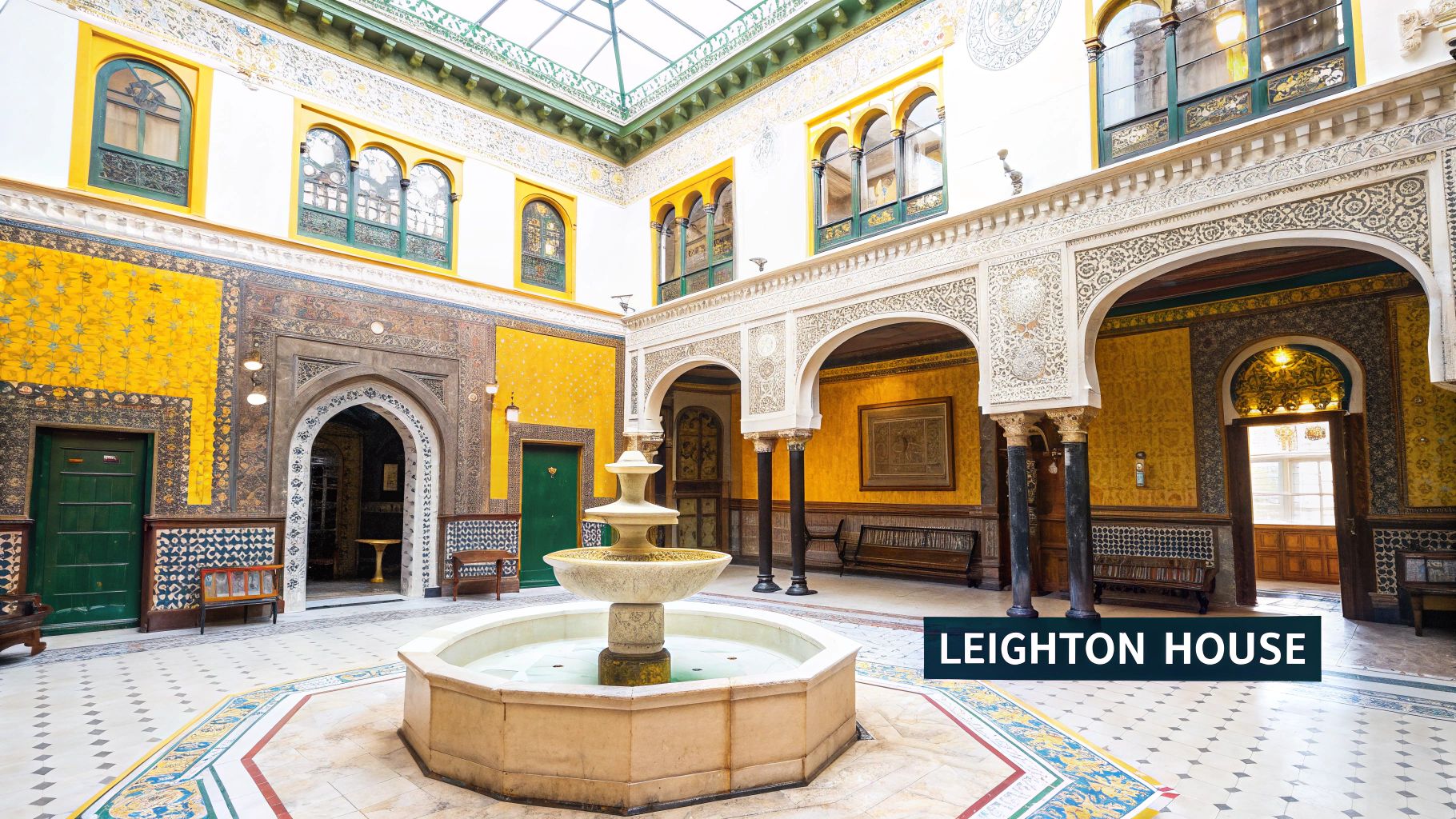
The highlight is the spectacular Arab Hall, a golden-domed masterpiece featuring a central fountain and a mesmerising collection of 16th and 17th-century Islamic tiles from Damascus, Cairo, and Isfahan. As you explore, each room reveals another layer of opulent decoration and personal artistry, from the grand painting studio with its vast north-facing window to the intimate, silk-lined drawing room. It provides a rare and inspiring glimpse into the mind of a Victorian creative genius.
Practical Tips for Your Visit
- Best Time to Visit: Aim for a weekday afternoon to experience the serene atmosphere with fewer crowds.
- Location & Transport: Located at 12 Holland Park Road, W14 8LZ. The nearest Tube stations are High Street Kensington and Olympia.
- Time Allocation: Allow at least 90 minutes to fully absorb the intricate details of the house and the art collection.
- Pairing Suggestion: Combine your visit with a stroll through the tranquil Kyoto Garden in nearby Holland Park. For a more comprehensive itinerary, consider incorporating this unique spot into a wider exploration of the city, as detailed in our 3-day London travel guide.
- Good to Know: Photography (without flash) is generally permitted, so you can capture the stunning interiors. Check their website for temporary exhibitions before you go.
2. The Kirkaldy Testing Museum
Step back into the industrial heart of Victorian London at The Kirkaldy Testing Museum, an extraordinary time capsule dedicated to the science of materials. Housed in its original 1874 building in Southwark, this museum was once a world-leading laboratory where David Kirkaldy’s mantra, "Facts not Opinions," was put to the test. It is one of the most authentically preserved and truly unusual places to visit in London.

The centrepiece is the colossal Universal Testing Machine, a hydraulic marvel that spans four stories and was used to test the strength of materials for iconic structures like the original Wembley Stadium. On a guided tour, you can see this magnificent machine in operation, alongside preserved office spaces and fascinating scientific instruments. It’s a powerful, tangible connection to the engineering innovations that built the modern world.
Practical Tips for Your Visit
- Best Time to Visit: The museum has very limited opening days (typically one Sunday a month). Booking your tour months in advance as soon as dates are released is essential.
- Location & Transport: Situated at 99 Southwark Street, SE1 0JF. The nearest stations are Southwark, Borough, and London Bridge.
- Time Allocation: Tours last approximately 90 minutes. It's recommended to arrive 15 minutes early to check in.
- Pairing Suggestion: After your tour, explore the vibrant Borough Market for a bite to eat or take a short walk to the Tate Modern to contrast industrial history with contemporary art.
- Good to Know: This is a volunteer-run museum with passionate guides. Wear comfortable shoes as the tour involves multiple staircases. Sign up for their mailing list to get notifications about new tour dates.
3. Crossrail Place Roof Garden
Floating above Canary Wharf's Elizabeth line station, the Crossrail Place Roof Garden is a serene urban oasis encased in a stunning timber lattice roof. This architectural marvel houses a hidden botanical world, blending exotic plants from across the globe with the sleek lines of modern design. It’s a tranquil escape that offers a surreal juxtaposition of nature and commerce, making it a truly unusual place to visit in London.
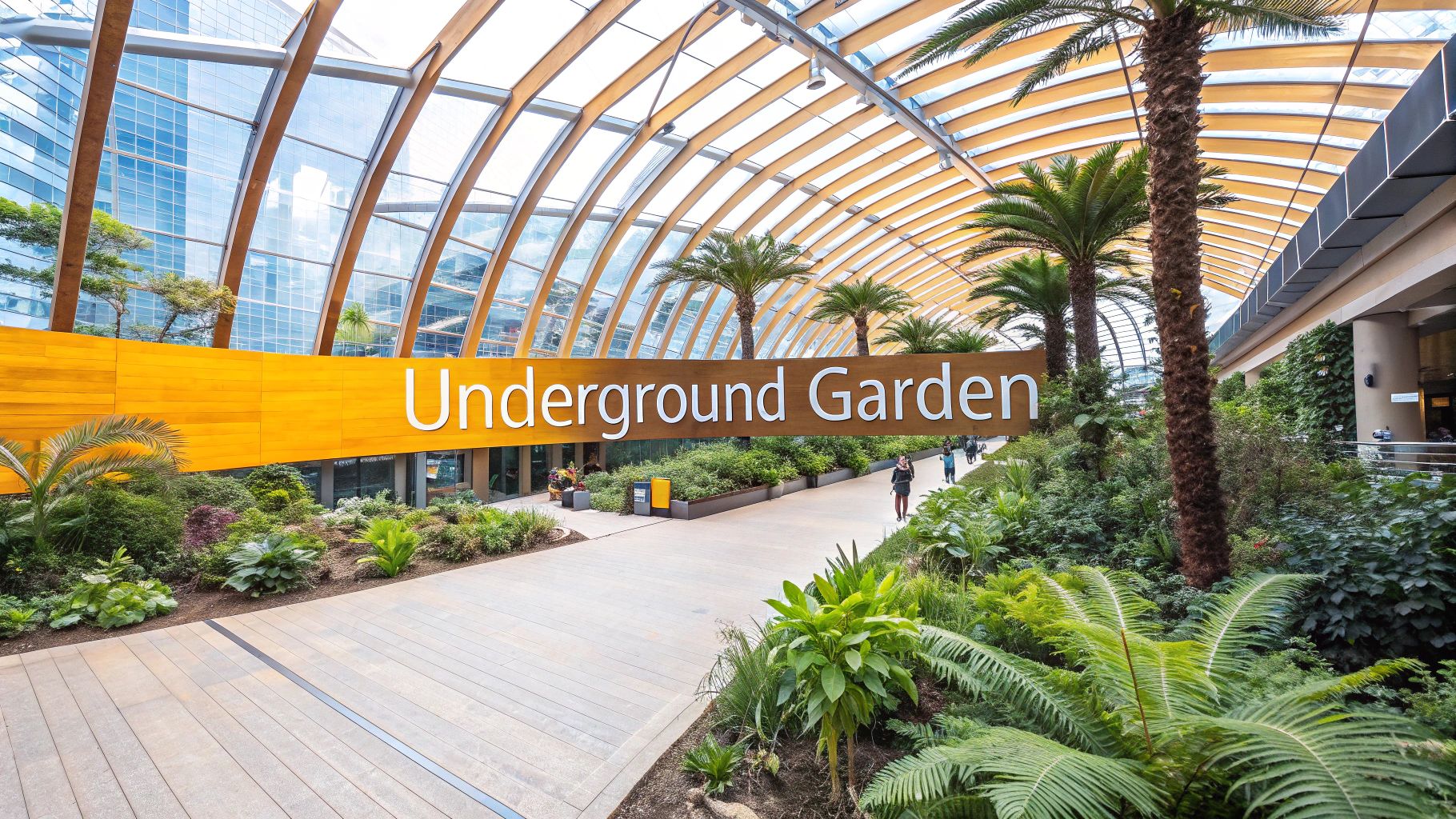
The garden is split into two hemispheres, with plants from the Eastern hemisphere on one side and the Western on the other, cleverly arranged according to their native longitude. As you meander through tree ferns from Australia and sweetgum from America, you'll find quiet benches and even a small performance space nestled among the foliage. It’s a perfect spot to read a book, enjoy a moment of peace, or simply marvel at how nature can thrive in the most unexpected corners of the city.
Practical Tips for Your Visit
- Best Time to Visit: Aim for a weekday mid-morning or mid-afternoon to enjoy the space with fewer people from the surrounding offices.
- Location & Transport: Located at Crossrail Place, Canary Wharf, E14 5AR. The easiest way to get there is via the Canary Wharf station (Jubilee Line, DLR, and Elizabeth Line).
- Time Allocation: Allow around 30-45 minutes to wander through the garden and appreciate the unique architecture and planting.
- Pairing Suggestion: After your visit, explore the extensive public art collection scattered around Canary Wharf or grab a bite at one of the many waterside restaurants. For a structured exploration of the area's modern marvels, you might enjoy our 4-day London city break itinerary.
- Good to Know: The garden is partially open to the elements, so it can be a little breezy. Entry is free, and it often stays open until late in the evening.
4. The Brunel Museum – Thames Tunnel Exhibition
Hidden in Rotherhithe, The Brunel Museum celebrates one of history’s greatest engineering feats: the Thames Tunnel. Housed in the original Victorian engine house that once powered the tunnel's construction, this compact museum tells the gripping story of the world's first tunnel built beneath a navigable river. It’s an inspiring monument to human ingenuity and perseverance, making it one of the most historically significant unusual places to visit in London.
The exhibition vividly brings to life the dangerous and pioneering work of Marc and Isambard Kingdom Brunel. You can explore artefacts recovered during the dig and learn about the immense challenges faced, from floods to the mysterious "caisson disease" that afflicted the workers. The museum’s highlight is the Grand Entrance Hall, a huge underground chamber that was once described as the eighth wonder of the world. Standing inside this cavernous space, you can truly appreciate the scale of this groundbreaking achievement.
Practical Tips for Your Visit
- Best Time to Visit: A weekday visit is recommended to avoid the weekend rush and enjoy a more personal experience in the compact exhibition space.
- Location & Transport: Located at Railway Avenue, Rotherhithe, London, SE16 4LF. The nearest stations are Rotherhithe (Overground) or Canada Water (Jubilee Line).
- Time Allocation: Plan for 60 to 90 minutes to fully explore the museum and absorb the fascinating history.
- Pairing Suggestion: Afterwards, enjoy a pint at The Mayflower pub next door, which has a claim to be the oldest pub on the Thames and offers great riverside views.
- Good to Know: Check the museum's website for special events, including guided descents into the tunnel shaft and boat tours that provide a unique perspective on Brunel's work along the river. Wear comfortable shoes, as the floors are original Victorian brick.
5. Highgate Cemetery – The Overgrown Victorian Necropolis
More than just a resting place for the famous, Highgate Cemetery offers an otherworldly experience, particularly in its wild and atmospheric West Side. This section has been deliberately left to nature since 1975, creating a hauntingly beautiful landscape where crumbling Victorian mausoleums are draped in ivy and anarchic foliage reclaims ornate monuments. A guided tour here feels like stepping into a gothic novel, making it one of the most compelling unusual places to visit in London.
The guided tour reveals the stories behind the intricate tombs, winding through the Egyptian Avenue and leading to the breathtaking Circle of Lebanon, a ring of vaults built around an ancient cedar tree. The atmosphere is thick with history and a serene sense of decay, offering a profound escape from the modern city and a unique perspective on Victorian London's relationship with life and death.
Practical Tips for Your Visit
- Best Time to Visit: Visit in autumn when the falling leaves create a beautifully melancholic atmosphere, or in spring when wildflowers emerge amongst the gravestones.
- Location & Transport: Located at Swain's Lane, London N6 6PJ. The nearest Tube station is Archway, followed by a 15-minute uphill walk or a short bus ride.
- Time Allocation: The compulsory West Side guided tour lasts around 70 minutes. Allow extra time to explore the East Side (where Karl Marx is buried) at your own pace.
- Pairing Suggestion: Afterwards, enjoy a well-deserved pint at The Flask, a historic pub in Highgate Village, or take a walk across the expansive Hampstead Heath for panoramic city views.
- Good to Know: You must book the West Side tour in advance via the Highgate Cemetery website, as spaces are limited and fill up quickly. Wear sturdy, waterproof footwear as the paths are uneven and can be muddy.
6. The Vaults – Subterranean Waterloo Tunnels
Beneath the relentless energy of Waterloo Station lies a labyrinthine underworld of creativity and performance. The Vaults are a network of cavernous Victorian railway arches, repurposed from their 1860s origins into one of London's most atmospheric and unconventional arts venues. Stepping down into this subterranean realm feels like discovering a secret city, where raw brickwork and echoing tunnels provide an unforgettable backdrop for immersive theatre, art installations, and live events, making it a truly unusual place to visit in London.
The experience here is entirely dictated by the ever-changing programme, which champions the weird, the wonderful, and the avant-garde. From interactive plays that lead you through winding passages to vibrant, multi-sensory art exhibitions, The Vaults offer an escape from the ordinary. The space itself is a key performer, its industrial heritage and ghostly ambiance amplifying every production. It’s an otherworldly venue that guarantees an experience far removed from a traditional gallery or theatre.
Practical Tips for Your Visit
- Best Time to Visit: The annual VAULT Festival (typically running from late January to March) offers the most extensive and diverse range of programming.
- Location & Transport: Located on Leake Street, SE1 7NN. The nearest station is Waterloo (Tube and National Rail), which is just a few minutes' walk away.
- Time Allocation: For immersive theatre or a major exhibition, plan for at least two to three hours. Arrive a little early to soak in the unique atmosphere.
- Pairing Suggestion: Before your event, explore the ever-changing street art in the Leake Street Graffiti Tunnel right outside. Afterwards, enjoy a riverside walk along the nearby South Bank.
- Good to Know: It can be cool underground regardless of the season, so bring an extra layer. Programming is event-based, so always check their official website for the current schedule and to book tickets in advance.
7. The Mail Rail – Royal Mail Underground Railway
Journey deep beneath the streets of London to uncover a hidden piece of the city's history at The Postal Museum's Mail Rail. For over 75 years, this secret underground railway transported mail across the capital, a bustling, driverless network operating far from public view. Now, you can ride the miniature trains through its original tunnels, exploring a world frozen in time and discovering one of the most brilliantly unusual places to visit in London.
The immersive ride takes you through the narrow, winding tunnels, past deserted platforms and original sorting offices that tell the story of the people who worked here around the clock. The experience masterfully blends historical narration with atmospheric projections, bringing the railway's fascinating past to life. It’s a captivating adventure that offers a truly unique perspective on how London's communication network once operated just 70 feet below ground.
Practical Tips for Your Visit
- Best Time to Visit: Book for a mid-week slot during school term-time to enjoy a less crowded train and more space in the accompanying museum exhibits.
- Location & Transport: Located at 15-20 Phoenix Place, WC1X 0DA. The nearest Tube stations are Farringdon, Russell Square, and Chancery Lane.
- Time Allocation: Plan for around 90 minutes to two hours to fully enjoy the Mail Rail ride and the fascinating interactive displays in The Postal Museum.
- Pairing Suggestion: After your subterranean adventure, explore the historic streets of nearby Clerkenwell, known for its fantastic gastropubs and design studios. Incorporating unique attractions like this can elevate many short city breaks.
- Good to Know: Booking your tickets online in advance is highly recommended as rides sell out, especially on weekends and holidays. Arrive 15 minutes before your time slot.
8. Abney Park Cemetery
Step into a world where nature has reclaimed history at Abney Park, a Victorian garden cemetery in Stoke Newington that feels like a forgotten gothic wilderness. Established in 1840, this is no manicured burial ground; since the 1970s, it has been allowed to grow into a semi-wild urban woodland. It’s this haunting blend of crumbling monuments, overgrown pathways, and ancient trees that makes it one of the most atmospheric and unusual places to visit in London.
The 32-acre non-denominational cemetery is one of London's "Magnificent Seven" and serves as both a historic site and a local nature reserve. As you wander, you’ll discover the final resting places of Victorian industrialists, social reformers, early feminists, and prominent abolitionists, their stories etched into stone now enveloped by ivy. The park’s centrepiece is the derelict Abney Park Chapel, an architectural gem that adds to the profound sense of melancholic beauty.
Practical Tips for Your Visit
- Best Time to Visit: A crisp autumn afternoon offers stunning light and colour, but any daylight hours are suitable. Avoid visiting after dark.
- Location & Transport: Located on Stoke Newington High Street, N16 0LH. The nearest Overground station is Stoke Newington.
- Time Allocation: Plan for 90-120 minutes to explore the winding paths and discover hidden corners.
- Pairing Suggestion: Afterwards, explore the independent shops and cafes of Stoke Newington Church Street or visit the nearby Clissold Park for a more traditional park experience.
- Good to Know: Wear sturdy walking shoes as the paths can be uneven. Download a map from the Abney Park Trust website beforehand to help you navigate and find key monuments. The atmosphere can feel isolating, so you may prefer to visit with a friend.
9. The Petrie Museum of Egyptian Archaeology
Hidden within the corridors of University College London, The Petrie Museum is a staggering time capsule of ancient Egyptian and Sudanese life. Far from the polished glass cases of the British Museum, this is an intensely academic and atmospheric collection, housing over 80,000 objects. It presents one of the world's most significant troves of Egyptian artefacts in densely packed displays, making a visit feel like a genuine discovery and cementing its place among the most fascinating unusual places to visit in London.
Exploring the Petrie is a treasure hunt through millennia of history. You'll find everything from the world’s oldest surviving linen garment, the Tarkhan Dress, to delicate mummy portraits, ancient jewellery, and countless everyday objects that offer an unparalleled glimpse into daily life along the Nile. Its humble, university setting allows for an intimate encounter with history, free from the crowds and commercialism of larger institutions.
Practical Tips for Your Visit
- Best Time to Visit: A weekday morning is ideal for a quiet, contemplative experience, allowing you to get close to the cases without interruption.
- Location & Transport: Located within UCL at Malet Place, WC1E 6BT. The nearest Tube stations are Goodge Street and Euston Square.
- Time Allocation: Plan for 60 to 90 minutes to browse the overwhelming collection at a comfortable pace.
- Pairing Suggestion: After immersing yourself in ancient Egypt, explore the nearby Grant Museum of Zoology, another of UCL's quirky and brilliant collections.
- Good to Know: Given the sheer density of artefacts, it's a good idea to research specific items of interest on their website beforehand. The museum has a vast online catalogue you can explore to plan your visit.
10. Charlton House – Jacobean Mansion Time Capsule
Hidden away in suburban South East London, Charlton House is a magnificent Jacobean mansion that offers an authentic journey back to the 17th century. Built between 1607 and 1612, this stunning red-brick building is one of the finest surviving examples of its kind in the country, yet it remains largely undiscovered by tourists. This is not a roped-off museum; it’s a living building now used as a community centre, making it one of the most accessible and unusual places to visit in London.
Stepping inside feels like entering a time capsule. You can wander through rooms featuring original carved fireplaces, elaborate plasterwork ceilings, and grand wooden staircases that have remained largely unchanged for over 400 years. The house exudes an atmosphere of quiet grandeur, allowing you to connect with London’s history on a deeply personal level, far from the typical tourist trail. Its survival and continued use make it a truly special and inspiring heritage site.
Practical Tips for Your Visit
- Best Time to Visit: Arrive on a weekday morning to see the house in its role as a community hub and enjoy the architecture with minimal crowds.
- Location & Transport: Located on Charlton Road, SE7 8RE. The nearest train station is Charlton, with a short bus ride or a pleasant 15-minute walk to the house.
- Time Allocation: Plan for around 90 minutes, especially if you join a guided tour, to appreciate the intricate details and history.
- Pairing Suggestion: After exploring the mansion, take a walk through the adjoining Charlton House Park. For those fascinated by London's historic residences, you can discover more on our Royal Indulgence tour of London & England.
- Good to Know: As it's a functioning community centre, it’s wise to phone ahead to confirm public access and check if tours are running, as rooms can sometimes be booked for private events.
Comparison of 10 Unusual London Attractions
| Place | Visit complexity | Resource requirements | Expected outcomes | Ideal use cases | Key advantages |
|---|---|---|---|---|---|
| The Leighton House Museum | Moderate — limited opening hours; check before visiting | ~90 min; low admission fee; limited wheelchair access | Intimate, atmospheric Victorian interiors and focused art viewing | Victorian art/interior enthusiasts, quiet museum visits, photography | Authentically preserved artist's studio, Islamic tilework, small crowds |
| The Kirkaldy Testing Museum | High — extremely limited guided tours; pre-book months ahead | Tours infrequent (90 min); advance planning required; not wheelchair accessible | Rare industrial heritage viewing of original hydraulic testing machine | Industrial history and engineering specialists seeking rare access | Unique, intact Victorian testing machine and preserved laboratory |
| Crossrail Place Roof Garden | Low — free, year‑round access but can be busy at peak times | 30–45 min typical; free entry; fully wheelchair accessible | Architectural indoor botanic experience with strong photo ops | Quick visits, architecture/plant lovers, families | Free, architect-designed subterranean garden; excellent accessibility |
| The Brunel Museum (Thames Tunnel) | Moderate — limited weekend hours; special events require booking | 60–90 min; affordable admission; limited wheelchair access | Compact, hands-on insight into Victorian tunnel engineering | Engineering/history enthusiasts, small-group visits | Direct connection to Brunel and original engine house; authentic artifacts |
| Highgate Cemetery (West Side) | Moderate–High — West Side only via guided tours; book in advance | ~90 min tours; guided fee; uneven terrain; not wheelchair friendly | Haunting, overgrown Victorian necropolis with notable memorials | Gothic/photography enthusiasts, historic biography visitors | Dramatic Gothic monuments, wildlife, notable burials in atmospheric setting |
| The Vaults (Waterloo Tunnels) | Moderate — event-based programming; peak festival season busiest | 2–3 hours for shows; ticketed events; steep access, limited accessibility | Immersive theatre/art in atmospheric Victorian brick vaults | Immersive theatre fans, contemporary art seekers, nightlife visitors | Unique subterranean venue with varied programming and strong atmosphere |
| The Mail Rail (Royal Mail) | Low–Moderate — online booking recommended; rides sell out | ~90 min total; moderate ticket price; fully wheelchair accessible | Short operational underground train ride plus postal exhibits | Families, transport/history enthusiasts, casual tourists | Operational historic driverless railway ride; excellent interpretation and accessibility |
| Abney Park Cemetery | Low — self-guided free access during daylight; map recommended | 90–120 min; free; uneven, overgrown paths, not wheelchair friendly | Gothic, semi-wild cemetery experience with ecological interest | Photographers, nature/history walkers, quiet exploration | Large, uncrowded Victorian wilderness cemetery with strong atmosphere |
| The Petrie Museum of Egyptian Archaeology | Low — university hours; check term-time schedule | 60–90 min; free entry; reasonable wheelchair access | Dense, scholarly Egyptology displays with high artifact concentration | Students, researchers, serious Egyptology visitors | One of the world’s richest Egyptology collections in an uncrowded setting |
| Charlton House | Moderate — suburban location; tours by appointment recommended | ~90 min; free (donation suggested); some stairs limit accessibility | Well-preserved Jacobean domestic interiors and period detail | Architecture/history enthusiasts, quiet historic-house visits | Exceptionally intact 17th‑century Jacobean mansion with authentic features |
Your Journey Into the Unseen City Awaits
London’s story is not just told in its grand palaces and iconic landmarks. As we have explored, the city's true character often resides in the quiet corners, the subterranean tunnels, and the forgotten gardens that lie just beyond the well-trodden tourist path. From the opulent, artistic sanctuary of the Leighton House Museum to the raw industrial power preserved within the Kirkaldy Testing Museum, each destination on this list offers a unique key to unlocking a different facet of London's complex personality.
This journey has taken us through time and across the capital. We've descended into the Victorian engineering marvel of the Brunel Museum's Thames Tunnel, traversed the silent, ivy-clad avenues of Highgate Cemetery, and ridden the historic Mail Rail deep beneath the city streets. These experiences prove that for every famous attraction, there are dozens of equally fascinating, unusual places to visit in London that provide a richer, more intimate connection to its heritage and people. Exploring them is not just about ticking off a list; it is about engaging with the city on a deeper level.
Embracing the Spirit of Discovery
What connects these seemingly disparate locations, from the tranquil Crossrail Place Roof Garden to the atmospheric Vaults in Waterloo? It is the spirit of discovery. Choosing to visit the Petrie Museum's staggering collection of Egyptian artefacts or wander the Jacobean halls of Charlton House is a deliberate step away from the mainstream. It is an investment in a more personal and memorable travel experience, one that rewards curiosity with authentic stories and unforgettable moments.
These adventures offer a fresh perspective on a city you thought you knew. They reveal:
- The layers of history: Discovering how industrial innovation, artistic passion, and social change have physically shaped the modern metropolis.
- The beauty in the unexpected: Finding serene nature in a place like Abney Park Cemetery or futuristic design atop a Canary Wharf station.
- The power of preservation: Appreciating the dedicated efforts to keep these unique historical and cultural sites alive for future generations.
By stepping off the beaten track, you transform from a tourist into a true explorer. You collect not just souvenirs, but stories. You see the London that Londoners know, a city of hidden courtyards, secret histories, and enduring mysteries. This list is your invitation, your map to the unseen. The only question left is which path you will choose to follow first on your quest to find the most intriguing and unusual places to visit in London.
Ready to craft your own unique London adventure? At BTOURS, we specialise in creating bespoke self-drive itineraries that give you the freedom to explore these hidden gems and more at your own pace. Discover our curated journeys and start planning your unforgettable trip into the heart of unseen London today at BTOURS.